How to grow Camellia sasanqua? Detailed guide to cultivation methods, precautions and propagation methods
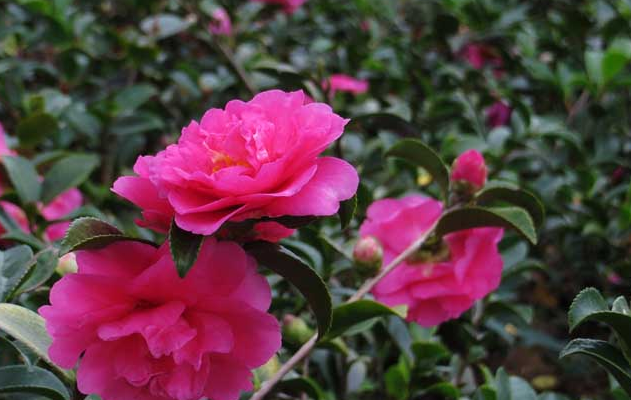
Camellia sasanqua is a plant that many people may have heard of; its flowers are truly delicate and beautiful, and it is really super good-looking. What are the cultivation methods and precautions for Camellia sasanqua? What are the propagation methods for Camellia sasanqua:
Cultivation methods and precautions for Camellia sasanqua:
1. Soil: Camellia sasanqua is suitable for growing in fertile, loose, well-drained acidic sandy soil. Alkaline soil and clay soil are not suitable for planting, and calcareous soil should be avoided even more. When growing it in pots in northern regions, it is best to choose a potting soil made mainly of leaf mold or peat soil, with a small amount of river sand added.
2. Watering: Water Camellia sasanqua to keep the potting soil moist but not waterlogged. In summer, water once each morning and evening; in winter, water once every few days. Except in winter, water should also be sprayed on the leaves every few days to keep them clean. When watering, the soil must be thoroughly soaked.
3. Sunlight: Camellia sasanqua is a semi-shade plant and should be protected from strong light. Generally, from May to September each year, it should be grown in a shaded place. If exposed to direct blazing sun, the leaves and buds are easily scorched, causing the leaves to curl and, in severe cases, to dry up and fall off. In late autumn and winter, it needs more sunlight.
4. Temperature: Camellia sasanqua likes a warm environment, and the suitable growth temperature is 18-25°C. The temperature should not be too high; when the air temperature exceeds 35°C, the young leaves are prone to sunscald. At the same time, Camellia sasanqua has relatively strong cold resistance, and in winter it can be kept over winter in a cold room at above 2°C.
5. Fertilizing: Fertilizer for Camellia sasanqua should be light and fully decomposed. Applying raw or concentrated fertilizer will burn the roots, especially for one- or two-year-old young seedlings. Generally, apply a dilute nitrogen fertilizer once from February to March to promote the growth of branches and leaves. Apply a dilute cake fertilizer water once from April to May to help flower bud differentiation. Apply 0.2% potassium dihydrogen phosphate once from September to October to promote larger flowers and more vivid colors.
6. Pests: Camellia sasanqua has relatively few pests and diseases. The main diseases include gray leaf spot, sooty mold, and anthracnose, which should be prevented and treated early. Once disease occurs, it can be sprayed with an equal-part Bordeaux mixture diluted 300 times. If there is damage from scale insects, red spider mites, and the like, they can be removed by brushing manually. If red spider mites occur, spraying with soaked tobacco leaf water mixed with chili water is also very effective.
7. Pruning: Like Camellia japonica, Camellia sasanqua also needs timely bud thinning and removal of spent flowers to reduce nutrient consumption. Generally, keep 1 flower bud per branch and thin out the rest so that nutrients are concentrated, resulting in larger and more vivid flowers. Removing spent flowers in time not only keeps the plant shape attractive, but also helps new branches sprout and promotes healthy growth of the plant.
Propagation methods for Camellia sasanqua:
Camellia sasanqua can be propagated by cuttings, grafting, layering, and sowing, but cuttings are generally used most often. Cuttings are taken in May. Select vigorous branches from a mother plant more than 5 years old, with the base of the cutting retaining a heel, remove excess leaves from the lower part, and keep only 2-3 leaves. A short single-bud cutting can also be taken as a cutting, inserted as soon as it is cut. The cutting bed should be shaded, and roots can form after about 20-30 days, after which light can gradually be let through in the morning and evening.
That is all for the introduction to the cultivation methods and propagation methods of Camellia sasanqua. With such a beautiful flower, why not hurry and grow one?
Cultivation methods and precautions for Camellia sasanqua
Camellia sasanqua is a common ornamental plant distributed in southern China. Its leaves are elegant, its flowers are vivid, and its flowering period is especially long. It is a distinctive plant that combines flower appreciation and foliage appreciation, and it is usually suitable for growing as a potted plant at home. But do you understand the cultivation methods for Camellia sasanqua? Do you know what to pay attention to when growing Camellia sasanqua? If not, quickly follow along with the editor to learn about it.
Cultivation methods for Camellia sasanqua1. Soil
When growing Camellia sasanqua at ordinary times, you must choose suitable soil. The soil should be loose and fertile, and drain smoothly. It is best to mix leaf mold and peat soil together to make potting soil. Moreover, when growing Camellia sasanqua, choose a type with relatively strong water absorption, and spread coarse sand at the bottom of the flower pot so that air and water can pass through easily.
2. Moderate fertilizing
When growing Camellia sasanqua at ordinary times, you must fertilize moderately, because it does not have high fertilizer requirements. Especially in its seedling stage, fertilizer should not be applied too early, otherwise it will affect the growth of the seedlings. In addition, for newly transplanted Camellia sasanqua, fertilizer should also not be applied too early, otherwise root burn may occur and the plant may die.
3. Growing environment
At ordinary times, be sure to place Camellia sasanqua in a suitable environment for growing. It is a shade-loving plant, so timely shading must be provided during the hot summer weather. Even after entering the cold winter, Camellia sasanqua should not be placed under direct strong light, otherwise its leaves will curl and the number of flowers will decrease noticeably.
Precautions for cultivationWhen growing Camellia sasanqua, be sure to water moderately and do not let the potting soil become too wet, otherwise it will affect the air permeability of the soil. If watered too much, it is also likely to cause disease. Under normal circumstances, watering once every 4 to 5 days is enough, but in hot summer weather, it is necessary to spray water on the plant leaves every day. In addition, when growing Camellia sasanqua, if using a new flower pot, the pot must be soaked in clean water for 24 hours to let the pot's residual heat dissipate before planting Camellia sasanqua, otherwise Camellia sasanqua will be difficult to survive.
How to grow Camellia sasanqua, cultivation methods and precautions for Camellia sasanqua / avoid direct strong light
Camellia sasanqua and plum blossom are certainly familiar to everyone; they are among China's top ten famous flowers. But do you know Camellia sasanqua? It is said that Camellia sasanqua gets its name because its leaves resemble tea and its flowers resemble plum blossoms, and it is a beautiful flowering plant. In daily life, many beginners want to know how to grow Camellia sasanqua. For this, the editor has carefully compiled the cultivation methods and precautions for Camellia sasanqua. Friends who want to grow it, come in and take a look.
1. How to grow Camellia sasanqua, create the environment
Camellia sasanqua combines the advantages of tea and plum blossom, and its beauty is astonishing just to think about. It is also loved by many people for this reason. As for how to grow Camellia sasanqua, we need to create the most favorable environment for it according to its growth habits. For this, the editor will explain in detail the cultivation methods and precautions for Camellia sasanqua from aspects such as soil, light, and watering. Let's continue reading.
2. Cultivation methods and precautions for Camellia sasanqua
1. Soil, slightly acidic
How to grow Camellia sasanqua? First, of course, is choosing soil. Even for a potted Camellia sasanqua bought directly from a flower shop, the soil needs to be changed. According to the growth habits of Camellia sasanqua, we should choose loose, fertile, well-drained acidic sandy soil.
Precautions: To ensure good drainage, it is best to choose a clay pot with good air permeability and strong water absorption, and first spread a layer of coarse sand grains or coarse slag grains at the bottom of the pot to facilitate drainage and air permeability.
2. Light, avoid strong light
Among the cultivation methods and precautions for Camellia sasanqua, light is especially important to note. It is said that Camellia sasanqua is a semi-shade plant. It likes light but is slightly shade-tolerant, and avoids strong light, so it is best grown in a semi-shaded, semi-sunny environment. Appropriate light can encourage Camellia sasanqua flowers to open and bloom abundantly.
Precautions: When the sun is strong in summer, be sure to shade Camellia sasanqua, otherwise strong light may scorch its leaves and buds, causing the leaves of Camellia sasanqua to turn yellow, curl, or even fall off, seriously affecting its ornamental value.
3. Temperature, 18-25°C
Camellia sasanqua likes a warm environment and is slightly cold-tolerant. The optimal growth temperature is 18-25°C. If you want Camellia sasanqua to grow well, it is best to keep it in this temperature environment.
Precautions: Although Camellia sasanqua is cold-tolerant, if potted, it is best not to let it go below minus 2°C, otherwise it is easily damaged by freezing and plant growth will be affected. Therefore, in winter, everyone should move Camellia sasanqua indoors to overwinter, preferably keeping the room temperature at 3-6°C. In other seasons, it is enough to maintain it under a shade shed.
4. Watering, water thoroughly when watering
How to grow Camellia sasanqua? Watering is a very key part. It is said that Camellia sasanqua likes a moist environment, so we should water frequently, but each watering must be thorough! In spring and autumn, water Camellia sasanqua once a day to keep the potting soil moist; in summer, water once each morning and evening; in winter, water once every few days.
Precautions: Watering Camellia sasanqua depends on the situation, but do not let it become too wet, so as not to affect soil air permeability. Moreover, watering too much can easily cause a series of diseases. Except in winter, water should also be sprayed on the leaves every few days to keep them clean.
5. Fertilizing, apply thin fertilizer frequently
Camellia sasanqua does not have high requirements for fertilizer and water, so if you want it to grow quickly, it is best to apply thin fertilizer frequently. Generally, from February to March, apply human waste 1 or 2 times to promote the growth of branches and leaves; from April to May, apply cake fertilizer water once to promote flower bud differentiation; from September to October, apply phosphate fertilizer once more to promote good flowering and also help it overwinter.
Precautions: Fertilizing Camellia sasanqua should be light, especially in the seedling stage. Fertilizer must not be applied too early, so as not to cause seedling burn. In addition, for newly transplanted Camellia sasanqua, fertilizing also requires attention. Once too much fertilizer is applied, it is easy to cause seedling burn and result in dead plants.