How to make a Boston fern grow vigorously, and can it be grown hydroponically?
Boston fern, this is something many people absolutely love, this Boston fern is quite nice-looking, what are the ways to make this Boston fern grow vigorously? Can Boston fern be grown hydroponically:
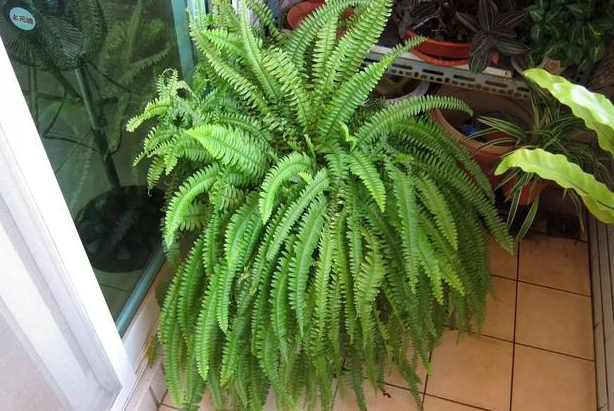
Ways to make a Boston fern grow vigorously:
1. Light
It can be grown anywhere indoors with bright light, avoid positions exposed to direct sunlight.
If placed by a windowsill, it is recommended to rotate the pot about 1/4 turn each week, so the potted plant receives even indirect sunlight.
When light is insufficient, the leaves will appear thin, long and weak, and prone to withering; but when light is too strong, the leaf color will turn grayish-green.
2. Watering
During the growing period, keep the soil evenly moist, and avoid overwatering that causes the plant's roots to sit in water, otherwise it will lead to root rot.
If it is a fern grown in a hanging basket, the soil in the pot usually dries out very quickly, so pay special attention to watering frequency.
3. Humidity
The Boston fern (Nephrolepis exaltata) needs to be placed in a high-humidity environment; generally, when placed indoors, it will need frequent misting (several times a day) with a spray bottle to raise the air humidity around the leaves.
If it is grown outdoors, then pay attention to shading and the rapid drying caused by wind, and still mist it often.
4. Temperature
Keep the care temperature at 16-24°C; in winter it should be placed indoors to avoid cold damage.
5. Soil choice
For potted Boston ferns, it is recommended to use peat soil or peat soil; of course, also add appropriate ordinary soil and some river sand to the growing medium as a drainage medium.
6. Fertilizing
Fertilize once every 2 months, foliage plant nutrient solution: dilute one small bottle with water each time (1:1).
7. Pruning
Branches and leaves that have turned brown should be pruned immediately; prune slightly withered old leaves or branches and leaves that have died at lower positions (unable to get adequate light); you may also leave them alone. It is recommended to use sharp scissors to keep the plant looking neat.
8. Repotting
When the plant's roots continue to grow and fill the pot, it should be repotted; spring is the most appropriate time to repot the Boston fern.
It is recommended to repot once every 1~2 years, each time moving it into a pot 1 size larger than the original; if you do not want to repot, it is still recommended to remove 25% of the roots in spring to control the plant's size.
Can Boston fern be grown hydroponically:
Boston fern can be grown hydroponically.
That is all for the introduction on ways to make a Boston fern grow well; it can also be grown hydroponically.
Can Boston fern be grown hydroponically
Boston fern can be grown not only in soil but also hydroponically, and the hydroponic method is even simpler.
The above is the introduction on whether Boston fern can be grown hydroponically; below let us look at the planting methods and cultivation techniques for Boston fern.
Propagating ferns does not require seeds or spores; the method of propagating ferns by stems
Flower and Bonsai Network introduction: What Flower and Bonsai Network brings you today is an article about propagating ferns without seeds or spores, and the method of propagating ferns by stems; let us take a look.
There are many varieties of indoor ornamental ferns, such as the common bird's nest fern (Asplenium nidus), sword fern (Nephrolepis cordifolia) and Boston fern. Below let us look at the propagation methods for sword fern and Boston fern. Sword fern can also be propagated by spores, while Boston fern can only be propagated by division and runners; let us take a look.
I. Introduction to division propagation
Method 1: Directly take the new root balls growing around the outer edge of the roots for propagation.
Method 2: Use a sharp knife to cut and divide larger root balls for propagation.
II. Soil choice for raising seedlings:
For soil cultivation propagation, it is recommended to use peat soil or ordinary growing medium.
For hydroponic propagation, it is recommended to use special sponge for cuttings or seedling raising.
III. How to propagate with a section of stem
Let the Boston fern produce runners, and when new plants (seedlings) grow, cut them off (division) and then plant them.
How can small branches grow out quickly?
In daily care, keep the medium in a slightly moist state, maintain the relatively high humidity conditions Boston fern needs, and avoid direct sunlight during the propagation period.
If in an environment with high air humidity, even if the soil is slightly dry there will be no problem; only with high humidity can side buds grow, and only when the roots have a chance to breathe will they be healthy, so air humidity is also an important key.
As for watering, it is actually very simple: just lift the leaves at the edge of the pot slightly and pour water with a narrow-spout watering can, or place it in a shallow water tray for about half an hour to let capillary action draw water upward. On ordinary days, place a wide water tray underneath to provide air humidity, but do not let the bottom of the pot soak in water.
IV. Why do the leaves turn yellow?
Leaves appearing dry brown or brittle (so-called browning) are usually caused by air that is too dry accompanied by excessive salt.
Avoid placing the leaves near heat sources or electrical outlets, because if the temperature around the Boston fern changes drastically, it will also cause browning.
If the leaves turn yellow or wither (when not browning), it is usually caused by overwatering. Immediately stop and reduce watering, cut off the damaged leaves, and check the plant's root system to see whether it has already rotted. If the vast majority of the plant's roots have turned black, the whole plant should be thrown away!
Ferns are tropical plants; when watering, use room-temperature water, and in winter avoid water temperature that is too low.
V. Pest and disease control for ferns:
1. Scale insects
Scale insects are one of the pests and diseases Boston fern is prone to encountering; they look like tiny brown discs and are easily found on compound leaves. When found, immediately scrape them off with a fingernail or remove them with a tool of similar texture.
2. Red spider mites
Red spider mites are not common, but their damage to Boston fern plants is even greater than that of scale insects. If there are spider webs between compound leaves, that is evidence of red spider mite infestation; when found, cut off the affected compound leaves.
If the weather is warm enough, you can rinse off red spider mites with warm water slightly above room temperature. Regular misting not only helps Boston fern retain moisture but can also stop the invasion of red spider mites, which like dry conditions!
When dealing with pest and disease problems on Boston fern, avoid using insecticides, because ferns are easily harmed by chemical agents.