A Detailed Explanation of the Flower Language, Value and Propagation Methods of the Saraca
Is the Saraca truly a flower free of all sorrow? The Saraca, also known as the Flame Flower, is the blossom of the Saraca tree. The Saraca also has many uses, such as medicinal value. So let us go and learn about the Saraca. What is the flower language of the Saraca? What values does the Saraca have? How does the Saraca propagate?
1. What is the flower language of the Saraca?
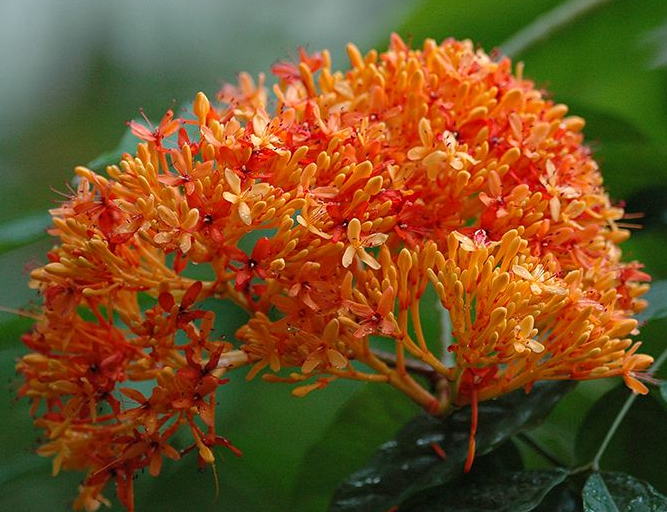
When the Saraca tree blooms, strangely, the flowers have no corolla; the golden-yellow parts are flower buds, known in botany as “incomplete flowers.” The flowers, shaped like golden torches, dot the green leaves and cover the tree crown, very bright and eye-catching, as if they were a golden pagoda. The leaves are pinnately compound. When the young leaves first emerge, because the petioles are soft and cannot support the leaves to spread out, they hang downward; together with the deep purple color of the young leaves, on close inspection they resemble a monk's purple kasaya soaked by rain. Legend has it that Shakyamuni Buddha was born beneath this kind of tree, and so it is revered as a sacred tree of Buddhism. Therefore some people have said that as long as you sit beneath a Saraca tree, anyone will forget all their worries and be free of care.
2. What values does the Saraca have?
This species can be used to rear lac insects, and it is an excellent host for lac insects; the bark is used as medicine and can treat rheumatism and menorrhagia. Because the flowers are large and beautiful, it is also a fine tree for garden landscaping and ornamental purposes.
3. Propagation methods of the Saraca
Propagate by seed. The pods mature in August; after harvesting, place them in a ventilated spot to dry in the shade. The seeds are fairly large, with a 1000-grain weight of 6850g. Threshed seeds should not lose water, must not be exposed to the sun, and must not be piled and composted; they are best sown immediately after harvesting and do not store well. Stored in bags at room temperature, they lose all germination capacity within 3 months; stored mixed with sand, their germination capacity can be maintained for half a year. When the seeds germinate, the daily average temperature must be above 18°C. Generally in late August the seeds are sown densely in a wet sand bed or nursery plot; germination begins in late September, with October being the peak germination period, and the germination rate can reach 80%. After germination, the seedlings are left in the sand bed or nursery plot to overwinter with cold protection. After spring sowing in March of the following year, the seedlings are transplanted to the field for growing on, with a spacing of 30~1000px; they should not be too densely planted, so as to favor the cultivation of large seedlings. Large seedlings used for urban landscaping generally need to be transplanted 2 times and grown for 3~4 years before they are suitable for leaving the nursery. There are few pests and diseases at the seedling stage. During the vigorous growth period in spring and summer, apply nitrogen fertilizer once a month to push the seedlings along; stop fertilizing after autumn begins, so as to help the seedlings overwinter and resist cold.
An Appreciation of Saraca Pictures, Plus an Introduction to Its Main Values and Flower Language
The Saraca is a tree species, and its growth cycle is relatively long. It grows in large numbers in China and India. In China it mainly grows in the southern regions, especially the tropical regions. This is a plant that very much likes sunlight and can grow very well in high-temperature environments; low temperatures are harmful to the Saraca. Below, the editor will introduce to you what the morphological characteristics of the Saraca are, what the main values of the Saraca are, and what the propagation methods of the Saraca are.
What is the flower language of the Saraca?
When the Saraca tree blooms, strangely, the flowers have no corolla; the golden-yellow parts are flower buds, known in botany as "incomplete flowers." The flowers, shaped like golden torches, dot the green leaves and cover the tree crown, very bright and eye-catching, as if they were a golden pagoda. The leaves are pinnately compound. When the young leaves first emerge, because the petioles are soft and cannot support the leaves to spread out, they hang downward; together with the deep purple color of the young leaves, on close inspection they resemble a monk's purple kasaya soaked by rain. Legend has it that Shakyamuni Buddha was born beneath this kind of tree, and so it is revered as a sacred tree of Buddhism. Therefore some people have said that as long as you sit beneath a Saraca tree, anyone will forget all their worries and be free of care.
Morphological characteristics of the Saraca
Tree, 5-20 m tall; DBH up to 25 cm. Leaves with 5-6 pairs of leaflets; young leaves slightly purplish red, drooping; leaflets nearly leathery, oblong, ovate-lanceolate or long-obovate, 15-35 cm long, 5-12 cm wide, the basal 1 pair often smaller, apex acuminate, acute or obtuse, base cuneate, lateral veins 8-11 pairs; petiolules 7-12 mm long. Inflorescences axillary, relatively large, the rachis hairy or nearly glabrous; involucre large, broadly ovate, hairy, caducous; bracts ovate, lanceolate or oblong, 1.5-5 cm long, 6-20 mm wide, the lowest 1 largest and gradually smaller upward, hairy or glabrous, caducous or late-caducous; bracteoles similar in shape to the bracts but much smaller than the bracts; flowers yellow, later the lower part (base of the calyx lobes and the disk, stamens, style) turning red, bisexual or unisexual; pedicels shorter than the calyx tube, without a joint; calyx tube 1.5-3 cm long, lobes oblong, 4, sometimes 5-6, ciliate; stamens 8-10, of which 1-2 often reduced and subulate, filaments exserted, anthers oblong, 3-4 mm long; ovary slightly curved, glabrous or hairy along both sutures and the stipe. Pods brown, flat, 22-30 cm long, 5-7 cm wide, the valves curling; seeds 5-9, irregular in shape, flat, with a shallow groove in the center of each face. Flowering April-May; fruiting July-October.
Main values of the Saraca
This species can be used to rear lac insects, and it is an excellent host for lac insects; the bark is used as medicine and can treat rheumatism and menorrhagia. Because the flowers are large and beautiful, it is also a fine tree for garden landscaping and ornamental purposes.
Propagation methods of the Saraca
Propagate by seed. The pods mature in August; after harvesting, place them in a ventilated spot to dry in the shade. The seeds are fairly large, with a 1000-grain weight of 6850g. Threshed seeds should not lose water, must not be exposed to the sun, and must not be piled and composted; they are best sown immediately after harvesting and do not store well. Stored in bags at room temperature, they lose all germination capacity within 3 months; stored mixed with sand, their germination capacity can be maintained for half a year. When the seeds germinate, the daily average temperature must be above 18°C. Generally in late August the seeds are sown densely in a wet sand bed or nursery plot; germination begins in late September, with October being the peak germination period, and the germination rate can reach 80%. After germination, the seedlings are left in the sand bed or nursery plot to overwinter with cold protection. After spring sowing in March of the following year, the seedlings are transplanted to the field for growing on, with a spacing of 30~1000px; they should not be too densely planted, so as to favor the cultivation of large seedlings. Large seedlings used for urban landscaping generally need to be transplanted 2 times and grown for 3~4 years before they are suitable for leaving the nursery. There are few pests and diseases at the seedling stage. During the vigorous growth period in spring and summer, apply nitrogen fertilizer once a month to push the seedlings along; stop fertilizing after autumn begins, so as to help the seedlings overwinter and resist cold.
What the morphological characteristics of the Saraca are, what the propagation methods of the Saraca are, and what values the Saraca has: the editor has already introduced all of these to you in detail above. The Saraca has a very long flowering period, and the scenery when it blooms is quite extraordinary; at its peak it can reach the effect of the whole tree being covered in flowers. It is relatively well suited to being planted in parks and gardens. If you are interested, you can learn more about the Saraca.
Mayodendron igneum (Kurz) Kurz, the Chinese Tulip Tree: A Profile of Mayodendron igneum: How to Grow It / How to Propagate It
Mayodendron igneum ProfileMayodendron igneum (Kurz) Kurz
How to Grow Mayodendron igneum and Points to Note: An Introduction to Mayodendron igneum
Mayodendron igneum is a small tree of the genus Mayodendron in the family Bignoniaceae, reaching up to 15 m tall. It often grows in dry-hot river valleys and relatively humid valley lowlands and low mountain thickets at altitudes of 150-1900 m, and likes environments with abundant sunlight. The short raceme inflorescences grow on old stems or side branches, and the corolla is orange-yellow to golden-yellow. It is an excellent garden tree, suitable for parks, courtyards, scenic areas and so on. Mayodendron igneum is called "A Ci Ma Ha Neng" by the Hani people, "Zheng Tong Gang" by the Jingpo people, and "Mai Nuo Bi" by the Dai people. The flowers can be eaten as a vegetable; its bark, stem bark and root bark are used as medicine and can treat dysentery, diarrhea and so on.
The Flame Tree is a deciduous large tree of the family Bignoniaceae, also known as the Spathodea, native to Africa. Its flowering period is between winter and spring, the flowers are large and cup-shaped, the tree is about 10 m tall, the flowers about 10-12 cm long, and the crown is relatively broad. It is often used as a shade tree or street tree, and is also suitable for planting in parks, communities, tourist areas and other places. On close inspection, the deep red petals have a ring of golden-yellow markings along the edge, exceptionally gorgeous.
The Flame Tree flowers between winter and spring, with large cup-shaped flowers. The plant is 10-20 m tall, the trunk straight, grayish white, easily branching; the leaves are odd-pinnately compound, entire, the leaflets with short stalks, ovate-lanceolate or oblong; paniculate or racemose inflorescences, terminal, the corolla bell-shaped, red or orange-red, a single flower about 10 cm long, flowering March-June. The fruit is a capsule, oblong-lanceolate, about 20 cm long, the seeds winged. The crown is relatively broad; it belongs to the genus Spathodea in the family Bignoniaceae. It is native to tropical Africa, and is now commonly cultivated in Southeast Asia, Hawaii and other places; it is cultivated fairly widely in Taiwan, China, and has been introduced in small amounts in South China. It is often used as a shade tree or street tree, and is also suitable for planting in parks, communities, tourist areas and other places.
The Flame Tree is the national tree of the Republic of Gabon.
Morphological characteristics of Mayodendron igneum
Mayodendron igneum, an evergreen tree, up to 15 m tall, DBH 15-20 cm; bark smooth, young branches with oblong white lenticels.
Large odd bipinnately compound leaves, up to 60 cm long, the rachis cylindrical, grooved; leaflets ovate to ovate-lanceolate, 8-12 cm long, 2.5-4 cm wide, apex long-acuminate, base broadly cuneate, oblique, entire, glabrous on both sides, lateral veins 5-6 pairs; lateral petiolules 5 mm long, terminal petiolule up to 3 cm long. The inflorescence has 5-13 flowers, forming a short raceme, growing on old stems or side branches, the peduncle about 2.5-3.5 cm long; pedicels 5-10 mm long.
Calyx about 10 mm long, about 7 mm in diameter, spathaceous, densely puberulent outside. Corolla orange-yellow to golden-yellow, tubular, slightly constricted at the base, 6-7 cm long, 1.5-1.8 cm in diameter, limb lobes 5, semicircular, about 5 mm long, reflexed.
Filaments about 4.5 cm long, base pubescent, anthers versatile, anther 2-celled, the connective extending at the apex into an awn-like point, the anthers and stigma slightly exserted beyond the corolla tube.
Ovary long-cylindrical, style about 6 cm long, stigma 2-lobed, ovules numerous. Capsule long-linear, pendulous, up to 45 cm long, about 7 mm thick, valves 2, thinly leathery, the septum slender-cylindrical, corky. Seeds ovoid, membranous, numerous, with white transparent membranous wings, about 13-16 mm long including the wing.
Style 6 cm long, stigma ovate-lanceolate, 2-lobed. Disk annular, 4 mm high. Capsule blackish brown, 15-25 cm long, 3.5 cm wide. Stamens 4, filaments 5-7 cm long, anthers 8 mm long, versatile.
Seeds with a surrounding wing, nearly circular, 1.7-2.4 cm in both length and width.
Flowering February-May, fruiting May-September.
Ecological habits of Mayodendron igneum
Mayodendron igneum often grows in dry-hot river valleys and relatively humid valley lowlands and low mountain thickets at altitudes of 150-1900 m.
Mayodendron igneum is native to tropical and subtropical regions. It likes high temperatures, high humidity and abundant sunlight, but can tolerate dry heat and semi-shade; it is not cold-tolerant and avoids frost. The optimum growing temperature is 23 to 30°C; it can tolerate temperatures around 0°C, but if kept for a long time at a low temperature of 5 to 6°C, its branches will suffer cold damage. In South China it can be cultivated in the open ground; in other regions it can only be grown as a dwarfed pot plant and moved indoors in winter. It likes neutral to slightly acidic soil that is deep, of medium fertility and well drained, and is not tolerant of saline-alkaline soil. It grows slowly on dry, barren soil.
Mayodendron igneum likes light and tolerates heat, drought, waterlogging and poor soil, but for cultivation a well-drained loam or sandy loam is best; it is not wind-tolerant, and branches break easily in strong wind; however, it is not cold-tolerant, and the optimum growing temperature is 23-30°C. Apply sufficient base fertilizer when planting, and pay attention to supplying water to young trees during high-temperature and dry periods.
Mayodendron igneum has a low demand for fertilizer, but it still needs appropriate supplementary fertilizer during growth and development, mainly compound fertilizer and organic fertilizer. According to the soil fertility status, fertilize 3-5 times a year, following the principle of frequent light applications. The Flame Tree needs a relatively high temperature to flower; in the northern part of South China, because the temperature is relatively low, it does not flower or flowers little. When it blooms, the flowers open at the top layer of the crown, like blazing flames, the flowers brilliant as fire, extremely eye-catching. It can be used for street trees and courtyard landscaping.
Light: a sun-loving plant, requiring strong light.
Optimum growing temperature: 23-30°C
Growth characteristics: a fast-growing tropical tree species. Tolerates heat, drought, moisture and poor soil; brittle branches are not wind-tolerant; easily transplanted.
Cultivation techniques for Mayodendron igneum
Mayodendron igneum is best sown by broadcasting, with a covering of soil about 0.5 cm thick; take care to shade it to keep the bed surface moist. Germination begins in about 15 days, with a germination rate of 60%. When the seedlings are 3-5 cm tall, transplant them into nutrient bags for growing on; 1-year-old seedlings are 60-80 cm tall and can leave the nursery for planting. If growing large seedlings, they need to be moved to a large seedling bed with a spacing of 1.5 m x 1.5 m; after 2-3 years, when the DBH of the seedlings reaches about 5 cm, they can leave the nursery.
The Flame Tree has a massive crown, high water content in its branches and leaves, and a relatively shallow and sparse root system, so it is top-heavy and highly prone to wind damage. When planting, it should be planted somewhat deeply and the soil pressed firm, then earthed up and pruned in time to ensure a dignified and beautiful tree shape. When planting the Flame Tree as a specimen in courtyards, lawns, parks and other places, the branching point should be set at about 1.5 m, and through pruning the crown should be developed into a spherical, umbrella-like or other shape. After planting, tending and management should be strengthened. In the first 3 years, clear weeds, remove grass, loosen the soil, expand the planting holes and fertilize 2-3 times each year; after 4 years, tend it 1-2 times each year.
The fruit of Mayodendron igneum matures when it turns from green to brown. After harvesting the fruit, spread it out in a ventilated place; when the outer shell splits open naturally, the seeds can be obtained. The seeds are flaky, thin and light. When grown as a street tree, the spacing is 5.6 m, and the planting hole size is 70 cm x 80 cm, with sufficient base fertilizer applied.
Management methods
Land preparation
Plow the subsoil to a depth of 20 to 30 cm, break up the clods, and remove stones, tiles, residual roots, weeds and so on. Apply 400 to 800 kg of calcium-magnesium-phosphate-potassium fertilizer per mu. For small redwood seedlings, use bed-style cultivation, with the bed surface 20 cm above the ground, the seedling bed 1.2 m wide, and the length depending on the terrain. Set a 40 cm wide walking path between every two beds, and set a 20 x 20 cm drainage and irrigation ditch on the outer side of each bed; for the whole plot, set 40 x 30 cm drainage and irrigation ditches around the perimeter.
Seedling transplanting
Lifting seedlings should be done when the soil is moist. Water thoroughly 3 hours before lifting the seedlings, so that moist soil clings to the root mass and the roots are not injured. When lifting seedlings, plant them as you lift them; do not leave them exposed to strong light for a long time. If long-distance transport is needed, dip the roots of the seedlings in thin mud slurry and wrap them tightly in plastic bags. After the whole plot is planted, irrigate promptly. The best planting seasons are from early October to mid-December and from early February to late March; from late December to late January, cold damage is likely, and planting after April will affect survival because of strong light and high temperatures. Planting can be done in furrows or holes, with 10,000 to 15,000 plants per mu. For bare-root transplanting, spread the root system out in the hole, do not let it curl, cover with fine soil, lift slightly to spread the root mass, then press gently firm, water thoroughly to settle the roots, and cover with a layer of topsoil to preserve moisture. Autumn planting should avoid freezing in winter; when the temperature drops below 0°C, cold-protection measures should be taken, generally by spreading dry grass and fallen leaves over the seedling bed, or by arching over it with plastic film.
Intertillage and weeding
Intertillage and weeding can promote the absorption of nutrients by the seedling root system. The depth of intertillage depends on the depth of the seedling root system and the growth stage. For young seedlings and small seedlings, intertillage should be shallow; for medium and large seedlings, it should be deep; near the plant roots it should be shallow, and between plants and rows it should be deep, generally 3 to 5 cm being suitable. Intertillage and weeding are often carried out in May to June; after July, when the seedling root system has expanded into the spaces between plants and rows, intertillage should be stopped, otherwise the root mass will be cut and the seedlings damaged.
Fertilizer and water management
For cultivating Mayodendron igneum, fertile and well-drained sandy loam or loam is best. Apply sufficient base fertilizer when planting, and pay attention to supplying water to young trees during high-temperature and dry periods. The Flame Tree has a low demand for fertilizer, but it still needs appropriate supplementary fertilizer during growth and development, mainly compound fertilizer and organic fertilizer.
For red flower-wood balls that leave the nursery at 2 to 3 years old, the purpose of topdressing is to promote the growth of branches and leaves, so more nitrogen fertilizer can be applied; but in the late growth stage of the seedlings in autumn, more phosphorus and potassium fertilizer should be applied. In addition to dried manure and human urine, decomposed pig manure and urine can also be applied as topdressing, which has the effect of hastening the red color of the Flame Tree. For large-scale cultivation, chemical fertilizers can also be applied in combination. For seedlings that leave the nursery at 2 to 3 years, apply 1.2 kg of ammonium nitrate, 1.5 kg of superphosphate and 0.5 kg of potassium chloride per 100 sq m.
How to Grow Mayodendron igneum: Land Preparation and Bed Making
Plow the subsoil to a depth of 20 to 30 cm, break up the clods, and remove stones, tiles, residual roots, weeds and so on. Apply 400 to 800 kg of calcium-magnesium-phosphate-potassium fertilizer per mu. For small red?wood seedlings, use bed-style cultivation, with the bed surface 20 cm above the ground, the seedling bed 1.2 m wide, and the length depending on the terrain. Set a 40 cm wide walking path between every two beds, and set a 20 x 20 cm drainage and irrigation ditch on the outer side of each bed; for the whole plot, set 40 x 30 cm drainage and irrigation ditches around the perimeter.
Seedling transplanting
Lifting seedlings of Mayodendron igneum should be done when the soil is moist. Water thoroughly 3 hours before lifting the seedlings, so that moist soil clings to the root mass and the roots are not injured. When lifting seedlings, plant them as you lift them; do not leave them exposed to strong light for a long time. If long-distance transport is needed, dip the roots of the seedlings in thin mud slurry and wrap them tightly in plastic bags. After the whole plot is planted, irrigate promptly. The best planting seasons are from early October to mid-December and from early February to late March; from late December to late January, cold damage is likely, and planting after April will affect survival because of strong light and high temperatures. Planting can be done in furrows or holes, with 10,000 to 15,000 plants per mu. For bare-root transplanting, spread the root system out in the hole, do not let it curl, cover with fine soil, lift slightly to spread the root mass, then press gently firm, water thoroughly to settle the roots, and cover with a layer of topsoil to preserve moisture. Autumn planting should avoid freezing in winter; when the temperature drops below 0°C, cold-protection measures should be taken, generally by spreading dry grass and fallen leaves over the seedling bed, or by arching over it with plastic film.
Intertillage and weeding
Intertillage and weeding can promote the absorption of nutrients by the seedling root system. The depth of intertillage depends on the depth of the seedling root system and the growth stage. For young seedlings and small seedlings, intertillage should be shallow; for medium and large seedlings, it should be deep; near the plant roots it should be shallow, and between plants and rows it should be deep, generally 3 to 5 cm being suitable. Intertillage and weeding are often carried out in May to June; after July, when the seedling root system has expanded into the spaces between plants and rows, intertillage should be stopped, otherwise the root mass will be cut and the seedlings damaged.
Timely topdressing. For red flower?wood balls that leave the nursery at 2 to 3 years old, the purpose of topdressing is to promote the growth of branches and leaves, so more nitrogen fertilizer can be applied; but in the late growth stage of the seedlings in autumn, more phosphorus and potassium fertilizer should be applied. In addition to dried manure and human urine, decomposed pig manure and urine can also be applied as topdressing, which has the effect of hastening the red color of the red flower?wood. For large-scale cultivation, chemical fertilizers can also be applied in combination. For seedlings that leave the nursery at 2 to 3 years, apply 1.2 kg of ammonium nitrate, 1.5 kg of superphosphate and 0.5 kg of potassium chloride per 100 sq m.
Propagation methods of Mayodendron igneum
Mayodendron igneum is commonly propagated by cuttings, sowing or air layering, all best done in spring. After the seeds germinate, they generally flower in 5-6 afternoons. Sowing is generally used, and can be done in spring; when the seedlings are 30-40 cm tall they can be transplanted once, and when 1 m tall they can be planted out. Layering or cutting propagation can also be carried out during the growing season.
Mayodendron igneum needs a relatively high temperature to flower; in the northern part of South China, because the temperature is relatively low, it does not flower or flowers little. When it blooms, the flowers open at the top layer of the crown, like blazing flames, the flowers brilliant as fire, extremely eye-catching.
Propagation methods: Because Mayodendron igneum flowers in multiple seasons, seeds can be collected in multiple seasons, and so sowing is the main method of propagating seedlings. When its capsule matures, the pericarp turns from greenish to blackish brown; at this time, harvest the fruit and place it in a windless spot to dry in the shade or in the sun. After it splits, gently tap out the seeds. They can be sown immediately after harvesting in a suitable season, or stored until the following spring for sowing when it is cold in winter. Because the seeds are tiny, broadcasting is generally used, with a thin covering of soil after sowing. After sowing, keep the seedbed moist at a temperature of about 25°C; they generally germinate in about 1 week, with a germination rate of 60% to 80%. After the seedlings have grown for 50 to 60 days, when the stems are slightly lignified, they can be moved to the field for cultivation; they can leave the nursery in 1 to 2 years and flower in 3 to 5 years.
The cutting survival rate of Mayodendron igneum is low. When using vegetative propagation, grafting, air layering and other methods can be used to increase the survival rate and to dwarf the plants for pot cultivation. Plants obtained by vegetative propagation generally flower in 1 to 2 years.
Disease control of Mayodendron igneum: common diseases of Mayodendron igneum
Damping-off mainly occurs in spring when there is a lot of rain, and both seedlings and mature plants are affected. Dark brown lesions form at the affected sites, and in severe cases whole patches die.
Control methods
Transplant with disease-free new soil, and the fertilizer used must be thoroughly decomposed; never use fresh farmyard manure. Remove diseased plants promptly. Before transplanting, sterilize the soil with 50 ml of 40% formaldehyde mixed with 6 kg of water per sq m, or mix 70% pentachloronitrobenzene with fine soil at a ratio of 1:30 and spread it on the seedbed soil. One week after spring planting of small seedlings, spray 1000-fold 70% thiophanate-methyl solution or 1000-fold 75% chlorothalonil solution, spraying once every 10 days, alternating the two.
Main insect pests of Mayodendron igneum
The main insect pests include aphids, geometer moths, yellow noctuid moths, thief noctuid moths, large and small cutworms and scarab beetles. Aphids affect plant growth and induce sooty mold; geometer moths and noctuid moths damage leaves as larvae, and in severe cases can eat all the young shoots in 2 to 3 days; cutworms and scarab beetles bore into and feed on the root system as larvae; cutworms mainly harm cuttings and seedlings, while scarab beetles harm large, medium and small seedlings alike.
To control aphids, spray 5% diesel emulsion or 3 to 5 degrees Baumé lime-sulfur mixture before sprouting, to kill overwintering adults and eggs. Spray a second time after the flowers fall, and a third time in October in autumn. To control geometer moth and noctuid moth larvae, spray 1500-fold 50% methamidophos solution; control them early and while they are small. The larvae of cutworms and scarab beetles are underground pests; the control method is to strengthen nursery management and not apply undecomposed organic fertilizer. Plow in winter to turn the overwintering larvae up to the surface to freeze to death. Use 3% carbofuran granules at 2 kg per mu, applying them in furrows 10 to 20 cm deep in the soil.
Variety classification of Mayodendron igneum
Spathodea, of the family Bignoniaceae, with 2 species, distributed in tropical Africa; 1 species has been introduced and cultivated in China.
Evergreen trees; leaves large, opposite, odd-pinnately compound or trifoliolate;
leaflets entire; flowers large, orange-red or scarlet, arranged in panicles or racemes;
calyx split on one side;
corolla broadly bell-shaped, inflated on one side;
stamens 4, exserted, anthers pendulous;
disk cup-shaped; ovary 2-celled, ovules in several rows;
capsule oblong-lanceolate, tapering at both ends, dehiscing loculicidally, the valves woody;
seeds elliptical, with broad wings.
Family: Bignoniaceae;
Distribution count: worldwide: 2 species; China: 1 species; introduction status: not introduced.
Distribution range of Mayodendron igneum
Mayodendron igneum is native to Taiwan, Guangdong, Guangxi and southern Yunnan. It is cultivated in the South China Botanical Garden and the Xishuangbanna Botanical Garden. It is also distributed in Vietnam, Laos, Myanmar and India. Besides Hong Kong, it is now widely planted in Hawaii, Southeast Asia, and especially Taiwan.
Mayodendron igneum is native to Africa and is now widely cultivated in India and Sri Lanka.
It is cultivated in Guangdong, Fujian, Taiwan and Yunnan (Xishuangbanna) in China. The Flame Tree is robust by nature and likes light; it tolerates heat, drought, waterlogging and poor soil, but for cultivation a well-drained loam or sandy loam is best; it is not wind-tolerant, and branches break easily in strong wind; however, it is not cold-tolerant, and the optimum growing temperature is 23-30°C; it can grow and develop normally only above 10°C.
Uses and purposes of Mayodendron igneum: ecological value
Making hedges
Because of its strong adaptability, tolerance of pruning and liking for sprouting, it has advantages as a hedge. Generally, the soil in urban landscaping is relatively poor, and construction waste cannot be thoroughly removed; the Flame Tree grows relatively well in this kind of poor environment, is naturally strongly stress-resistant, and has few pests and diseases. As long as it is pruned diligently, a hedge planted in the same year shows results in the same year. The Flame Tree is also suitable for planting on slopes and so on. Naturally developing branches of the Flame Tree can grow to 1.2 m in one year and to about 2 m in two years, and begin to flower and bear fruit.
Landscaping
When Mayodendron igneum is arranged in spherical form, techniques such as group planting, branch cutting, branch spreading and pruning and shaping can be used, planting it in a well-arranged way on lawns and dotting it in the depths of courtyards; the bright red Flame Tree fruit gives people a warm feeling in the cold winter. Flame Tree balls arranged in a regular pattern along both sides of roads or in the central green belt can also play a role in landscaping, beautification and eye-catching effect.
Scenic spot accents
As an accompanying planting in scenic forest land, Mayodendron igneum can express natural wild charm.
As bonsai and cut flower material
Mayodendron igneum tolerates pruning, and the main branches change naturally in many ways. The fruit-viewing period of the Flame Tree runs from autumn to winter, and the fruit becomes redder and redder. For example, the Flame Tree bonsai exhibited each year at the Moshan Bonsai Garden of Wuhan East Lake attracts tourists to stop and linger. The fruiting branches of the Flame Tree are also cut flower material, especially in autumn and winter when arranged with chrysanthemums, wintersweet and so on for traditional artistic flower arrangements.
Ornamental value
The crown is umbrella-shaped, conical and so on; the tree posture is graceful, the pinnate leaves lush, the flowers large and bright red, blooming above the crown, very much like torches, with extremely high ornamental value. China has already introduced the red-flowered type, while the yellow-flowered one has not yet been introduced. The Flame Tree is an excellent ornamental flagship tree species for landscaping in its place of origin. After being introduced to Hainan, because it flowers in winter and the flowers are red, it has been hailed as "a fire in winter." The Flame Tree has great development potential in the tropical and southern subtropical regions of southern China.
In the depths of winter, across the northern land, thousands of miles are ice-bound and thousands of miles of snow drift, yet in the south the Flame Tree is lush with branches and leaves, standing tall like a canopy, green as if about to drip, with dense shade covering the ground; among the branches and leaves, flowers bloom in masses, incomparably brilliant red, like a blazing fire. Seen from afar, it is like clusters of blazing flames, and also like patches of dazzling sunset clouds at the horizon, very spectacular.
Medicinal or dietary value of Mayodendron igneum
The medical information and health dietary information on Huhuawang is for reference only and cannot be used as a basis for diagnosis or medical treatment. For any health problem, consult professional medical personnel; for the treatment of any disease, follow medical advice.
Ultimate flower-protecting mission: to love yourself, start from reality and strictly follow medical advice. For illness, do not be careless, do not delay, do not give up hope; face it bravely, warm the silent world with love, and care for the flower field within your heart with your heart.
Medicinal value
Medicinal parts: bark, stem bark, root bark.
Harvesting and processing: Bark and stem bark: cut and collect in late spring and early summer, and dry in the sun. Root bark: dig the roots in autumn and winter, wash them clean, peel off the root bark, and dry in the sun.
Efficacy and indications: The Hani people use the bark to stop diarrhea and dysentery. It treats dysentery and diarrhea. The Jingpo people use the stem bark to remove toxins and cut short malaria. It treats malaria. Root bark: used for postpartum weakness and incomplete lochia. The Dai people use the root bark for toothache, fatigue and weakness, postpartum weakness, and continuous dripping lochia.
Dietary value
The flowers can be eaten as a vegetable; the wood is brown with a gray tinge, and the difference from the sapwood is not clear; the texture is finer than that of Chinese wingnut wood, and the material is also relatively heavy and hard;
Garden uses of Mayodendron igneum
Mayodendron igneum flowers between winter and spring, with large cup-shaped flowers; the tree is about 10 m tall, the flowers about 10-12 cm long, and the crown relatively broad. It is often used as a shade tree or street tree, and is also suitable for planting in parks, communities, tourist areas and other places.
When Mayodendron igneum blooms, the flowers open at the top layer of the crown, like blazing flames, the flowers brilliant as fire, extremely eye-catching. It can be used for street trees and courtyard landscaping.
In the depths of winter, across the northern land, thousands of miles are ice-bound and thousands of miles of snow drift, yet in the south the Flame Tree is lush with branches and leaves, standing tall like a canopy, green as if about to drip, with dense shade covering the ground; among the branches and leaves, flowers bloom in masses, incomparably brilliant red, like a blazing fire. Seen from afar, it is like clusters of blazing flames, and also like patches of dazzling sunset clouds at the horizon, very spectacular.
Cultural background and legends of Mayodendron igneum
Long ago, there was a beautiful young girl in West Village. Because she was so exceptionally beautiful, people forgot her name and all called her "Beauty."
Beauty grew up day by day, and suitors came in an endless stream. Her parents were delighted and decided to marry her to a chief who owned herds of cattle, flocks of sheep, gardens and servants. But they never expected that she would refuse firmly. She said, "I do not love rich men who live off others. I love that hardworking and brave young man named Dutu."
Dutu was a farmer's son. The bananas he grew were especially fine, and the wine brewed from those bananas was especially fragrant. He was a famous archer and had once gone alone into the jungle to hunt and kill a man-eating leopard.
When the chief heard that Beauty was unwilling to marry him but was willing to marry Dutu, he was furious. At that time, the Kingdom of Buganda was at war with Buvuma Island, and soldiers were being conscripted from every tribe. The chief decided to separate Beauty and Dutu by sending Dutu to the army.
Dutu was conscripted and went to the front. Before he left, Beauty came to see him off. Holding back her grief, she said, "Be brave and win honor. I hope you return soon. I will always wait for you."
The war raged fiercely by the shores of Lake Victoria. After Dutu left, Beauty stood on the hillside all day long, gazing toward the great lake. Day after day, several months passed, and Beauty did not see Dutu return, so she could not help growing anxious. One day, she said to an eagle circling in the sky, "Please fly to the lakeshore and see when my Dutu will return, all right?"
The eagle saw Beauty's anxious face and felt great sympathy, so it spread its wings and flew toward the lakeshore.
On the battlefield, the drums thundered and the horns blared together as the Bugandan warriors charged at the enemy. Dutu, holding a spear and a bow, ran at the very front. Unfortunately, several hidden arrows flew in and struck him in the head. This brave farmer's son fell in a pool of blood.
When the eagle saw that the enemy had been defeated, it was overjoyed and cried "caw, caw, caw" three times. But when it discovered Dutu's body lying on the ground, it was overcome with infinite sorrow. It circled in the air again and again, not knowing how to go and report to Beauty.
When the eagle did not return, Beauty was burning with anxiety. She stopped a bee flying past her and said, "I have already heard the victory drums. Fly quickly to the lakeside and congratulate my Dutu. Tell him that I am waiting on the hillside for his return."
The bee came to the battlefield and saw the eagle standing on the branch of a withered tree, shedding tears, and immediately understood everything. It could not bear to go back and deliver this terrible news either, so it settled on the heart of a wildflower by the roadside and wept softly.
Beauty of West Village kept waiting on the hillside. Her lover did not return, and there was no news from the eagle or the bee, which made her grieve in despair. She had no choice but to appeal to the blazing sun, saying, "Ah! Heaven above! Help me! Use your beam of light to carry me to the shore of the great lake, so that I may see my lover and pour out my heart to him."
The sun had witnessed this war and knew that Dutu had died in battle, and it deeply sympathized with this infatuated young girl, so it shot a long beam of light toward her. Beauty grasped the beam tightly with both hands and gently swung to the shore of the great lake. When she saw the soldiers burying Dutu's body, she fell to her knees on the ground and cried out to the sun, "Heaven above! Do not leave me here all alone. Please use your flames to melt me, and let me go together with my lover!"
The sun greatly admired the girl's absolute sincerity, so it sent down a flash of fire and cremated her. The soldiers buried her ashes together with the body of the brave Dutu.
The following year, when the people of West Village came to the shore of Lake Victoria to visit the grave of this devoted pair of lovers, they found that a beautiful tree had already grown on the grave. Its canopy was like an umbrella, shading the grave. The whole tree was covered with branches of blossoms, bright red as fire, every flower facing the sun. People admired the beauty of the flowers, collected the seeds, and took them back to plant in their gardens. Now this tree is found everywhere in Uganda. Some call it the flame tree, and some call it the lovers' tree.
The Tree of the Buddha's Birth - Flame Flower
In Xishuangbanna, the Dai people as a whole believe in Theravada Buddhism, and many plants associated with Buddhism have been widely planted and worshipped, and the flame flower is one of them.
More than 2,500 years ago, in the northwest of ancient India, at the foot of the Himalayas (in present-day Nepal), there was the kingdom of Kapilavastu. King Suddhodana and Queen Mahamaya had been married for many years without having a child, until when the queen was 45 years old, one night in a dream she saw a white elephant flying through the air and entering her womb - the queen was pregnant. According to the customs of ancient India at that time, a woman pregnant with her first child had to return to her parents' home to give birth. On the eve of giving birth, Queen Mahamaya rode in a palanquin carried by an elephant back to her parents' home. When she passed by Lumbini Garden, she felt somewhat fatigued from the journey, so she got down from the palanquin to rest in the garden. When Queen Mahamaya walked to a lush, flourishing flame flower tree covered with golden-yellow blossoms and reached out to support herself on the trunk, the movement of the fetus was triggered, and beneath the flame flower tree she gave birth to a great sage for the ages - Shakyamuni. Therefore, almost every Dai village in Xishuangbanna has a temple, and almost every temple has flame flowers planted around it. In addition, some families who have no children but wish to have them often plant a flame flower tree in front of or behind their house.
It is said that as long as one sits beneath the sorrowless flower tree, anyone will forget all worries and be free from care and sorrow.
Flame Landscape
In the depths of winter, across the northern land, thousands of miles are sealed in ice and thousands of miles drift with snow, yet in the south the flame tree is still lush with branches and leaves, standing tall like a canopy, green as if about to drip, casting dense shade over the ground. Among the branches and leaves, clusters of flowers bloom in incomparable brilliant red, like a blazing fire. Seen from afar, they look like masses of roaring flames, and also like dazzling rosy clouds at the horizon, extremely spectacular.
In mid-spring, the flame tree's fallen blossoms lie in profusion, red all over the ground, easily reminding one of ancient lines such as "Fallen red is not a heartless thing; turned into spring mud, it protects the flowers even more" and "In the western palace and southern inner quarters, autumn grass grows thick; fallen red covers the steps and is left unswept." At such times, girls from nearby villages always come together in groups to the Xishuangbanna Tropical Botanical Garden to pick up petals as ornaments. That scene is truly a most beautiful landscape painting: tall, upright green trees, bright red flowers all over the ground, slender and lovely Dai maidens, and colorful painted paper parasols, clearly layered and harmoniously colored, as if a famous melody were flowing from a violin - too wonderful for words, deeply moving.
Plant Culture - Fountain Tree
The fountain tree, that is, the flame tree. In Suriname, in places such as Flendiship and Nassau, there is an evergreen tree with luxuriant branches and leaves and a thick but short and stout trunk, whose tips continuously spout fine streams of water on both sides all year round, closely resembling a fountain, hence it is called the "fountain tree." The water it spouts is clear and sparkling, mild and tasteless, and can be drunk. The reason it can spout water is that this tree's root system is especially developed. On the island of Madagascar in East Africa, there is a woody-stemmed herbaceous plant, 7-10 m tall, with banana-like leaves growing on its straight trunk and arranged oppositely in a single plane, much like an opened folding fan, and also like a peacock displaying its tail. The scientific name of this tree is "traveler's palm," and some call it "fan banana," "fan tree," or "peacock tree." Its leaves are thick and solid, and can be made into various vessels such as cups, saucers, spoons, bowls, basins, and buckets, and can also be cut into tablecloths and curtains. They are also commonly used as roofing material for houses, and from a distance look just like glazed tiles. Its bark can be used to lay floors.
The base of the traveler's palm's leaf sheath can store a large amount of water. In the dry season, when travelers passing by are thirsty, they can pierce the base of the leaf stalk with a small knife, and clear, sweet, cool water will flow out as a refreshing drink to quench thirst. Because its leaves can shade the sun and its cucumber-like fruit can satisfy hunger, it is a resting place for weary and thirsty travelers, and so people call it the "traveler's tree."
This tree is also found in Taiwan, China, Guangzhou, Hainan Island, China, and other places. Wall Tree. In the Chuankasha region of Saudi Arabia, there grows a drought-tolerant tree. This tree has a strange habit: like creeping ivy, it cannot grow independently on its own and must have something to rely on.
Because it always leans against another object on one side as it grows, the trunk of this tree is not round but round on one side and flat and straight on the other, like a round log sawn lengthwise into two halves. Local people call it the "wall tree." Wall tree wood is hard, and especially when making boards, the flat and straight side has no bark and can be sawed directly into planks, making it a high-quality timber. However, this tree grows slowly and generally takes twenty or thirty years to mature into usable timber. Flag Tree. On both sides of the high mountain valleys of the Rocky Mountains in the United States, rows of peculiar trees grow everywhere. The branches and leaves of this tree all grow on the same side, closely resembling a banner fluttering in the wind, and scholars of high mountain research call it the "flag tree." Because the wind direction on high mountains is constant and the wind speed is extremely high, the strong wind and snow cut away the branches and leaves on the windward side, leaving only those on the leeward side, making them a natural "wind vane," so that people can tell at a glance the prevailing wind direction there.
The National Flower and City Flower of the Fire-Bloom Flower
The flame tree is the national tree of the Republic of Gabon.
Fire-bloom flower, with the aliases flame tree, fountain tree, bracteate calyx tree, and flame wood, is the national tree of the Republic of Gabon.
The Flower Language of the Fire-Bloom Flower
The flower language of the fire-bloom flower: Use my passion to soothe your wounded heart.
In Xishuangbanna, the Dai people as a whole believe in Theravada Buddhism, and many plants associated with Buddhism have been widely planted and worshipped, and the flame flower is one of them. It is said that as long as one sits beneath the flame flower tree, anyone will forget all worries and be free from care and sorrow.
The fire-bloom flower is just as its name suggests. The deep red petals have a ring of golden patterns along their edges. Each petal is like a ball of fire, and the whole flower is as dazzling and eye-catching as a torch. During the flowering season of the fire-bloom flower, gazing at the tree from afar is like looking at a flame tree burning with raging fire, extremely spectacular. Below, let's take a look with the editor at what the flower language of the fire-bloom flower is.
Fire-Bloom Flower Pictures