What plants can be grown in water and fill a pot? Papyrus, water hyacinth, water lettuce
Plants are something many people absolutely love, especially water-grown ones; the growing method is super simple and they are fairly easy to keep alive. What plants can be grown in water and fill a pot:
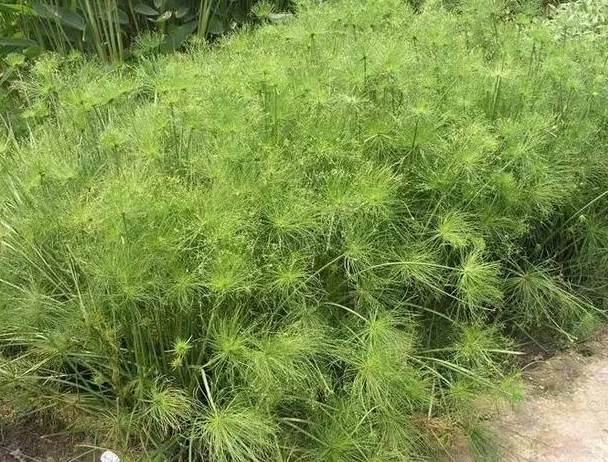
1. Papyrus
Papyrus has many similar varieties, some of which are even field weeds, but it is a very good ornamental plant, and it is suitable for planting in the yard, suitable for soil culture or planting in water. Care is simple; you only need to keep the year-round temperature above 5°C, and keep the growing environment warm and slightly moist with good ventilation.
2. Water hyacinth
Water hyacinth is a plant grown for both its leaves and flowers. During the Qing Dynasty it was a private ornamental plant of the nobility, and later it caused widespread overgrowth because it was used to improve water quality, so many people still have a bad impression of it. In fact, its ornamental value is quite good: the swollen rhizomes, the emerald green leaves, and the paired with variegated flowers.
For care, you need to keep the environment above 10°C year-round, give it ventilation and diffused light, and it can live as long as there is water.
3. Water lettuce
Water lettuce is also called "hibiscus lotus"; its leaf shape looks just like a peony flower, elegant in appearance, and suitable for pot culture.
The growing environment needs to stay above 7°C, with ventilation and diffused light, and a certain level of humidity.
4. Copper coin grass
Copper coin grass is an amphibious foliage plant; as long as you have a tuber segment about 5 cm long, you can just drop it into water and it will live. In a place above 15°C, with plenty of diffused light and ventilation, it can grow into a new plant in less than 3 days.
Keep the growing environment above 5°C and maintain plenty of diffused light, and it will keep growing continuously.
That is all for the introduction to plants that can be grown in water and fill a pot. Hurry and get one for your home.
Can water hyacinth be grown in a pot in water at home?
Water hyacinth, also known as water hyacinth, has short, fine root hairs on its fleshy roots. It can root shallowly in the mud underwater and can also float in deep water to grow. The underwater part of the plant has horizontal stolons that can spread on their own and sprout new clumps. The leaves are upright and extend above the water surface, while the leaf stalks swell into air-bladder shapes. As the water level rises, the root hairs can detach from the mud and stand upright to float. The flower scape is solitary, with 6-12 flowers at the top forming a short spike inflorescence. The small flowers are purplish blue with 6 petals; the upper one is larger and has a dark blue patch in the center, with a bright yellow eye spot in the patch, hence the name water hyacinth.Water hyacinth is suitable for growing in shallow and still water. Its leaves and flower scapes can extend about 30 cm above the water surface, so it is suitable for water culture in deep barrel-shaped vats or pots. Each year in early spring, take out the mother plant stored over winter, cut off the small buds growing from the base of the mother plant together with roots, and put them into a deep-water pot; they will naturally root and send out new leaves, floating in the water to grow.
Water hyacinth likes a warm climate, and the most suitable water temperature is 18-23°C. During the growing period it needs plenty of sunlight, and after flowering it can be moved indoors for display. Its natural reproductive capacity is very strong. In the ponds of the Jiangnan region, one water hyacinth can spread across nearly ten meters of water surface in 1 year. Under pot culture conditions, its natural reproductive capacity is greatly reduced, but it will still fill the whole pot. Its perennial roots are afraid of freezing, so it should be moved indoors as early as possible before winter. The pot should not lack water, and it should be exposed to light as much as possible.
What water-grown plants are there? Water-grown plant cultivation methods
Many people keep water-grown plants at home and in the office. In spare time from work and life, looking at these plants more can relieve eye fatigue quite a bit. So what water-grown plants are there? Today I will tell you what water-grown plants there are and how to cultivate them.
1. Lucky bamboo
An evergreen upright shrub in the genus Dracaena of the Liliaceae family, very suitable for indoor water-grown flowers. Lucky bamboo has emerald green leaves and straight stems, round like bamboo. The leaves are ovate with pointed tips, and the leaf stalk base clasps the stem. It is an extremely shade-tolerant plant and still grows well and stands tall and strong under weak light conditions. It can be placed indoors for a long time to view its leaves and does not need special care; as long as there is enough water, it will grow vigorously. When growing in water, cut the lucky bamboo stem into small sections of more than 20 cm as cuttings and insert them into water. As long as 1/3 of the cutting can be immersed in water, it can take root and survive.
2. Spider plant
A perennial evergreen herbaceous flower in the Liliaceae family, with clustered linear leaves and longitudinal yellow-white stripes at the edges or in the middle. In summer and autumn, slender, flexible, drooping stolons are sent out from between the leaves, and young leaves and aerial roots sprout at the tips or nodes, with white flowers. Spider plant can be grown in water indoors; it not only purifies the air, but also looks beautiful and is easy to manage. Dig out the potted spider plant, remove the soil from the roots, cut off old roots and rotten roots, keep the fibrous roots, and put it into a container bottle. Fill the bottle with clean water and flower nutrient solution, and let the spider plant roots grow immersed in water.
3. Pothos
A plant in the genus Philodendron of the Araceae family, belonging to climbing vine foliage flowers. It likes warm, humid environments. The vine can reach several meters long, with aerial roots at the nodes, and the leaves grow larger and larger, alternate, and evergreen. The pothos stems are slender and soft, and the leaves are delicate and elegant. Water culture is very simple: ensure the water is changed once every 2 to 3 days, with a simple nutrient added. Pothos has high ornamental value; its trailing stems hang down naturally, and it can both purify the air and make full use of space, adding lively lines and bright colors to dull cabinet surfaces.
4. Ivy
In the Araliaceae family, genus Hedera, it is the most ideal indoor and outdoor vertical greening variety. An evergreen vine, its branches and tendrils are slender and soft, with aerial roots, climbing onto other objects. The leaves are alternate, triangular-ovate, and the demand for pot culture is increasing day by day. It is a typical shade plant and can grow in full-light environments. It grows well under warm and humid climate conditions, but is not cold-tolerant. Water culture is simple and its vitality is strong.
5. Asparagus fern
In the Liliaceae family, genus Asparagus, a perennial evergreen herbaceous flower. The stems are slender and weak, and the branches are fine and leaf-like, spreading horizontally. The flowers are small and white. The berries are spherical and black. After the fruit ripens, it presents a scene of dots of red among dense green, elegant and lovely. The plant is strongly shade-tolerant. Placed at the bedside or on a desk, it is elegant and dignified, and is a very good indoor flower. Asparagus fern is also an ideal supporting material for cut flowers. In recent years, water-grown asparagus fern has been successfully developed, and it is even more elegant when placed in the home.
6. Hyacinth
Also known as Dutch narcissus, it belongs to the Liliaceae family, genus Hyacinthus, a perennial herb, with a spherical or flattened spherical bulb, the outer skin flag purple-blue or white, etc. The leaves are basal, thick and fleshy, strap-shaped and lanceolate. The flower stem is drawn out from the center of the leaf stem, a raceme, with delicate flower posture, colorful, brilliant and eye-catching, and a pleasant light fragrance. It likes a sunny and cool, humid environment, and is suitable for both pot culture and water culture. When growing in water, place its bulb in a hydroponic nutrient solution; its appearance is clean and very ornamental!
7. Dieffenbachia
A plant in the Liliaceae family, with basal leaves thickly leathery, oblanceolate, broadly lanceolate, or broadly strap-shaped, 10-40 cm long and 2.5-5.5 cm wide, with acute tips and narrow long bases, and fibrous roots at the nodes. The flower stem is short and thick, 4-8 cm long including the inflorescence; the terminal spadix is oblong, with densely arranged, sessile, pale yellow, hemispherical flowers. There are rich varieties, including green-leaf and variegated-leaf types. It likes shady and humid environments, and in summer it should be placed in a shaded place to avoid strong light. It is a relatively adaptable ornamental flower variety, usually grown as a potted ornamental. In recent years, there have been more and more water-grown varieties, which are not only highly ornamental but can also effectively clean indoor air pollution.
8. Thousand-year wood dragon's blood
An evergreen shrub in the Orchidaceae family. The stem is round and straight, the leaves are slender, new leaves extend upward, and old leaves hang down. The middle of the leaf is green, and the edges have purple-red stripes. It likes high temperature and high humidity, and is also drought-tolerant and shade-tolerant. Water culture is simple, and its appearance is stylish.
9. Brazil wood
Scientific name fragrant dragon's blood tree, also called Brazil iron tree, a plant in the Liliaceae family, genus Dracaena. An evergreen tree with a neat plant shape and upright stems. The leaves are clustered at the top of the stem, 40-90 cm long and 6-10 cm wide, slightly blunt at the tip, curved into a bow shape, with bright yellow or milky white stripes; the leaf margins are bright green and have wavy undulations and luster. The flowers are small. Yellow-green, fragrant. It likes environments with sufficient light, high temperature, and high humidity, and is also shade-tolerant and drought-tolerant. It also grows well in bright diffused light and in the relatively dry environment of northern rooms. Brazil wood is mostly propagated by cuttings. As long as conditions such as temperature are suitable, Brazil wood can grow all year round. It is a world-famous new generation indoor foliage plant with a beautiful and neat plant shape. In recent years, its hydroponic varieties have developed rapidly. As long as enough slow-release fertilizer is added, it can grow normally. Rotating placement in the living room, study, and sitting room has an elegant, simple style and is highly ornamental.
10. African daisy
A perennial herb in the Asteraceae family, with relatively large flower diameter, rich flower colors, and blooming all year round. It likes warm, sunny, and airy environments, is a semi-cold-tolerant flower, and likes fertile and loose soil. African daisy is a very good cut flower variety, lasts a long time in water, and is highly ornamental, and it is also good at absorbing formaldehyde. These water-grown plants generally do not need special management. Any container with a certain volume that allows the root system to spread can be used, and a glass container with an open mouth is more beneficial for maintaining water quality and root growth. When planting, avoid letting the leaves be immersed in water to prevent rot; place it under suitable light conditions and it will soon take root; add some water when you find there is little, to prevent the root system from drying out; when the water becomes turbid, take out the plant, clean the container, and refill with water. Generally for water-grown plants, change the water once every three days and apply nutrient solution once; the ratio and amount of nutrient solution depend on the size of the plant.
There are many water-grown plants. Water-grown plants are extremely ornamental, beautiful and elegant. Placing them in transparent glass bottles in the living room, bedroom, balcony, study, and courtyard, etc., makes very good decorations and crafts. They can not only add color to home life, but also better show the owner's unique taste. The above is the knowledge shared with everyone, and I hope it can help everyone.