How to grow Ixora chinensis, and can it be kept indoors?
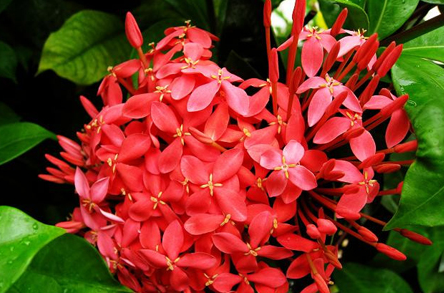
Ixora chinensis, this one is about to bloom, and the flowers of this Ixora chinensis bloom as one big blossom, very beautiful. How do you grow Ixora chinensis? Can Ixora chinensis be kept indoors:
How to grow Ixora chinensis:
1. Temperature: Ixora chinensis likes sunlight, likes warmth, and is not cold-tolerant. It is best placed in a sunny courtyard, roof garden, and south-facing or west-facing balcony. When the lowest winter temperature drops to 5°C, it should be moved indoors and kept in a sunny spot inside a windowsill. Keeping the room temperature above 5°C allows it to overwinter safely, and in the following spring, once the temperature steadily stays above 10°C, it can be moved back outside.
2. Potting soil: For potted Ixora chinensis, it is best to choose a clay pottery pot with good permeability; if choosing a less permeable but more attractive purple clay pot or plastic pot, you can line the bottom of the pot with a layer of broken tiles or broken hard plastic foam blocks to enhance air permeability and drainage. The potting soil should be humus-rich, loose, fertile, acidic soil, with a pH value of 5.0 to 6.5 being suitable. Do not use saline-alkali soil or heavy clay soil. The growing medium can be prepared with 4 parts leaf mold, 4 parts sandy loam, and 2 parts river sand, with some properly decomposed soybean cake powder or sesame oil residue mixed in, and a little hoof powder can also be placed at the bottom of the pot as base fertilizer.
3. Fertilizing: Ixora chinensis likes fertilizer. During the growing period, apply a small amount of nitrogen-phosphorus-potassium compound fertilizer about once every half a month. Do not apply nitrogen fertilizer alone, otherwise the branches and leaves will grow excessively and few flowers will form. From mid-April to early May, apply decomposed soybean cake water twice as a top dressing. From mid-May until budding, apply 2 to 3 times a decomposed liquid fertilizer mixed with nitrogen and phosphorus. During the flowering period, 2 to 3 applications of decomposed phosphorus liquid fertilizer are also needed.
4. Watering: The potting soil of Ixora chinensis should be watered by the principle of seeing dry and seeing wet; water as soon as it looks dry, and stop once thoroughly watered. Do not let water accumulate. In spring, water once every 4 days. In summer, generally water once every 1 to 2 days, and sprinkle water around the potted plant once each morning and evening to increase air humidity. In summer, it is best to water with soft water; hard water is unfavorable to the growth of Ixora chinensis, causing yellow leaves in mild cases and death in severe cases. To overcome the alkalinity of the soil and water quality, during the growing season water once a week with alum fertilizer water so the plant keeps its leaves dark green.
5. Pruning: In early winter, the plant should be shaped and pruned, keeping strong branches and cutting off diseased, pest-damaged, weak, and overly dense branches. When pruning Ixora chinensis, attention should be paid to pinching. When the seedlings are 15 to 20 cm tall, pinch once to encourage more branching and make the plant shape fuller. After flowering, multiple prunings are also needed. Each spring when repotting and changing the soil, keep about 20 cm on the overwintered old plant and do one heavy pruning.
Can Ixora chinensis be kept indoors:
Ixora chinensis is not suitable for indoor care for the following reasons:
Like most plants, Ixora chinensis absorbs oxygen and releases carbon dioxide at night, making it especially unsuitable for the bedroom.
If Ixora chinensis is grown indoors, a sunny balcony is still fine, but other places are slightly dim with insufficient sunlight. Over time, the plant becomes thin and weak, blooms less, or does not bloom easily. Moving it outdoors can ensure sufficient sunlight and normal growth.
Ixora chinensis is suitable for growing in a hot and humid environment. The temperature in an ordinary home environment is between 15 and 23°C, but on a ventilated balcony the temperature cannot reach the standard, making it difficult to form flower buds, and the plant is weak and not suitable for blooming.
That is all for the introduction to how to grow Ixora chinensis. This Ixora chinensis is not suitable for indoor growing.
How to grow Ixora chinensis: growing methods for Ixora chinensis
Ixora chinensis is also called Shandan flower and Longchuan flower. It has a long flowering period and bright flower colors, and is mostly used in gardens, but it can also be cultivated as a potted flower. If you still do not know how to grow Ixora chinensis, then take a look at the content below.
Growing methods for Ixora chinensis
Ixora chinensis likes a warm, humid, and sunny environment. It is not cold-tolerant, tolerates partial shade, and is not tolerant of waterlogging or strong light. The suitable growth temperature for Ixora chinensis is 15-25°C, from March to September it is 24-30°C, and from September to the following March it is 13-18°C. The winter temperature should not be lower than 0°C; too low makes it susceptible to frost damage. On the contrary, Ixora chinensis is heat-tolerant and still grows normally above 32°C.
Overall, Ixora chinensis has relatively strong adaptability to temperature. Ixora chinensis likes moisture and fears dryness. During the growth period of stems and leaves, sufficient water is needed to keep the potting soil moist, which helps shoot sprouting and leaf growth. But being too wet for a long time can easily cause part of the root system to rot, affecting growth and flowering. If the soil is too dry or alternately dry and wet, and water supply is not timely, leaf drop will occur.
Ixora chinensis needs sufficient sunlight, especially during the growth period of stems and leaves. Under sufficient sunlight, the leaves are emerald green and glossy, which helps inflorescence formation, neat flowering, and vivid flower color. It can also grow in a semi-shaded environment, but the leaves are pale green and lack luster, with fewer flowers and lighter flower color. However, proper shading under strong summer light can prolong the viewing period of the flowers.
For cultivating Ixora chinensis, fertile, loose, and well-drained acidic sandy loam is best. For potting, use a mixed soil of growing medium, peat soil, and coarse sand, with a pH of 5-5.5 being suitable.
Four-season management of Ixora chinensis
(1) Spring management: In early spring, Longchuan flower should be placed in a bright place for cultivation, keep the potting soil moist, and frequently sprinkle and spray water around it to increase air humidity. Repot when the outdoor temperature steadily stays at 15°C. Prune appropriately before repotting; Longchuan flower with poor plant shape can be heavily pruned. After repotting and re-establishing growth, move it to a balcony for cultivation, keep sufficient light, and begin fertilizing after new leaves appear.
(2) Summer management: Longchuan flower likes high temperatures and tolerates strong light, so no shading is needed in summer. But because it has many leaves and a high evaporation rate, it has relatively high water requirements. Keep the potting soil moist, water once each morning and evening every day, and at the same time spray its leaves and surroundings more to meet its air humidity requirements.
Summer is the season when Longchuan flower grows and blooms. It can be placed in a bright indoor area, and attention should be paid to fertilizer supply.
(3) Autumn management: After the autumn temperature becomes cool, the growth and flowering of Longchuan flower slow down, so the amount of fertilizer can be reduced while ensuring sufficient light. After the temperature drops in late autumn, let it undergo low-temperature training outdoors to increase its cold resistance. Gradually reduce the amount of watering so the potting soil becomes somewhat dry. Longchuan flower can tolerate short-term low temperatures around 0°C, but it is not tolerant of frost. Before frost, it should be moved to a sunny balcony for cultivation. If the indoor temperature in autumn and winter is kept above 15°C, then when the outdoor temperature drops to 15°C it should be moved indoors to a bright place for cultivation, which can prolong the flowering time.
(4) Winter management: Longchuan flower is not cold-tolerant. It can overwinter safely when the room temperature is above 5°C. At this time, the growth of Longchuan flower is in a stagnant state, so sufficient light should be ensured, watering should be reduced, the potting soil should be kept somewhat dry, and no fertilizer should be applied. When the indoor temperature is relatively high at noon, spray water on its leaves and surroundings several times.
Growing methods for Ixora chinensis, and precautions for growing Ixora chinensis
Ixora chinensis likes sunlight, likes warmth, and is not cold-tolerant. It is best placed in a sunny courtyard, roof garden, and south-facing or west-facing balcony. When the lowest winter temperature drops to 5°C, it should be moved indoors and kept in a sunny spot inside a windowsill. Keeping the room temperature above 5°C allows it to overwinter safely, and in the following spring, once the temperature steadily stays above 10°C, it can be moved back outside. Besides being planted in the ground, Ixora chinensis can also be potted. For potted Ixora chinensis, it is best to choose a clay pottery pot with good permeability; if choosing a less permeable but more attractive purple clay pot or plastic pot, you can line the bottom of the pot with a layer of broken tiles or broken hard plastic foam blocks to enhance air permeability and drainage. The potting soil should be humus-rich, loose, fertile, acidic soil, with a pH value of 5.0 to 6.5 being suitable. Do not use saline-alkali soil or heavy clay soil. Ixora chinensis has bright flower colors and great ornamental value, and is deeply loved by many people. Below, let us look at the growing methods and precautions for Ixora chinensis.
Growing methods for Ixora chinensis 1. Soil requirementsIxora chinensis has relatively high soil requirements. It is best to choose loose, breathable, and well-drained acidic soil. The pH value of the soil needs to be between 5 and 5.5. Soil that is too acidic or alkaline is not conducive to plant growth.
2. Sufficient lightPlant growth cannot be separated from sufficient sunlight, and the same is true for Ixora chinensis. When growing Ixora chinensis at home, it needs to be placed in a sunny place, and sufficient light must be maintained every day. However, strong summer light requires proper shading.
3. Temperature controlThe suitable temperature for the growth of Ixora chinensis is around 15 to 25 degrees. It is a flower that can tolerate high temperatures and also a certain degree of low temperature. However, when growing it in winter, the temperature should not be lower than 0°C, otherwise the plant will suffer frost damage.
4. Sufficient wateringIxora chinensis is a flower that relatively likes water, so when growing it at home you can water it frequently, but the amount of water must be limited. There must be no water accumulation in the potted flowerpot; too much water will cause the plant roots to rot.
5. Sufficient fertilizingIxora chinensis likes fertilizer. During the growth period, it needs to be fertilized once every half a month. The best fertilizer is generally a liquid fertilizer mixed from nitrogen, phosphorus, potassium, ferrous sulfate, and horseshoe slices in a ratio of 1:1:1:2:3.
6. Shaping and pruningIxora chinensis must be pruned as necessary at certain times. When pruning, the main task is to properly thin branches and pinch the plant so that it can better ventilate and receive light, and produce more flowers.
Precautions for growing Ixora chinensis in springIt is spring now, so friends who grow Ixora chinensis at home should pay attention. In spring, the temperature rises and the sunlight is bright, which is a stage of very rapid growth for Ixora chinensis, so everyone must grasp the timing. First, when the outdoor temperature is around 15 degrees, Ixora chinensis should be repotted, but before repotting, Ixora chinensis still needs appropriate pruning, so that when it blooms in summer it will produce more flowers. Second, after successful repotting, the potted Ixora chinensis needs to be placed on a balcony at home for cultivation. The main thing is to maintain sufficient light for the plant. When new leaves appear on the plant, you can gradually begin fertilizing.