How to Grow the Five-Pointed Star Flower and When to Sow It
The five-pointed star flower is truly superb when in bloom, a vivid red, so beautiful you simply cannot get enough of it. How do you grow the five-pointed star flower? When do you sow it:
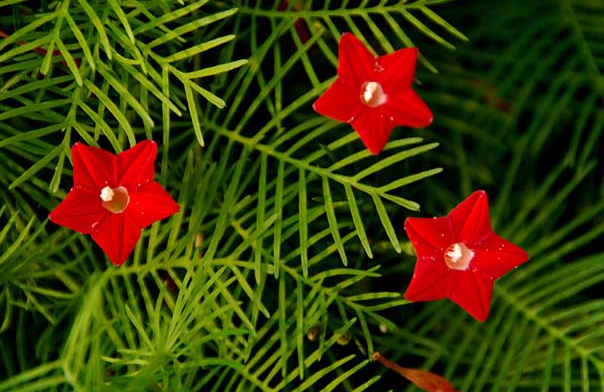
How to grow the five-pointed star flower:
1. Planting: plant the five-pointed star flower out after the last frost; in areas where night temperatures are still fairly low, early planting out is generally not recommended. For single-row planting, space plants about 35 cm apart; for raised seedlings or fertile soil, the spacing should be somewhat wider.
2. Watering: during the growing period, the five-pointed star flower should generally be watered once a day; in hot summer weather, when the plant grows vigorously, water once in the morning and once in the afternoon, but never let water accumulate in the pot.
3. Fertilizing: apply decomposed liquid fertilizer water once a month to the five-pointed star flower; pinching out is not necessary throughout the growing period, letting it climb naturally. Just pay attention to watering and fertilizing to promote rapid growth of the stems and vines, and the flowering will be even more abundant.
4. Training the vines: in the early stage, manually help train the vines of the five-pointed star flower onto a trellis, fence, tree or other support. In the middle and later stages the plant has a very strong climbing ability of its own, so apart from shaping it, there is no need to bother with it; just let it climb and twine freely.
5. Seed collecting: the capsules of the five-pointed star flower ripen unevenly and split open easily once ripe, so seeds should be harvested in batches in good time; seeds remain viable for 4 to 5 years. The roots can be used as medicine, having a heat-clearing and swelling-reducing effect, and are used to treat ear infections and hemorrhoids and fistulas.
When to sow the five-pointed star flower:
Generally sown directly in the open ground in early spring, in April
That is all for the introduction to the cultivation methods of the five-pointed star flower and the sowing time; hurry and plant one in your own home.
How to Care for the Five-Pointed Star Flower: Cultivation Methods for the Five-Pointed Star Flower
The five-pointed star flower is also called golden silk thread or brocade screen, and is a type of bindweed plant. Its flowering period is especially long, and its flower colors are gorgeous and alluring, making it suitable for growing as a potted plant indoors. But how should this five-pointed star flower be cared for? Below, the editor sets out the specific cultivation methods for the five-pointed star flower; after reading, you will be able to master them.
Cultivation Methods for the Five-Pointed Star Flower1. The living habits of the five-pointed star flower
To grow the five-pointed star flower well, you must first understand its living habits. This plant originated in the tropical regions of the Americas and was later introduced to temperate and tropical regions around the world; it likes a warm environment, fears cold and is susceptible to frost, and grows slowly when the temperature is on the low side. The seeds of the five-pointed star flower only germinate at 20 to 25 degrees, and after germination they grow fastest under conditions of ample sunlight.
2. Sowing the five-pointed star flower
The five-pointed star flower is mostly propagated from seed. When growing it at home, you can use nutrient soil for raising seedlings; after sowing, cover with about 1.5 cm of fine soil, and in four or five days tender little seedlings will appear. Once the seedlings appear, you can thin them out, removing the diseased and weak ones and keeping the strong ones, watering promptly, and once they have grown a little more you can transplant and plant them out.
3. Fertilizer and water management for the five-pointed star flower
During the growing period, the five-pointed star flower should be watered once a day; when the weather is hot in summer, it grows fastest, and at this time the number of waterings needs to be increased, and you can water twice a day, which lets its stems and vines grow quickly and also greatly prolongs the flowering period. In addition, during cultivation the five-pointed star flower should be fertilized once a month, and the fertilizer can be decomposed liquid fertilizer water.
An Analysis of Five-Pointed Star Flower Growing Techniques
When it comes to the five-pointed star flower, everyone is familiar with it, because its flowers closely resemble a five-pointed star, so everyone calls it the five-pointed star flower. Its scientific name is cypress vine, also called dense-leaved cypress, and it was recorded in China long ago. The five-pointed star flower originated in Mexico and is widely grown in China. Many friends are especially fond of this flower but do not know how to grow it, and often the potted five-pointed star flower they buy dies without their realizing why. Today I will explain the growing and cultivation techniques for the five-pointed star flower.
Conditions
Because cypress vine originated in tropical regions, it likes warmth, dislikes cold, fears frost, and grows very slowly when the temperature is low; the suitable temperature for seed germination is 20 to 25°C. It requires an environment with ample sunlight; most types are not strict about day length, but the fish-flower cypress vine only blooms when daylight is shorter than 12 hours. It is not strict about soil, but grows well in fertile, loose soil.
The thousand-seed weight of fernleaf cypress vine seed is around 139, and the seeds can be used for 3 to 4 years. The fruits ripen unevenly and fall off easily once ripe, so they should be collected as they ripen. Each fruit contains 3 to 4 seeds; if you have both red-flowered and white-flowered plants, the seed should be collected separately.
Sowing
In spring, raise seedlings in a protected area; after the last frost, plant out in the open ground. The seedling-raising period is about 45 days and must not be too long, otherwise the vines produced by the seedlings will become tangled together.
Sowing in ordinary nutrient soil for seedling raising and growing the seedlings on will produce good growth. Sow in seedling trays. Sow about 100 g per square meter of seedbed, and after sowing cover with about 1.5 cm of fine soil; it must not be too thin, otherwise the seedlings easily emerge with the seed coat still attached. Keep the soil temperature at 20 to 25°C; dry seed emerges in 4 days. Cypress vine emerges easily, but often unevenly, so seed should be selected carefully to make the seedlings uniform. The author has observed that cypress vine seedlings are extremely afraid of drought; when drought is even slightly severe they wither and die, and even watering makes it very hard for them to recover, so special attention should be paid to this when raising seedlings. Because it is a taprooted plant, it is best to grow the seedlings on in plastic seedling pots 8 cm in diameter, and to transplant only once, planting 1 seedling per container. You can also use 72-cell plug trays to grow the seedlings on, and during that period also pay attention to the water supply. In the middle and later stages of seedling raising, control soil moisture at a moderate level. During the seedling stage, always give full light; if the seedlings are fairly large and the vines have become tangled together, separate them as early as possible, and if necessary move the seedling pots a certain distance apart.
The red flowers of fernleaf cypress vine are more gorgeous than the white ones, and most people prefer the red flowers. But even if you collect only red-flowered seed, most offspring may still segregate out white flowers. The seeds are hard to distinguish, but at the seedling stage they are very easy to tell apart. The stems of red-flowered plants are deep red, while the stems of white-flowered plants are green, so as long as you observe carefully you can distinguish them well. If you carefully select seed every year and pay attention to isolation, the offspring will show fewer and fewer mixed colors.
Cultivation
Plant out after the last frost; in areas where night temperatures are still fairly low, early planting out is generally not recommended. Cypress vine has a strong ability to self-sow; if you do not care about how early or late it flowers, you can also use self-sown seedlings in the second year of cultivation, but because there is no seed selection and the seedlings emerge late, the landscaping effect is somewhat poorer. Cypress vine has a large growth volume, so apply plenty of base fertilizer, spread it evenly, and plow deeply. Dig holes and plant out, remove the plastic seedling pots, set the seedlings in the holes, 1 plant per hole, cover the root balls with fine soil, then water, and cover with soil to close the holes. For single-row planting, space plants about 35 cm apart; for raised seedlings or fertile soil, the spacing should be somewhat wider; self-sown seedlings emerge late and their growth is delayed, so the spacing should be somewhat smaller. Watering promptly can promote stem and leaf growth, but be careful not to let it grow too rampantly, so as to avoid delaying flowering. In the early stage, manually help train the vines onto a trellis, fence, tree or other support. In the middle and later stages the plant has a very strong climbing ability of its own, so apart from shaping it, there is no need to bother with it; just let it climb and twine freely. Potted plants should be watered and fertilized frequently. (In winter it can also be grown indoors, but attention should be paid to room temperature, light and other conditions.)
In northern households, cypress vine can also be grown in winter. After heating is supplied at home, use the "paper towel cultivation method" (also called forcing seedlings) to make cypress vine seeds germinate within a short time. Once the seeds show tender sprouts, scatter them into a flower pot and cover with 1 to 1.5 cm of soil to ensure the growth of the cypress vine. After about a week, the cypress vine will take root and sprout, and at this time the cypress vine seedlings must be treated with care. Because there is less light in winter, you need to artificially choose a spot with fairly ample light to grow the cypress vine; it is recommended to place it in a south-facing room, and the flower pot should be placed fairly close to the heating to ensure a suitable temperature.
Propagation
Cypress vine is propagated from seed. You can harvest seed in early November each year and sow it in April the following spring; it sprouts after a week, and when the seedlings have 3 to 4 leaves, plant them out; when the seedlings are too large, transplanting does not easily survive. When cypress vine is ripe, the seeds split open naturally and it self-sows. Cypress vine has strong vitality and good adaptability, and generally has no particular pests or diseases.
Growing and cultivating the five-pointed star flower is fairly simple. If you like it, you can plant some at home yourself. The five-pointed star flower comes in white, red and other colors; planting several different colors and combining them will look very beautiful. The five-pointed star flower not only has high ornamental value but also high medicinal value; the whole plant can be used as medicine, with a very good effect on clearing heat and detoxifying, and it is very commonly used in traditional Chinese medicine. Having said all this, if any friends are interested in the five-pointed star flower, you can come to Tubatu to look up information.