How long is the flowering period of Fritillaria imperialis? Detailed guide to growing methods
Fritillaria imperialis, this is a flower that many people absolutely love; the blooms of this Fritillaria imperialis are truly beautiful. What are the growing methods for Fritillaria imperialis? How long is the flowering period of Fritillaria imperialis:
Growing methods for Fritillaria imperialis:
1. Soil requirements
Fritillaria imperialis has relatively high soil requirements. For field soil used to plant Fritillaria imperialis, choose loose, fertile, organic-matter-rich, well-drained sandy soil; for potted Fritillaria imperialis, an equal mix of humus soil, garden soil and sand can be used as the growing medium.
2. Temperature requirements
Fritillaria imperialis is sun-loving, shade-tolerant and cold-tolerant, so it needs low-temperature treatment. It is best to keep the temperature at 5-9°C. The growing temperature for Fritillaria imperialis is 7-20°C. When Fritillaria imperialis is dormant in summer, the bulbs can be lifted and stored, with a storage temperature of about 13°C.
3. Common diseases and their control
The common diseases of Fritillaria imperialis are rust and gray mold. Rust mainly occurs on the leaf backs, petioles and stem bases of Fritillaria imperialis, with symptoms appearing as many brown spore masses; in severe cases, Fritillaria imperialis will wither and die early. The main control methods for rust are strengthening management and promptly removing residual plants. To prevent rust, a 1000-fold dilution of thiophanate-methyl and Xin Gaozhi film can be mixed and sprayed before the disease occurs. The symptoms of gray mold appear on the leaf edges and leaf tips of Fritillaria imperialis as water-soaked-looking lesions; in severe cases it withers and dies. The method to control gray mold is to mix and spray a 500-fold dilution of amobam and Xin Gaozhi film.
Flowering period of Fritillaria imperialis:
Fritillaria imperialis blooms generally in spring, with the flowering period concentrated from April to May.
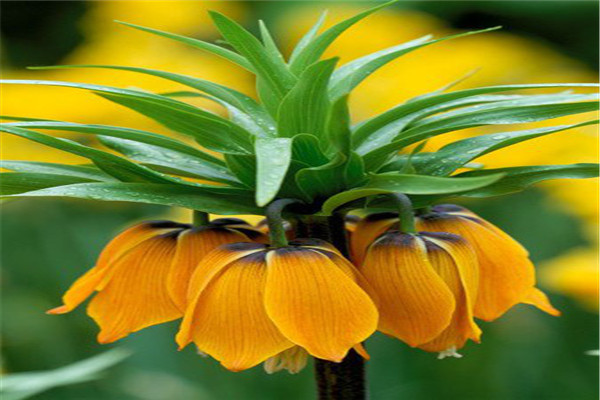
The flowers of Fritillaria imperialis are still very beautiful and vivid; the flower colors are mainly bright red, as well as orange-yellow and yellow. Fritillaria imperialis is medium in plant size, and when it blooms the flowers generally open at the top of the plant; the bell-shaped large flowers usually form a cluster of several blooms, and the flowers hang downward, which is very peculiar.
In addition, there are other species of Fritillaria, such as Fritillaria persica, which has long flower spikes and generally blooms in early summer;
Fritillaria michailovskyi, also called Michailovsky's fritillary, has relatively small flower spikes and bell-shaped flowers, and its flowering period is in early summer.
That is all for the introduction to the growing methods and flowering period of Fritillaria imperialis. Hurry and get one at home; it really does grow to look quite beautiful.
Morphological characteristics and habits of Fritillaria imperialis. Cultivation and propagation methods of Fritillaria imperialis
Fritillaria imperialis is a perennial bulbous flower, an autumn-planted bulb. The fresh bulb is relatively large, and the plant height is about 70 cm; the stem is upright, and the leaves are ovate-lanceolate to lanceolate, with entire margins. Flowers are borne at the top of the plant, several gathered together, with a bell-shaped corolla hanging beneath a group of leaf-like bracts. The flowers are bright red, orange-yellow and yellow, and the flowering period is March to June.
To plant Fritillaria imperialis, choose loose, fertile, organic-matter-rich, well-drained sandy loam with a pH of 6.0-7.5, and apply sufficient base fertilizer before planting; decomposed organic fertilizer or fish and bone meal are both acceptable; for potted plants, an equal mix of humus soil, garden soil and sand is suitable as the growing medium.
Plants of the genus Fritillaria are traditionally cultivated in our country mostly as medicinal materials. But worldwide, nearly 100 species are cultivated as ornamental flowers. Fritillaria imperialis is one of the most famous and most common species among them.
Morphological characteristics of Fritillaria imperialis
Fritillaria imperialis is a perennial bulbous flower; the fresh bulb is relatively large, and the plant height is about 70 cm; the stem is upright, and the leaves are ovate-lanceolate to lanceolate, with entire margins. Flowers are borne at the top of the plant, several gathered together, with a bell-shaped corolla hanging beneath a group of leaf-like bracts.
The flowers of Fritillaria imperialis are bright red, orange-yellow and yellow, and the flowering period is May. There is also Fritillaria persica (F. persica) with a plant height of 80 cm, long flower spikes, blooming in early summer, and it can be used in flower borders. Fritillaria michailovskyi, also known as Michailovsky's fritillary (F. michailovskyi), has a plant height of 20 cm, fine gray-green leaves; small flower spikes, bell-shaped flowers, and drooping.
The bulb has 2-3 fleshy scales, with a diameter of 1.5-4 cm. The leaves are sessile, broadly linear, with 3-4 leaves whorled or opposite, and the tips are tendril-like and hooked. The raceme bears 1-6 flowers, produced between the leaf axils at the top of the stem, bell-shaped, pale yellow to yellow-green, with purple netted markings inside, nodding. The flowering period is March to June.
Ecological habits of Fritillaria imperialis
Fritillaria imperialis is sun-loving, shade-tolerant and cold-tolerant, and needs low-temperature treatment at 5-9°C for about 13-17 weeks; the growing temperature is 7-20°C. The soil should be moist and well-drained. It is dormant in summer; the bulbs are lifted and stored, with a storage temperature of about 13°C, and the bulbs are divided and propagated in summer and autumn.
Cultivation techniques for Fritillaria imperialis
To plant Fritillaria imperialis, choose loose, fertile, organic-matter-rich, well-drained sandy loam with a pH of 6.0-7.5, and apply sufficient base fertilizer before planting; decomposed organic fertilizer or fish and bone meal are both acceptable; for potted plants, an equal mix of humus soil, garden soil and sand is suitable as the growing medium. Autumn, September to October, is the suitable planting period; for field planting, the plant spacing is about 30 cm, and after planting cover with 8 cm-12 cm of soil.
In regions with a cold climate, cover the plants for overwintering. After the new shoots emerge in early spring, apply a topdressing once in time to promote stem and leaf growth. Keep the soil moist at ordinary times; for varieties that bloom in late spring, appropriate shading during the flowering period gives better quality. During the growing period, it is susceptible to leaf spot disease and the lily black weevil, which can be controlled by spraying a 50% thiophanate wettable powder 700-800-fold dilution and a 140% omethoate emulsifiable concentrate 1000-fold dilution respectively. After the aboveground part withers in summer, it enters the dormant period; it can be left in the soil to pass the summer, but the soil should not be too wet, to avoid rot of the underground bulb; it can also be dug up and stored in a cool, ventilated environment to pass the summer. Bulb rot disease occasionally occurs; in addition to disinfecting the bulbs, Bordeaux mixture can also be sprayed regularly for control.
Propagation methods of Fritillaria imperialis
Fritillaria imperialis is propagated by dividing the bulbs, usually done in summer and autumn, and propagation is mainly by separating the small daughter bulbs.
Variety classification of Fritillaria imperialis
Main varieties
1. 'Aureomarginata', flowers orange, leaf margins deep yellow;
2. 'Crown Imperial', flowers in two whorls, orange-red;
3. 'Lutea Maxima', flowers deep yellow;
4. 'Premier', flowers orange-yellow with purple markings.
The genus Fritillaria has about 100 species, distributed in the Northern Hemisphere, especially in the Mediterranean region, southwestern Asia and western North America. Common species include Fritillaria thunbergii (F. thunbergii), Fritillaria cirrhosa (F. cirrhosa), Fritillaria ussuriensis (F. ussuriensis), and Fritillaria camschatcensis (F. camtschatcensis).
The flower language of Fritillaria imperialis
The flower language of Fritillaria imperialis: patience. Because its flowers always hang their heads, the flower language of the crown imperial fritillary is patience.
Another saying for the flower language of Fritillaria imperialis: splendor.
After reading the above introduction to the cultivation and propagation methods of Fritillaria imperialis, do you have a better understanding of the cultivation and propagation of Fritillaria imperialis? If you want to know more about Fritillaria imperialis, please keep following.
Introduction to Fritillaria imperialis and its cultivation and management techniques
Fritillaria imperialis (crown imperial, imperial fritillary)
Scientific name: fritillaria imperialis
Family and genus: Liliaceae, Fritillaria
Morphological characteristics: bulb large. Stem upright, leaves ovate-lanceolate to lanceolate, with entire margins. Several flowers are borne at the top of the plant, with a bell-shaped corolla hanging beneath a group of leaf-like bracts. Flowers bright red, orange-yellow and yellow.
Ecological habits: sun-loving, shade-tolerant and cold-tolerant, needs low-temperature treatment at 5-9°C for about 13-17 weeks; the growing temperature is 7-20°C. The soil should be moist and well-drained. It is dormant in summer; the bulbs are lifted and stored, with a storage temperature of about 13°C, and the bulbs are divided and propagated in summer and autumn.
Cultivation and management: choose loose, fertile, organic-matter-rich, well-drained sandy loam with a pH of 6.0-7.5, and apply sufficient base fertilizer before planting; decomposed organic fertilizer or fish and bone meal are both acceptable; for potted plants, an equal mix of humus soil, garden soil and sand is suitable as the growing medium. Autumn, September to October, is the suitable planting period; for field planting, the plant spacing is about 30 cm, and after planting cover with 8 cm-12 cm of soil. In regions with a cold climate, cover the plants for overwintering. After the new shoots emerge in early spring, apply a topdressing once in time to promote stem and leaf growth. Keep the soil moist at ordinary times; for varieties that bloom in late spring, appropriate shading during the flowering period gives better quality. After the aboveground part withers in summer, it enters the dormant period; it can be left in the soil to pass the summer, but the soil should not be too wet, to avoid rot of the underground bulb; it can also be dug up and stored in a cool, ventilated environment to pass the summer. Bulb rot disease occasionally occurs; in addition to disinfecting the bulbs, Bordeaux mixture can also be sprayed regularly for control.
Pest and disease control: during the growing period, it is susceptible to leaf spot disease and the lily black weevil, which can be controlled by spraying a 50% thiophanate wettable powder 700-800-fold dilution and a 140% omethoate emulsifiable concentrate 1000-fold dilution respectively.
Flowering period: May.