Medinilla Cutting Methods and Watering Tips
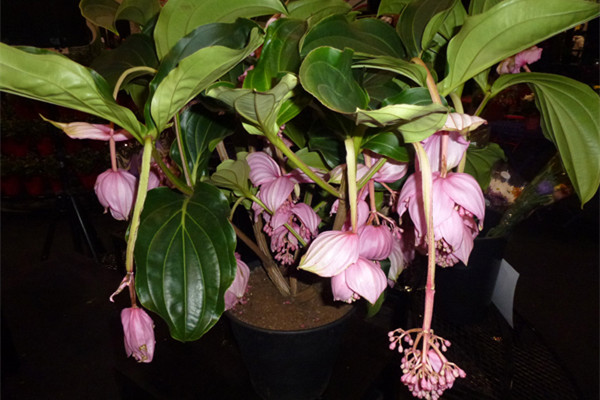
Medinilla (Medinilla magnifica) is a flower that many people absolutely love; this medinilla is beautiful. How do you propagate medinilla from cuttings? How do you water medinilla:
How to propagate medinilla from cuttings:
I. Preparation Work
1. Cutting medium
The cutting medium for medinilla can be a mixed medium, or pure sand can also be used. The best choice is a mixed medium, as a mixed medium is more beneficial for plant growth and is more breathable and loose.
2. Cutting time
Generally speaking, April to August and September to November each year are relatively suitable times for medinilla cuttings. According to observations, the survival rate of cuttings taken from April to August is somewhat higher than that of September to November. Therefore, it is recommended that fellow flower growers choose April to August for their cuttings as much as possible.
3. Cutting stems
For the selection of cutting stems, semi-lignified stems with leaves at the tip should be chosen. Note that stems in a healthy growing state should be selected.
II. Steps
Dig a hole in the potting soil suitable for inserting the cutting, insert the selected cutting into the prepared mixed medium, press the mixed medium firmly after inserting the cutting, water it appropriately, and be careful not to water too much, otherwise it is easy to cause root rot in the plant. After the cutting is completed, cover the plant with a layer of shade netting to create a good growing environment for it. About 30 days after the cutting is completed, the medinilla will take root, and after about 60 days it can be potted up.
How to water medinilla flowers:
Medinilla flowers relatively prefer shady and moist environments. As long as you see that the soil of the medinilla flower is relatively dry, you can water it.
That is all for the introduction to medinilla cutting methods. Pay attention to the watering of this medinilla flower.
How to propagate medinilla from cuttings
Preparation work for medinilla cuttings
Cutting medium
The cutting medium for medinilla can be a mixed medium, or pure sand can also be used. The best choice is a mixed medium, as a mixed medium is more beneficial for plant growth and is more breathable and loose.
Cutting time
Generally speaking, April to August and September to November each year are relatively suitable times for medinilla cuttings. According to observations, the survival rate of cuttings taken from April to August is somewhat higher than that of September to November. Therefore, it is recommended that fellow flower growers choose April to August for their cuttings as much as possible.
Cutting stems
For the selection of cutting stems, semi-lignified stems with leaves at the tip should be chosen. Note that stems in a healthy growing state should be selected.
Steps for medinilla cuttings
Dig a hole in the potting soil suitable for inserting the cutting, insert the selected cutting into the prepared mixed medium, press the mixed medium firmly after inserting the cutting, water it appropriately, and be careful not to water too much, otherwise it is easy to cause root rot in the plant. After the cutting is completed, cover the plant with a layer of shade netting to create a good growing environment for it. About 30 days after the cutting is completed, the medinilla will take root, and after about 60 days it can be potted up.
Introduction to cutting propagation and cultivation management of medinilla flowers
Medinilla flower
Medinilla flower is also called pearl medinilla, Medinilla, etc. It is native to tropical forest regions. Its flower growth and appearance are similar to those of the fuchsia, because their flowers all hang from the stems, making them very distinctive. They are widely cultivated and propagated throughout the country. Below, let us get familiar with the cutting propagation and cultivation management of medinilla flowers.
I. Growth habits of medinilla flowers
It likes high temperature, high humidity, and a semi-shady environment. It is not cold-tolerant and avoids scorching sun exposure. It requires fertile, loose leaf mold or peat soil, and the winter temperature should not be lower than 16°C. The growing medium needs to be a mixed medium mainly composed of coarse peat. The pH value must be controlled between 3.5 and 4. The daytime temperature should be maintained at 21°C, and at night at 19°C, and the humidity should always be maintained at around 80%. The plant's growth cycle begins with flowering and ends in autumn. The plant needs more nitrogen (N) in spring and more potassium (K) in summer, with fertilizer added once a week. During the growing season, the ratio of nitrogen, phosphorus, and potassium should be balanced. If the irrigation water is taken from rivers or lakes with high EC values, a water quality test should be done before use to analyze the water's composition.
II. Propagation of medinilla flowers by cuttings
1. Cutting season
Generally speaking, April to August in spring and summer, and September to November in autumn are both acceptable, but according to the experience of flower growers, the survival rate in spring and summer is higher than in autumn.
2. Softwood cuttings
From late spring to early autumn, when the plant is growing vigorously, select robust stems of the current year as cuttings. After cutting the stems, select the sturdy parts and cut them into sections 5 cm to 15 cm long, and each section should have 2-3 or more leaf nodes. When cutting the cuttings, be sure to cut 2 cm away from the stem node, and both the upper and lower cuts should be flat (the knife must be sharp).
3. Hardwood cuttings
After the temperature rises in early spring, select robust stems from the previous year as cuttings. Each cutting usually retains 3 to 4 nodes, and the cutting method is the same as for softwood cuttings.
4. Cutting medium
The cutting medium can use fine sand:perlite = 3:1, or peat:vermiculite = 4:1, or peat:perlite:vermiculite = 4:1:1. Before cutting, first soak the lower end of the stems 1 cm to 2 cm into a growth regulator, such as using 50 mg/L indoleacetic acid (IAA) + 50 mg/L indolebutyric acid (IBA) for 1 to 2 minutes, which can promote faster rooting of the cuttings. After cutting, in order to prevent water from accumulating at the bottom when the cuttings root, place a perforated tray under each plug tray containing the cuttings. After cutting, careful care is required. Cover the seedbed with plastic film and shade netting. On sunny days, spray (water) once every 1 to 2 days, and maintain the temperature at 22°C to 28°C, light at 5000 lux to 100000 lux, and relative humidity at 85% to 95%. After 40 to 50 days, they can take root, and after about 60 days, they can be transplanted into pots.
Medinilla flower
III. Cultivation management of medinilla flowers
Repot every spring, remove the old soil, add fertile, well-drained leaf mold, and provide appropriate shade. During the growing period, keep the soil moist. For indoor cultivation in winter, increase light and reduce watering. During the flowering period from April to June, humidity should not be too high, otherwise it is easy to cause flower drop. When the flower buds begin to change color, growers should place the plant in a slightly warmer place to prevent bud drop. The number of flower buds must be proportional to the size of the plant, but the flower buds must be more than 5 cm long. If they are less than 5 cm and it happens to be winter, they are very likely not to bloom.
Classify the plants. In addition to classifying by the number of flowers, they can also be classified by different tiers. Plants have three different tiers: 1 tier, 2 tiers, and 3 tiers. Forcing blooms is a difficult point in the care of medinilla. Natural flowering is concentrated from January to May. If cultivated in a greenhouse, flowering can be forced throughout the year. If you want to provide flowering plants after summer, you must control the temperature well, because if the temperature is too high or too low, the flower buds will not fully open.
Pests and diseases: Leaf spot and stem rot sometimes occur; spray with 70% thiophanate-methyl wettable powder at 1000 times dilution. Pests include whiteflies and scale insects, which can be killed by spraying with 50% dichlorvos emulsifiable concentrate at 1000 times dilution.
Whether propagating medinilla flowers by cuttings or by sowing, high-quality cuttings and seeds must be selected, and inferior cuttings and seeds must be eliminated. Only in this way can medinilla flowers with green leaves and brilliant flowers be propagated. If care and management are proper, medinilla flowers can also bloom all year round.