Potted Osmanthus Tree Planting Techniques and How Much One Pot Costs
Osmanthus trees are loved by many people, especially when they bloom, for their fragrance. What are the planting techniques for potted osmanthus trees? How much does a bonsai osmanthus tree cost per pot:
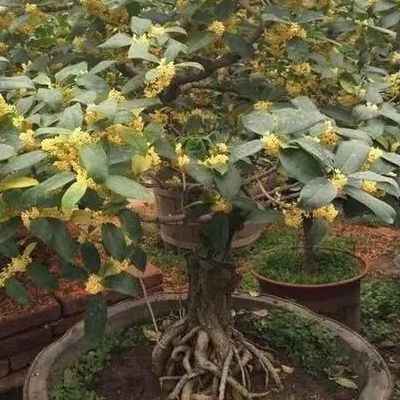
Potted Osmanthus Tree Planting Techniques:
For potted osmanthus, it is best to choose plants that are short and sturdy, with a relatively thick trunk and evenly balanced branches and leaves. The potting soil should be loose, fertile, well-drained sandy loam. Soil that is too heavy or too loose is unsuitable for osmanthus growth. Generally, mix and use 50% leaf mold, 40% garden soil, and 10% rice husk ash.
Osmanthus produces new branches twice a year in spring and autumn, but the spring shoots grow best. It generally sprouts in March, spring shoots develop in late April, grow into semi-mature sturdy branches by the end of June, form flower buds during the high temperatures of August, and bloom by the end of September.
Branches from the previous year also bear flowers, but the flowers are few and of poor quality. Therefore, after blooming in autumn, one pruning is needed. When pruning, according to the plant's growth vigor, overly dense branches should be properly thinned so that sturdy branches are evenly retained on each side branch. If branches are too dense, photosynthesis is affected, which can cause physiological imbalance and affect bud formation and blooming.
At the same time, leggy branches grown in summer and autumn should be cut off. The second pruning is done in early spring before buds sprout, cutting off all dead branches, thin and weak branches, and diseased or pest-infested branches after winter. If the plant is too tall and has few lower branches with an unattractive shape, the top of the main trunk can be cut off to encourage adventitious buds on the lower part to sprout new branches. In addition, during the growth period, suckering branches should be frequently removed to concentrate nutrients, which benefits spring shoot growth and flower formation.
Although osmanthus is not strict about light, it blooms more and has a stronger fragrance in environments with ample sunlight and good ventilation. If kept in a semi-shaded place for a long time, it blooms less and has a faint fragrance. Potted osmanthus is not cold-tolerant, so in winter it should be placed indoors in a sunny spot. It can generally overwinter at above 4°C.
When light is poor and temperatures are low, leaf drop is easily caused. In late March of the following year, the potted plant can be moved outdoors to a sunny place for care.
During the growing period, fertilizer and water management should be strengthened. Potted osmanthus uses a relatively large pot, and in spring and autumn it is generally watered once every 4-5 days. Osmanthus dislikes excessive moisture, especially during the autumn blooming period, as too much moisture can cause flower drop.
Normally, just keep the potting soil moist. Summer is the peak growing season for the plant. When temperatures are high, the potting soil dries easily, so watering should be sufficient. Water once every morning, and in the evening, depending on how dry or moist the potting soil is, if dry, water lightly once more. During the plum rain season and summer showers, promptly tip the pot to drain excess water to avoid root rot.
Osmanthus greatly likes fertilizer. When it sprouts in spring, apply 30% cake fertilizer water and human waste (which must be fully decomposed) once every 7-10 days to promote sprouting and branch growth.
After July, apply 30% decomposed chicken or pigeon manure water or fish waste water, or add 0.5%-1% superphosphate to the above fertilizer solution, to promote flower bud growth and produce good flowers.
When the potting soil is too dry, do not fertilize immediately. Water so the potting soil is slightly moist before fertilizing, to avoid leaves being scorched and curling.
Bonsai Osmanthus Tree Prices:
The price of a bonsai osmanthus tree is greatly related to the size and shape of the osmanthus tree. Those from 80cm to 150cm sell for 600 each.
That is all for the introduction to bonsai osmanthus tree planting methods and prices. If you like them, hurry and get one for your home.
Potted Osmanthus Tree Planting Techniques Potted Osmanthus Tree Planting Techniques and Precautions
In August, the fragrance of osmanthus fills everywhere. Its aura and its beauty make it impossible for many people to forget even now, and because of this, many people have gradually fallen in love with the captivating fragrance of osmanthus. Nowadays, many people also plant osmanthus trees at home. Do you know the planting techniques and precautions for osmanthus trees? Below, let us follow our editor to take a look at how to grow osmanthus trees!
The osmanthus tree is evergreen all year round and has luxuriant branches and leaves. Its blooming season is in autumn, and it can be called "dominating the three autumns and overpowering all flowers." It is widely used in gardens, often as a landscape tree, sometimes planted alone and sometimes planted in pairs. Through continuous artificial cultivation, osmanthus trees now roughly include several types: Dan Gui, Jin Gui, Yin Gui, and Siji Gui. Dan Gui, Jin Gui, and Yin Gui all bloom in autumn and can collectively be called August Gui.
The maintenance technique for osmanthus trees is in summer. Newly planted osmanthus trees should be watered thoroughly. During the flowering period in mid-September, water appropriately to keep the soil moist. The principle should be frequent application of light fertilizer, mainly with quick-acting nitrogen fertilizer, with reasonable pruning, strengthened photosynthesis, and reduced pests and diseases.
When watering potted osmanthus, follow the principle of not watering until dry, and watering thoroughly when you do. Summer temperatures are high, so the amount of watering should be greater. When the temperature is above 25°C, water once every afternoon. When osmanthus blooms, maintain moist conditions for both soil and air, and at the same time spray the leaves more to increase relative air humidity.
The precautions for potted osmanthus are, first, to choose slightly acidic soil; at the same time, water at the right time and grasp the principle of "two less, one more"; skillfully apply topdressing, applying fully decomposed dilute cake fertilizer water once every 10 days in spring, applying dilute decomposed chicken or duck manure water or fish waste water after July, and applying a liquid fertilizer mainly based on phosphate fertilizer once in early September; and prune appropriately.
More information:
|What are the effects of mulberry leaves?|How to plant iris? Iris picture display|Introduction to the cultivation methods of cleome|
|What are the cultivation methods of globe amaranth?|A brief discussion of the air layering propagation method of rhododendron|Campion flower picture display|
|Radiation-proof flowers, which flowers can protect against radiation|How to grow sago palm? Sago palm cultivation methods|Do cactus protect against radiation|
Potted Osmanthus Tree Planting Techniques
Osmanthus is the collective name for many trees in the Chinese genus Osmanthus, and it is widely used in landscaping. The main cultivated varieties include Jin Gui, Yin Gui, Dan Gui, and Yue Gui, among others. Its cultivation history in China spans more than 2,500 years, and since ancient times it has been deeply loved by Chinese people and regarded as a traditional famous flower. Now let us take a look at potted osmanthus tree planting techniques!
Osmanthus Tree Planting Environment
1. Temperature: The osmanthus tree likes warmth. In cultivation areas, the average temperature is 14-28°C, the average July temperature is 24-28°C, the average January temperature is above 0°C, it can withstand a minimum temperature of -13°C, and the most suitable growing temperature is 15-28°C. In China, in areas south of the Qinling Mountains and the Huaihe River, it can overwinter outdoors. It is not very cold-tolerant, but compared with other evergreen broadleaf tree species, it is still a relatively cold-tolerant tree species.
2. Moisture: The osmanthus tree likes moisture. Humidity is extremely important for the growth and development of osmanthus. It requires an annual average humidity of 75-85% and annual precipitation of about 1,000 millimeters. Especially during the young stage and when mature trees bloom, it needs more water. If drought occurs, flowering will be affected. Waterlogging must be strictly avoided, but it also has a certain drought tolerance.
3. Light: Osmanthus relatively likes sunlight and can also tolerate shade. Under full sunlight, its branches and leaves grow luxuriantly and it blooms densely. In shaded places, branches and leaves grow sparsely and flowers are few. If potted indoors in the north, special attention should be paid to ensuring sufficient light to benefit growth and flower bud formation. Strong sunlight and deep shade are unfavorable to its growth. Generally, 6-8 hours of light per day is required.
4. Soil: Osmanthus is not very strict about soil. Except for alkaline soil, low-lying land, or soil that is too heavy and poorly drained, it can generally grow. However, deep, loose, fertile, well-drained, slightly acidic sandy loam is most suitable.
5. Air: Osmanthus has a certain resistance to harmful gases such as chlorine, sulfur dioxide, and hydrogen fluoride, and also has a relatively strong ability to absorb and retain dust. It is suitable for planting in places with ventilation and light, likes a clean and well-ventilated environment, and is not tolerant of smoke and dust damage. After being harmed, it often fails to bloom.