How to grow Cymbidium orchids and points to note, and how much does one pot cost?
Cymbidium orchid is a plant, and you should not underestimate this Cymbidium orchid; this Cymbidium orchid is truly beautiful when it blooms. What are the growing methods and points to note for Cymbidium orchids? How much does a pot of Cymbidium orchid cost:
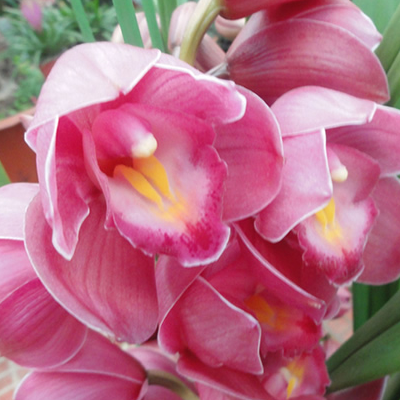
Growing methods and points to note for Cymbidium orchids:
Growing methods for Cymbidium orchids:
1. Soil: Cymbidium orchids require a loose, breathable, well-drained growing medium. They can be grown in leaf mold, or in a mix of sphagnum moss, charcoal bits, fern roots, charcoal, bark chunks, crushed bricks, and so on. Ordinary potting soil and the potting soil used for growing Chinese orchids are not suitable. Soil with poor aeration and drainage will cause root rot. ???? ???
2. Watering: Cymbidium orchids prefer relatively high air humidity. In spring, summer, and autumn, while giving the roots sufficient water, the leaves should also be misted frequently. However, after blooming in early spring, during the brief dormant period of Cymbidium orchids, watering must be reduced, and more water can only be given once the new shoots have grown larger new roots.
3. Sunlight: Cymbidium orchids need ample diffused light for growth. In summer and autumn, a shade net should be used to provide about 50% shade; on cloudy days or in winter and spring when the sunlight is soft, the shade net should be opened to allow direct light. However, during the blooming period, the orchid plant should be placed in a spot with weaker light so that its flowers bloom brightly.
4. Temperature: They prefer warm winters and cool summers, with an optimal growing temperature of 10°C to 25°C. The nighttime temperature is best around 10°C, and especially during the blooming period, keeping the temperature above 5°C and below 15°C can extend the flowering period by more than 3 months.
5. Fertilizing: During the growing period, apply light fertilizer frequently, and supplement with dilute chemical fertilizer or compound fertilizer. If more bone meal and decomposed bean cake fertilizer are applied, the flowers can be made larger and more numerous. Liquid fertilizer should be diluted at 1:1000, applied once every 10 days. Sufficient fertilizer should be applied before blooming, and no fertilizer should be applied during the blooming period or the height of summer.
6. Pests and diseases: If the growing environment is poor, Cymbidium orchids are prone to pest and disease damage. Common diseases include Fusarium disease, black rot, soft rot, anthracnose, gray mold, and southern blight, so a fungicide should be sprayed once every half month to prevent diseases. Special attention must also be paid to the cleanliness of the environment, water sources, planting materials, and tools.
7. Pruning: The pseudobulbs of Cymbidium orchids generally contain more than 4 leaf buds. To avoid dispersing nutrients, the newly emerging small shoots and their growing points must be completely removed. This operation should begin after the blooming period ends, removing shoots once a month, and stop before the new blooming period, so that nutrients can be concentrated, the mother pseudobulb strengthened, and the flowers made larger and more numerous.
Points to note when growing Cymbidium orchids:
(1) Points to note about the flower pot and medium: A ceramic flower pot with many holes on all four sides is commonly used, with 1 part sphagnum moss and 2 parts fern roots, or granular materials such as bark chunks 1.5 to 2 cm in diameter, crushed bricks, charcoal, pot shards, and volcanic ash used as potting material. This keeps aeration and water permeability good, so the roots do not rot. A flower pot 15 cm in diameter can hold 3 to 4 orchid seedlings per pot; for large-pot planting, 10 to 20 clumps of orchid seedlings can be planted per pot.
(2) Points to note about air temperature: The suitable temperature for Cymbidium orchid growth is 10 to 25°C, and the nighttime temperature is better at around 10°C. If it is around 15°C, the leaves appear green with a jade-green luster, and the flower buds suddenly elongate. In January to February, large flowers emerge, and the flower stems are soft and cannot stand upright, so stakes must be used for support. In February to March, tender shoots emerge early, making the time for division and repotting earlier. If it rises to 20°C, the leaf clumps grow luxuriantly and flowering is affected, and the flower buds also turn yellow and wither without opening. For this reason, tropical regions often use the method of spraying cold water in the evening to lower the temperature, increasing the temperature difference between day and night. The effect is relatively good and is beneficial to growth and flower bud differentiation.
(3) Points to note about humidity: The roots of Cymbidium orchids are often exposed to the air and prefer relatively high humidity. Therefore, water should be applied around the flower pot to increase humidity. After blooming there is a short dormant period, during which watering should be reduced, and during the vigorous growing period in spring and summer they must not be allowed to dry out.
(4) Points to note about light: Cymbidium orchids slightly prefer sunlight, but in midsummer they must not be exposed to direct sunlight, otherwise severe sunscald will occur. Excessive shading will make the plant weak and spindly, the leaves unable to stand upright, with fewer flowers and greater susceptibility to disease.
(5) Points to note about fertilizing: Cymbidium orchid plants are large and grow luxuriantly, so they require relatively more fertilizer. Fermented cake fertilizer, chicken manure, and the like can be mixed with 1/3 clay, then water added to make balls about 2 cm in diameter, dried in the sun, and kept for later use. In spring, place them on the pot surface at a certain distance from the new shoots. They can be applied twice a year, several pellets each time. In the vigorous growing season, if they seem short of fertilizer, top-dress with well-fermented liquid fertilizer, 1 to 2 times a week.
How much does a pot of Cymbidium orchid cost:
The price of Cymbidium orchids changes each year according to the market. Generally, during holidays, the price of the flowers rises accordingly. It also needs to be divided according to quality. Generally speaking, the wholesale price of top-grade Cymbidium orchids with more than 4 flower spikes is 150—200 per pot. In flower shops in various places, it rises a bit more. Mid-range ones with 3—4 spikes are around 100—150, and the lowest-grade Cymbidium orchids cost under 100 yuan.
That is all for the introduction to the growing methods and blooming period of Cymbidium orchids. Why not hurry and grow one?
Growing methods and points to note for Cymbidium orchids
Selection of growing medium and pot
It is best to choose a tall cylindrical pot with many holes in the bottom and on all four sides. The growing medium should be bark chunks, fern roots, or the like with good aeration and water permeability. Charcoal, ceramsite, and other materials should be added to the lower part of the pot to help drainage.
Fertilizing and watering
After division and planting, do not water immediately. If dryness is noticed, water can be sprayed on the leaves and pot surface to prevent the leaves from drying out, falling off, and the pseudobulbs from shrinking. Water can only be given after new shoots and new roots have grown. During cultivation, watering should depend on the weather and the dry-wet conditions. During the vigorous growing period, sufficient water must be supplied to the roots, and in dry and hot seasons water must be given promptly. When the winter temperature is relatively low, the number of waterings can be reduced. The pH of the water used for watering is best at 6.5. Cymbidium orchids relatively prefer fertilizer. After new shoots grow in spring, apply compound fertilizer mainly of nitrogen fertilizer at a concentration of 0.1%-0.2%, once a week, or diluted decomposed cake fertilizer water. During the bud stage, quick-acting phosphorus and potassium fertilizer should be applied additionally in advance.
Growing methods1. Soil
When growing Cymbidium orchids, the choice of soil is very important. They like loose, breathable soil with good drainage. Ordinarily, leaf mold can be used to grow Cymbidium orchids, or pot soil can be made from materials such as sphagnum moss, charcoal bits, and bark chunks. Ordinary potting soil cannot be used, because its aeration and drainage are relatively poor, and after planting it will cause the roots of Cymbidium orchids to rot.
2. Moisture
Only with reasonable watering can Cymbidium orchids grow normally. This plant, the Cymbidium orchid, likes air with high temperature and high humidity. In spring, summer, and autumn, sufficient water should be given to the roots, and water should also be sprayed on the leaves promptly, but after blooming in early spring, Cymbidium orchids enter a brief dormant period. At this time the water supply must be reduced, and only after the new shoots have grown larger can more water be given.
3. Sunlight
Cymbidium orchid is a plant that likes sunlight. It likes to grow in an environment with ample sunlight, but it cannot tolerate strong light exposure. It is best to place it in an environment with ample diffused light. However, after entering the blooming period, Cymbidium orchids should be placed in a spot with weaker light, so that the flowers they produce are more brilliant.
Points to noteWhen growing Cymbidium orchids, be sure to prevent pests and diseases. When diseases such as leaf spot and gray mold occur, spray carbendazim promptly; after pests occur, catch them promptly or spray medicine. In addition, when growing Cymbidium orchids, also pay attention to pruning. Their pseudobulbs generally contain more than 4 leaf buds. To prevent them from dispersing nutrients, the newly grown small shoots must be completely removed.