Four Seasons Begonia: Growing Methods, Blooming Period and Price
Four Seasons Begonia is a plant that many people absolutely love; this Four Seasons Begonia is just that appealing. How do you grow Four Seasons Begonia? What are its blooming period and price?
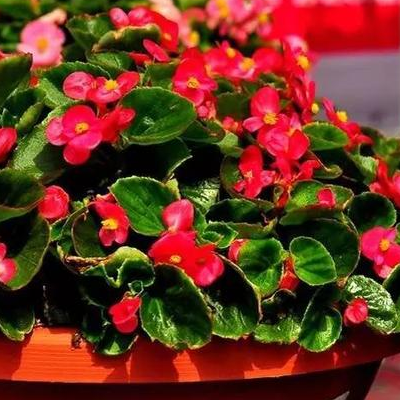
How to grow Four Seasons Begonia:
1. In spring it can be exposed to direct sunlight, but from April to October it should be grown under all-day shade, with just a little sunlight in the morning and evening;
2. During the growing seasons of spring and autumn, apply light fertilizer frequently; during the growing season, apply a nitrogen-containing fertilizer twice a month, and decomposed cake fertilizer can be used; before flowering, apply more phosphorus and potassium fertilizer to promote blooming;
3. Water according to the "dry-wet" principle: wait until the potting soil is dry before watering;
4. To promote flowering, pinching is essential. When the plant grows to 15cm, pinch it once. After the flowers fade, remove the spent flowers, which can promote branching and let the plant produce new flower buds.
Four Seasons Begonia blooming period: blooms all year round
How much does Four Seasons Begonia cost:
If the Four Seasons Begonia is just an ordinary seedling, it is generally 5 jiao each; if it is already planted and has a flower pot, the price will be a bit higher.
That's all for the introduction to Four Seasons Begonia's growing methods, blooming period and price. If you like it, don't miss out.
How long is the Four Seasons Begonia blooming period? Blooming-period care for Four Seasons Begonia: fertilize frequently / plenty of light
Four Seasons Begonia is a flower with both beautiful blooms and foliage and high ornamental value. This flower is suitable both for growing at home and for planting in large areas. If we talk about the most beautiful moment of this flower, it is certainly the blooming period. So how long is the Four Seasons Begonia blooming period? What does blooming-period care for Four Seasons Begonia involve? Let me walk you through it below.
I. How long is the Four Seasons Begonia blooming period? October to May
If Four Seasons Begonia is planted in spring, its flowering time is around October, and the blooming period continues until May of the following year. The blooming period of Four Seasons Begonia runs from late autumn to early summer of the following year, covering almost all four seasons of spring, summer, autumn and winter, which is why people call it Four Seasons Begonia - a very fitting name indeed.
II. Blooming-period care for Four Seasons Begonia
Four Seasons Begonia is a plant with a very long blooming period, but if you want its flowers to stay open for a long time, then the care and management during the blooming period must not be neglected at all; improper management can easily cause the flowers to wither early. The methods for blooming-period care of Four Seasons Begonia are described in detail below. Let's take a look together.
1. Fertilizer management
When Four Seasons Begonia is flowering, its demand for fertilizer is very high, because flowering consumes a large amount of nutrients, so if you want to keep the flowers open, fertilizer is indispensable. During the blooming period, Four Seasons Begonia basically needs fertilizing once every 10 days. When fertilizing, remember to apply light fertilizer frequently; the fertilizer must first be diluted with water before application, otherwise it can easily burn the plant and cause the flowers to drop early.
2. Watering management
During the blooming period of Four Seasons Begonia, watering is also a very important part. There is no fixed frequency for watering Four Seasons Begonia; it generally needs to be adjusted according to the climate. Generally, when the potting soil turns pale, it can be watered. Try to follow the principle of "don't water until dry, and water thoroughly when you do", but don't wait until it is completely dry before watering.
3. Light management
Four Seasons Begonia is a light-loving plant, but it is not tolerant of strong light, so light management during its blooming period also needs attention. In spring and autumn the light is not too strong, so we can let it receive light all day; in summer when the light is strong, we need to provide shade, and it is best to move it indoors to a semi-shaded spot for growing.
4. Winter management
The blooming period of Four Seasons Begonia runs through all four seasons, but this plant is rather afraid of cold, so extra care is needed when growing it in winter. In winter it is best to keep it indoors, and it is best to keep the indoor temperature above 15°C. In addition, fertilizer and water management should be strengthened in winter so that the begonia can continue to bloom. When the temperature rises again at noon, we can move it outdoors to receive a few hours of sunlight, which helps it get through the winter better.
5. Pest and disease management
During the blooming-period care of Four Seasons Begonia, if it is not cared for properly, pests and diseases are very likely to appear. Such problems are extremely harmful to the plant, so they must be dealt with promptly. The specific treatment methods are described in the article on pest and disease control for Four Seasons Begonia, so I won't repeat them here.
How to grow Four Seasons Begonia so it blooms continuously: care tips for Four Seasons Begonia
Four Seasons Begonia, also known as wax begonia and clamshell begonia, has a graceful plant form, glossy green leaves, and delicate, charming flowers. It is suitable for display and accent in courtyards, corridors, on desks, balconies, conference room tables, restaurants and other places. It has been grown as a potted ornamental for a thousand years. Its blooming period is extremely long, and it can bloom almost all year round, but most abundantly in late autumn, winter and spring. The flower colors include orange-red, peach red, pink, white and so on. Placed on a desk in the cold season, it fills the room with the feeling of spring; placed under the eaves of a balcony in spring and summer, it looks even more lively and full of vitality. So how do you grow Four Seasons Begonia so it blooms continuously? Let's take a look below with the editor of wed114.
Four Seasons Begonia flower pictures
I. Introduction to Four Seasons Begonia
Four Seasons Begonia, also known as wax begonia and clamshell begonia, Latin name: Begonia semperflorens Link et Otto. It is a succulent herb of the family Begoniaceae and the genus Begonia. The roots are fibrous; the stem is upright, succulent, hairless, much-branched at the base, and leafy. The leaves are ovate or broadly ovate, slightly oblique at the base, with serrated edges and eyelash-like hairs, glossy on both sides, green, but the main vein is usually slightly red. It is native to Brazil. Four Seasons Begonia is the most common and most widely cultivated species among begonias. It has a graceful posture, tender and glossy leaves, and clustered flowers that open in all four seasons, with a slight fragrance, making it one of the main potted flowers for indoor and outdoor decoration. People use it in flower bed arrangements with excellent results. With the appearance of some relatively heat-tolerant varieties, Four Seasons Begonia is very likely to become one of the most important flower bed flowers in China, with advantages such as a neat, rounded plant shape, abundant and dense flowers, easy combination with other flower bed plants, and a long ornamental period, and it is therefore becoming more and more popular. It is generally cultivated in spring and autumn.
Four Seasons Begonia flower pictures
II. How to grow Four Seasons Begonia so it blooms continuously
1. Water
Spring and autumn are the growth and flowering periods, when the soil needs to contain more water; water promptly and keep it moist. In summer and winter, Four Seasons Begonia is in a semi-dormant or dormant period, so water can be reduced and the potting soil kept a little drier; especially in winter, water even less, and the potting soil should always be kept slightly dry.
2. Sunlight
In early spring, Four Seasons Begonia can receive direct sunlight, but as the sunlight intensifies, it must be shaded appropriately. After Qingming, potted plants can be moved outdoors to a shade shed for growing. In East China, from April to October it must be grown under all-day shade, but it is best to give it a little sunlight in the morning and evening. After Frost's Descent, it should be moved indoors to prevent freezing and keep warm, and indoor placements should be in a sunny spot.
3. Fertilizing
During the spring and autumn growing periods, follow the principle of applying light fertilizer frequently, mainly applying decomposed odorless organic dilute fertilizer water or soaked inorganic fertilizer solution. During the bud-setting and flowering stage, apply more phosphorus fertilizer to encourage more flower buds. In summer and winter, when growth is slow, apply less or stop fertilizing, which can avoid rot diseases caused by tender stems and leaves and weakened heat and cold resistance.
4. Temperature
In the hot midsummer season, take measures to avoid strong direct light and lower the temperature, creating a small environment below 30°C for growing. In winter, as long as the temperature is kept above 10°C, it can survive the winter safely.
5. Choosing suitable potting soil
The choice of potting soil is extremely important for Four Seasons Begonia. A potting soil that has been left for a long time should be mixed with garden soil and then supplemented with a small amount of river sand for preparation; of course, a small amount of bone powder can also be added as a base fertilizer, which can make the begonia grow more vigorously and flourish.
6. Reasonable light and ventilation
In early spring, Four Seasons Begonia should be placed in a sunny spot on the balcony, and ventilation should be maintained and paid attention to at all times. Observe it frequently, and after a long time, rotate the flower pot 180° in place. After the last frost, Four Seasons Begonia should be transplanted to a position with only scattered sunlight. Do not water too much; keep it moist, and apply a dilute liquid fertilizer of nitrogen, phosphorus and potassium once every 1-2 weeks.
7. Humidity is especially important
Four Seasons Begonia likes warm and humid environments, and this should not be changed for it. During its growing period, it is most suitable to place it in a cool, ventilated spot with scattered light for growing. In summer, watering should be controlled and fertilizing stopped, to prevent the leaves from turning yellow due to sunlight exposure; spray water on the leaves and the surrounding ground every day to ensure the surrounding humidity and lower the temperature.
Four Seasons Begonia flower pictures
III. Care methods to make Four Seasons Begonia bloom more
① The potting soil should be made of half leaf mold and half garden soil, mixed evenly with a small amount of river sand, and a small amount of cake fertilizer added as a base fertilizer.
② The suitable growing temperature is 20°C—24°C. Normally it should be kept indoors in a sunny spot, and in summer it should be given a cool, ventilated environment, avoiding strong direct sunlight. In winter, the room temperature needs to be kept above 15°C.
③ Watering should follow the principle of alternating dry and wet, and apply a dilute liquid fertilizer combining nitrogen and phosphorus or a compound flower fertilizer once every half month. In summer, control watering and stop fertilizing. In autumn, keep the potting soil moist and apply decomposed cake fertilizer water once every 7—10 days.
④ After flowering in spring and autumn, promptly remove the spent flowers and one node of tender stem at the top, to encourage the lower axillary buds to sprout new branches.
⑤ During the growing period, spray water on the leaves regularly; after each pinching, pause spraying for a few days to prevent the wound from rotting.
Four Seasons Begonia flower pictures
IV. Pest and disease control for Four Seasons Begonia
Under conditions of high temperature and high humidity, Four Seasons Begonia is extremely prone to bacterial leaf spot disease. At first, dark brown spots appear on the leaf surface, gradually spreading into dark brown concentric rings. Before the disease occurs, an equal-amount Bordeaux mixture can be sprayed for prevention, and attention should be paid to improving cultivation conditions and management methods. In the early stage of the disease, diseased leaves should be promptly removed and burned to prevent further spread. Summer is the peak period for aphids and red spider mites, so non-polluting pesticides should be used promptly for control.
Insect pests
Pest and disease control: The main diseases include leaf spot disease and bacterial diseases, which should be controlled with thiophanate, chlorothalonil, validamycin, etc. The main pests are various pests that harm leaves and stems, including slugs, thrips, leaf miners, etc., and targeted pesticides should be used.
Diseases
(1) Common diseases include powdery mildew and bacterial damping-off disease; pests include aphids, mealybugs and red spider mites, and in summer and autumn it is easily harmed by the larvae of scarab beetles. Control methods, with environmental control: high temperature and high humidity favor the reproduction of pathogens, so dense planting should be avoided during cultivation to facilitate ventilation. When growing in a greenhouse, if the climate happens to have a large day-night temperature difference, watering in the evening should be avoided, so as not to cause the night temperature to drop, resulting in excessively high humidity or even condensation of water vapor.
(2) Keep the cultivation site clean: if there are infected plants and leaves, they should be removed and destroyed immediately. Avoid wetting the leaves when watering.
Damping-off is one of the common diseases of Four Seasons Begonia, and it occurs both in flower farms and in home potted begonias. It mainly harms the base of the stem and the leaves near the soil surface. In the early stage of the disease, dark-colored spots appear on the stem base near the soil surface, which expand into a brown, rotting condition. Leaves develop dark green, water-soaked round spots, and when the petiole is infected, brown rot appears. On humid mornings, white to light brown mycelial threads can be seen at the diseased spots. Severely affected plants collapse or rot and die. The pathogen overwinters as mycelium or sclerotia in diseased residual tissues or in the soil. When wounds are created during division or cutting propagation, and when the temperature is 20-24°C, humidity is high, or during rainy weather and overwatering, the pathogen invades and often causes severe outbreaks of the disease.
Control methods
(1) Remove diseased leaves promptly when found and strengthen ventilation.
(2) Use soilless cultivation. For soil cultivation, it is recommended to apply compost fermented with effective microorganisms. Choose fresh soil rich in organic matter, or pond mud, river mud, etc., to prepare the potting soil.
(3) Where conditions permit, carry out soil disinfection with 40% quintozene · thiram or seed-dressing bis powder, at 8g per sq m, mixed evenly with the soil and then put into pots for later use.
(4) In the early stage of the disease, spray with 95% Lüheng No. 1 premium product at 3000 times dilution, or 20% tolclofos-methyl emulsifiable concentrate at 1200 times dilution, 50% damping-off spirit wettable powder at 1000 times dilution, or potassium permanganate at 1200-1300 times dilution.
(5) After the disease occurs, 40% quintozene · thiram or seed-dressing bis powder can also be mixed with fine sand into a 1:200 medicinal soil, and 100-150g applied per plant or per pot into the holes, once every 10-15 days.
(6) Use 0.4-0.45kg of well-cultured Trichoderma harzianum, add 50kg of fine soil, mix evenly and spread it over the base of the diseased plants, which can effectively control the spread of the disease. Begonias are sensitive to fungicides, and some new varieties need to be tested first before large-scale application.