How to grow Fuchsia hybrida, and how long is its flowering period
Fuchsia hybrida is a plant many people have seen, and its flowers are truly stunning to look at. What is the cultivation method for Fuchsia hybrida? What is its flowering period like:
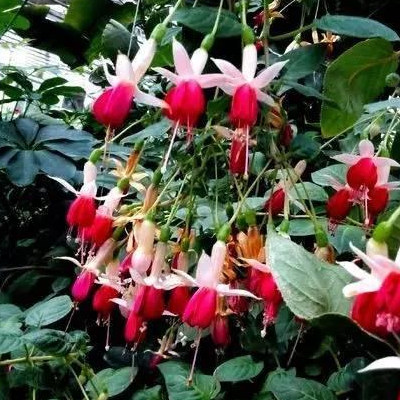
Cultivation method of Fuchsia hybrida:
1. Fuchsia hybrida has different light requirements in different seasons. In winter, early spring and late autumn it needs full sun; in early summer and early autumn it needs half-day sun; in the sweltering height of summer it should be shaded;
2. Spray water on the leaves several times a day and sprinkle water on the ground to lower the temperature and increase air humidity;
3. During the growing period, apply light fertilizer frequently, about once every ten days with dilute cake fertilizer or compound fertilizer.
Before fertilizing, the potting soil should be on the dry side; after fertilizing, spray once with water using a fine nozzle, so that fertilizer water does not stick to the leaves and cause rot.
Flowering period of Fuchsia hybrida: April to December
That is all for the cultivation method and flowering period of Fuchsia hybrida. Friends who like it should not miss out.
How to grow Fuchsia hybrida, cultivation method and precautions for lantern flower / Fuchsia hybrida
Fuchsia hybrida knowledge encyclopedia:Fuchsia hybrida (Latin scientific name: Fuchsia hybrida Hort. ex Sieb. et Voss), also known as: lantern flower, Fuchsia hybrida. It is a perennial subshrub with erect stems. It grows 50-200 cm tall and 6-20 mm thick, is much branched, covered with short soft hairs and glandular hairs, gradually becoming hairless when old, and the young branches are tinged with red. The leaves are opposite, ovate or narrowly ovate, 3-9 cm long and 2.5-5 cm wide. It likes a cool and humid environment, fears high temperatures and strong light, and prefers fertile, loose, slightly acidic loam; the winter temperature should not be lower than 5°C.
Native to Mexico, it is widely cultivated throughout the world and widely grown in China, especially in greenhouses in the north or on the plateaus of the northwest and southwest. Potted plants are suitable for embellishing reception rooms, flower stands and desks; placed in a bottle of clean water, they are both ornamental and can root and propagate.
Growth habits of Fuchsia hybrida:
It likes a cool and humid environment, fears high temperatures and strong light, and cannot tolerate sweltering heat or rain and sun exposure. It prefers fertile, loose, slightly acidic soil that is rich in humus and well drained. In winter it requires warmth and humidity, ample sunlight and air circulation; in summer it requires dry, cool and semi-shaded conditions while maintaining a certain air humidity. When the summer temperature reaches 30°C, growth becomes extremely slow; at 35°C, large numbers wither and die. The winter temperature should not be lower than 5°C; if it falls below 5°C, it is prone to frost damage.
Varieties of Fuchsia hybrida:
Coral red fuchsia (var. corallina): a clumping dwarf variety with dark leaves and large, wheel-shaped flowers; the calyx is crimson and the corolla is violet.
Globose short-tubed fuchsia (var. globosa): branches are hairless and drooping, leaf veins are red, the flower stalk is long and the sepals are crimson; the petals are bright blue-violet and about 1/2 the length of the calyx lobes.
Variable short-tubed fuchsia (var. discolor): a clumping dwarf variety with dark purplish-red branches. The leaves are small, in whorls of 3, ovate-lanceolate. The flowers are small and numerous; the calyx is red, the tube is slender and short; the petals have blunt tips and are shorter than the calyx lobes.
Riccarton short-tubed fuchsia (var. riccartonii): branches are slender and drooping. The leaves are very small. The flowers are long and drooping; the calyx tube is bright red and the petals are violet.
White-calyx fuchsia (F. Alba~coccinnea): a cultivated hybrid. The calyx tube is white and relatively long, the lobes are recurved, and the petals are red.
Long-tubed fuchsia (F. fulgens): the plant is 1-2 m tall, sparsely covered with soft hairs, and has tuberous stems at the lower part. The branches are somewhat succulent and tinged with red, and the leaves are relatively long, 10-20 cm long and 5-12 cm wide. The calyx tube is long and tubular, slender at the base, bright vermilion, 5-7.5 cm long. The petals are short, 1 cm long, and deep crimson.
Three-leaf fuchsia (F. tri-phylla): a low clumping shrub, 20-50 cm tall, with leaves usually in whorls of 3, green on the upper surface and bright red-brown on the underside, with dense down along the veins. The flowers are vermilion, 4 cm long, with a long calyx tube that widens upward, and very short petals.
Propagation methods
Mainly by cuttings. Apart from the hot summer, they can be taken all year round, with spring cuttings rooting fastest.
In spring from March to May, and in autumn from August to September. Choose robust growing branches, each section with 2-3 stem nodes, keep the upper pair of leaves, cut the base diagonally near the node, immerse the whole cutting in a 0.1 potassium permanganate solution for 30 seconds, then stand it upright with the leaves exposed and continue soaking the base for 30 minutes. Take it out and brush it clean with clean water, then keep it in clean water for 24-48 hours before inserting the cutting, with a density such that the leaves do not cover one another. After the cuttings root, transplant them as early as possible. Generally the roots should not exceed 2 cm in length. First plant the cuttings in plain soil (made of 50% garden soil plus 50% river sand) in small pots to encourage root growth. Plain soil is less irritating to new tender roots, which helps survival. After planting, water thoroughly twice, arrange them closely in a shallow basin, and place in a semi-shaded spot for care.
Field management
Light
It likes a semi-shaded environment, but has different light requirements in different seasons. In winter, early spring and late autumn it needs full sun; in early summer and early autumn it needs half-day sun; in the sweltering height of summer it should be shaded.
Temperature
The growing temperature for Fuchsia hybrida is 10-28°C; the summer temperature must not exceed 30°C, and at 35°C large numbers wither and die. Therefore, cooling measures should be taken in summer; in winter it requires ample sunlight and the cultivation temperature must not be lower than 5°C, otherwise frost damage will occur, and insulation measures must be taken.
Humidity
Spray water on the leaves several times a day and sprinkle water on the ground to lower the temperature and increase air humidity.
Fertilization
Because Fuchsia hybrida grows fast and blooms many times, during the growing period apply light fertilizer frequently, about once every ten days with dilute cake fertilizer or compound fertilizer. Before fertilizing, the potting soil should be on the dry side; after fertilizing, spray once with water using a fine nozzle, so that fertilizer water does not stick to the leaves and cause rot.
Pest and disease control
Wilt disease and rust often occur. To control rust, spray with a 400-fold dilution of 20% carboxin emulsifiable concentrate; to control wilt disease, apply a 1000-fold dilution of 10% acetic acid solution (antimicrobial agent 401) into the soil.
When ventilation is poor, aphids, scale insects and whiteflies also occur, and can be killed by spraying with a 1000-fold dilution of 40% omethoate emulsifiable concentrate.
How to grow lantern flower, cultivation method and precautions for Fuchsia hybrida / Fuchsia hybrida
Brief introduction to lantern flower
Lantern flower, also known as Fuchsia hybrida or Fuchsia hybrida, is a perennial herbaceous flowering plant with many varieties; the main flower colors come in three types: red, purple and white. Although it is delicate and beautiful, it cannot withstand the scorching sun of midsummer. It likes a cool, humid climate, with an optimum growing temperature of 10°C-25°C; in winter it requires ample sunlight, and in summer it needs a semi-shaded environment. When the summer temperature exceeds 38°C, its metabolism slows and growth comes to a standstill, and leaf drop and root rot often appear at this time; if effective measures are not taken, the whole plant may die.
Key care points for lantern flower
[Soil]: It likes loose, well-drained sandy loam.
[Water]: In winter and the rainy season, water once every 2-3 days; in autumn and on sunny days, water once a day; in summer, when it is in a semi-dormant state, control water to prevent leaf drop and root rot.
[Sunlight]: It likes an environment with ample sunlight; insufficient sunlight easily causes leggy growth and reduces flowering.
[Fertilizer]: Apply sufficient organic fertilizer before planting; control nitrogen fertilizer in the early growth stage to prevent leggy growth; increase phosphorus and potassium fertilizer during the flowering period.
[Temperature]: The optimum growing temperature is 15-25 degrees; in summer it fears heat and high temperatures, and once the temperature exceeds 30 degrees it enters a semi-dormant state; in winter it must not fall below 5 degrees.
Propagation techniques for lantern flower
[Cutting propagation]
Softwood cuttings are usually taken from current-year branches in late spring and early autumn, or hardwood cuttings from last-year branches in early spring. The material used for cuttings is nutrient soil, river sand, peat soil or similar. For home cuttings, it is difficult to obtain an ideal cutting medium due to limited conditions, so it is recommended to use the ready-mixed and sterilized cutting medium provided by this site; medium-coarse river sand can also be used, but it must be rinsed several times with clean water before use. Do not use sea sand or river sand from saline-alkali areas, as they are not suitable for the growth of flowering plants.
When taking softwood cuttings, during the vigorous growth period from late spring to early autumn, select robust current-year branches as cuttings. After cutting off the branches, choose the sturdy parts and cut them into sections 5-15 cm long, each section bearing more than 3 leaf nodes. When cutting the cuttings, note that the upper cut should be made horizontally about 1 cm above the topmost leaf node, and the lower cut should be made diagonally about 0.5 cm below the bottommost leaf node; both cuts should be smooth (the knife must be sharp).
When taking hardwood cuttings, after the temperature rises in early spring, select robust branches from the previous year as cuttings. Each cutting usually retains 3-4 nodes, and the cutting method is the same as for softwood cuttings. The optimum temperature for rooting of cuttings is 20°C-30°C; below 20°C, rooting is difficult and slow; above 30°C, the upper and lower cuts of the cuttings are easily infected by pathogens and rot, and the higher the temperature, the greater the proportion of rot. When low temperatures are encountered after cutting, the main insulation measure is to wrap the flower pot or container used for cuttings with plastic film; when the temperature is too high after cutting, the main cooling measure is to shade the cuttings, blocking out 50-80% of the sunlight, and at the same time mist the cuttings 3-5 times a day; on sunny days with higher temperatures, mist more often, while on cloudy and rainy days with lower temperatures and higher humidity, mist less often or not at all.
After cutting, the relative air humidity must be maintained at 75-85%. The basic requirement for rooting of cuttings is that before the cuttings root, they must be kept fresh and tender so they can carry out photosynthesis to produce rooting substances. However, cuttings that have not rooted cannot absorb enough water to maintain their internal water balance, so misting must be used to reduce water evaporation from the cuttings: under shaded conditions, mist the cuttings 3-5 times a day; the higher the temperature on sunny days, the more frequent the misting, and the lower the temperature on cloudy and rainy days, the less frequent or no misting. But excessive misting makes the cuttings prone to infection by pathogens and rot, because many kinds of pathogens exist in water. Cutting propagation cannot do without sunlight, because the cuttings still need to carry out photosynthesis to produce nutrients and rooting substances to supply their rooting needs. However, the stronger the light, the higher the temperature inside the cuttings, the more vigorous the transpiration, and the more water consumed, which is not conducive to the survival of the cuttings. Therefore, after cutting, 50-80% of the sunlight must be blocked out, and after the root system grows, gradually remove the shade net: on sunny days remove the shade net at 4:00 pm each day, and put it back before 9:00 am the next day.
Layering propagation
Select a robust branch, and from about 15-30 cm below the tip, peel off a ring of bark, with the wound after peeling about 1 cm wide and deep enough to just remove the outer bark. Cut a piece of plastic film 10-20 cm long and 5-8 cm wide, put some moistened garden soil on it, and wrap it around the girdled part like bandaging a wound, tying the upper and lower ends of the film tightly so the middle bulges. Roots form in about four to six weeks. After rooting, cut off the branch together with the root system, and it becomes a new plant.
Potting and transplanting
When potting seedlings or repotting large plants that have been grown for several years, first place a 2-3 cm thick layer of coarse-grained medium at the bottom of the pot as a drainage layer, sprinkle a layer of fully decomposed organic fertilizer on top as base fertilizer, about 1-2 cm thick, then cover with a thin layer of medium about 1-2 cm thick, and then place the plant in, so as to separate the fertilizer from the root system and avoid burning the roots. The medium used for potting can be one of the following: vegetable garden soil : furnace slag = 3:1; or garden soil : medium-coarse river sand : sawdust (mushroom residue) = 4:1:2; or one of paddy soil, pond mud or leaf mold. After potting, water thoroughly once and place in a shaded environment for a week of care. When transplanting seedlings, first dig the planting hole, sprinkle a layer of organic fertilizer at the bottom of the planting hole as bottom fertilizer (base fertilizer), about 4-6 cm thick, then cover with a layer of soil and place the seedling in, so as to separate the fertilizer from the root system and avoid burning the roots.
Pest and disease control methods
1. Gray mold
Gray mold occurs in continuous rainy weather, or when too much nitrogen fertilizer is applied, or when there is insufficient light. It mainly harms stems, leaves and flowers, causing water-soaked spots on the affected parts; if not controlled in time, they gradually expand into a rotting state covered with gray hairy mycelium, and in severe cases the plant dies.
Solution: In the early stage of the disease, promptly spray a 500-fold dilution of 65% zineb or 50% carbendazim or other new agents, once every 7-10 days, for 3-4 consecutive sprays. Usually pay attention to ventilation and light so the plant grows well and its disease resistance improves. After the disease occurs, promptly prune and dispose of the diseased branches and leaves to reduce the source of infection.
2. Powdery mildew
Powdery mildew mainly harms stems, leaves and flower buds. After infection, there is a layer of white powder on the surface, and in severe cases the leaves shrivel and the flowers become smaller.
Solution: Pay attention to ventilation and light, apply more phosphorus and potassium fertilizer, and improve the plant's disease resistance. After the disease occurs, promptly spray an 800-fold dilution of 70% thiophanate liquid or a 2500-fold dilution of triadimefon or other suitable agents, once every 10 days, for 2-3 consecutive sprays.
Guide to getting lantern flower through the summer
[Avoiding the heat and shading] When summer arrives, if the temperature exceeds 30°C, avoid strong direct sunlight; during the day, move the potted plant to a cool, ventilated place under the balcony, and move it back up to the balcony after sunset (best placed under a shade shed or in the shade of a tree). Move the potted plant from the south-facing balcony to the north-facing balcony in advance to avoid sunlight. Place the potted plant in a larger bamboo basket or cardboard box, and bank soft potting soil around it to prevent the flower pot from being directly scorched by sunlight.
[Increasing humidity and cooling] Put half a brick or a whole brick into a container, pour clean water into the container (the water should be higher than the brick surface), and place the potted plant on the brick; this can cool it for a long time. Move the potted plant to a ventilated, light-shaded place downstairs, dig a small soil pit in the ground, bury the potted plant in the soil, and wait until autumn to move the potted plant indoors. Once the potted plant has been heated by the scorching sun, before it has dissipated the heat, never water the leaves or the flower pot, to prevent uneven hot and cold causing accidental damage. During the period of heat protection and cooling, because light is reduced, control watering, never too much or too frequent; simply keep the potting soil moist.
[Preventing rain exposure] Summer is a rainy season. Before it rains, place the potted plant in a rain-sheltered place. If a thunderstorm comes and there is no time to move the flower pot,
promptly pour out the accumulated water in the pot. If the pot is still too wet at this time, sprinkle the crushed charcoal left after burning on the surface of the potting soil so that some of the excess water evaporates. If the water in the potting soil cannot evaporate for a long time and the potting soil is too wet, it can also easily lead to leaf drop and root rot, causing the whole plant to die.