How to grow potted wisteria, and how many years until it blooms
Wisteria is a plant that is super beautiful to look at, can grow into a cascade, and can also be grown as a potted plant. How do you grow potted wisteria? How many years until wisteria blooms:
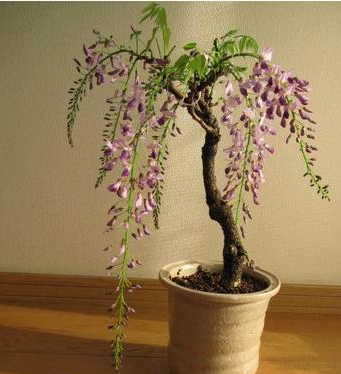
1. Watering: Wisteria has a well-developed root system and a strong main root, and is very drought-tolerant, but it does like moist flower soil. However, there must be no standing water in the pot, otherwise it will cause root rot, so water frequently but in small amounts.
2. Fertilizing: In general, fertilizing 2 to 3 times a year is enough. Before wisteria sprouts, nitrogen fertilizer can be used, and during the growing season, organic fertilizer should be applied about 2 times.
3. Soil: Because wisteria's main root is very long, when growing it in a pot, the soil layer needs to be buried somewhat deep. It is itself tolerant of poor soil, and fertile soil can better promote growth. It also has strong adaptability to the pH of flower soil. In general, for potting, fertile flower soil with good drainage and aeration is sufficient.
4. Pruning: In addition to daily care, pruning is also essential. Pruning is generally done during wisteria's dormant period, and when pruning, the usual approach is to remove the dense and keep the sparse so the branches are evenly distributed. Also, to make wisteria have lush leaves and abundant flowers, it still needs to be pruned according to its habits.
How many years until wisteria blooms:
Generally, wisteria takes 3 to 4 years to bloom, so you still need to be patient.
That is all for the introduction to the cultivation methods for potted wisteria and the time it takes to bloom. Go grow a wisteria right away.
How many years until wisteria flowers bloom, and how long is the flowering period of wisteria flowers / flowering period April to May
Wisteria flowers are a relatively common flowering plant in people's lives, with very high ornamental value, and many people grow them in various regions of our country. But when it comes to when wisteria flowers are most beautiful, it is certainly when they bloom. So how many years until wisteria flowers bloom? And how long is the flowering period of wisteria flowers? Below, the editor will take everyone to learn about this.
I. How many years until wisteria flowers bloom
As for how many years until wisteria flowers bloom, this depends on its propagation method. If propagated by sowing seeds, it generally takes at least 7 years to bloom. If propagated by cuttings, it takes at least 3 years. So when it blooms needs to be considered in light of various factors.
II. How long is the flowering period of wisteria flowers
The flowering season of wisteria flowers is generally in spring. The flowering period of wisteria flowers is generally from mid-April to early May. Its flowering period is considered short among flowering plants. It forms buds in March, the flowers bloom in April, and May to August is its fruiting period.
III. How many times a year do wisteria flowers bloom
As for how many times a year wisteria flowers bloom, in fact they can generally bloom twice, respectively in spring and in late summer to early autumn. The reason wisteria flowers can bloom twice is usually to ensure reproduction, as a supplement to the first flowering. However, not every wisteria flower can bloom twice. If improper care is given during the cultivation of wisteria flowers, it is also possible that they will not bloom.
IV. Why wisteria flowers do not bloom
1. Insufficient light
Wisteria flowers are a light-loving plant. Whether potted or planted in the ground, wisteria flowers need to receive at least 6 hours of light every day. If there is insufficient light, it will be unable to carry out photosynthesis, and thus unable to bloom.
Solution: During the cultivation of wisteria flowers, if it is spring or autumn, when the light is not too intense, we can let it receive light all day. If it is summer, especially at noon when the sunlight is strongest, we had best move it indoors to a semi-shaded place. After those few hours of peak light have passed, we can put it back outdoors.
2. Improper pruning
Generally, beginners at growing flowers do not know how to prune wisteria flowers and only cut off the vines that grow too fast. This is wrong, because those are the reproductive branches. So during pruning, if you do not understand, do not cut. Even if you are going to prune, first cut off the dead branches and withered leaves, then seek help from a professional.
Solution: When pruning wisteria flowers, prune according to its own growth condition. If it grows too fast, we should promptly cut off weak branches and dead branches. If the plant grows too slowly, even if the time is suitable, do not prune, so as not to affect its blooming.
How can potted wisteria be made to bloom year after year?
Wisteria has a well-developed root system. Although it likes sunlight, it is also shade-tolerant. It is cold-tolerant, drought-tolerant, and not particular about soil slopes. For those planted in the open ground, management is simple. However, as a potted plant, wisteria is not easy to care for and manage, so there is a saying that "potted wisteria does not bloom." If the following points can be done well, with careful management, potted wisteria will still have lush branches and leaves and bloom year after year.
1. Promptly cut off spent flowers to prevent pods from growing. Wisteria blooms from the end of April to the beginning of May. After the flowers fade, it forms thick pods up to 20 cm long. A small potted wisteria can form more than 10 pods, which consume a lot of nutrients, making it very difficult to bloom the following year. For this reason, cut off the spent flowers, and the earlier the better.
2. Promptly cut off elongated vines to prevent them from twining around other objects. Potted wisteria must be kept free of anything around it to climb on, and trained into a small shrub form. But in the hot and rainy season, even if there is nothing around to climb on, it will sometimes still extend branch tips and search around in all directions. When this phenomenon is found, the long vines should immediately be cut off to avoid consuming nutrients. If not, once it twines around other objects, it will grow rapidly and vigorously. Experience has proven that any potted wisteria that twines around other objects will not bloom the following year, and sometimes may not bloom for several years.
3. Never let the temperature be too high during overwintering. If potted wisteria overwinters indoors, and the room temperature is on the high side, the wisteria will not get sufficient dormancy, will consume stored nutrients, and this will affect blooming the following year. Wisteria is fairly cold-tolerant and can overwinter outdoors. Even if the temperature drops below 0°C, it will not be damaged by freezing.
4. Control fertilizing. Because potted wisteria has a small pot and little soil, the nutrients contained in the potting soil are far from enough to meet its needs for growth and blooming. If fertilizer is not replenished in time, blooming will be affected. But if fertilizing is not controlled, it easily causes branches to grow excessively, which also affects blooming. Generally, before flowering, apply a little diluted cake fertilizer water, and after flowering, apply a little slow-release phosphate fertilizer to promote flower bud differentiation. In winter and summer, no application is needed