How to Propagate Gardenia by Air Layering with Girdling: Detailed Steps and Method
Gardenia is something many people have seen, and this gardenia is extremely lovable. What is the air layering propagation method for gardenia:
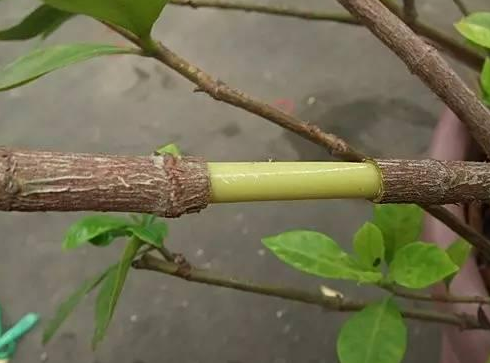
1. Perform ring girdling on the branch.
Choose a sharp knife, disinfect it before use, and the cut part is 1~2 cm below the growth node, with the ring-girdled part about 3 cm.
The girdled part of the gardenia must be scraped clean, and at the same time be careful not to injure the inner stem.
2. Wrap with sphagnum moss.
Here you can see the already wrapped soil ball. Sphagnum moss is quite suitable (water-retaining, loose soil also works). After soaking it completely in clean water, it can be used. Bind it with transparent plastic film so you can clearly see whether roots have formed inside, then tie both sides with string and secure them to prevent water loss.
3. Cut the branch.
After about 30~45 days, you can see that the plastic film is full of roots. At this time, you can cut off this section of stem together with the soil ball, cutting it off 2~3 cm from the bottom of the soil ball.
As shown in the picture above, transplant it together with the soil ball. Gardenia is very easy to keep alive, and the roots grow relatively well. Unlike cuttings, even if they have rooted, the transplant survival rate is still very low.
That is all for the introduction to the air layering propagation method for gardenia. This gardenia air layering method can let you grow a lot of gardenias.
Potted Cultivation Methods and Precautions for Gardenia
The gardenia has a beautiful appearance, is extremely attractive, gives off a fresh fragrance, and has excellent ornamental value. A well-grown gardenia has emerald green leaves and jade-white flowers. Do you know what the cultivation methods and precautions for gardenia are? What are the reasons why gardenia does not bloom? Let us take a look together below!
Propagation Methods for Gardenia
1. Cutting propagation: In May—June, select semi-lignified, well-developed young shoots, cut them into 10—15 cm lengths, soak the base in 1000 mg/kg naphthaleneacetic acid for 3~5 seconds, and insert them into acidic soil with strong water and fertilizer retention. Generally, a mixture of 3 parts leaf mold or mountain soil and 1 part sawdust, peat, or river sand can be used. After insertion, they can root in about 1 month and can be transplanted after 50 days. In southern China, water propagation is often used in summer, carried out from April to July. That is, insert the cut 10—15 cm long cuttings with 2~3 leaves retained at the top into a woven basket lid or a perforated plastic board, float the lid or plastic board on the water surface, and just let the upper part of the cuttings emerge above the water. After insertion, place them in half shade, maintain the water temperature at 16~18°C, and new roots can grow in 20 days. When the temperature is high, change the water frequently, once a day, and do not let the water deteriorate. When the roots grow to 2~3 cm, they can be transplanted.
2. Layering propagation: Mostly carried out in May~June. Select 1~2-year-old robust branches, 25~30 cm long, press them into the soil 3~5 cm, and they can root in about 1 month and be cut from the parent plant after 2 months. Air layering can also be used, that is, on an adult gardenia, select 2—3-year-old robust branches, ring-girdle them 1~2 cm, then wrap them with moist peat, wrap the outside tightly with a plastic bag, keep the soil moist, and new roots can grow in about 40 days and be cut from the parent plant after 2~3 months.
3. Division propagation: In May, if there are 2~3 branches growing together at the base of the root, cut them apart from the root with a knife. Each division should have fine roots. After applying plant ash to the wound, plant them separately.
Cultivation Methods for Gardenia
1. Pot soil selection: Gardenia is an indicator flower that prefers acidic soil, with a suitable pH value of 5 to 6. Therefore, a slightly acidic soil environment is the key to determining whether gardenia grows well. If the soil acidity is unsuitable, future management will yield twice the result with half the effort. The culture soil should be made by mixing 7 parts slightly acidic sandy red soil and 3 parts leaf mold. It is advisable to control the soil pH value between 4.0-6.5. For cultivation soil, you can choose leaf mold, peat soil, or composted sawdust plus half garden soil. Do not use old wall soil or coal cinder. Using commercially available clivia soil is more convenient and practical.
2. Scientific watering: Gardenia prefers moist soil and relatively high air humidity. During the growth period from April to September, keep the pot soil moist. During the growth period, appropriately increase watering. Usually, water when the pot soil turns white, and water thoroughly at one time. In the hot summer, spray the leaf surface 2-3 times a day to increase air humidity and help the plant cool down. However, after the flowers bud, watering should not be excessive to avoid bud drop. In winter, it is better to keep watering on the dry side to prevent root rot from excessive water. Water whenever the surface of the pot soil looks dry, and in the evening you can use a spray bottle to sprinkle water on the leaf surface. If it dries out completely and wilts, it will be unfavorable for growth. For plants that grow too vigorously and have relatively long internodes, do not water at night; water after the sun comes out in the morning. In northern areas with alkaline water, tap water should be left to stand for two days before use. Every three to five days, water thoroughly once with a water solution containing 0.5 g citric acid and 1 g ferrous sulfate per liter, which can make the leaves glossy and emerald green.
3. Reasonable fertilizing: Gardenia's demand for fertilizer: Gardenia is a fertilizer-loving plant. In the culture soil, 3% decomposed cake fertilizer can be added as base fertilizer. During the growing season, apply alum fertilizer water made by composting cake fertilizer with ferrous sulfate once a week, or use 0.1% humic acid complete-nutrient organic liquid fertilizer. During the bud stage, apply 0.1% potassium dihydrogen phosphate aqueous solution once to twice, which can make the flowers larger and the fragrance richer. Stop fertilizing during the hot summer period when the temperature is above 35°C and in autumn when it is below 15°C. After entering the peak growth season in April, topdress once every half month (when fertilizing, it is best to dilute with more water to prevent burning the flowers). This can not only meet the gardenia's fertilizer needs, but also keep the soil environment in a relatively balanced slightly acidic state, prevent the occurrence of chlorosis, and at the same time avoid the harm to gardenia caused by sudden supplementation of ferrous sulfate and local over-acidity.
4. Give more sunlight: Gardenia likes light. It can also grow in half shade for a long time, but the flowering branches will be longer and the flowers fewer. Except for the need for shade during the strong light at noon from July to August and during the winter dormancy period, it generally needs to be kept in the sun to produce abundant flowers and lush leaves.
5. Good winter dormancy: Gardenia can overwinter outdoors in the Qinling area of China, but potted gardenia roots will be damaged after harsh winter, and recovery in spring is slow. Overwintering indoors with heating, although not affected by freezing damage, has insufficient light, causing weak growth, and most young buds formed in autumn fall off, with flowering delayed the next year. A better way is to place the potted flower in a cold room at about 5°C to make it dormant, or wrap the flower pot well with foam plastic and other insulation materials, protect the root system, and place it in a windproof and sunny place for overwintering. Then recovery in spring is fast and flowering is early.
6. Change the pot soil at the right time: Use a small pot for small seedlings, and gradually move them into larger pots. When the crown width is 2 to 3 times the pot diameter, it is time to change the pot. It can be changed at any time during the growing season. After turning the pot out, plant it with the soil ball into a new pot, and it is appropriate for the diameter to be about 5 cm larger than the original pot. For household potted plants, when the pot reaches about 28 cm, generally no more pot changing is done, only the pot soil is replaced. It is better to change the soil in March in spring. After turning the pot out, cut off some old roots, shake off half of the old soil, plant it into the pot with new soil, water thoroughly, place it in a warm and half-shaded place, and keep it in the sun when new buds sprout.
7. Proper pruning: For large-flowered gardenia seedlings, pinch off the tip at 20 cm on the main trunk, leave 3 to 4 branches, and when the branches have 2 pairs of leaves, pinch off the tips again to promote branching, after which they can be allowed to grow freely. Small-leaved gardenia does not need tip pinching. After flowering each year, lightly prune, cutting off inner branches and diseased or weak branches, and shorten individual leggy branches. When the crown of large-flowered gardenia becomes too large after 4 to 5 years, severe pruning can be carried out after flowering. Generally, leave 2 pairs of leaves on the upper branches and shorten them. After budding, remove buds growing inward and buds on the lower part of the main trunk, and the plant shape will become more compact and beautiful. Remember that gardenia branches must not be shortened at the top in spring, otherwise they will not bloom that year.
Precautions for Gardenia Cultivation
1. Gardenia likes fertilizer, but fears concentrated fertilizer. Generally, before bud appearance, topdress twice with cake fertilizer water rich in phosphorus and potassium. After bud appearance, stop fertilizing. If too much fertilizer is applied, it is easy to burn the roots and cause bud drop. During the growing season, apply decomposed cake fertilizer water or manure water once every half month, and add 1%~2% ferrous sulfate to prevent soil alkalization.
2. Gardenia likes half shade and fears direct strong light, requiring about 50% shade. If exposed to the sun, the leaves will turn yellow and white and even fall off, so in summer it must be kept in a shaded place or a place with scattered light. Let it receive light in the morning and evening to avoid yellowing of the leaves.
What Is the Flower Language of Gardenia?
The flower language of gardenia is “eternal love, a lifetime of waiting and joy.” In legend, the flower language of gardenia is waiting love. The flower language of gardenia: joy. If you like this flower, you have a heart of gratitude and repayment, treat others sincerely, and as long as others are slightly kind to you, you repay them with heartfelt thanks. This is because you have a pure heart and do not understand the sinister nature of people's hearts, and your sincerity keeps you often cheerful, while forgiving others also fills you with joy.
In Which Month Does Gardenia Usually Bloom?
When gardenia blooms can be divided by region as follows. In North China, buds usually appear in early May and flowers bloom in early to mid-June. One flower has a flowering period of 8-5 days, and the whole flowering period is about one month.
What Are the Reasons for Yellowing Leaves of Gardenia?
1. Improper moisture
① Overwatering: In this case, the young leaves of gardenia turn dark yellow and lusterless, but the old leaves show no obvious change. At this time, just take the plant out of the pot and place it in a ventilated and cool place, and put it back after the soil dries.
② Lack of water: Leaf tips or edges become withered and dry, and old leaves wither, yellow, and fall from bottom to top, but in this case new leaves grow relatively normally. At this time, water enough and water thoroughly.
2. Improper light
① Too much light: Yellow spots appear on the sun-facing part of the leaves. At this time, you only need to move it to a shaded place for care and it can recover. Newly grown leaves will no longer have yellow spots.
② Insufficient sunlight: At this time, the leaves will turn yellow and even fall off. Just place it under the sun to supplement sunlight.
3. Improper fertilizing
① Too much fertilizer: This mainly shows as brown tips on new leaves, thick and lusterless leaf surfaces, and scorched yellow old leaves that fall off. At this time, fertilizing must be stopped immediately, and in severe cases the soil should also be flushed to reduce the concentration.
② Insufficient fertilizer: Insufficient fertilizer can also cause the plant to turn yellow. For example, with iron deficiency, the leaves appear light yellow or white, while the veins remain green. At this time, spray 0.2%-0.5% ferrous sulfate water for prevention and control; with magnesium deficiency, old leaves turn yellow first, then new leaves turn yellow, while the veins remain green. At this time, spray 0.7%-0.8% boron-magnesium fertilizer for prevention and control.
4. Too low temperature: Too low temperature can also cause leaf yellowing. Just move it to a place with a higher temperature.
What Are the Reasons Why Gardenia Does Not Bloom?
1. Improper water and fertilizer: Once water and fertilizer are excessive, the plant will grow excessively. If reproductive growth lacks sufficient nutrients, it will affect flower bud formation, leading to no flowering or very little flowering. Some may bloom but even drop immediately. During the flower bud differentiation stage, special attention should be paid to the combination of phosphorus and potassium fertilizers, such as 0.2% potassium dihydrogen phosphate solution, which is beneficial to flower bud formation and bud development. If fertilizing is too concentrated during the bud stage, or watering is suddenly more and then less, it will also cause flower and seedling drop.
2. Unsuitable light: Gardenia likes shade, and special attention must be paid to excessively strong light in summer and excessively weak light in winter. Too strong or too weak light will affect gardenia flowering.
3. High soil alkalinity: Gardenia likes acidic soil. If the soil for cultivating gardenia has high salt and alkali content, it will cause plant chlorosis and ultimately affect flowering.
4. No pruning or shaping: Gardenia branches are messy. A large number of miscellaneous branches consume a large amount of nutrients, and branches that are too dense affect photosynthesis. Both are important reasons for failure to bloom.
5. Severe pests and diseases: I believe everyone can understand this. Severe pests and diseases will inevitably cause flowers and buds to drop.
Cultivation Methods for Gardenia: What to Do When the Leaves Turn Yellow
Gardenia, also known as zhizi, originated in China. Gardenia leaves remain green all year round, and the flowers are fragrant and elegant. With green leaves and white flowers, it is especially fresh and lovely. It is suitable for placement in front of steps, by ponds, and along roadsides. Whether planted in the ground or in pots in courtyards, patios, or under tree shade, it grows well. It can also be used as a flower hedge and for potted ornamental display. The flowers can also be used for flower arrangements and worn as decoration. Gardenia likes a warm, humid, and sunny environment, is relatively cold-tolerant, tolerates half shade, fears waterlogging, and requires loose, fertile, and acidic sandy loam.
1. Pot soil selection for gardenia cultivation
For gardenia pot soil, mountain soil can be used, or a mixture of 4 parts leaf mold (peat), 4 parts vegetable garden soil, and 2 parts river sand. It is best for the plant to retain soil when potting. In the early potting stage, keep the pot soil moist, pay attention to shading, do not fertilize for the time being, and let it recover for 10~15 days. Then gradually place it in a sunny place. The time for changing pots is generally April~May.
2. Temperature requirements for gardenia cultivation
The suitable growth temperature for gardenia is 20~28%. From late spring to early autumn, when the weather is hot, pay attention to shading, preventing high temperatures, and preventing direct sunlight, and speed up air circulation, otherwise the leaves are prone to yellowing. Ground-planted gardenia is transplanted in March~April, and the soil ball should be retained when transplanting. From late spring to early autumn, sunlight is abundant, so appropriate water spraying is needed to cool and increase humidity. Potted gardenia can overwinter outdoors in the south. In the Huang-Huai River basin, move it into a greenhouse in mid-October, keep the room temperature at 5~12°C; if it exceeds 15°C, it will affect dormancy and growth the following year. In winter, place it in a place with sufficient sunlight, air circulation, and suitable temperature.
3. Watering methods for gardenia cultivation
In winter, pay attention to controlling watering. It is better to keep it on the dry side. The lower the temperature, the less watering should be done, so as to increase the concentration of body cells, which is beneficial for resisting cold. Low temperature or overly wet pot soil can easily cause leaf drop, or even death.
Water gardenia by the principle of watering when dry and stopping when wet. If the soil is too wet, the roots will suffocate from lack of oxygen and die, and the aboveground parts will show yellow leaves and bud drop. Especially after gardenia buds appear, the amount of watering must be controlled even more. Generally, water once every 2~3 days in spring and autumn, 1~2 times a day in summer, and once every 5~7 days in winter. In addition, in summer, apply alum fertilizer water once every half month, and usually also spray water on the leaf surface frequently to remove dust, which is beneficial to plant growth.
4. Fertilizing methods for gardenia cultivation
Gardenia likes fertilizer. When potted, in addition to applying organic fertilizer as base fertilizer together with repotting, it should also be topdressed frequently during the growth period, preferably with thin fertilizer applied frequently. During the growth period, apply organic liquid fertilizer once about every 10 days, preferably 10%~15% concentration cake fertilizer water. After bud appearance, apply quick-acting phosphorus fertilizer 2~3 times, such as 0.5% superphosphate. Do not fertilize beyond autumn; fertilizing after autumn causes vigorous growth of autumn branches and makes the plant susceptible to freezing damage. During the growth period, in combination with fertilizing and watering, water once with 0.2% ferrous sulfate water about every 15~20 days to prevent leaf yellowing.
5. Shaping and pruning methods for gardenia cultivation
Cutting off the top shoots of gardenia to promote branching is beneficial for more flowering. Gardenia mostly branches in threes, often forming interlaced and overlapping branches, which seriously affects ventilation and light transmission and causes branches to become weak and disordered, so timely pruning is necessary to form a beautiful plant shape. Gardenia is an evergreen shrub with fat leaves and large flowers, and the main branches should be fewer rather than more. First of all, cultivate an upright main trunk, and branches can grow from the main trunk. Flower buds form every April, so when removing some branches on the main trunk in April—May, care should be taken to retain flower buds. After the flowers fade in June, cut them off immediately, which can reduce nutrient consumption and promote new branches. When new branches grow to 2~3 nodes, carry out the first pinching, remove some axillary buds, so as to avoid excessive and crowded branching. In August, pinch the three-forked branches to cultivate the crown. After 2~3 years, a dignified and beautiful potted gardenia can be formed.
6. Precautions for gardenia cultivation
(1) Gardenia likes fertilizer, but fears concentrated fertilizer. Generally, before bud appearance, topdress twice with cake fertilizer water rich in phosphorus and potassium. After bud appearance, stop fertilizing. If too much fertilizer is applied, it is easy to burn the roots and cause bud drop. During the growing season, apply decomposed cake fertilizer water or manure water once every half month, and add 1%~2% ferrous sulfate to prevent soil alkalization.
(2) Gardenia likes half shade and fears direct strong light, requiring about 50% shade. If exposed to the sun, the leaves will turn yellow and white and even fall off, so in summer it must be kept in a shaded place or a place with scattered light. Let it receive light in the morning and evening to avoid yellowing of the leaves.
7. Propagation methods for gardenia
Gardenia is mainly propagated by cuttings, and can also be propagated by layering, division, and sowing.
(1) Cutting propagation
In May—June, select semi-lignified, well-developed young shoots, cut them into 10—15 cm lengths, soak the base in 1000 mg/kg naphthaleneacetic acid for 3~5 seconds, and insert them into acidic soil with strong water and fertilizer retention. Generally, a mixture of 3 parts leaf mold or mountain soil and 1 part sawdust, peat, or river sand can be used. After insertion, they can root in about 1 month and can be transplanted after 50 days.
In southern China, water propagation is often used in summer, carried out from April to July. That is, insert the cut 10—15 cm long cuttings with 2~3 leaves retained at the top into a woven basket lid or a perforated plastic board, float the lid or plastic board on the water surface, and just let the upper part of the cuttings emerge above the water. After insertion, place them in half shade, maintain the water temperature at 16~18°C, and new roots can grow in 20 days. When the temperature is high, change the water frequently, once a day, and do not let the water deteriorate. When the roots grow to 2~3 cm, they can be transplanted.
(2) Layering propagation
Mostly carried out in May~June. Select 1~2-year-old robust branches, 25~30 cm long, press them into the soil 3~5 cm, and they can root in about 1 month and be cut from the parent plant after 2 months. Air layering can also be used, that is, on an adult gardenia, select 2—3-year-old robust branches, ring-girdle them 1~2 cm, then wrap them with moist peat, wrap the outside tightly with a plastic bag, keep the soil moist, and new roots can grow in about 40 days and be cut from the parent plant after 2~3 months.
(3) Division propagation
In May, if there are 2~3 branches growing together at the base of the root, cut them apart from the root with a knife. Each division should have fine roots. After applying plant ash to the wound, plant them separately.
Precautions: Reasons for yellowing leaves of gardenia
First, improper moisture
a. Overwatering: In this case, the young leaves of gardenia turn dark yellow and lusterless, but the old leaves show no obvious change. At this time, just take the plant out of the pot and place it in a ventilated and cool place, and put it back after the soil dries.
b. Lack of water: Leaf tips or edges become withered and dry, and old leaves wither, yellow, and fall from bottom to top, but in this case new leaves grow relatively normally. At this time, water enough and water thoroughly.
Second, improper light
a. Too much light: Yellow spots appear on the sun-facing part of the leaves. At this time, you only need to move it to a shaded place for care and it can recover. Newly grown leaves will no longer have yellow spots.
B. Insufficient sunlight: At this time, the leaves will turn yellow and even fall off. Just place it under the sun to supplement sunlight.
Third, improper fertilizing
a. Too much fertilizer: This mainly shows as brown tips on new leaves, thick and lusterless leaf surfaces, and scorched yellow old leaves that fall off. At this time, fertilizing must be stopped immediately, and in severe cases the soil should also be flushed to reduce the concentration. b. Insufficient fertilizer: Insufficient fertilizer can also cause the plant to turn yellow. For example, with iron deficiency, the leaves appear light yellow or white, while the veins remain green. At this time, spray 0.2%-0.5% ferrous sulfate water for prevention and control; with magnesium deficiency, old leaves turn yellow first, then new leaves turn yellow, while the veins remain green. At this time, spray 0.7%-0.8% boron-magnesium fertilizer for prevention and control.
Fourth, too low temperature. Too low temperature can also cause leaf yellowing. Just move it to a place with a higher temperature.
Precautions: Reasons why gardenia does not bloom
First, improper water and fertilizer. Once water and fertilizer are excessive, the plant will grow excessively. If reproductive growth lacks sufficient nutrients, it will affect flower bud formation, leading to no flowering or very little flowering. Some may bloom but even drop immediately. During the flower bud differentiation stage, special attention should be paid to the combination of phosphorus and potassium fertilizers, such as 0.2% potassium dihydrogen phosphate solution, which is beneficial to flower bud formation and bud development. If fertilizing is too concentrated during the bud stage, or watering is suddenly more and then less, it will also cause flower and seedling drop.
Second, unsuitable light. Gardenia likes shade, and special attention must be paid to excessively strong light in summer and excessively weak light in winter. Too strong or too weak light will affect gardenia flowering.
Third, high soil alkalinity. Gardenia likes acidic soil. If the soil for cultivating gardenia has high salt and alkali content, it will cause plant chlorosis and ultimately affect flowering.
Fourth, no pruning or shaping. Gardenia branches are messy. A large number of miscellaneous branches consume a large amount of nutrients, and branches that are too dense affect photosynthesis. Both are important reasons for failure to bloom.
Fifth, severe pests and diseases. I believe everyone can understand this. Severe pests and diseases will inevitably cause flowers and buds to drop.