Kalanchoe (Florist Kalanchoe) Cutting Propagation: Rooting Tips and Rooting Time
Kalanchoe is something many people absolutely love to grow; it is relatively easy to care for and has a long blooming period. What is the cutting propagation method for kalanchoe? How do you speed up rooting in kalanchoe:
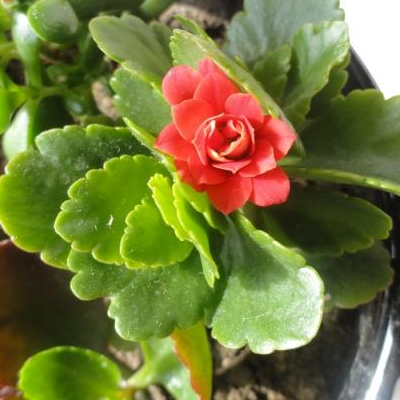
1. Cutting soil: mix leaf mold, garden soil and river sand in a 1:1:2 ratio; if you don't have these, you can actually just buy peat soil and use it directly.
2. Key to successful rooting of cuttings: soil disinfection. Many cuttings root with difficulty, mostly because disinfection was not thorough enough. Besides the branches, the soil must also be treated; you can sun-expose the cutting soil for three days in advance, or water it with carbendazim solution.
3. Branch selection: choose slightly mature fleshy stems and cut them to 5-6 cm long.
4. Tip for speeding up rooting: add 1-2 crushed aspirin tablets to the cutting soil; rooting generally occurs in 15-30 days. You can also dissolve aspirin in water and pour it around the roots.
5. For early blooming, fertilizing must keep up; apply fertilizer once every half month during the growing season. Plant height is controlled by pinching and topping, and after planting out you can also spray once with 0.2% daminozide, then spray once more when the plant grows to about 12 cm.
That is all for the kalanchoe cutting method. Why not hurry up and grow kalanchoe?
How to Grow Kalanchoe: A Detailed Guide to Kalanchoe Cutting Propagation
Kalanchoe is relatively easy to cultivate and has beautiful flowers, making it very suitable for display on floral stands. But I wonder whether everyone knows how to grow kalanchoe, and since kalanchoe sets little seed, cutting propagation is used in production. Below, the editor of wed114 wedding website will specifically introduce the detailed steps and requirements of the kalanchoe cutting method.
How to Grow Kalanchoe
Kalanchoe cutting method one: requirements for different time periods
On the second day after cutting kalanchoe, spray the cuttings once with a mixed solution of 0.1% sucrose and urea. Since kalanchoe is a succulent plant with high water content in its tissues, it should not be watered too frequently in normal times; if the medium is too wet, it easily causes root rot, so usually water once every 2-3 days. On rainy days, be careful to prevent rain exposure. After about half a month it will root, and after 3-4 weeks the callus tissue at the base of the leaf stalk can grow small tiller buds; after the tiller buds emerge, spray once with a mixed solution of 0-2% monopotassium phosphate and sucrose.
How to Grow Kalanchoe
After that, spray 0.5% foliar nutrient solution for flowers once every 10 days; after one and a half months, it can be potted up and transplanted. The potting soil is best as a well-drained, loose and fertile sandy loam; after potting, water once every 2-3 days. In winter, if the temperature is below 5°C, move it indoors to overwinter.
How to Grow Kalanchoe
Kalanchoe cutting method two: choice of season
Leaf cuttings of kalanchoe can be done throughout the year, but summer and autumn are best. Before cutting, prepare the cutting bed first; the cutting medium is fine river sand or well-drained sandy loam.
How to Grow Kalanchoe
When cutting, first cut a certain length of branch from the mother plant, use a blade to cut the leaf off along the base of the stalk, rinse the cut with fresh tap water, then place it in a ventilated and shady spot; after the sap at the wound has dried, insert it diagonally into the medium to a depth of 2-3 cm. After inserting, press the medium firm, then water, and spray the cuttings and the surrounding area once with 50% wettable powder.
How to Grow Kalanchoe: How to Prune Kalanchoe
Many people choose kalanchoe as an ornamental plant for the home when selecting houseplants. This is because kalanchoe is named for its long blooming period, and is also called "longevity flower"; its symbolism is very popular. Below, we introduce how to grow kalanchoe and how to prune kalanchoe.
How to Grow Kalanchoe
1. Suitable growing temperature
Generally, the suitable growing temperature for kalanchoe is 15°C to 25°C. If the temperature is too high or too low, kalanchoe will enter a dormant state, affecting its growth needs. Therefore, during cultivation, take care to avoid exposure to strong sun in summer, and in winter when the temperature is too low, kalanchoe can be moved indoors for growing;
2. Suitable light duration
Kalanchoe generally likes to grow in a sunny environment, but apart from taking care to prevent sunscorch in summer, in ordinary seasons it can be placed in a sunny spot. If kalanchoe is kept in a shady environment for a long time, this is unfavorable to its growth needs and also easily leads to leaf drop and no flowers;
3. Sufficient water for growth
As for the growth habits of kalanchoe, it belongs to the drought-tolerant type of flowers, so kalanchoe does not need a lot of watering; generally keeping to watering about once every 3-4 days is enough. At the same time, mainly keep the potting soil moist, and also take care in humid seasons to mainly control watering to prevent root rot caused by too much water in kalanchoe;
4. Moderate fertilizing
During the growth period, kalanchoe also needs sufficient nutrients, so in the peak growing season, take care to apply a compound liquid fertilizer to kalanchoe about once every two weeks, which helps promote its growth needs and helps kalanchoe bloom more abundantly;
5. Preventing and controlling pests and diseases
As the environment becomes milder, kalanchoe also easily suffers from pest and disease infection. Take care to keep the indoors ventilated to prevent pests and diseases from entering the room, and also mainly use some insecticides to prevent pest and disease infection. The main diseases seen are downy mildew and anthracnose.
How to Prune Kalanchoe
The purpose of topping and pinching kalanchoe is to promote branching, increase the amount of blooming, and control plant height; it is a common means in kalanchoe shape management. The most commonly used pruning and shaping methods for kalanchoe are pinching (nipping), topping, and thinning out branches. But pinching, topping and thinning out branches are common auxiliary means to control the height and shape of kalanchoe. Pinching and topping both remove the young buds at the top after the cuttings have rooted, limiting upward growth and promoting more side buds. This makes the plant shape shorter, sturdier and fuller, compact and ball-shaped, or forming a flower-ball-shaped plant. The difference between the two methods is the different height of the top young buds removed and the different timing.
1. Pinching
Generally earlier, used when no backup seedlings are needed. Usually about one month after the cuttings have rooted, when the plant has grown to 4-6 cm tall with 4 or 5 pairs of leaves, the first pinching can be done. From varieties that have been grown, varieties with long "internodes" often produce few side buds after pinching, and the new top buds still grow upward; when the "internode" length can reach more than 4 cm, pinching 2-3 times still may not necessarily achieve the goal of limiting height, and after blooming the plant height can reach 40-50 cm. For such varieties, pinching can also be done a bit earlier.
2. Topping
Topping is the method used when backup seedlings are needed; it is slightly later than pinching, waiting until the plant is 10 cm tall. Leave 3-5 pairs of leaves and a 5 cm tall stem, and remove the top bud to serve as a new cutting for re-propagation; at this time the new cutting is robust, roots quickly, and grows well.
3. Thinning out branches
Thinning out branches is removing overly dense, thin and weak side branches or diseased branches from the base of the main stem. This increases light penetration and ventilation inside the plant, promotes the development of inner branches, and reduces the occurrence of pests and diseases. It makes the side branches moderately dense, with sufficient nutrition, uniform and sturdy, with many buds and flowers.
Some kalanchoe varieties have particularly strong branching ability and small branching angles; they do not need pinching or topping, or after one pinching will produce many side buds. For such varieties, the method of thinning out branches is needed to shape them, using the "remove the weak, keep the strong" method to remove excess branches, leaving 3-5 sturdy main stem branches evenly distributed. After blooming, a compact and elegant plant shape about 30 cm tall can be formed. Otherwise, with too many side branches, nutrition is dispersed when budding, resulting in many bundles but few buds, and small flowers that are not full.
Through the introduction of how to grow kalanchoe and how to prune kalanchoe, is everyone clear now? For more home knowledge, please stay tuned.