Hibiscus Flower Cutting Propagation Methods, Fertilization Tips and Flower Meaning
Hibiscus is a beautiful flower that many people absolutely love to grow. What are the cutting propagation methods for hibiscus? How do you fertilize hibiscus? What is the flower meaning of hibiscus?
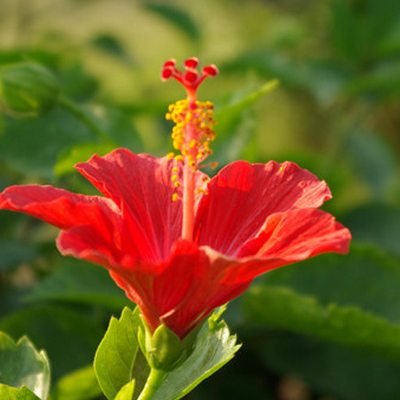
Cutting propagation methods for hibiscus:
1. Timing
Hibiscus can be propagated by cuttings all year round, and the best times for cuttings are spring and autumn. When taking cuttings in winter, the temperature is too low and the cuttings root rather slowly, so heat preservation measures are needed.
2. Cutting selection
For cuttings you can use terminal buds or young shoots; they root relatively quickly and become mature plants relatively slowly, but the growth rate is uniform. If you choose semi-lignified or fully lignified branches as cuttings, they root slowly, but after rooting and sprouting they become mature plants quickly, and the growth rate is not uniform.
3. Propagation method
Prepare the pot and soil for the cuttings, water the soil thoroughly, place the prepared cuttings into the soil, pay attention to drainage and air permeability, and put them in a spot with filtered light and good ventilation. Generally after two to three weeks the cuttings sprout; after rooting you can repot them to encourage the root ball to grow, and once established they can be transplanted into the garden.
How to fertilize hibiscus:
1. Fertilization method when repotting and pruning
For potted plants, the soil should preferably be loose, fertile sandy loam, and repotting should be done every year in early spring in April before moving them outdoors. In the fertilization method for hibiscus, three things should be done when repotting: first, replace with new potting soil; second, cut away some of the overly dense, curled fibrous roots; third, apply sufficient base fertilizer, adding a little phosphate fertilizer at the bottom of the pot. To keep the tree shape beautiful and the flower count high, according to the strong branching and suckering ability of hibiscus, pruning and shaping can be done in early spring before and after moving it out; for each branch, leave 2-3 buds at the base and cut off everything above, as pruning can promote new branches, making the growth more vigorous and the plant shape more attractive. After pruning, because the above-ground part consumes less, water and fertilizer should be appropriately restrained.
2. Fertilization after moving outdoors
Hibiscus is a sun-loving species, and in early May it should be moved outdoors to a spot with ample sunlight; this is also the growing season for hibiscus, so management such as fertilizing and watering, loosening the soil and weeding should be strengthened. Apply a dilute liquid fertilizer once every 7-10 days, and water according to whether the potting soil is dry or wet, as too dry or too wet will both affect flowering. Management after autumn should be careful, and attention should be paid to applying less fertilizer later on so as to avoid producing autumn shoots. Autumn shoots are tender in tissue and weak in cold resistance, and will suffer frost damage on cold days.
3. Fertilization after moving indoors
Hibiscus is not tolerant of frost, so after Frost's Descent and before the Start of Winter it must be moved indoors for warmth. The overwintering temperature should be no lower than 5°C to avoid frost damage, and no higher than 15°C to avoid affecting dormancy. Poor dormancy will make the next year's growth and flowering weak. Any furniture room facing south with good heat preservation conditions can be used for overwintering, and when the weather is colder you can cover it with paper or plastic film for warmth. When first moved indoors, open the windows for ventilation every day during the daytime, watch for changes in the dryness and wetness of the potting soil, and water appropriately. On the coldest days, watering helps prevent frost damage, but fertilization should be stopped.
Hibiscus flower meaning:
Fresh love, subtle beauty
Symbolizes refinement, purity and shyness
That is all for the propagation methods and fertilization methods. The flower meaning of this hibiscus is quite nice, and it can be given as a gift.
Hibiscus Flower Meaning, Cultivation Methods and Technical Growing
Some friends love hibiscus very much but really do not know how to grow it, and are also very unfamiliar with technical cultivation. Below is a related explanation of the cultivation methods and technical growing of hibiscus.
Hibiscus flower meaning
Flower meaning: fresh love, subtle beauty.
Hibiscus cultivation method: repotting
Every year in April, before moving it outdoors, it should be repotted. The soil should preferably be loose, fertile sandy soil. When repotting, also replace with new potting soil, cut away some of the overly dense, curled fibrous roots, apply sufficient base fertilizer, and add a little phosphate fertilizer at the bottom of the pot.
Pruning
After moving it outdoors, carry out pruning; for each branch, leave 2-3 buds at the base and cut off everything above, as pruning can promote new branches, making the growth more vigorous and the plant shape more attractive. After pruning, water and fertilizer should be appropriately restrained.
Temperature
After Frost's Descent and before the Start of Winter it must be moved indoors, because hibiscus is not tolerant of frost. The overwintering temperature should be no lower than 5°C to avoid frost damage, and no higher than 15°C to avoid affecting dormancy. When the weather is colder you can cover it with paper or plastic film for warmth. When first moved indoors, open the windows for ventilation every day during the daytime, watch for changes in the dryness and wetness of the potting soil, and water appropriately. On the coldest days, watering helps prevent frost damage, but fertilization should be stopped.
Management
Management is also very important. When it is moved outdoors to a spot with ample sunlight in early May, management such as fertilizing and watering, loosening the soil and weeding should be strengthened. Apply a dilute liquid fertilizer once every 7-10 days, and when watering pay attention to whether the potting soil is dry or wet, as too dry or too wet will both affect flowering. Management after autumn should be careful, and attention should be paid to applying less fertilizer later on so as to avoid producing autumn shoots. Autumn shoots are tender in tissue and weak in cold resistance, and will suffer frost damage on cold days.
Watering
During the winter, just keep the pot slightly moist; generally water once every 5 to 10 days, and the amount of water should not be too much, so as to avoid root rot caused by a low-temperature, high-humidity soil environment. In the dry winter climate of the north, phenomena such as pale yellow leaves and dry leaf edges may appear, so attention should be paid to raising the indoor air humidity. Methods such as spraying and washing the branches and leaves or covering with plastic film can be used to increase the air humidity around the plant and create suitable humidity conditions for its growth.
Pest and disease control
After moving indoors in winter, if indoor ventilation is poor and light is insufficient, it is prone to aphid and scale insect damage; attention should be paid to improving the ventilation and light conditions of the indoor environment and combining this with chemical control. When there are only a few scale insects, they can be gently brushed off with a soft brush.
Hibiscus cultivation techniques: site selection and land preparation
Choose a sunny site with a warm, humid climate and fertile, loose, well-drained, slightly acidic soil.
Propagation method
In production, cutting propagation is mostly used, generally including greenhouse cuttings and outdoor cuttings. Choose the corresponding method according to the different situation. For outdoor cultivation, take cuttings in early spring in May-June; select one-year-old, semi-lignified, thick branches as cuttings, with a cutting length of 8-10cm; remove all the lower leaves, cut off half of the upper leaves, insert one third into coarse sand, then water thoroughly, with a plant and row spacing of 4cmx4cm. Maintain air temperature and cover with plastic film on top. After 20 days most have rooted, and after growing for more than a month they can be potted. Indoor cuttings are generally taken in early spring in January-February together with pruning, using sand as the substrate, for better results. In cold places, use heating and keep the temperature at 20-25°C, fill a pot with sand, insert into the pot, spray water 1-3 times a day, and they will root in just over 40 days and be potted in 60 days, with a survival rate of 60%.
Transplanting the cuttings
After rooting, pot them up. Prepare the potting soil with 4 parts sandy loam and 1 part manure soil, mix evenly, and cover the drainage hole at the bottom of the pot with a tile to prevent the potting soil from being lost when watering. Put base fertilizer in the bottom layer, then add the mixed soil and plant the seedlings, water thoroughly, with a watering frequency of once a day, and after shading and acclimatizing the seedlings well, place them in a spot with ample sunlight; after 2-3 years of cultivation, repot them, with the repotting time being in late spring and early summer when they are moved out.
Field management
For both outdoor and indoor cultivation, shading should be provided in the initial period after cutting, and the relative humidity should be kept between 85%-95%, with the temperature controlled at 18-25°C, ensuring a certain amount of light, and topdressing once every half month; at the end of October move them into the greenhouse, control the room temperature at 15-22°C, begin to pay attention to ventilation, and apply less fertilizer or apply it as a side dressing. During management, the temperature requirements are very strict, as it involves the length and amount of the flowering period; in summer there are many flowers and the flowering time is long, while at low temperatures there are fewer flowers and the flowering period is short.
Summary: Friends who like growing hibiscus, hurry and buy hibiscus, you can plant it yourself. In warm places, hibiscus can be planted as a flowering hedge, and it is a very good decorative fabric. The above information is for reference only.
More information
|Cuban oregano|Marigold cultivation|Care methods for the happy tree|Flower pictures and names|Effects of golden pothos|How to grow gardenia|
|Cactus cultivation methods|Potted flower pictures|Orange jasmine bonsai|Crab claw cactus cultivation methods|Serissa bonsai|Bowl lotus|
|Office feng shui plants|Alocasia cultivation methods|Camellia cultivation methods|Hyacinth flower meaning|Rose pictures|
|Money tree pictures|Plum blossom poems|Potted fruit trees|How to grow carnations|Is the rubber tree toxic|Cymbidium 'Jiuzi Dahua'|