Can Acorus gramineus bonsai be kept at home? A price reference for one pot
Acorus gramineus has a scent, and this scent has an invigorating effect. Can Acorus gramineus bonsai be kept at home? How much does one pot of Acorus gramineus bonsai cost:
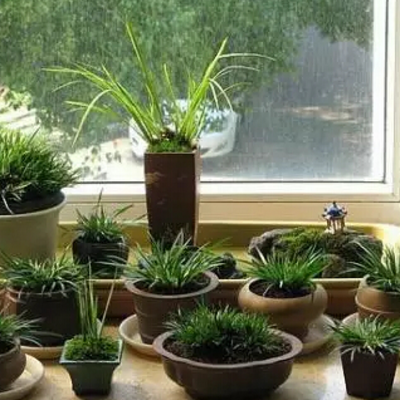
Can Acorus gramineus bonsai be kept at home:
For most people, variegated Acorus gramineus may seem like a very unusual name that they have never heard of, and they may think it is some rare and exotic plant. But in fact, variegated Acorus gramineus can often be seen in our daily lives. It is a plant with upright, narrow, elongated leaves that carry golden-yellow coloring, alternating yellow and green. It is generally suitable for household pot cultivation or water cultivation.
Variegated Acorus gramineus is said to be a mutated variety of Acorus gramineus. According to plant encyclopedias, it is an evergreen perennial herbaceous plant, and its rhizome is very unusual, creeping horizontally underground. The leaves of variegated Acorus gramineus are narrow and elongated, with golden-yellow longitudinal stripes embedded in the green leaves, crisscrossing yellow and green.
As a feng shui plant for protecting the home and warding off evil, variegated Acorus gramineus can be propagated by division in daily cultivation. It can be grown as an indoor potted ornamental, placed on various balconies or indoors near windows. When work is busy, it allows the mind and eyes to relax a little.
How much does one pot of Acorus gramineus bonsai cost:
Why is Acorus gramineus 'Huangjinji' expensive, and why is Acorus gramineus 'Jinqian' expensive? Different varieties naturally differ greatly, and in terms of external appearance, only those with deep green color, sealed tips, round shape and even symmetry are top grade. In addition, with the same appearance, the more buds and seedlings, the more expensive. If the Acorus gramineus is not yet many years old, then the price is not high. Imported varieties such as Huangjinji generally cost over 100 or over 1,000 yuan. Old seedlings of many years naturally cost over 10,000 yuan.
The reason Acorus gramineus is expensive can be said to be that it is itself a kind of "botanical curio." The reason people like to grow it is that Acorus gramineus looks delicate and elegant, and when combined with strange stones, moss, wooden stands and so on to make a bonsai, it gives people a fresh and refined feeling. Nowadays more and more people grow Acorus gramineus bonsai, many of them enthusiasts of calligraphy and painting, tea art, flower arrangement and antiques, who buy it to place on their desks for calm and health cultivation, and some young people born in the 1980s also come to buy it. They value Acorus gramineus for being small and exquisite, deep green, and easy to shape, and grow it like a small grass. The most expensive Acorus gramineus has actually reached a price of over 10,000 yuan before it can be bought!
Acorus gramineus can be placed indoors, but note that this Acorus gramineus is toxic and cannot be eaten. Now that the price of this Acorus gramineus has been introduced, why not hurry and grow one.
How to grow Iris pseudacorus, Iris pseudacorus pictures and prices
✤
The scientific name of Iris pseudacorus is Iris pseudacorus L. It is a perennial wetland or emergent rhizomatous herbaceous flower. This plant is tall with short, thick rhizomes. The leaves of Iris pseudacorus are relatively dense and green in color, shaped like long swords, about 60-100 cm in length. The midrib of this flower is relatively obvious and has transverse reticulate veins. The flower stem is slightly taller than the leaves. The upper part of the falls is oblong-elliptical and nearly equal in width at the base, with brown markings on it, and the standards are pale yellow.
Iris pseudacorus is a type of aquatic flower plant and is also outstanding among aquatic flowers. This plant has brightly colored flowers and elegant, beautiful flower forms, with relatively high ornamental value, and it also has a relatively wide range of suitable planting areas. It can be cultivated in open ground beside ponds, can also be cultivated in water, and can also be cultivated and used for decoration in places with water in home courtyards. The flower diameter of this plant is about 8 cm, and it generally blooms from May to June each year.
✤Propagation methods of Iris pseudacorus
1. Seed propagation among the propagation methods of Iris pseudacorus. Seed propagation is generally carried out in June-July after the plant seeds mature; they can be collected and then sown, and the seedling rate is also relatively high. Seeds that have been dried and stored need to be soaked in warm water for about half a day before sowing. For cultivation, it is better to use nutrient soil as the bed soil. The suitable temperature for germination is about 18-24°C. After sowing, they germinate in about 20-30 days, and seedlings of Iris pseudacorus generally bloom in 2-3 years.
2. Division propagation among the propagation methods of Iris pseudacorus. Division propagation is generally better carried out in spring and autumn. The specific steps are as follows: first, we need to dig out the rhizomes and cut off the aged rhizomes and fibrous roots, then use a sharp knife to cut them into several sections according to a length of 4-5 cm. It is best for each section to have about 2 terminal buds. Of course, the root sections can also be temporarily cultivated in warm sand, and then transplanted after sprouting and rooting.
✤Management and care of Iris pseudacorus
1. Iris pseudacorus can be grown as a potted plant for ornamental purposes, but for potted ornamental use, the potting soil is best made of nutrient soil and garden soil. It is easier to survive after division, because this is a hydroponic plant and flower, so during cultivation the potting soil also needs to remain moist or have 2-3 cm of shallow water. It can be planted at the waterside and pondside. After planting, remember to press the covering soil firmly to prevent it from being washed away by water waves or bitten by fish, which would affect rooting.
2. The cultivation site for Iris pseudacorus needs ventilation and light transmission so that the plant can grow better. During the high-temperature period in summer, water needs to be sprayed on the leaf surface to reduce water loss, while during the growth period it should be fertilized 2-3 times, mainly with decomposed cake fertilizer or flower compound fertilizer. In winter, dead leaves need to be cleaned up in time. Potted plants and field-planted seedlings divided and replanted once every two years can better play a role in propagation and renewal. This plant has few pests and diseases, and in high-temperature summers triadimefon wettable powder can be sprayed.
✤Price introduction of Iris pseudacorus
The price of Iris pseudacorus flower seedlings is relatively cheap. The purchase quantity and whether you buy potted plants, seeds or flower seedlings will also affect the price of this flower. The price of Iris pseudacorus in Jiangsu is 1 yuan/plant, the seed price of this flower in Beijing is 0.6 yuan, with a quantity of about 30 seeds, while the price of yellow iris flower seedlings is generally 1.5-3 yuan/plant, and the potted price of this plant is about 40-50 yuan. Friends can purchase according to their own needs.
Conclusion:Iris pseudacorus has strong adaptability and is one of the flowers used in relatively large quantities in wetland waterscapes in various places. Whether arranged by lakesides, pond edges or cultivated as bonsai, the waterscape scenery it displays is very poetic and picturesque. Moreover, using a few Iris pseudacorus flowers to decorate the living room, bedroom or study in home decoration will also make people feel relaxed and happy. At the same time, Iris pseudacorus is also a good medicine. The above is the editor's introduction on how to grow Iris pseudacorus, along with picture appreciation and price introduction, and I hope it can be helpful to everyone.
Propagation methods of Iris pseudacorus, Iris pseudacorus flower language
Iris pseudacorus belongs to the Iridaceae family, Iris genus. Also called water iris. It is a perennial wetland or emergent rhizomatous herbaceous plant, with a tall plant and short, thick rhizomes. The flowering period is May-June. Iris pseudacorus is the pride of aquatic flowers, with bright yellow flowers and beautiful flower forms, like golden butterflies dancing among the flowers, with extremely high ornamental value. It has a wide range of adaptability and can be cultivated in open ground beside ponds, and can also be cultivated as an emergent plant in water, with very good results.
Iris pseudacorus is a type of aquatic flower plant and is also outstanding among aquatic flowers. This plant has brightly colored flowers and elegant, beautiful flower forms, with relatively high ornamental value, and it also has a relatively wide range of suitable planting areas. It can be cultivated in open ground beside ponds, can also be cultivated in water, and can also be cultivated and used for decoration in places with water in home courtyards. The flower diameter of this plant is about 8 cm, and it generally blooms from May to June each year.
Propagation methods of Iris pseudacorus1. Seed propagation among the propagation methods of Iris pseudacorus. Seed propagation is generally carried out in June-July after the plant seeds mature; they can be collected and then sown, and the seedling rate is also relatively high. Seeds that have been dried and stored need to be soaked in warm water for about half a day before sowing. For cultivation, it is better to use nutrient soil as the bed soil. The suitable temperature for germination is about 18-24°C. After sowing, they germinate in about 20-30 days, and seedlings of Iris pseudacorus generally bloom in 2-3 years.
2. Division propagation among the propagation methods of Iris pseudacorus. Division propagation is generally better carried out in spring and autumn. The specific steps are as follows: first, we need to dig out the rhizomes and cut off the aged rhizomes and fibrous roots, then use a sharp knife to cut them into several sections according to a length of 4-5 cm. It is best for each section to have about 2 terminal buds. Of course, the root sections can also be temporarily cultivated in warm sand, and then transplanted after sprouting and rooting.
Management and care of Iris pseudacorus1. Iris pseudacorus can be grown as a potted plant for ornamental purposes, but for potted ornamental use, the potting soil is best made of nutrient soil and garden soil. It is easier to survive after division, because this is a hydroponic plant and flower, so during cultivation the potting soil also needs to remain moist or have 2-3 cm of shallow water. It can be planted at the waterside and pondside. After planting, remember to press the covering soil firmly to prevent it from being washed away by water waves or bitten by fish, which would affect rooting.
2. The cultivation site for Iris pseudacorus needs ventilation and light transmission so that the plant can grow better. During the high-temperature period in summer, water needs to be sprayed on the leaf surface to reduce water loss, while during the growth period it should be fertilized 2-3 times, mainly with decomposed cake fertilizer or flower compound fertilizer. In winter, dead leaves need to be cleaned up in time. Potted plants and field-planted seedlings divided and replanted once every two years can better play a role in propagation and renewal. This plant has few pests and diseases, and in high-temperature summers triadimefon wettable powder can be sprayed.
Conclusion on Iris pseudacorusIris pseudacorus has strong adaptability and is one of the flowers used in relatively large quantities in wetland waterscapes in various places. Whether arranged by lakesides, pond edges or cultivated as bonsai, the waterscape scenery it displays is very poetic and picturesque.