How do you grow petunias so they bloom profusely and fill the pot, and will they bloom again the second year?
Petunias, these are something many people absolutely love, and when petunias bloom they really are so beautiful, just like trumpets. How do you grow petunias so they bloom profusely? Will petunias bloom again the second year:
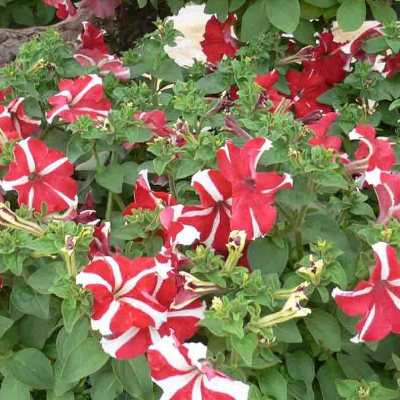
How to grow petunias so they bloom profusely:
Secret one: Sow in autumn
Sowing in early autumn or buying seedlings in mid-autumn is the most important factor. Generally you can choose to sow at the end of August, using seedling plugs and a three-piece seedling kit. Autumn sowing takes about 7-10 days to germinate, and before germination there is no need to put them in the sun; after germination they should be gradually exposed to sunlight, and once the seedling roots have filled the seedling plug (about 20 days), the first potting-on can be done. (I usually skip the sowing step, because sowing takes a fair amount of time, and when time and energy do not allow, I choose to buy plug seedlings directly in September-October.) If you sow in spring, once the temperature rises the plants will bloom quickly before they have filled out, which makes it relatively hard to achieve the pot-filling effect.
Secret two: Strong sunlight.
For the first potting-on, or for purchased 128-cell plug seedlings, generally a small pot of about 12 cm is used. After potting on, ensure sufficient sunlight, water alternately wet and dry, and once the branches have filled the potting-on pot you can plant them in their final position. For final planting choose a flower pot at least 25 cm in diameter with 1 plant per pot, or plant 2 in a 40 cm long trough planter, to ensure growing space. Petunias need plenty of sunlight throughout their entire life cycle; a lack of sunlight makes the plants grow leggy and produce few flowers. In Jiangsu, Zhejiang and Shanghai, as long as there is no rain, snow or freezing, petunias can overwinter outdoors; if you have a sunroom, try not to let the temperature get too high, otherwise they will bloom early before the branches have grown lush.
Secret three: Pinching
The second factor in getting petunias to fill the pot is pinching; removing apical dominance promotes the sprouting of side branches, and the more side branches there are, the more mainstays of blooming there will be. The first pinching is generally done when the seedling has 6 true leaves, and after that, every time a side branch grows to 6 leaves, pinch once, pinching off 2 leaves and leaving 4 leaves, abbreviated as “pinch 2, keep 4”. In early March, carry out the final shaping of the plant form, and a pot of compact, trailing petunias is beginning to take shape.
Secret four: High-phosphorus fertilizer
Petunias are flowers that really need fertilizer. After potting on until the end of February, water with a growth-type liquid fertilizer once every 7-10 days; at final planting, add long-acting fertilizer such as chicken manure fertilizer or slow-release fertilizer; from early March all the way through the flowering period, water with a flowering-type liquid fertilizer 1-2 times a week.
Secret five: Hard pruning
Petunias are flowers that grow very fast, and of course fast growth means they also decline fast, and the only way to keep them blooming madly on and on is hard pruning. The vigorous growth period for petunias is June, July, August and September, and they will roughly need a hard prune every three weeks; about 10 days after a hard prune they will be covered in flowers again. Before the cold snap arrives on October 20, they will have had 3-4 hard prunes, mainly in July, August and September. If petunias are continuously hard pruned and well managed, they can be treated as biennial herbaceous plants.
Do petunias bloom the second year:
Petunias will bloom in the second year, and even the third year; it is just that the later it gets, the harder pruning becomes.
That is all for the introduction to how to grow petunias; have you learned something new now?
What months are petunias in bloom, do petunias still bloom the second year / they can bloom every year
Petunias are one of the plants best suited to flower appreciation. Besides the lovely meaning of petunia flowers, this is inseparable from their super-long flowering period; with good care their flower-viewing time can last more than 6 months, which ranks among the top in the plant world. So what months are petunias in bloom? How many years can petunias live? Do petunias still bloom the second year? Let me tell you the answers.
What months are petunias in bloom
The petunia flowering period is usually from April to mid-October. It can bloom in spring when the temperature is above 20-odd degrees, continuing until the first frost. The flower shape is funnel-shaped, and the flower colours include white, purple, red and so on. Whether used as decoration or for viewing, it has very great value.
How many years can petunias live
Petunias belong to the genus Petunia, and they are themselves a perennial herbaceous plant, so under normal circumstances they can be grown indefinitely, and combined with the correct petunia growing methods they can be kept filling the pot again and again. However, in many places petunias are often cultivated as a 1-2 year plant, depending on what the flower grower wants.
Do petunias still bloom the second year
Since petunias can survive for many years, do petunias still bloom the second year? The answer is that they can bloom, and as long as the care and management techniques are correct, they can rebloom every year, and the flowers will still be bright and beautiful. Below let us learn about the management techniques for getting them to rebloom.
Care of petunias after flowering
1. How do you prune petunias after flowering?
First remove the flower stems and withered flowers, then also cut off some old and yellowed leaves, to avoid them consuming extra nutrients on the plant; moreover, after the flowering period winter is about to arrive, and cutting them off helps ensure petunias overwinter smoothly.
2. Apply additional phosphorus and potassium fertilizer
After the flowering period ends, you need to apply some phosphorus and potassium fertilizer; dissolve it in water and then water it into the soil, which can replenish the nutrients consumed by flowering, and at the same time increase its cold resistance, so that it can still keep its leaves green in winter and lay a good foundation for blooming the second year.
3. Increase light
After flowering you need to increase the light in the petunia's environment; it is best to place it somewhere with sunlight, but you need to pay attention to keeping it warm, so the ideal positions are a south-facing balcony, window and so on.
4. Control watering
Try to choose morning for watering, and do not often water in the evening, because in the evening the light is weaker and the petunia's photosynthesis is relatively faint; the water needed at this time is less, and watering in the evening easily makes the soil too wet, giving a much worse effect than in the morning.
How do you save seeds from petunias after flowering, methods for saving petunia seeds after flowering
Petunia flowers are beautiful, rich and colourful, and bloom abundantly, making people marvel at the power of nature, so petunias are much loved. So how do you save seeds from petunias after flowering? Below we introduce the methods for saving petunia seeds after flowering.
How do you save seeds from petunias after flowering, methods for saving petunia seeds after flowering
A well-grown petunia can produce several dozen flowers in succession within a year. In the hot, rainy summer season it easily lodges, so when the plant reaches a certain height, a small bamboo cane needs to be set up as a support and tied well with plastic strips. Good varieties must have their seeds saved well; wait until they mature in autumn, then collect the seeds, label them by category and store them. If variations appear, they should be kept with even greater care. For hybridising petunias, after selecting the female parent and male parent, cut off the upper end of the flower bud at dusk on the day before flowering, then remove the stamens and wrap it in a wax paper bag.
The next morning take off the wax paper bag, use the stamens of the male parent for hand pollination, then wrap it in the wax paper bag again; after one or two weeks the wax paper bag can be removed, but the pollinated seed pod must be well marked and well recorded. The following year all the hybridised seeds should be planted well, and after flowering you can see the results, from which the role of various genetic factors can be studied. Experienced petunia enthusiasts can tell good from poor by the shape of the cotyledons, so as to remove inferior seedlings early. They can also estimate the flower colour from the colour of the young stem, for example white-green for white flowers, deep purple.