Tulip Hydroponic Growing Methods and Introduction to Flowering Period Length
Tulips are extremely beautiful flowers that many people love. Can tulips be grown hydroponically? How long is the tulip flowering period:
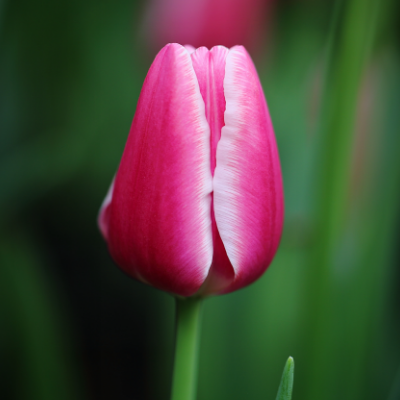
Can tulips be grown hydroponically:
Yes, they can be grown hydroponically.
1. Hydroponic management during the germination stage:
Fill the pot containing the bulbs with clean water so that the roots of the bulbs are immersed in the water. Place the pot indoors in a spot with ample sunlight exposure, keep the room temperature at 13°C, and do not let the temperature fluctuate too much. In 4-7 days, both roots and shoots will grow out, thus entering the vegetative growth stage.
2. Hydroponic management during the vegetative growth stage:
During this period, as the growth amount and growth speed of roots, stems, and leaves increase, a large amount of water is needed. Keep the water level in the pot sufficient, check for water loss every 2 to 3 days, and replenish water in time so that the roots remain immersed in water. Change half of the water or nutrient solution every 3 to 4 days. If all the water is replaced at once, the roots tend to grow thin, long, and weak. Control the growth temperature at 15°C-18°C. The temperature must not be too high, otherwise the plant will become leggy, with thin and long stems, affecting its beauty. Because plants have phototropism, frequently rotate the direction of the pot so that the stems can grow upright without leaning. After 15-20 days of growth, when the number of leaves reaches 3-4, an oval flower bud will appear at the tip of the stem. From then on, it enters the flowering stage.
3. Hydroponic management during the flowering stage:
After the bud appears, the temperature can still be controlled at 15°C-18°C. In 5-7 days, the flower bud gradually opens, and the flower shows a brilliant color. After the flower opens, the pot can be moved to a cool, shaded place indoors, which can prolong the flowering period. Generally, an open flower can last 15-20 days.
How long is the tulip flowering period:
From blooming to fading, the approximate time for a tulip is about 1 week.
Tulips can be grown hydroponically, but note that the tulip flowering period is extremely short, so if you want to see it, pay attention to the timing of the bloom.
How Long Is the Tulip Flowering Period and What Are the Tulip Planting Methods
We all know that the tulip is the national flower of the Netherlands. Its flower colors are vivid and its varieties are many, so many people like to go and admire tulips. Therefore, before admiring them, you must clearly understand when the tulip flowering period is. In addition, what are the tulip planting methods? Let's learn about them together!
How long is the tulip flowering period
1. How long is the tulip flowering period? Usually, the tulip flowering period is during March-April each year, which is also the spring when hundreds of flowers bloom. However, sometimes this is not necessarily the case. Tulip flowering is affected by temperature. Although the tulip is a plant that blooms in early spring, when the temperature is too low or too high, the tulip flowering period will also be delayed, and the flowering season is not long. It lasts about ten days at most, and then the flowers will gradually fade.
2. Tulip flowering times vary. Some are relatively early and bloom in early March, while the late ones do not bloom until late April. The flowering time is also short, generally just over ten days. In addition, the flowering period differs according to the latitude of the growing region, generally from late March to early May. Moreover, tulips bloom at around 8 in the morning, so if you want to watch them bloom, you have to get up early.
What are the tulip planting methods
1. Home and personal planting
Tulips are relatively suited to a mild environment. They are relatively suited to growing in places with a temperature between 5°C and 20°C. Before planting, the bulbs must go through a low-temperature treatment stage. If you want to plant them at home, it is best to buy them from a reputable store, because most of the bulbs have already been treated by the producer and can be planted directly after you buy them. When planting tulips, temperature must be considered. In the north, they can only be planted in spring, while in the south they can be planted all year round.
2. Open-ground ornamental planting in scenic areas
The tulip is a very beautiful flower. Now more and more scenic areas like to use tulips for decoration to increase visual appeal, and tulips come in all kinds of colors. Tulips planted in scenic areas generally need to begin open-ground field planting in September of the previous year. In this way, the planted tulip bulbs will undergo natural low-temperature treatment in the soil, and will begin to grow after the temperature rises to around 8°C the following year.
3. Protected cultivation in greenhouse facilities
For tulips cultivated in greenhouses, generally, in order to coordinate with holiday sales, planting should begin around mid-to-late November of the previous year. According to holiday needs, sometimes it is to coordinate with New Year's Day, and sometimes it is to coordinate with the Spring Festival, so the cultivation time periods also differ. If continuous production is desired, a batch can be planted about every 10 days. This can avoid concentrated market supply while ensuring continuous supply.
4. Hydroponic tulips
Many people like hydroponic tulips. Although hydroponic tulips are beautiful, they require very high cultivation skills. If you are a beginner grower, the editor suggests using soil cultivation instead! When growing hydroponically, pay attention to using a suitable support to hold the bulbs. Do not soak the bulbs directly in water, or problems such as bulb rot and foul water will appear later. Therefore, use suitable containers to hold the bulbs above the water surface so that the basal plate of the bulbs just touches the water.
The content on how long the tulip flowering period is and what tulip planting methods there are is introduced here. We hope it helps everyone! Now everyone understands the tulip flowering time, right? If you want to admire tulips, you must choose the right time, otherwise you will miss the good opportunity to see the flowers.
Can Tulips Be Grown Hydroponically? Tulip Hydroponic Methods
Perhaps some people know something about hydroponic flowers, but do you know whether tulips can be grown hydroponically? Below we will explain tulip hydroponic methods to everyone.
Can tulips be grown hydroponically?
Tulip hydroponic methods:
1. Bulb selection: Choosing suitable and disease-free bulbs is the key to hydroponic production of cut tulips. Hydroponic tulips require cold treatment of the bulbs. Before the end of October, control the temperature at 9°C, then gradually lower it, and from December to January keep the temperature at about 2°C and the humidity at 85-95%.
2. Planting method:
① According to the desired flowering time, select and determine the cultivation time and planting method. For hydroponic cut flower cultivation, the bulbs should be planted in disinfected and watertight needle trays, keeping the rooting temperature stable at 8°C and the humidity between 60% and 70%.
② After about two weeks of rooting, ensure the roots are more than 3 cm long, then move the needle trays to the greenhouse. The relevant greenhouse conditions are: humidity at 60%-70%, adding nutrient solution so that the EC value of the water is 1.5 ms to 2.0 ms, and temperature controlled at 15-20°C. Such values favor the rapid growth of tulips.
③ The early growth stage is very prone to disease, so in the early growth stage, to prevent diseases caused by filamentous fungi, spray pesticides 2 to 3 times. Choose low-toxicity agents, thiophanate-methyl, highly effective chlorothalonil, thiram, etc., with a concentration between 750 and 1000 times.
④ Spray foliar fertilizer at appropriate times according to growth conditions to coordinate vegetative growth and reproductive growth. During the growth process, due to root exudates and other environmental conditions, an oil film will form on the water surface of the needle tray. This will cause the root system to lack nutrient supply, leading to browning of the root system. Therefore, change the water 2 to 3 times as appropriate.
3. Culture solution: Place the planting trays in a rooting room at 5°C with a small amount of air circulation. Replenish water at appropriate times. Tap water or rainwater with a conductivity value of 1.5 ms/cm can be used. For varieties prone to leaf cracking, water with a conductivity value of 2 ms/cm should be used during the rooting stage.
4. Care: When tulip roots grow to 100 px, place the planting trays on a relatively flat surface in the greenhouse and remove diseased bulbs or bulbs that have not sprouted. At this stage, ensure the water level reaches the overflow outlet, keep the temperature at 16-18°C, and maintain humidity at 60-80%. At the end of planting, the frequency of watering can be reduced to half of the previous amount. Before harvest, sufficient water should be provided to the plants, which can prolong the tulip flowering period.
More information