Weeping Fig (Ficus benjamina) Cultivation Methods and Differences from the Small-leaf Fig
Weeping fig, this plant is generally a foliage plant, and many people absolutely love it. What are the cultivation methods for weeping fig? What are the differences between weeping fig and small-leaf fig:
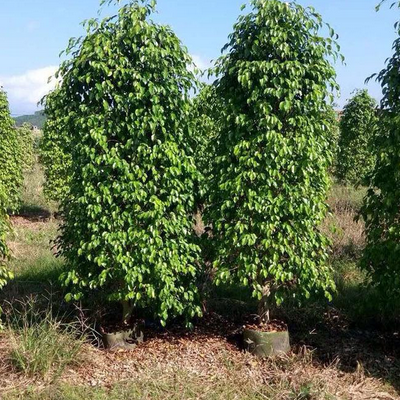
Weeping Fig Cultivation Methods:
1. Light and temperature: When cultivating weeping fig, generally place it in a bright spot, but avoid direct strong light, especially variegated weeping fig. Insufficient light will cause the internodes of weeping fig to elongate, the leaves to droop and soften, and the growth to be weak. The suitable growth temperature for weeping fig is 15-30°C, and the overwintering temperature should not be lower than 5°C.
2. Watering: During the vigorous growth period of weeping fig, it should be watered frequently to maintain a moist state, and water should be frequently sprayed on the leaf surface and surrounding space to promote plant growth and improve leaf gloss. In winter, overly wet potting soil can easily cause root rot, so watering should wait until the pot is dry.
Differences between Weeping Fig and Small-leaf Fig:
They are the same species
Weeping fig is a large tree of the Moraceae family, also known as small-leaf fig or fine-leaf fig, reaching a height of up to 20 m and a diameter at breast height of 30—50 cm. In tropical rainforests, it often "dominates aggressively by strangling, killing the host, and replacing it." When animals carry its seeds to the branches or bark crevices of other trees, these seeds will germinate. Young weeping figs can produce adventitious roots and behave like epiphytes. As the fig tree continues to grow, its adventitious roots cross and fuse with each other, gradually wrapping and tightening around the host tree, and using the host tree to support its own body. When it gradually grows into a large tree, its roots and stems have completely wrapped around the host tree. The host tree eventually dies due to its vascular tissue being constricted and nutrient deficiency, while the fig itself becomes an independent large tree.
That concludes the introduction to weeping fig cultivation methods. It turns out that weeping fig and small-leaf fig are the same plant.
Weeping Fig Propagation Methods and Daily Care Key Points
How to cultivate weeping fig? Weeping fig can also be called small-leaf fig. Common varieties include golden weeping fig, variegated weeping fig, and others. The weeping fig trunk is smooth and upright, and the leaves are dark green and glossy. Below, let us learn the care guide for the "green air purifier," the weeping fig.
1. Environmental benefits
Weeping fig is a very effective air purifier. It can absorb harmful gases such as formaldehyde and benzene from the air, and can also absorb indoor smoke, while releasing a large amount of oxygen, increasing the negative ion content in indoor air and raising air humidity. It is quite effective at improving indoor air quality.
2. Care guide
(1) Soil selection
For potted weeping fig, choose fertile, well-drained soil. For the potting soil, mix compost with an equal amount of peat soil, and apply some base fertilizer as bottom fertilizer. The potting soil should preferably be replaced once every spring.
(2) Light
Weeping fig can be placed in a bright spot, and direct sunlight should be avoided.
(3) Temperature
A room temperature of 15-30°C is most suitable for weeping fig growth, and the overwintering temperature should not be lower than 5°C.
(4) Watering
During the vigorous growth period, water weeping fig frequently to keep the potting soil moist, and frequently spray water on the leaf surface and around the plant to improve leaf gloss. After winter begins, water only when the pot is dry.
(5) Fertilizing
During the growth period, weeping fig should preferably be given a dilute fertilizer solution once every half month, mainly nitrogen fertilizer, and appropriately combined with some potassium fertilizer.
(6) Propagation
① Cuttings
Generally carried out from April to June. First select mature, robust growing branches, cut 10 cm long young shoots, remove the lower leaves, keep 2-3 leaves at the upper part, and insert them into a sand bed. They can root in about 1 month.
② Air layering
Generally carried out from April to August. Select semi-lignified terminal branches from the mother plant, keep 3-4 leaves at the upper part, make a ring bark girdle or tongue-shaped cut below them, then wrap with moss and bind with plastic film. They can root in about 30 days.
(7) Placement and display
Weeping fig has small leaves, dark green leaf color, drooping and dense branches, and a graceful tree shape. It can be made into a tree-form potted plant and used for decorative displays in lobbies, conference rooms, entrance halls, courtyards, streets, and other places.
That is all the content of the weeping fig care guide. Growers and friends are welcome to come to Huinong.com to learn more knowledge and techniques related to nursery stock!
Small-leaf Fig Ficus microcarpa Small-leaf Fig Illustrated Guide: How to Grow Small-leaf Fig / How to Propagate Small-leaf Fig
Small-leaf Fig ProfileSmall-leaf Fig Ficus microcarpa
Small-leaf Fig Cultivation Methods and Precautions Small-leaf Fig Introduction
Evergreen tree, branches with drooping aerial roots. Leaves elliptical to obovate, 1-4 cm long, apex obtuse-acuminate, base cuneate, margin entire or slightly wavy, pinnate veins, lateral veins 5-6 pairs, leathery, hairless. Syconia axillary, nearly oblate, pale red when ripe. Flowering period May-December.
Morphological Characteristics of Small-leaf Fig
Banyan is a large evergreen tree, while small-leaf fig is a small evergreen tree. The crown is umbrella-shaped or rounded, up to 20-30 m tall, diameter at breast height can reach 2 m, with aerial roots.
Propagation Methods of Small-leaf Fig
Seed propagation and cutting propagation. For cuttings, choose healthy branches with strong vitality, cut the bottom into a duck-bill shape, then soak in rooting agent for 1 hour. It is then very easy to survive.
Distribution Area of Small-leaf Fig
Place of origin: Banyan is native to India, Malaysia, and Myanmar
Other: China, Vietnam, the Philippines, and the Taiwan region of China also produce small-leaf fig.
Cultivation Techniques of Small-leaf Fig
(1) Temperature: It likes warmth, and the most suitable growth temperature is 20~25°. It is tolerant of high temperatures and can grow well at temperatures above 30°. It is not cold-tolerant, and the safe overwintering temperature is 5°. Variegated varieties have slightly poorer cold tolerance, and the overwintering temperature should preferably be maintained above 8°0. Low temperatures will cause a large number of leaves to drop.
(2) Light: It likes bright indirect light and has a certain tolerance for shade. It is not tolerant of intense sunlight exposure. When light is too strong, it will scorch the leaves and cause yellowing and burnt leaves. It should also not be too shady, otherwise it will cause a large number of leaves to drop and fade the beautiful markings of variegated varieties. From May to September, shading should be provided, or the plant should be placed in a place with sufficient indirect light. At other times, it should be given sufficient sunlight.
(3) Watering: It likes a moist soil environment. During the growth period, water should be supplied fully to keep the potting soil moist. In winter, watering needs to be controlled. When the temperature is low and the potting soil is too wet, it can easily lead to root rot.
(4) Environmental humidity: It likes a humid environment. During the growing season, when the weather is clear and the air is dry, water should be frequently sprayed on the branches, leaves, and surrounding environment to increase relative air humidity.
Nursery Site Selection
Select land with sufficient water sources and convenient irrigation, slightly acidic sandy soil, sheltered from wind, facing the sun, and well drained. Dig trenches in the ground to make beds, turn the soil 15~25 cm deep, remove debris, level the land, and apply 1000~2000 kg of farmyard manure as base fertilizer per 667 sq m. Make bed ridges 1.5 m wide and 30 cm high, leaving irrigation and drainage ditches and walking paths on both sides. The bed surface should be slightly higher in the middle and slightly lower on both sides, so as to facilitate drainage of accumulated water in the bed. Finally, rake the bed surface level and fine, and carry out sterilization treatment.
Cutting Selection
From late February to early-to-mid March, select mother trees over 10 years old and growing robustly. From the outer middle-upper part of their crowns, cut 2~3-year-old robust branches 4~6 cm in diameter, free of pests, diseases, and damage. Remove side branches and leaves, and cut them into 1.8~2 m long cuttings. Trim the upper end of the cutting flat, wrap the wound with yellow mud slurry, then bind it with film. Cut the lower part into a horse-ear-shaped cut surface, requiring the cut surface to be smooth and not torn. Soak the lower cut end in 50 mg/l ABT rooting powder solution for about 2 hours, then let it dry slightly and wait for the alcohol in the solution to evaporate before inserting. Cuttings cut on the same day should be inserted completely on the same day to prevent the cuttings from losing water, the cuts from being damaged, and tissue necrosis.
Cutting Technique
Insert the treated cuttings upright into the bottom of the pit in a timely manner. The plant-row spacing is generally 20 cm x 20 cm. The base of the cutting should enter the soil 30~40 cm, with the branch exposed above the soil 1.5 m, then fill with soil and firm it. After cutting is completed, immediately water thoroughly to settle the roots, and irrigate the cutting bed thoroughly. Be sure to make the base of the cutting closely contact the soil, so as to facilitate water absorption from the soil through the cut. For cuttings of 2~3-year-old large branches of small-leaf fig, it should be done before the branches sprout. According to observation, when the soil temperature of the nursery bed reaches above 16°C, the cuttings begin to root.
Post-cutting Management
1. Heat preservation and moisture retention: In mid-to-late March, the temperature changes greatly. If the daily maximum temperature reaches above 15°C, water once at noon to retain moisture. Later, as the temperature steadily rises, daily watering should be increased to 2~3 times, so that the surface soil does not turn white. To improve the nutritional status of the soil and allow it to heal and root as early as possible, 2% potassium dihydrogen phosphate can be used for foliar topdressing. After about 15 days, the buried branches first sprout tender buds, and after another 30 days they gradually heal and root.
2. Removing tillers and wiping buds: The cuttings of small-leaf fig are very rich in their own nutrients. If sunlight is sufficient and the temperature is too high, they will sprout a large number of buds and leaves before rooting. At this time, except for retaining the terminal bud, all the rest should be wiped off to avoid excessive consumption of nutrients.
3. Timely topdressing: To meet the growth requirements of the cuttings, one week after rooting, apply a thin fertilizer once in a timely manner, and then apply once every 15 days thereafter. In this way, after 3~4 fertilizations, the root group of the cuttings is well developed and growth is vigorous, and they can absorb nutrients from the lower layers. After 1 year of cultivation in the nursery, they can be planted with soil.
4. Disease and pest control: The main diseases and pests of small-leaf fig include leaf blight, bark rot, gray-white silkworm moth, fig thrips, and cloud-marked longhorn beetle. Control methods: 1) Use scraping to scrape off the rotten diseased bark, and apply carbendazim and other agents for disinfection. 2) Spray fenitrothion or phosphamidon and other agents to kill adult cloud-marked longhorn beetles. 3) For other pests, spray dichlorvos or trichlorfon and other agents during the nymph or larval stage.
5. Summary:
(1) Small-leaf fig is a plant that roots easily from cuttings. With large-branch cuttings, the survival rate reaches over 90%, and the cultivation time is short and the plants take shape quickly, which can quickly meet the demand of urban greening for large seedlings.
(2) For large-branch cuttings, the survival rate mainly depends on the selection of cuttings. If the selected cuttings are thin and weak, the survival rate will be reduced, and short cuttings will prolong the seedling formation period.
Medicinal or Therapeutic Value of Small-leaf Fig
The medical information and health dietary information on Huahua.com are for reference only and cannot be used as a basis for diagnosis or medical treatment. Any health issues should be consulted with professional medical staff, and any disease treatment should follow a doctor's advice.
Ultimate flower-protecting task: To love yourself, start from reality and strictly follow a doctor's advice. For illness, do not be careless, do not delay, do not give up hope, face it bravely, warm the silent world with love, and care for the flower field in your heart with your heart.
Main Medicinal Components
Small-leaf fig is used medicinally mainly for its leaves, Folium Fici Microcarpae. Studies have shown that small-leaf fig leaves mainly contain flavonoids, triterpenoids, oleanolic acid, aliphatic compounds, and steroidal compounds, among others.
Pharmacological Effects
Among them, the medicinal components have significant effects in treating cardiovascular diseases, anti-inflammation, and antibacterial activity, among others. They have long been used among the people, and Keteling capsules, which use its extract as the main component for treating asthma and chronic bronchitis, have already been included in the ministerial standards. However, there is still very little theoretical research on the components of small-leaf fig.
Disease Control of Small-leaf Fig: Leaf Blight
1. Symptoms
It mainly damages leaves. The leaf tip, leaf margin, or part of the leaf first loses green, then forms light brown lesions, with a light brown ring line at the edge, and the boundary between diseased and healthy parts is clear. Black small dots, namely the pathogen's pycnidia, are produced on the front and back of the lesions.
2. Pathogen
Macrophoma sp., belonging to the imperfect fungi. The pycnidia are in the diseased tissue, round to oblate, dark brown, initially buried, slightly protruding. Conidia are elliptical to ovoid, colorless when young, without septa, yellow-brown when mature, with 1-2 oil droplets, occasionally with 2 septa.
3. Occurrence pattern
The pathogen overwinters as pycnidia and mycelium in diseased parts or in the soil with fallen diseased tissue. When conditions are suitable the following spring, it produces conidia, which spread by splashing water and invade through wounds to cause infection. Rainy weather and high humidity favor disease occurrence.
4. Control methods
① Careful maintenance to make the banyan grow robustly. ② Entering the rainy season, pay attention to controlling humidity. ③ At the early stage of disease, spray 70% mancozeb wettable powder 500 times solution or 40% chlorothalonil suspension 500 times solution, 50% thiophanate-methyl and sulfur suspension 800 times solution, or 50% carbendazim wettable powder 600 times solution.
Psyllid Control
The small-leaf fig psyllid is the main pest of small-leaf fig. It mainly damages the new shoots and leaves of small-leaf fig. This pest can occur almost all year round, but is most abundant from April to September, and is especially serious when small-leaf fig sends out new shoots. Early April to early May is the peak period for the emergence of the first generation of adult small-leaf fig psyllids. During this period, temperatures rise and rainfall increases, and the fig psyllid reproduces and grows quickly, making it the key stage for control during the year.
Fig psyllid (Macrohomotoma gladiatean Kuwayama) belongs to Homoptera, Calophyidae, also known as fig psyllid. In recent years, because fig psyllids have caused damage on small-leaf fig, they have not only affected the healthy growth and ornamental landscape value of small-leaf fig, but even caused the death of small-leaf fig due to untimely control, and have become a major insect pest of small-leaf fig.
I. Symptoms of Fig Psyllid Damage
Fig psyllid nymphs secrete white waxy threads. The nymphs generally hide in the white waxy fluff, forming small white clusters at the tips of tender branches, tightly wrapping the insect body. The nymphs suck the tree's sap within the white waxy fluff. Adults mostly lay eggs on newly sprouted tender buds, and their egg-laying period coincides with the tender shoot sprouting period of small-leaf fig. The weaker the tree vigor, the more severe the damage. In severe cases, the branches of the banyan dry up, leaves fall off, and leaves shrivel or even drop, hindering tree growth and affecting ornamental value. Their excrement also induces sooty mold.
II. Morphological Characteristics of Fig Psyllid
Nymph: 1st-2nd instars relatively flat. 1st instar 0.4~0.6 mm long, yellow-red; 2nd instar 1.2 mm long. Wing buds protrude, and the abdomen secretes a large amount of white waxy threads.
Egg: spindle-shaped, one end relatively pointed, initially yellow-white and translucent, later turning light brown, about 0.5 mm long. Adult: body length 4~5 mm, whole body brown-green, front of head relatively flat, compound eyes protruding to the sides, brown. Antennae 10-segmented, forewings and hindwings transparent, with a pointed horn-shaped brown spot at 1/3 of the front margin of the forewing. Thoracic and abdominal dorsum brown, venter green. Female abdomen spindle-shaped, tip pointed, egg sheath dagger-shaped, tough.
III. Annual Life History of Fig Psyllid
Fig psyllid occurs 4 generations a year on small-leaf fig. The overwintering generation of psyllids lays eggs in early October of the previous year, with a hatching peak in late October, adults begin to appear in early April of the following year, and the adult peak appears in early May. The 1st generation of psyllids lays eggs in early May, with a hatching peak in early June and an adult peak in early July. The 2nd generation lays eggs in early July, with a hatching peak in early August and an adult peak in late August. The 3rd generation lays eggs in late August, with an adult peak in early October. From April to October, generation overlap is obvious.
IV. Control Methods for Fig Psyllid
(1) Physical control
1. Pruning branches: In combination with pruning, appropriately prune the branches of small-leaf fig severely affected by pests (more than 40% of the leaves on the outer crown wrapped by the white waxy fluff secreted by nymphs), and pull all pruned branches outside the city to open ground for burning and burial. Thereafter, every time small-leaf fig is found in the above condition, the same method should be used.
2. Trunk whitewashing: This can begin at the end of November each year. Whitewash the trunks of street trees and small-leaf figs with especially severe pest damage. Trunk whitewashing can appropriately curb the transfer of fig psyllids between small-leaf fig trees.
(2) Chemical control
Chemical control is the main and effective control method when small-leaf fig psyllid damage occurs over a relatively large area. Because fig psyllid nymphs are tightly wrapped and protected by the white waxy fluff they secrete, and the nymphs suck the tree's sap within the white waxy fluff, chemical control of fig psyllid should use systemic chemicals that can be absorbed by plant leaves.
The main chemical agents used to control small-leaf fig psyllid are: 2.5% Daconil emulsifiable concentrate, 10% imidacloprid wettable powder, and 40% omethoate emulsifiable concentrate. If the pest damage is severe, the concentration of the solution used is about 800 times. To prevent fig psyllids from developing resistance, use 1 pesticide each time and alternate the 3 pesticides. Each control application should spray the solution on all leaf surfaces of small-leaf fig. When climatic conditions are suitable and pest damage is severe, control once every 15~20 d.
(3) Trunk injection method
On the trunk of the small-leaf fig tree, use a motorized hole-drilling and injection machine to drill a small hole about the thickness of a little finger at a 45-degree angle, with a depth of 4-20 cm (calculated according to the diameter at breast height of the banyan). Then insert the mouth of the infusion bottle into the small hole. When preparing the medicine, first measure the diameter at breast height of the banyan, then prepare the liquid at 1:1, that is, a banyan with a diameter at breast height of 0.1 m should be matched with 10 ml of medicine. Generally, after hanging the drip for more than 1 hour, all psyllids on the tree will be washed out. It was found that when the trunk injection method was used to apply 30% dichlorvos and omethoate emulsifiable concentrate and the ring-barking method was used to apply 40% omethoate emulsifiable concentrate 10 times solution, the control effects 10 days after treatment were 75.56% and 59.24%, respectively.
The advantages of the trunk injection method are little environmental pollution, thorough control, and long duration (effective for 20 days). The disadvantages are that because the small-leaf fig trunk is juicy, the injection hole easily accumulates water, and the hole opening is difficult to heal. Therefore, drilling and injection once in May or October each year is appropriate, and the drilled hole should not be too large.
Difference between Small-leaf Fig and Weeping Fig? Are Small-leaf Fig and Weeping Fig the Same Plant?
The answer is: the same plant.
Weeping fig is a large tree of the Moraceae family, also known as small-leaf fig or fine-leaf fig.
It can reach a height of up to 20 m, with a diameter at breast height of 30-50 cm. In tropical rainforests, it often "dominates aggressively by strangling, killing the host, and replacing it." When animals carry its seeds to the branches or bark crevices of other trees, these seeds will germinate. Young weeping figs can produce adventitious roots and behave like epiphytes. As the fig tree continues to grow, its adventitious roots cross and fuse with each other, gradually wrapping and tightening around the host tree, and using the host tree to support its own body. When it gradually grows into a large tree, its roots and stems have completely wrapped around the host tree. The host tree eventually dies due to its vascular tissue being constricted and nutrient deficiency, while the fig itself becomes an independent large tree.
Are Small-leaf Fig, Large-leaf Fig, and Banyan the Same Plant?
Family: Moraceae. Genus: Ficus. Evergreen tree, branches with drooping aerial roots. Leaves elliptical to obovate, 1~4 cm long, apex obtuse-acuminate, base cuneate, margin entire or slightly wavy, pinnate veins, lateral veins 5~6 pairs, leathery, hairless. Syconia axillary, nearly oblate, pale red when ripe. Flowering period May-December.
Morphology: Banyan is a large evergreen tree, while small-leaf fig is a small evergreen tree. The crown is umbrella-shaped or rounded, up to 20-30 m tall, diameter at breast height can reach 2 m, with aerial roots.
Large-leaf fig, Moraceae, is a local native tree species, a large evergreen tree, with tree height up to 15 m. Leaves 10-15 cm long. In spring, large leaf buds appear at the branch tips, then light green leaves unfold, while at this time the inconspicuous flower bracts fall all over the ground. The fruit hangs like a small tomato, changing from green to yellow, and after maturity becomes a red berry that is edible. Characteristics: strong growth, full tree form, able to withstand strong winds, easy to transplant, suitable for use as street trees, landscape trees, and shade trees.
What we usually call banyan is small-leaf fig, and the banyan referred to in Fuzhou, the City of Banyans, also refers to small-leaf fig.
Uses of Small-leaf Fig: Landscape Uses
The tree is robust, with dense green shade. It is a low-maintenance, high-grade shade tree, street tree, landscape tree, firebreak tree, windbreak tree, hedge tree, or pruning-shaped plant, and is the most widely used tree species in landscape applications in the Taiwan region of China. It is also the city tree of Liuzhou in Guangxi and Leshan in Sichuan.
Suitable Sites
Courtyards, campuses, parks, amusement areas, temples, and other places can all use single planting, row planting, or mass planting.
Bonsai Making: WateringAdd water to the rainbow sand once every 7-10 days.
Nutrient Supply
Summer and autumn are the vigorous growth periods, with high nutrient demand. Add nutrient solution once every 7~10 days to meet its growth needs. Spray a dilute potassium dihydrogen phosphate solution 2-3 times per month, which can make the leaves thicker and more lush, the stems stronger, and increase side branches.
Suitable Growth Temperature
15~30°C. It grows fastest during the high-temperature and high-humidity season in summer.
Pruning
Tolerates pruning well and can be shaped into various forms, such as the characters for fortune (fu) and longevity (shou).
Small-leaved banyan (Ficus microcarpa) picture