Crabapple Potted Cutting Method and Blooming Time
Crabapple, this is something super many people like, it grows beautifully, especially when it blooms, in clusters. What is the crabapple cutting method? When does potted crabapple bloom:
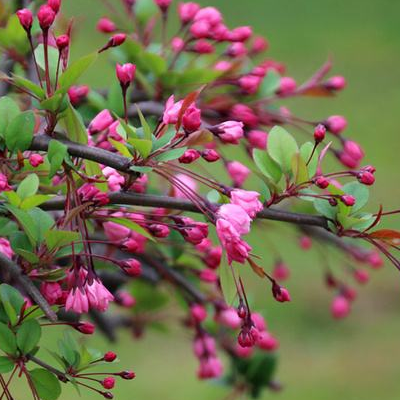
Crabapple cutting method:
(1) Cutting time.
Home cuttings are best done between April and May, when the temperature rises above 20°C. At this time the air humidity is high and the temperature is warm, making management simple and suitable for the rapid rooting of begonias.
(2) Cutting medium.
Wash river sand, dry it in the sun, then place it in a pot. River sand that has been washed and then sun-dried has basically achieved the purpose of disinfection, and the sun-dried river sand helps raise the temperature under daytime sunlight, promoting the healing and rooting of the cut surface of the cuttings.
(3) Selection of cuttings.
Cut strong branches, each segment with 3~4 nodes, cut the top into a flat shape and the bottom into a horseshoe shape, to expand the contact surface with the sand and promote rooting.
(4) Cutting and management.
Insert into the sand pot at a spacing of 3 cm × 4 cm. When cutting, first use a bamboo stick of the same thickness as the cutting to poke holes in the pot sand, then insert the begonia branch. Within 2 days after inserting, do not water, to help the cut surface form a healing callus. On the 5th day, spray water with a temperature similar to the sand, watering until water flows out from the bottom of the pot. Place in a cool place, and generally do not water again. After about 10 days, roots of 3~4 cm can grow. At this time, place the pot in the sun and water according to the weather. After 6~7 more days, it can be potted and planted.
Crabapple likes sunlight, is not tolerant of shade, and dislikes waterlogging. Crabapple is extremely cold-hardy and has strong adaptability to severe cold and dry climates, so it can withstand cold weather. Generally speaking, crabapple can grow well at minus 15°C and can be placed outdoors entirely.
When does potted crabapple bloom:
In different regions, due to temperature differences, the flowering period of crabapple is April-May, extended to March-June.
That is all for the crabapple cutting method and blooming time. If you have the chance, you should plant one.
How to grow crabapple: Potted crabapple cultivation methods
Crabapple has long been known as the "national beauty," with lovely flower forms and extremely high ornamental value. Su Shi once wrote, "I only fear the flower will fall asleep deep in the night, so I burn tall candles to light up the red makeup," which is enough to prove the charm of crabapple. So for the homehow to grow crabapple? Next Xiao Qi will sharecrabapple cultivation methods and precautions。
I. Crabapple cultivation methods
Crabapple likes light and also tolerates partial shade. It has strong adaptability, is cold-tolerant and drought-tolerant. It is not strict about soil and can generally be cultivated in well-drained land, but avoid low-lying and saline-alkali land. It has strong sprouting ability and can be pruned. Crabapple is extremely cold-hardy, so it can withstand cold climates, but there must be a limit. Generally speaking, crabapple can grow well at minus 15°C and can be placed outdoors entirely. However, if it is especially cold, such as minus thirty or forty degrees, protective measures should be taken.
Planting and repotting of crabapple should be paused in February to March, and late autumn is also suitable. It is advisable to use loose, fertile garden soil, humus soil mixed with sand or rice husk ash as the medium, and mountain soil can also be used. When potting or repotting, a large amount of decomposed cake crumbs and bone meal can be put at the bottom of the pot as base fertilizer. Young trees grow quickly, so they can be repotted every 1~2 years, while old stumps can be repotted every 2~3 years. When repotting, the root system and branches need to be pruned to increase elegance and maintain balance. Crabapple should be placed in a sunny, ventilated, and airy location. If light is insufficient, growth will be poor, and no shading is needed in summer. Crabapple is relatively cold-resistant. In summer it can be buried pot and all in a wind-sheltered, sunny place outdoors, or moved into a bright room to overwinter, with the temperature kept at 0°C. If the indoor temperature is raised in summer, it can bloom early, and be moved out in March of the following year.
Crabapple cultivation should keep the pot soil moist, but waterlogging is not allowed. During the growing periods of spring and summer, it needs appropriate more watering. In the low temperatures of midsummer, watering should be timely and ample. If water is lacking, the leaf edges are prone to scorch. After autumn turns cool, gradually reduce watering. After leaf fall in summer, water even less to prevent root rot. It is a deciduous tree species, so it is not suitable to spray water on the branches and leaves too much. Crabapple likes fertilizer and can be given appropriate more fertilizer, and attention should be paid to the combined use of nitrogen, phosphorus, and potassium. If too much nitrogen fertilizer is used, it easily causes lush branches and leaves but sparse flowering. After flowering in spring, mainly apply nitrogen fertilizer to promote the growth of branches and leaves. In summer and spring, apply more phosphorus and potassium fertilizer to benefit flower bud differentiation and ensure abundant flowers and bright colors. Fertilizers can include cake fertilizer, human manure and urine, bone meal, chicken manure, fishy water, etc.
Crabapple has strong sprouting ability and grows quickly. Attention should be paid to beautifying pruning. After leaf fall in summer and before sprouting in spring, dead branches, diseased and insect-infested branches, weak branches, crossing branches, overlapping branches, overly dense branches, and other messy branches can be cut off. After flowering in spring, according to shape requirements, overly long branches can be appropriately shortened to promote the production of side branches, increase the number of flower buds, and ensure unique flowering the following year. In addition, after sprouting in spring, excessive, overly dense, and poorly positioned buds of crabapple seedlings can be removed to prevent weak branches from spreading.
II. Crabapple cultivation precautions
1. Watering should keep the pot soil moist. In dry and midsummer weather, it is also necessary to spray water on the leaf surface and ground to increase air humidity, which is beneficial to growth. Avoid water accumulation in the pot and rain exposure, otherwise root rot is likely. In winter, the pot soil should preferably be slightly dry. Every 7 days, spray the leaves and environment with clean water, which both increases humidity and keeps the leaves clean. During the growth period, apply dilute cake fertilizer water once about every 10 days; during the bud stage, apply quick-acting phosphorus fertilizer as a top dressing. When fertilizing, note that the fertilizer liquid should not splash onto the leaves; do not fertilize during the flowering period and in winter and summer.
2. The suitable growth temperature for bamboo crabapple is 18~20°C, with a well-ventilated environment with diffused light. In high-temperature seasons, measures such as shading, ventilation, and spraying water should be taken; in winter, the room temperature should preferably be kept above 10°C, and it can be placed in a sunny place. When cultivated at home, during the growing season it should be placed outdoors under diffused light 1~2 times a week, and in winter it should be placed in a sunny, wind-sheltered place.
3. Bamboo crabapple plants are relatively tall, so supports such as thin bamboo are needed to prop up the branches to prevent lodging. At the same time, every spring it is necessary to repot, change soil, and prune branches, cutting off weak branches, overlapping branches, and residual roots. For plants that have bloomed for 2~3 years and are too tall, short pruning should be carried out, leaving only 6~10 cm of the stem, to let them sprout new branches again.
The above ishow to grow crabappleandcrabapple cultivation methods and precautionsintroduced. Before cultivating crabapple, you should first understand the crabapple cultivation methods, so you do not need to worry about not being able to keep crabapple alive.
Recommended reading:
① How to grow red photinia: Photinia cultivation methods
② How to grow silk tree flowers: Silk tree flower cultivation methods
③ Oleander cultivation methods and precautions: Oleander picture appreciation
④ Camellia cultivation methods and precautions: Camellia picture appreciation
⑤ Peony planting techniques: Peony management and care experience
Potted crabapple cultivation methods
1. Potted crabapple likes a partial shade environment, place it on the inner side of a balcony, at an east-facing or west-facing window.2. To water crabapple, water only after the soil is dry, and each time water until water flows out.
3. Potted crabapple should be pinched back often. Do not feel sorry for the flower buds. Continuously pinch off the tips of each branch, and only then will it keep branching and become ball-shaped, rather than growing long as a single stem, which is not only ugly with few flowers but also easy to break. Flowers that have bloomed should also be pruned off in time.
4. Often rotate the direction of the flower pot so it does not grow crooked toward one direction of light.
5. If the leaves of potted crabapple are too dense, remove some. Poor ventilation easily causes mildew disease. With this method I carefully grew one pot, full and lush, very proud of it, but only one pot, and afterward I never had the patience to do a second pot. For newly planted crabapple, pay attention to preserving water, ventilation, and maintaining diffused light.
Watering and fertilizing. Watering should keep the pot soil moist. In dry and midsummer weather, it is also necessary to spray water on the leaf surface and ground to increase air humidity, which is beneficial to growth. Avoid water accumulation in the pot and rain exposure, otherwise root rot is likely. In winter, the pot soil should preferably be slightly dry. Every 7 days, spray the leaves and environment with clean water, which both increases humidity and keeps the leaves clean. During the growth period, apply dilute cake fertilizer water once about every 10 days; during the bud stage, apply quick-acting phosphorus fertilizer as a top dressing. When fertilizing, note that the fertilizer liquid should not splash onto the leaves; do not fertilize during the flowering period and in winter and summer.
Light and temperature. The suitable growth temperature for crabapple is 18~20°C, with a well-ventilated environment with diffused light. In high-temperature seasons, measures such as shading, ventilation, and spraying water should be taken; in winter, the room temperature should preferably be kept above 10°C, and it can be placed in a sunny place. When cultivated at home, during the growing season it should be placed outdoors under diffused light 1~2 times a week, and in winter it should be placed in a sunny, wind-sheltered place.
Tying and repotting. Because crabapple plants are relatively tall, supports such as thin bamboo are needed to prop up the branches to prevent lodging. At the same time, every spring it is necessary to repot, change soil, and prune branches, cutting off weak branches, overlapping branches, and residual roots. For plants that have bloomed for 2~3 years and are too tall, short pruning should be carried out, leaving only 6~10 cm of the stem, to let them sprout new branches again.