How to propagate double-flowered petunias, and what to do when buds form but do not open
Double-flowered petunia: this flower has many layers of petals and comes in many colors, and it is super beautiful. Let's see how to propagate double-flowered petunias. What to do when double-flowered petunias grow flower buds but do not bloom:
Double-flowered petunia propagation methods:
There are two propagation methods for double-flowered petunias, seed sowing and cuttings, but the more commonly used propagation method is cuttings.
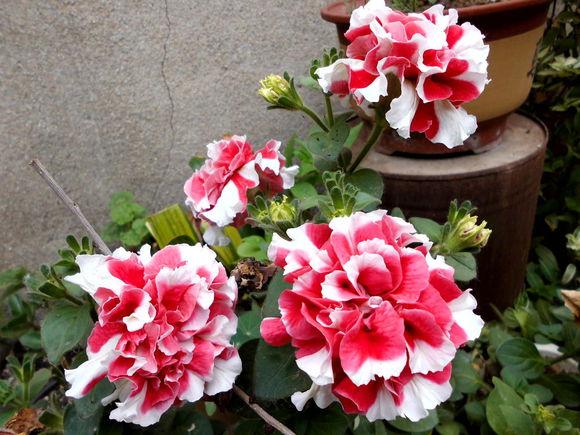
Sowing: 1. Prepare a flower pot with a diameter of about 20 cm, sow directly without covering with soil, and do not water by pouring; it is best to spray water with a spray bottle, as this can avoid washing away the seeds.
2. Generally, at a temperature of about 20 degrees, they will sprout in a week.
3. Double-flowered petunias should be grown in a high-temperature, dry environment, and the drainage of the potting soil must be good.
Cuttings: 1. Cut a healthy branch of about 10 cm (cut from below the node, as this is good for healing and rooting). The cut should be flat.
2. On the branch, keep only the upper 2-3 leaves; cut off all the others.
3. Use plain sandy soil or potting soil for cuttings, with a depth of 1/2 to 1/3 of the length of the cutting. After inserting, place it in a wind-sheltered, shaded environment. After autumn cuttings, place them indoors. At 20°C, they will take about 15 days to root.
Reasons why double-flowered petunias grow flower buds but do not bloom:
1. In order to make the plant shape of double-flowered petunias compact and the petals overlapping, it is necessary to pinch the tips multiple times starting from the seedling stage to encourage more branching.
2. The soil for planting petunias should not be given too much nitrogen fertilizer; more phosphorus and potassium fertilizer can be applied. Applying more phosphorus and potassium fertilizer during the flowering period can extend the flowering period and make the flowers more abundant and lush.
3. During the flowering period, water must not be lacking; otherwise, there will be few flowers and they will not be vivid.
4. Double-flowered petunia is a plant that really likes sunlight, so place double-flowered petunias in an environment with sufficient sunlight. If the leaves or flowers on one side are relatively sparse, just turn that side toward the sunny direction.
That is all for the introduction to double-flowered petunia propagation methods. If they do not bloom, look for these causes.
How to pinch the tops of double-flowered petunias, double-flowered petunia top-pinching methods (large image)
Double-flowered petunia plants are short, with a neat plant shape and compact branching. The flowers are bright and eye-catching, with five colors: red, pink, blue, white, and rose red. From planting to flowering takes about 90 days. Among these, top pinching is the most important step in the process of growing double-flowered petunias. Many beginners end up with ugly flower shapes because they do not pay attention to top pinching. Below, the editor introduces how to pinch the tops of double-flowered petunias and the top-pinching methods for double-flowered petunias.
Double-flowered petunia top-pinching methods
For upright varieties, be more aggressive with top pinching. The first top pinching generally keeps 4-6 leaves, while trailing varieties keep 6-8 leaves, and the same applies to side branches. During this time, pay attention to their branching condition. Generally, when the weather is hotter, branching is poorer, and flowering replaces branching. In winter, branching ability is better, and after top pinching, new branches can basically sprout from the leaf axils. Do not pinch the tops too late, as too late will delay growth. Determine how many leaves to keep according to the condition of the seedlings, and treat the main branch and side branches the same way.
If double-flowered petunias show excessive growth, it is mainly because they get too little sun. In winter, windowsills or balconies with little sunlight most easily cause excessive growth. Seedlings with excessive growth have longer internodes; when pinching the tops, pinch off more and keep only 4 leaves. For seedlings with good growth, generally keep 6 leaves when pinching the tops. Comparing two kinds of seedlings with different growth conditions, the internodes of excessive-growth seedlings are clearly longer than those of normal seedlings. Short internodes have an advantage: branching will be denser, and in the end the plant will look fuller and produce more flowers.
The timing for top pinching is generally when they are as large as in the picture below:
1. Before top pinching
2. After top pinching
3. Before pinching side branches
4. After pinching side branches
5. Afterwards, multiple top-pinching treatments should be carried out according to the growth of the side branches.
The above is the article on how to pinch the tops of double-flowered petunias and the top-pinching methods for double-flowered petunias. Double-flowered petunias have abundant and numerous flowers, with flower stems 8~10 cm, and the suitable growth temperature is 20~35°C. They bloom indefinitely and perform outstandingly. They grow vigorously, flower uniformly, and have strong adaptability. They have good heat and cold tolerance, strong disease resistance, and tolerance to rain and waterlogging. They are suitable for shelf sales, garden planting, flowerbed and flower-stem applications, landscaping, and so on.
Double-flowered petunia pictures: double-flowered petunia growing methods and precautions
The flower shape of double-flowered petunias is very beautiful, the colors are diverse and mostly quite vivid, and the flower density is also very high. If cared for well, the flowering period is very long, making them very suitable for indoor growing. Moreover, petunias have strong adaptability and can be sown and survive in all four seasons, making them a very popular flower. The petals of double-flowered petunias are overlapping, with a very good ornamental effect, and growing and caring for them is also relatively simple. What follows is an introduction to the growing methods and precautions for double-flowered petunias.
Soil
It requires slightly acidic, loose, fertile, well-drained soil. For potting soil, generally sandy loam and leaf mold can be mixed evenly in equal halves.
Fertilizing
Petunias have a long flowering period and need continuous nutrient supplementation to keep blooming. Therefore, during the growth period, generally apply a dilute liquid fertilizer once about every 10 days. During the bud stage, it is better to apply more phosphorus fertilizer to promote more and brighter flowers.
Watering
Usually water in moderation to prevent both excessive dryness and excessive moisture. If too dry, the plant easily wilts; if too wet, the roots easily rot. In summer, when the weather is hot and evaporation is greatest, replenish water in time to keep the potting soil moist but not waterlogged. In the rainy season, drain promptly to prevent waterlogging.
Light
Petunia is a long-day plant and requires relatively strong light conditions for photosynthesis to proceed smoothly. Therefore, whether potted or planted in the ground, it needs to be given sufficient light. With ample sunlight, it grows robustly with lush leaves and abundant flowers; if light is insufficient, the branches and leaves easily become leggy, and there will be fewer flowers or poor flower quality.
Temperature
For petunias, 20°C is most suitable for seed germination. The suitable growth temperature is 13~18°C, and the winter temperature should be 4~10°C. If it is below 4°C, plant growth stops. In summer, it can tolerate high temperatures above 35°C.
Pruning
When the seedlings grow to about 10 cm tall, pinch the tips to encourage side branches to sprout, resulting in more flowers. After each flowering, if seeds are not needed, promptly cut off the spent flowers and shorten the branches, and they can continue to sprout side branches and keep blooming.
Precautions for growing petunias:
1. After winter begins, the temperature keeps dropping, and petunias have slow metabolism and need very little water and fertilizer. Therefore, continue watering and fertilizing according to actual needs.
2. Always follow the principle of not watering until dry, and when watering, water thoroughly. If the potting soil is not too dry, do not water. Avoid excessive watering causing root rot and leaf drop or causing young branches to become leggy, which affects later flower bud differentiation and weakens cold resistance.
3. In winter, indoor air is dry, so for petunias, frequently spray and wash the leaf surface with water close to room temperature to remove dust and keep it clean, which helps photosynthesis. However, spraying water must not add water inside the pot, to prevent root rot.
Double-flowered petunias have certain requirements for soil. This flower is especially afraid of waterlogging, so when planting, choose soil with good drainage performance. Keep the soil moist but do not let there be too much standing water, otherwise it will cause the roots to rot and die. Petunias like a warm environment, so when planting in winter, place them in a warm place to prevent the plants from freezing to death. Double-flowered petunias have relatively high light requirements. Placing them in a place with enough sunlight makes them bloom earlier, and the flowering period is also longer.