How to grow Oriental lilies (perfume lilies) in water, and are they toxic when kept at home?
Oriental lily (perfume lily), many people love growing it, it looks beautiful and smells quite fragrant. How do you grow Oriental lilies in water? Are Oriental lilies toxic when kept at home:
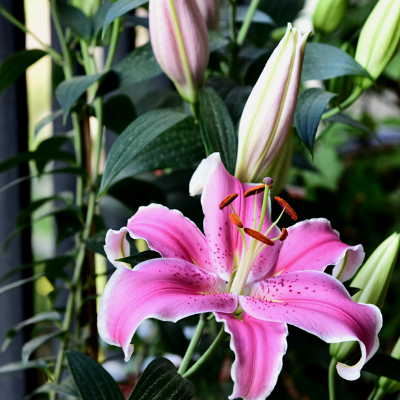
How to grow Oriental lilies in water:
1. Change the water frequently
First of all, if you want to grow Oriental lilies hydroponically, you must change the water frequently. Usually, at temperatures above 20°C, it is best to change the water once every 2 to 3 days; if the temperature is in the range of 15 to 20°C, once every 3 days to 1 week is enough; if the temperature is lower still, it is best to change it once a week.
2. Plenty of sunlight
Hydroponically grown Oriental lilies very much need plenty of sunlight. When growing them, take care to keep the temperature between 15°C and 25°C. If the temperature is too low, the Oriental lily will be unable to grow normally. Also, if the daily light hours increase, the lily will bloom earlier, but if there is not enough light, flowering will be delayed.
3. Add nutrient solution
The growing medium for Oriental lilies now is water, which lacks certain nutrient elements, so we need to add some suitable nutrient solution to help the plant grow. Of course, different plants need different nutrients, so we need to prepare a nutrient solution suited to the plant's growth to meet its needs.
4. Prune in time
Oriental lilies are used for flower arranging, decoration and so on, and generally need regular pruning; usually pruning once every two to three days is enough. Regular pruning not only makes the lily more beautiful, it also helps the plant absorb water better and can extend the lily's flowering period.
5. Growth requirements
Note that during hydroponic growing, the environment and climate are best warm, moist, cool and cold; the temperature must not be too high, and in summer it is best to keep them indoors.
Are Oriental lilies toxic when kept at home:
The Oriental lily itself is not toxic, but its fragrance can also overstimulate the central nervous system and cause insomnia.
That is all for how to grow Oriental lilies in water. Whatever you do, do not put them in the bedroom, or you may end up with insomnia.
Are Oriental lilies toxic?
Although the Oriental lily has a fresh fragrance, when it blooms it gives off a rich, strong scent. This scent contains a mild toxin; if you stay in the environment with it for a long time at night, it may make you excited and stimulate the nerves, making it hard to fall asleep at night. So when placing Oriental lilies in the bedroom, there should be limits on the time. During the day, putting a bunch of Oriental lilies in the bedroom not only freshens the air, the bright flowers also lift your mood; at night, since it is sleep time, people who generally sleep poorly or are sensitive to the scent of Oriental lilies can take them out to prevent insomnia and similar problems.
Generally, in other public places, such as the living room, meeting room, shop, office and so on, the Oriental lily's toxin is negligible. On the contrary, the Oriental lily is the ideal choice for decorating a space and scenting the air. Putting a few Oriental lilies in a public place, with their bright colours and fragrance, not only adds atmosphere and serves a decorative purpose, it can also help people relax and refresh the mind.
Oriental lilies can be used on so many occasions, so how should we normally care for Oriental lilies?
Complete guide to Oriental lily meanings: how to grow Oriental lilies
Lilies have always been a flower people rather like. In the West they symbolise purity, while in the East they are regarded as an auspicious flower, carrying the meaning of "a harmonious union lasting a hundred years". Among lilies there is a newer variety that is very popular, namely the Oriental lily. So what is the difference between this Oriental lily and an ordinary lily, and what is the meaning of the Oriental lily?
Differences between Oriental lilies and ordinary lilies:
Oriental lilies are given to the woman you have your eye on
Ordinary lilies are given to newlyweds
Meaning of ordinary lilies: a harmonious union lasting a hundred years
Meaning of Oriental lilies: love to eternity
Meaning of the Oriental lily:
The Oriental lily is the queen among lilies. Its petals always open with such confidence and great presence, and its sweet fragrance is equally free of pretence or the slightest concealment, everything so straightforward and direct. The Oriental lily really does have the presence of a lily queen, because the speckles often seen on flowers of the lily family cannot be seen on its petals, so its pure white petals can always open so proudly.
The snowy white of the Oriental lily symbolises flawless, spotless affection, so the Oriental lily's meaning includes purity and freshness. The meaning of the Oriental lily is: love to eternity; great and pure love; selfless love, and so on.
Meanings of Oriental lilies in different colours:
Pink Oriental lily symbolises: pure and refined, elegant;
Yellow Oriental lily symbolises: wealth, nobility;
White Oriental lily symbolises: a harmonious union lasting a hundred years, great love.
The legend of the Oriental lily:
The origin story of the lily is extremely poignant. Legend has it that Eve and Adam were tempted by the serpent to eat the forbidden fruit and were therefore driven out of the Garden of Eden. In her remorse, Eve could not help shedding sorrowful tears, and when the tears fell to the ground they turned into pure white, fragrant lilies.
In Germany there is also an old legend about the lily that almost everyone around the world knows. A girl named Alice lived with her mother in the Harz mountains. One day, the Grand Duke of Lorraine passed by this place in a carriage. He saw Alice and actually thought she was a fairy descended to earth, and immediately invited her to come back to the city with him. He thought that as a grand duke with power and influence he could behave unreasonably. To his surprise, Alice refused firmly. The grand duke would not give up and pulled the girl along. The girl cried out, calling on heaven for protection, and suddenly a divine wind blew and the girl was gone. But from the ground where the girl had stood, a lily rose up, giving off wave after wave of fresh fragrance. This is the origin of the lily in foreign legend. The lily represents purity and respect, and the white lily in particular is most highly esteemed. In the social customs of that time, a woman wearing white clothes and holding a lily showed nobility and chastity. In many medieval paintings of the Virgin Mary, the lily is painted with neither stamens nor pistils, meaning no impure sexual thoughts.
How to grow Oriental lilies
1. Soil: Oriental lilies prefer fertile, deep soil rich in humus, and most of all dislike hard clay; a well-drained, slightly acidic soil is best, with a soil pH of 5.5-6.5.
2. Watering: just keep the potting soil moist; the potting soil should not be too wet, otherwise the bulb rots easily.
3. Light: potted lilies have different requirements for light intensity at different growth stages. At the bud stage they need shading, and if the leaf temperature is too high they should also be shaded appropriately. At other growth stages, light should be increased, especially during the flower development stage. Temperature: the growth and flowering temperature of the Oriental lily is 16-24°C; below 5°C or above 30°C growth almost stops, the plant only grows normally above 10°C, and growth stalls again above 25°C. If the winter night temperature is below 5°C for 5-7 days in a row, flower bud differentiation and flower bud development are severely affected, delaying flowering or even causing blind flowers and split flowers.
4. Fertilising: lilies need relatively large amounts of nitrogen and potassium fertiliser, so during the growing period apply once every 10-15 days, while phosphate fertiliser should be limited, because too much phosphate fertiliser causes the leaves to turn yellow. (During the flowering period, phosphorus fertiliser can be applied additionally for 1-2 days.)
5. Pests and diseases:
(1) Grey mould: use captan, thiophanate-methyl or zineb at 500 times dilution for control
(2) Damping-off: before planting, soak in 500 times dilution of thiram or 50 times dilution of 40% formaldehyde for 15
(3) Root rot: the diseased plants need to be pulled out, then the soil disinfected with dexon
(4) Insect pests: for aphids, mites, white grubs and cutworms and the like, use omethoate, dicofol and poison bait for control.
6. Pruning: to make the bulb plump, after flowering the lily can be cut off at the base to reduce nutrient consumption, because flowering has already used up a lot of the bulb's nutrients. If you want to keep the bulb for replanting, you must continue fertilising to replenish the bulb's nutrients. After a month, the bulb can be dug out, the fibrous roots cut off, and it can be refrigerated for a while to break dormancy before planting again, but the flower quality will decline.
Are Oriental lilies toxic?
The Oriental lily is non-toxic. The fragrance released when it blooms is mildly toxic and may cause symptoms such as insomnia. Some people feel nauseous and want to vomit when they smell the fragrance of the Oriental lily, which proves that you are quite sensitive to the toxicity of that flower, and it is best not to grow it. People who are allergic, have a weak heart or sleep poorly should not keep lilies indoors. Lily flowers are showy and delicately fragrant, and the bulb is edible and a fine tonic. But the flower contains a peculiar stimulant; although the content is very low, if it accumulates in the bedroom and is smelled for a long time, it can also give people "flower drunkenness" symptoms, making them overexcited, restless, and even unable to sleep at night, so it should not be taken lightly.
The petals of the Oriental lily have no blemishes, and its fresh, elegant fragrance, a faint scent that seems to be there and yet not, gives a subtle sense of romance. If you want to give it to the person you have your eye on, it is very suitable, and the meaning is very good too.