How to deal with sticky sap oozing from a money tree? Learn how to completely wipe out scale insects
Money tree (Pachira aquatica) is a plant many people love to grow, but sometimes things go wrong. How do you deal with sticky sap oozing from a money tree? How do you completely wipe out scale insects:
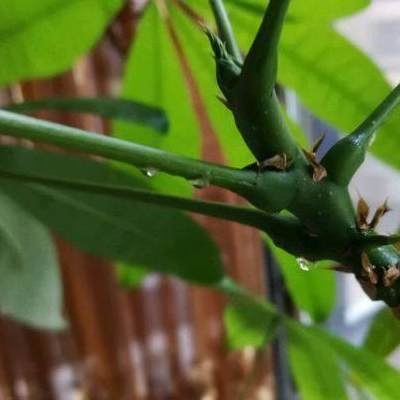
When a potted money tree at home oozes dew-like sticky liquid, shows small white dots and spots on the leaves, what is the cause?
The money tree may have been attacked by pests, and these are scale insects.
The control methods are as follows:
1. Mix baijiu (Chinese liquor) with water at a ratio of 1:2, and when treating the pests, pour it through the surface layer of the potting soil. Scale insects begin their activity in spring when the room temperature reaches 7°C. You can water once in mid-April, then about once every half month, and results appear after 4 consecutive treatments.
2. Use 50 ml of food vinegar, dip a small cotton ball in the vinegar, and gently wipe the stems and leaves of the affected plant with the wet cotton ball to wipe away and kill the scale insects. This method is convenient and safe; it not only achieves the goal of removing the pests but also helps the damaged leaves turn green and glossy again.
3. Use alcohol to gently and repeatedly wipe the affected potted plant; this can remove the scale insects, and remove them very cleanly and thoroughly. If you wipe diseased orchid leaves with alcohol, it not only removes the scale insects but also thoroughly kills larvae that are invisible to the naked eye, and the following year you will rarely find scale insect damage.
4. During the hatching period, before the larvae have settled, spray with pesticide once a week using omethoate or dichlorvos, and results can be seen after 3 to 4 consecutive treatments.
That is all for the causes of sticky sap oozing from a money tree and the handling methods. You should still take good care of your own money tree.
How do you control scale insects on chestnut trees? Methods for controlling scale insects on chestnut trees
Scale insects are the pest that chestnut growers dislike the most, so do you know how to control scale insects? Next, the editor will introduce the control methods for scale insects in detail.
Scale insects are the main pests harming chestnut trees. They attach to the inner branches and leaves, pierce and suck the sap, weakening the tree, causing leaves to yellow and branches to die. The scale insect mainly harming chestnut trees is the cottony cushion scale (Icerya purchasi). It overwinters on the branches and leaves in winter, and after temperatures rise in spring it reproduces in large numbers and damages the branches and leaves. At present, the chestnuts have already been harvested, which is the best time to control scale insects. Killing them off at this time reduces the overwintering population, and the damage next spring will be noticeably reduced.
Methods for controlling scale insects on chestnut trees:
After the chestnut trees are harvested, carry out orchard cleaning in time, remove all kinds of weeds and fallen branches, leaves, and fruit around the chestnut trees, prune off the dried and dead branches on the canopy damaged by pests and diseases, and bury them deeply or burn them together outside the orchard. Apply a healing and antiseptic membrane to the pruning cuts in time to protect the wounds and help them heal quickly, then spray the canopy once with a 500-fold dilution of Hushu Dajiangjun. After an interval of 15-20 days, spray the canopy again with lime sulfur at 0.8-1 degree Baume plus an aqueous solution of Hushu Dajiangjun. Spray evenly and thoroughly to wet all branches and leaves inside and outside the canopy, until water droplets begin to drip down.
How to completely kill scale insects
For people who grow succulents, scale insects are the hardest thing to escape. Summer is the peak period for scale insects, and some succulent growers may have already discovered traces of scale insects. If not, then that is of course even better.If you discover scale insects, there is no need to panic too much
Succulent plants will, more or less, sooner or later, have some chance of a scale insect outbreak. The reason is that scale insects are just too powerful. They not only harm succulents but are also the number one among the three major piercing-sucking pests in landscaping (the other two are spider mites and aphids), harming many kinds of plants, and they are also the hardest to control. Another point is that scale insects like hidden environments, and overly dense branches and leaves help them survive and reproduce. Succulent leaves are not just overly dense, they are extremely dense, so it is only normal for them to be targeted by scale insects.
If you discover scale insects, there is also no need to try to clean them out all at once
When you think about killing them all and cleaning them out completely, you may run into the awkward situation of killing both the pests and the plant, and you may even become nervously overcautious. This is because scale insects are really hard to clean out completely. Scale insects themselves reproduce in large numbers, there are few special-effect pesticides for controlling them, and eggs may remain in the soil. But there is no need to be too discouraged. Generally speaking, a small remaining number of scale insects will not have too serious an effect on succulents. When you think about wiping them out, you will find that scale insects actually cannot withstand many rounds of your efforts, and at least you can ensure that all the ones you can see are killed. It is just that scale insects are foolish and do not learn their lesson, and after a while they will want to play happily with your succulents again.
Actually, there are also times when scale insects are easy to kill
Scale insects generally have 1 to 3 generations per year, with a few having 4 to 5 generations. Before nymphs transform into adults, there is often an intermediate stage in which their appearance becomes sluggish and some even stop feeding. This time is around Jingzhe each year, and the second is from the end of May to early June. At this time most nymphs have hatched not long ago, their body surface has not yet secreted wax, and the scale cover has not yet formed, so they are still easy to kill with pesticide. Spray once every 7 days for 2-3 consecutive treatments. In early winter, it is the best time to kill the eggs. Spray the whole plant with a 1000-fold dilution of 40% Supusha or a 2000-fold dilution of 40% pure chlorpyrifos, which can basically ensure that scale insects will not break out greatly throughout the year. If you can seize these three opportunities to spray, the effect will be twice the result with half the effort.
So how do you wipe out scale insects?
1. Physical killing: use a needle, toothpick, or tweezers to pick them off one by one and kill them. This is suitable when the infestation is not yet very serious, for the fat, large scale insects on stems or on the back of leaves. Of course, I absolutely will not tell you that behind one cockroach there are N cockroaches. I will only tell you that for some especially formidable scale insect species, one female can lay from over a thousand to several thousand eggs, and with 2-3 generations a year, it is like child's play. For a small number of scale insects, you can directly pick them to death with a needle, but note that scale insects work as a gang... there may still be many in places you cannot see.
2. Send them away: use a pneumatic spray bottle or a tap spray head to spray water on the affected areas. As long as the water flow is strong enough, they can generally be washed away quite cleanly. You can also combine this with the pesticide spraying of method 4, replacing tap water with a very low-concentration pesticide solution, and any individual larvae not washed away will also be killed, because adult scale insects are mainly the ones difficult to kill with pesticide. However, this method has a drawback: the skin easily comes into direct contact with the pesticide solution.
3. Alcohol killing method: you can buy disinfecting alcohol at a pharmacy, with a concentration of 75% or higher, dip a brush in an appropriate amount of alcohol, and repeatedly wipe the infested areas. This can remove scale insects and remove them very cleanly and thoroughly. If the leaves are too dense and difficult to wipe, you can directly pour alcohol on the leaf center where the infestation is severe. Generally, those reached by the alcohol will die. After observing for a few days, if you still find more, continue using alcohol. This is suitable for a small number of succulents whose scale insect infestation has already exploded and whose leaf centers are already densely covered with scale insects.
4. Spraying pesticide: personally, I think the most effective is Guoguang Jiebizhi. I have also used insecticides claiming to be low-toxicity, such as Huhuashen, Supusha (pirimiphos-methyl), and matrine, but after spraying, it felt like they did not kill them cleanly. Guoguang Jiebizhi advertises itself as having strong fumigant, penetrating, contact-killing, and stomach-poison effects, and as being able to pass through the waxy shell of scale insects to act directly on the insect body, killing nymphs and adults, and also having good control effects on eggs. However, I have experienced phytotoxicity when using Guoguang Jiebizhi. It is recommended to prepare the solution at a concentration a little lower than the minimum concentration in the instructions. If you are not sure what concentration is suitable, you can first prepare a small amount and test it on Hongzhiyu and Jilongyue. As long as they do not suffer pesticide injury, other succulents generally will not have problems. In addition, when preparing it, you can also add a small amount of alcohol to improve the control effect, especially against scale insects that have developed resistance. It is recommended to spray in the evening or at night to avoid pesticide injury or sunburn caused by too-strong light right after spraying.
5. Burying pesticide: using the above methods, you can basically kill all the visible scale insects, but most of the eggs are in the soil, and after hatching they crawl up again (so for succulents bought from greenhouses, it is best to discard the soil and properly wash the roots). In addition, there are also root mealybugs at the base of the roots. Burying pesticide can nip scale insects in the bud and can also kill those unseen root mealybugs. If burying pesticide, carbofuran and Bayer Xiaolüyao are both good choices. Taking carbofuran as an example, carbofuran has systemic, stomach-poison, and contact-killing effects, has strong toxicity, a long residual effect period, fast results, is not afraid of rain, and has low cost.
It is worth noting that spraying and burying pesticide definitely pose certain risks to human health, especially carbofuran and Bayer Xiaolüyao, which are banned in some countries. As mentioned above, a small number of scale insects actually will not have too great an effect on succulents, so whether to use them or not is something you can judge for yourself. Later stages of scale insects... although there are quite a few transmission routes for scale insects, sometimes one succulent will be densely covered with scale insects while the succulents next to it have very few or none visible, but that does not mean it is safe...
That is all for the introduction to killing scale insects on succulents. I hope everyone can gain something from it!