How to Grow Passion Fruit from Seed in a Small Pot and Why It Only Flowers Without Fruiting
Passion fruit is something many people know as a fruit, and fruit also contains seeds. How do you grow passion fruit seeds in a small pot? Why does passion fruit only flower without fruiting:
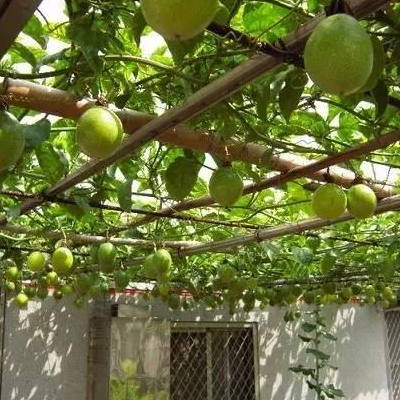
It likes a warm, humid environment, must be planted with good drainage, and needs light but frequent fertilizing, and then passion fruit can maintain a vigorous growth state. Before the flowering period, potassium dihydrogen phosphate can be given appropriately. If there are no insects for pollination during the flowering period, then manual pollination can be done to help it fruit.
Different varieties of passion fruit also produce different flowers. This friend's variety has purple flowers mixed with white, generally blooming in the afternoon. The flowering period is not long, but it is still quite beautiful.
Purple varieties of passion fruit can be pollinated by insects, otherwise they cannot fruit. If it is a yellow variety of passion fruit, then it is a bit more troublesome. Its stamens and pistils grow in a special way, with the stamens and pistils far apart, requiring cross-pollination, and insects also find it hard to ensure the pollination rate, so manual cross-pollination is needed for it to fruit easily.
If what you planted is a passion fruit with yellow flowers, then it definitely needs manual cross-pollination to fruit. When pollinating, just dip a writing brush into the pollen and apply it directly to the pistil.
The passion fruit grown by a friend only flowered without fruiting. Later, after listening to the advice of an expert flower grower, the friend pollinated the flowers personally, and finally it fruited.
The growing method for potted passion fruit is the same as for soil cultivation. If passion fruit only flowers without fruiting, then pollination is needed.
How to Grow Passion Fruit: How Do You Grow Passion Fruit Seeds?
Passion fruit is a fruit with a rich fragrance, rich in various nutrients such as amino acids, vitamins, carotenoids, trace elements, and more. It helps digestion, refreshes the mind, invigorates the blood and strengthens the body, calms and relieves pain, reduces stress and lowers lipids, and has many other effects. Its taste is very good and its nutritional value is very high, so how do you grow passion fruit? Today, the editor will take everyone to learn about it.
I. Growing Passion Fruit from Seeds:
1. Seed soaking
Before sprouting, soak the seeds in clean water at 20°C to 30°C so the seeds absorb enough water and sprout faster. The soaking time varies depending on seed maturity and water temperature. The more fully mature the seeds, the longer the soaking time, and lower water temperature also requires a longer time. Generally, soaking for 5 to 6 hours is needed.
2. Sprouting
Seed germination needs to meet the required temperature, moisture and oxygen, and it is photophobic, so it should be placed in a dark place. It germinates fastest under conditions of suitable moisture, good air permeability, and 25°C to 30°C without light. Wrap the soaked seeds in wet gauze or a wet towel, place them in a large bowl or small basin, and wash them with 25°C to 30°C water 1 to 2 times a day. It is best to mix the seeds with fine sand 3 times the volume of the seeds, put them in a water basin, and turn and move them 1 to 2 times a day, adding water when the fine sand dries. The seeds need alternating temperatures, with 30°C for 8 hours and 20°C for 16 hours each day, so they sprout neatly. Under normal conditions, they can sprout in 5 to 6 days.
II. The Growing Environment of Passion Fruit:
1、Temperature
The most suitable growing temperature for passion fruit is 20°C to 30°C. Generally, it grows well at temperatures not lower than 0°C. At -2°C, the plant will be severely damaged or even die. Areas with an annual average temperature above 18°C are most suitable for planting and are likely to achieve high yields. Therefore, it is widely distributed in the warm and humid areas of southern China, especially in Hainan.
2、Water
Generally, passion fruit grows best under conditions with annual rainfall of 1500 to 2000 mm that is evenly distributed, while areas for commercial development and planting should not have less than 1000 mm. Passion fruit is relatively drought-tolerant, but if drought occurs, irrigation is still needed. If the soil is too dry, it will affect vine and fruit development. In severe cases, the branches will appear withered, the fruit will not develop, and fruit drop will occur. During the rainy season, pay attention to drainage.
3、Light
As a tropical fruit, passion fruit likes sufficient sunlight to promote vine growth and nutrient accumulation. Long-day conditions are favorable for passion fruit flowering. In areas with annual sunshine hours of 2300 to 2800 hours, passion fruit has good vegetative growth, accumulates more nutrients, grows vines quickly, fruits early, and yields abundantly. The most suitable growing temperature is 20°C to 30°C. Generally, it grows well at temperatures not lower than 0°C. At -2°C, the plant will be severely damaged or even die.
4、Soil
Passion fruit has strong adaptability and does not demand much from the soil. But for large-scale production, the soil layer should be at least 0.5 m, and the soil should be fertile, loose, and well-drained, with a soil pH of 5.5 to 6.5 being suitable.
The above is the passion fruit growing method introduced to everyone by Duorou Huapu. We hope it is helpful to everyone. Welcome to continue following Duorou Huapu to learn more about growing potted fruits and vegetables!
Plant a passion fruit on the balcony, and you will have more than you can eat all year round!
Balcony passion fruit
A flower friend: I heard that passion fruit has very high nutritional value, so I specially bought a lot to eat before getting pregnant. The leftover seeds after eating were accidentally thrown into a flower pot with soil on my balcony. Unexpectedly, they actually sprouted. I watered the potted passion fruit seedlings, and they grew crazily, soon covering the whole balcony, and they fruited all year round. Even if the whole family ate freely, they could not finish them all. The money for buying passion fruit was saved, hahaha!
Below, I will share with flower friends some tips and precautions for growing passion fruit in pots on a balcony:
1. For choosing the potted location, it is best to choose a sunny, wind-sheltered balcony, and there must be a trellis for it to climb.
2. For choosing the potting soil, the soil for growing passion fruit must be soft and well-drained. Although it is drought-tolerant, attention should still be paid to watering in summer to avoid excessive drought affecting growth.
3. For the water requirements of potted plants, passion fruit is not tolerant of shady and damp environments and is somewhat drought-tolerant, but potted cultivation still requires attention to water supply to avoid affecting vine and fruit development. When it is too dry, the fruit will easily drop.
4. For the light requirements of potted plants, full sun or partial sun are both acceptable, but if you want passion fruit to bear more fruit, it is best not to plant it in a relatively shady place.
5. Passion fruit is a climbing plant, so a trellis must be set up to guide the vine growth.
6. Generally, passion fruit plants planted in spring can bloom by May, and a long-day environment is even more favorable for flowering and fruiting.
7. During the growth period, passion fruit needs to be pinched back many times, which can effectively promote the growth of side buds.