Fujian Tea Bonsai Styling Methods and Price Explained
Fujian tea bonsai: many people enjoy growing this type of bonsai. To grow a Fujian tea bonsai into a fixed shape requires styling. How do you style a Fujian tea bonsai? How much does a Fujian tea bonsai cost:
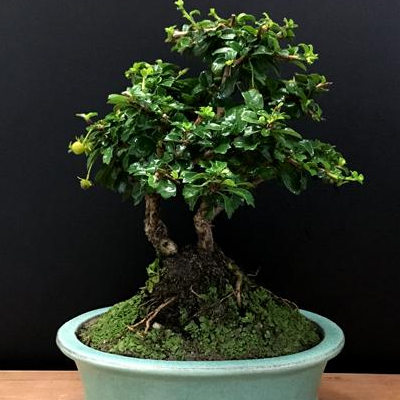
How to style a Fujian tea bonsai:
To make a Fujian tea bonsai, you can select robust one-year-old branches or current-year semi-lignified branches in spring or the plum rain season for cutting propagation; you can also use root cuttings from early summer to early autumn to obtain seedlings; in the south, you can also go into the woods to select and dig up wild stumps or young trees, and after cultivating them until they survive, process them and pot them up.
Fujian tea has extremely strong growth vigor and is extremely tolerant of pruning, making it suitable for the "grow branches and truncate trunk method" used in Lingnan bonsai, using repeated pruning and processing to make the branches and trunk achieve a naturally twisting, vigorous and powerful effect. Common tree forms include the straight-trunk style, double-trunk style, slanting-trunk style, multi-trunk style, forest style, cliff style, rock-clinging style, and so on.
Fujian tea is an evergreen small shrub with dense branches, and there are three types: large-leaf, medium-leaf, and small-leaf. Among them, small-leaf Fujian tea grows slowly, has small leaves, is dark green, glossy and lovely, has a well-developed root system, with gnarled and intertwining roots, and an antique and elegant posture that people adore.
Fujian tea has strong sprouting ability and is tolerant of pruning. The "grow branches and truncate trunk" method is often used to make a natural-style large tree-form bonsai. That is, when the young tree used for bonsai has grown to a certain thickness, carry out severe pruning and truncation (cut away most of the trunk), and at suitable positions and angles retain 1 to 2 or 3 to 5 branches as first-level side branches; when the second-level branches on them have grown to a certain thickness, retain one or two branches and cut them short to promote the growth of third-level branches; proceed in sequence, year after year, truncating the trunk and growing branches.
When the branches and leaves are too dense, besides cutting off vigorous water shoots at any time, carry out pruning once each in early summer and mid-autumn every year. When pruning, it should also be done according to the "grow branches and truncate trunk" method. After pruning in this way for several years, it will be cultivated into a bonsai with a vigorous and antique trunk, graceful branches and leaves, and a beautiful tree form.
The price of Fujian tea bonsai:
If you do not want to make a Fujian tea bonsai yourself, you can also choose to buy one. Fujian tea bonsai are not expensive, ranging from several tens to over a hundred yuan per plant. Let's look at a few examples to get an idea.
(1) Wanglin Horticulture's Fujian tea, height between 15cm-20cm, reference price 32 yuan.
(2) Jingruxuan 6-year Fujian tea bonsai, height between 40cm-50cm, reference price 129 yuan.
(3) Huayou Zhijia Fujian tea bonsai + rockery, height between 20cm-25cm, reference price 88 yuan.
Fujian tea bonsai prices vary, so choose according to the height and size you prefer.
The styling methods and prices of Fujian tea bonsai are introduced here. Get one for your home right away.
Making Miniature Bonsai
Making Miniature Bonsai
Plant bonsai are measured by the height of the plant above the soil, and landscape bonsai are measured by the length of the pot. Any that are below 10 cm belong to miniature bonsai. Characteristics of miniature bonsai:Small in size, taking up little space, light in weight, short time from planting and styling to viewing, and inexpensive.
The conception, making, and general principles of miniature bonsai are basically the same as ordinary landscape bonsai or plant bonsai. Because miniature bonsai have small pots, the plants used should have fine branches and small leaves, strong adaptability, and the styling should not be too complex. The maintenance methods are basically the same as ordinary bonsai, only requiring more careful management.
Miniature bonsai are small in size, and a single piece displayed alone looks monotonous and insignificant. Generally, several pieces are placed on a curio shelf. It is best to place different types of miniature bonsai together with 1-2 exquisitely crafted small handicrafts on the curio shelf, giving a sense of dazzling variety and richness.
Two miniature bonsai and a curio shelf
① Fan-shaped curio shelf. ② Irregular-shaped curio shelf.
Miniature bonsai have tiny forms, are exquisite and ingenious, lively and varied, and are highly flexible in arrangement. They can be placed on a desk or combined within a curio shelf, vividly reflecting the spirit and bearing of nature, and are deeply appreciated.
I. Materials for miniature bonsai
1. The plants of miniature plant bonsai should not exceed 10 cm in height (calculated by the part of the plant above the soil). The plant materials selected should have the characteristics of small leaves, short and thick trunks, strong adaptability, tolerance of pruning, ease of styling, and ease of survival, such as Serissa japonica, Chinese elm, Sageretia thea, Fujian tea, Gardenia jasminoides 'Radicans', small-leaf Podocarpus macrophyllus, Chinese fan palm, Buxus sinica, Buxus sinica var. parvifolia, Buxus sinica 'Pearl', Caragana sinica, small pomegranate, Berberis, small Cycas, small Ficus, small Bambusa multiplex, small chrysanthemum, Diospyros cathayensis, black pine, Rhododendron simsii, Bambusa multiplex 'Fernleaf', dwarf Asparagus setaceus, Adina rubella, and so on.
2. For the rocks of miniature landscape bonsai, those with beautiful texture, natural form, lustrous color, and elongated shapes with edges and corners are best. If there are caves in the rocks, even better. Commonly used stone types include petrified wood, Yingde stone, ax-cut stone, sea mother stone, pumice, reed tube stone, stalactite, and so on.
II. Pots for miniature bonsai
Miniature bonsai use relatively small pots. The mouth diameter of a tall cylindrical pot should preferably be 4-5 cm, that of a round or square pot 5 cm, and that of a shallow rectangular or oval pot 10 cm.
Miniature plant bonsai mostly use antique purple clay pots or glazed ceramic pots. The shape, depth, and color of the pot should coordinate with the leaf shape, leaf color, and the colors of flowers and fruits of the planted material, and should closely match the posture of the tree stump specimen. Household containers can also be used as pots, such as ashtrays, teacups, small bowls, bird food jars, and so on, but holes must be drilled in the bottom to facilitate drainage, otherwise the plants are prone to root rot.
Miniature landscape bonsai mostly use shallow long pots or oval pots, with materials such as white marble, marble, and alum stone being more common.
III. Making miniature bonsai. The sources of stump material for miniature plant bonsai are mainly obtained through grafting, cuttings, division, seedling cultivation, and digging up small wild tree stumps. Styling uses methods such as wiring, pruning, and root raising. During operation, one must be careful and meticulous, delicate and fine, striving to apply skill and force appropriately, expressed on the branches and trunk, so that small trees and tender branches show the appearance of an "ancient large tree" with twisting, vigorous strength and calm temperament, skillfully combining external form with inner temperament. Styling should be simple rather than complex, using a freehand brushwork approach, emphasizing the expression of posture, and achieving a fusion of spirit and form. After processing and styling, the stump material should first be transplanted into a slightly larger clay pot for cultivation, and after 1-2 years transplanted into an antique small pot of suitable shape, size, depth, and color for final planting, which can increase the survival rate.
The making of miniature landscape bonsai includes material selection,
processing, layout, embellishment, and so on. Generally, the close-to-middle view style within the weighted-side type is used, and attention should be paid to the proportion between the pot and the mountain peaks and to the beauty of the artistic conception. Because miniature landscape bonsai use relatively small stones, they are hard to find if lost when moved. After the styling is completed, it is best to glue the rocks to the surface of the pot with water-resistant adhesive.
On the Innovation of Lingnan Bonsai
After nearly a hundred years, through the efforts of several generations of Lingnan bonsai artists, Lingnan bonsai has gone from an embryonic form to gradual maturity, and has finally developed a school of its own and become a unique style. To this day, the Lingnan school of bonsai has been recognized by the world, and its influence at home and abroad is growing ever greater, becoming the most vigorous, most distinctive, most promising, and most influential bonsai in the domestic bonsai world. Many foreign bonsai enthusiasts speak ever more highly of Lingnan bonsai.
▲Yu Jingtu's work "Hundred Birds Returning to the Nest" (Sageretia thea, 120×70×80cm)
▲Yu Jingtu's work (black pine)
Lingnan is located in the subtropics, with high temperatures year-round, high humidity, abundant sunlight, and ample rainfall, suitable for the growth of various plants. In particular, shrub-type trees can grow year-round, such as Podocarpus macrophyllus, Murraya paniculata, Fujian tea, Sageretia thea, elm, kapok, banyan, mountain orange, acacia, crape myrtle, five-leaved maple, bougainvillea, red Loropetalum, red cattle, boxwood, masson pine, mountain pine, black pine, water pine, water horizontal branch, red fruit, Tang pear, black bone fragrant, Bolan, fragrant nanmu, red poplar, spring flower, mountain lattice wood, crab claw fragrant, baby's breath, pomegranate, pepperwood, bird's perch, toothache tree, and so on. These are all good materials for Lingnan bonsai.
▲Yu Jingtu's work (elm)
▲Yu Jingtu's work (Fujian tea, height 70cm)
Therefore, Lingnan bonsai is mainly based on miscellaneous broadleaf trees, supplemented by pines and cypresses. Miscellaneous broadleaf bonsai have a long annual growth period, basically without a winter dormancy period. Although a small portion have a winter dormancy period, it is short, only about one month, so they are very suitable for the Lingnan bonsai production methods of growing branches and truncating trunks, and stripping leaves and changing brocade. Pines and cypresses grow slowly, especially cypress trees, whose branches are soft, not easy to produce horizontal angular branches, and grow particularly slowly, so they are not very suitable for making Lingnan bonsai.
▲Yu Jingtu's work (Chinese hackberry)
The biggest difference between Lingnan bonsai and domestic brother schools and foreign bonsai is that Lingnan bonsai artists create Lingnan bonsai according to the principles of Chinese painting. They first conceive based on the hidden or exposed roots of the tree stump, the direction of the roots, and the form of the trunk - what form of bonsai will it be created into in the future? Lingnan bonsai, like Chinese painting, emphasizes artistic conception. The author applies his creative ideas and emotional expression to the entire process of creating the bonsai. During the creation process, according to the direction and form of the roots, stump, and trunk, the support positions and branch distribution as well as the position of the top are selected to properly handle the relationships between looking back and looking forward, gathering and scattering, and closing and opening. When these relationships are handled well, a Lingnan bonsai has qi openings (called leaving blank in Chinese painting), clear layers, strong three-dimensionality, emotion lodged in the scene, and inspires reverie. This is a silent poem and a three-dimensional painting.
▲Yu Jingtu's work (Sageretia thea)
Because Lingnan bonsai is created according to the principles of Chinese painting, the production process is very strict. One extra stroke (one branch support) or one fewer stroke will affect the effect of the entire bonsai.
▲Yu Jingtu's work (crape myrtle)
The main method of making Lingnan bonsai is growing branches and truncating trunks. If the trunk is not truncated, it is just a large tree and cannot be made into a bonsai of several tens of centimeters to over one meter. Of course, growing branches and truncating trunks is not limited to Lingnan school bonsai; other schools and foreign bonsai production also use this method. But what makes Lingnan bonsai's growing branches and truncating trunks different from other schools is that the support branches and distributed branches are shrunk from dragons into inches. In the words of old artists of the past, it is "one inch, three cuts." Because the production methods of growing branches and shrinking dragons into inches are used, from the selection of support positions to the distribution of branches and the layout of the entire bonsai, it is all made according to painting principles.
▲Yu Jingtu's work "Within Easy Reach" (Sageretia thea, trailing length 70cm)
Truncation is to control the proportion of branch supports, carried out segment by segment from thick to thin, like painting, where one segment is one stroke. Shrinking dragons is to arrange the direction of branches, guiding branches to reasonable positions according to the layout. Becoming inches is short, fast, and powerful, making the branch supports appear vigorous and forceful, revealing the support positions and the direction of branches, and making the layers clear. Lingnan bonsai reveals much and conceals little. Therefore, creating a mature Lingnan bonsai takes quite a lot of time and requires great skill.
Because Lingnan bonsai benefits from the unique climate conditions of the Lingnan region and is created according to the principles of Chinese painting, using the production methods of growing branches and truncating trunks and shrinking dragons into inches, Lingnan bonsai can originate from nature yet rise above nature. Through the long-term unremitting efforts of bonsai artists, the bonsai created are not confined to one pattern and are diverse in form.
From the early single form of close-to-tree styling and short-stump large trees, to the continuous creation of the cliff type, water-facing type, slanting-trailing type, moon-embracing type, kapok type, cloud head and rain feet, and so on. From single-trunk single plants to multiple trunks and even forest types. Especially in the past twenty to thirty years, excellent bonsai with strong Lingnan characteristics such as high falling branches, large spreading branches, and turning-back branches have been created. Because these large branches do not grow at the top, do not grow upward, but grow downward or horizontally, they are particularly difficult to cultivate. They grow slowly and must have a certain thickness and variation, so the cultivation time required is particularly long. In cold regions, where the annual growth period of plants is short, it is very difficult to create bonsai with large falling branches, large trailing branches, and large spreading branches. Only in the subtropical Lingnan region is it easy to cultivate and create such bonsai.
Stripping leaves and changing brocade is another technique for making Lingnan bonsai. For tree species such as acacia, Sageretia thea, Fujian tea, and Murraya paniculata, this method can be used two to three times a year, removing all the leaves and modifying and trimming the branches. This production method of stripping leaves and changing brocade is to better grow branches, sprout more buds to grow fine branches, accelerate the maturity of the bonsai, and shorten its cultivation time. After stripping leaves and changing brocade, the bonsai changes into another appearance. Although it is carried out in spring, summer, and autumn, when people see it, it feels as if it is winter, like after snow when the plants have no leaves at all, like a winter scene. More importantly, because no leaves can be seen and only branches are visible, each branch is like each stroke in a painting, and even the slightest disorder can be seen clearly. It is simply a fine brushwork painting.
Internationally, there is a certain limit on the height of bonsai, stipulated to be below one meter. But the people of Lingnan dare to innovate and keep pace with the times. As people's living standards improve and the home environment changes, more and more people have spacious homes and courtyards. Short and small bonsai can no longer meet the needs of their spacious environments, so in the past decade or so, Lingnan bonsai artists have begun to create large bonsai again. In Guangdong and other places, people have already created many large Lingnan bonsai over 1.5 meters. These large bonsai enter villa districts and large courtyards, are very favored, and sell at high prices with good economic benefits. More and more people like large bonsai. Large bonsai are an important aspect of the future development of Lingnan bonsai.