How to grow a Fukien tea bonsai? Causes of leaf drop and solutions
Fukien tea bonsai, this kind of bonsai is loved by many people; it is just that lovable. How do you grow a Fukien tea bonsai? What should you do if a Fukien tea bonsai drops its leaves:
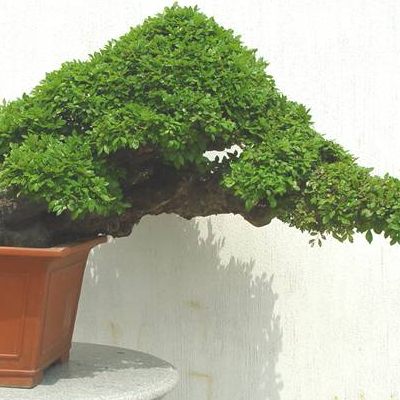
How to grow a Fukien tea bonsai:
(1) Placement. Fukien tea likes warmth and fears cold. If grown in a pot in the Yangtze River basin and northern regions, it should be placed in a space with good light, ventilation and humid air. In winter it must be moved into a greenhouse, with the temperature kept above 10 degrees Celsius, and a certain humidity maintained.
(2) Watering. A Fukien tea bonsai must maintain sufficient moisture; the soil must not be dry, and the leaves should also be sprayed with water frequently. It is even better to grow a layer of moss on the potting soil, which can retain moisture better.
(3) Fertilizing. From late spring to early autumn each year, apply 1-2 times a month of decomposed cake fertilizer water; in winter only one application of base fertilizer is needed.
(4) Pruning. Prune once each year in May in spring and September in autumn, removing excess branches that affect its appearance.
(5) Repotting. Repot once every 2-3 years, with late spring to early summer being the suitable time. When repotting, replace half of the old soil, replace it with fertile soil, and cut off old and dead roots.
(6) Pest and disease control. The common pest of Fukien tea is scale insects, which can be removed by manual brushing and washing.
What to do if a Fukien tea bonsai drops its leaves:
A Fukien tea bonsai generally drops its leaves because of light and lack of water, especially lack of water, which directly makes it a dried flower, and also causes leaf drop. Pay attention to watering, and do not expose it to strong sun.
That is all for the introduction to the cultivation methods for Fukien tea bonsai and the ways to deal with leaf drop. Get one at home quickly.
How to shape a Fukien tea bonsai and how much it costs
Fukien tea bonsai, this kind of bonsai is loved by many people; growing this Fukien tea bonsai into a fixed shape requires shaping. How do you shape a Fukien tea bonsai? What is the price of a Fukien tea bonsai:
How to shape a Fukien tea bonsai:
To make a Fukien tea bonsai, you can select vigorous one-year-old branches or current-year semi-lignified branches in spring or the plum rain season for cutting propagation; you can also use root cuttings from early summer to early autumn to obtain seedlings; in the south you can also go into the woods to select and dig wild stumps or young trees, and after cultivating the material until it survives, process it and pot it.
Fukien tea has extremely strong growth power and is extremely tolerant of pruning, suitable for the "grow branches and truncate the trunk method" used in Lingnan bonsai, using repeated pruning and processing to make the branches and trunk achieve a natural, twisting, vigorous and powerful effect. Common tree forms include straight trunk style, double trunk style, slanting trunk style, multi-trunk style, forest style, cascade style, root-over-rock style, etc.
Fukien tea is an evergreen small shrub with dense branches, and there are three types: large-leaf, medium-leaf and small-leaf. Among them, small-leaf Fukien tea grows slowly, has small leaves, is dark green, glossy and lovely, has well-developed roots, twisted and interlaced roots, and an antique and elegant posture, making it lovable.
Fukien tea has strong sprouting ability and is tolerant of pruning. The "grow branches and truncate the trunk" method is often used to make a natural large-tree-form bonsai. That is, when the young tree used for bonsai has grown to a certain thickness, carry out severe pruning (cut off most of the trunk), and at appropriate positions and angles keep 1 to 2 or 3 to 5 branches as first-level side branches; when the second-level branches on them grow to a certain thickness, keep one or two branches and cut them short to promote the growth of third-level branches; proceed in turn, year after year, truncating the trunk and growing branches.
When branches and leaves are too dense, besides cutting off water sprouts at any time, carry out one pruning each year in early summer and mid-autumn. When pruning, it should also be done according to the "grow branches and truncate the trunk" method. After pruning in this way for several years, it will be cultivated into a bonsai with a vigorous and antique trunk, dancing branches and leaves, and a beautiful tree form.
The price of Fukien tea bonsai:
If you do not want to make a Fukien tea bonsai yourself, you can also choose to buy one. Fukien tea bonsai are not expensive, costing from tens to over a hundred yuan per plant. Below are a few examples to help you understand.
(1) Wanglin Gardening's Fukien tea, height between 15cm-20cm, reference price 32 yuan.
(2) Jingruxuan 6-year Fukien tea bonsai, height between 40cm-50cm, reference price 129 yuan.
(3) Huayou Zhijia Fukien tea bonsai + rockery, height between 20cm-25cm, reference price 88 yuan.
The prices of Fukien tea bonsai vary, so choose according to the height and size you like.
That is all for the introduction to the shaping methods and prices of Fukien tea bonsai. Get one at home quickly.