A detailed guide to making Fukien tea bonsai: does it need sun?
Fukien tea bonsai is something many people love to grow; having one at home is truly a joy. What is the method for making Fukien tea bonsai? Does Fukien tea bonsai need sun?
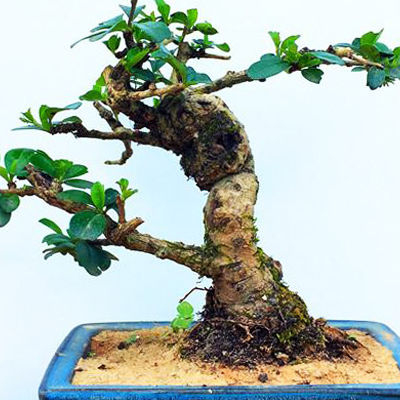
Fukien tea bonsai making method:
(1) Styling: usually done by cuttings. In spring or the plum rain season, choose healthy one-year-old branches or current-year semi-lignified branches for cuttings; you can also propagate by root cuttings from early summer to early autumn to obtain seedlings. In southern China, Fukien tea is often found in evergreen broad-leaved forests or thickets on low hills, where wild stumps or young trees can be dug up, cultivated until they survive, and then worked on and potted.
Fukien tea has strong growth vigor and is especially tolerant of pruning. You can use the "grow branches and cut the trunk" method common in Lingnan bonsai, shaping the branches and trunk into natural twists and strength through repeated working and pruning. The tree can also be styled as formal upright, slanting, forest, cascade and other forms.
(2) Potting: this process is best done in early summer. First choose a pot; you can use a glazed ceramic pot or a purple clay pot. The pot shape is generally a deeper rectangular or oval one; if the style is a forest planting, choose a longer rectangular pot, and if the style is cascade, a deeper round or square pot is more suitable.
Fukien tea should use slightly acidic pond mud rich in humus, loose and fertile, mixed with an appropriate amount of river sand. The bottom of the pot is best lined with river sand or vermiculite to help with aeration and drainage.
Does Fukien tea bonsai need sun:
Fukien tea bonsai does need sun, otherwise it will die, but it must not be exposed to scorching sun, and it must not be too dry or it will drop leaves.
That is all for the Fukien tea bonsai making method. Occasionally you should still take the Fukien tea bonsai outside to get some sun.
When is the best time to repot a tree stump bonsai? An introduction to tree stump bonsai repotting methods
April is a good time to repot bonsai: potted trees grow in limited potting soil, and after a certain number of years the fertility is exhausted, the soil layer hardens, the roots become densely packed and press against each other, and new roots struggle to grow. It is best to switch to a larger pot and fill it with fresh soil (changing the soil without changing the pot is also fine) to ensure the normal growth of the potted tree; experts habitually call this "repotting." Repotting intervals: flowering types, once every other year; deciduous miscellaneous trees, once every 2 to 3 years; pines and cypresses, once every 3 to 4 years. By tree age: miniature bonsai, once a year because the pot is small; young trees, once every 2 years; mature trees, once every 2 to 3 years; old trees, once every 4 to 5 years. Repotting season: generally it can be done in both spring and autumn, with spring being better. In spring, usually from late February to late April; in autumn, mid-October to mid-November is suitable. But because the physiological characteristics of potted trees differ, the repotting season also varies. For example, elm is cold- and drought-tolerant, so it can be repotted around Major Cold; while orange jasmine, Fukien tea, Japanese bush cherry, small-leaved fig and others share the traits of liking warmth and fearing cold, so repotting should properly be done around Qingming.
Repotting method: before repotting, the potting soil should be slightly dry. Use a bamboo stick to loosen part of the soil around the sides of the stump, turn the pot upside down and lift it, and take out the potted tree together with the soil. Use a bamboo stick to remove the old soil around the roots, but be sure to keep the soil ball attached to the roots. How much of the soil ball to keep varies with tree species. For pines and cypresses, about half can be kept, while for elm, skyflower, azalea, gardenia and tree species with many fine roots that grow easily, most of the old soil can be removed. Then cut off some aged fibrous roots so that new roots will grow. Before repotting, prepare dry mud or river mud and divide it into coarse, medium and fine grades; the coarse grade is about the size of a thumb. Cover the drainage hole with a curved tile, put the coarse soil particles at the bottom of the pot to help drainage and aeration, place the stump in a suitable position in the pot (the ratio of tree to pot edge should generally be 4:6 or 3:7, that is, the tree slightly offset to any side, left, right, front or back, is better), place the slightly finer soil around the stump roots and press it close to the roots, then cover the pot surface with coarse soil, and use a bamboo stick to poke it firm and press it tight so the stump is stable. Then water twice with a watering can; the first time can be called the settling water, until water seeps from the drainage hole at the bottom of the pot, and about 15 minutes later water a second time, making sure the roots and branches absorb enough. Place it in a shady, wind-sheltered spot; afterward water once every three or four days and mist the trunk once or twice a day. Only after a week move it outdoors into the sun. Do not fertilize within one month. For a newly repotted stump, it is best to cut off all the leaves to reduce water evaporation. The pot used must be washed clean; if using an old pot, scrub it clean first and dry it in the sun before use; if using a newly purchased pot, soak it in water for one or two days, commonly called "removing the fire," so it absorbs water before use.
Indoor bonsai management methods
The main thing is frequent sun and ventilation. If a bonsai is placed in the living room or indoors for a long time, because these places are poorly ventilated, the stump's leaves turn yellow, drop, disease and pests appear, branches die, and eventually the tree dies. All of this is caused by not getting enough sunlight, poor ventilation and improper watering. Usually when we are at work, or resting at night, when we are not enjoying it, we can move it outside the window or onto the balcony to get some sun and air, take some dew at night, and when it rains move it outside to get rained on. Only in this way can the bonsai grow vigorously.During growth, a stump must absorb nutrients from the potting soil, but the potting soil has limited nutrients and cannot maintain the needed nutrition for long. A lack of fertilizer will make the leaves yellow, the branches weak, the flowers sparse and the fruit few, weaken resistance to pests and diseases, and lower ornamental value. For this reason, attention should be paid to adding appropriate fertilizer. But generally tree stump bonsai grows slowly, so it is not suitable to fertilize too much, lest it grow excessively and spoil the beauty of the tree's form. Fertilizing requires attention to timing and amount, and you must also master the type and content of the fertilizer.
Stump growth mainly needs three fertilizers: nitrogen, phosphorus and potassium. Nitrogen fertilizer promotes the growth of branches and leaves, phosphorus fertilizer promotes flower bud formation, larger and more colorful flowers, and earlier ripening of fruit, and potassium fertilizer promotes the growth of stems, trunks and roots. Fertilizing also differs according to tree species. Pine and cypress bonsai are not suitable for much fertilizer; too much fertilizer will make the needles longer, change the shape and affect ornamental value. Apply base fertilizer once each winter, and one light topdressing during the growing season is enough. Flowering and fruiting bonsai such as azalea, pomegranate, hawthorn, golden bullet and winter jasmine should be fertilized appropriately before and after flowering and fruiting; besides nitrogen fertilizer, some phosphorus fertilizer should also be applied. For miscellaneous tree stumps such as Japanese bush cherry, Chinese elm and trident maple, fertilizer should not be excessive; if the leaf color is normal, fresh green and glossy, then you can skip or reduce fertilization to maintain the beauty of the tree's form.
Fertilizing stump bonsai requires attention to several points: organic fertilizer or various cake fertilizers must not be applied unless decomposed; concentrated fertilizer must not be applied; it must be diluted before use. Newly potted stumps are not suitable for fertilization, and fertilization is not suitable during the rainy season, the dog days, or when the potting soil is too wet. Only by mastering the key points of fertilizing will fertilizer damage be avoided.
When brewing cake fertilizer, putting citrus peel in the fertilizer bucket will greatly reduce the smell. Add a little ferrous sulfate too; this kind of fertilizer water is very suitable for southern tree species such as Fukien tea, sago palm, banyan, orange jasmine and osmanthus. These tree species adapt to growing in acidic soil, but in the north the soil is neutral or slightly alkaline, which is unfavorable for these plants and often causes yellowing leaves and weak growth. Usually you can regularly apply some fertilizer water containing ferrous sulfate to make the leaves dark green and glossy. Compound fertilizer sold on the market can also be used, but be sure to pay attention to the amount; apply less when using it, so as not to burn the roots.
More information:
Making and caring for Japanese bush cherry bonsai Winter care of foliage bonsai plants
Xichang City will create a "National Forest City" Wuhan: Christmas tree prices fell 10% year on year