Boxwood Bonsai Care Methods and Price Detailed Explanation
Boxwood bonsai, this kind of bonsai is truly beautiful, making people love it uncontrollably. What are the care methods for boxwood bonsai? What is the price of boxwood bonsai:
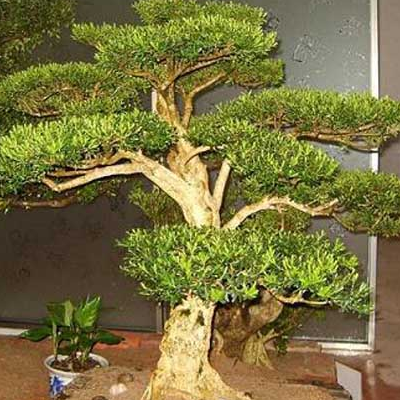
Boxwood bonsai care methods:
1. Watering
Watering boxwood bonsai differs from the general plant care principle of “don't water until dry, water thoroughly when you do”; its watering method is more complex. Boxwood naturally grows in areas with higher humidity, and when transplanted into a pot it cannot adapt, so it should be given plenty of water promptly to maintain a moist state. However, the watering method should also be adjusted according to the climate. For example, when there is sufficient water in the pot and the temperature is between 10°C and 20°C, the watering method is simply to mist the plant once a day; when the temperature is above 20°C, if the soil surface is dry, water to moisten the soil, then water thoroughly every corner of the foliage.
2. Light
Although boxwood likes light, it should not be placed in strong direct sunlight, which can easily damage its branches and leaves. Newly dug tree specimens should be placed in a shady, indirect-light location for cultivation for a period, then given routine care. After the boxwood has adapted to the new environment, it can be placed outdoors to grow naturally every 10 to 15 days, which can give it stronger vitality.
Prices of boxwood bonsai:
There are many varieties of boxwood bonsai, such as littleleaf boxwood, Chinese boxwood, pearl boxwood, and boxwood with melon-seed-shaped leaves. The price of boxwood bonsai is inseparable from the tree variety, the size of the trunk or tree shape, and the elegance and uniqueness of the styling. Boxwood bonsai prices range from over one hundred yuan to several thousand yuan, for example a 50 cm tall Chinese boxwood without a pot has a reference price of 650 yuan, a small pearl boxwood has a reference price of 380 yuan, and an 81 cm tall melon-seed-leaf boxwood without a pot has a reference price of 2,180 yuan.
That covers the care methods and prices of boxwood bonsai; you can get one for your home.
Care of Littleleaf Boxwood Bonsai, Prices of Boxwood Bonsai
Boxwood bonsai is a common type of bonsai. Boxwood grows relatively slowly but has a very long lifespan, so many people like to use boxwood to make bonsai.
Boxwood bonsai materials are mostly taken from wild old stumps by the waterside. Because of its small evergreen leaves and slow growth that is not prone to deformation, it has become an artistic treasure. Purple clay pottery pots are commonly used, with pot colors mostly purple or light yellow. The pot shape is determined by the styling form: for cascade style, a deep cylindrical pot is suitable; for slanting-trunk or curved-trunk style, an oval or rectangular pot is used. Today, the editor will briefly introduce boxwood bonsai care.
Littleleaf boxwood, an evergreen shrub or small tree of the Buxaceae family, likes warm, semi-shaded, humid climates, is drought-tolerant, cold-tolerant, and tolerant of pruning, is a shallow-rooted tree species, grows slowly, and has a long lifespan, making it an excellent tree material for making bonsai.
For bonsai material, one option is propagation by sowing or cuttings, but the cultivation time is long and it is very difficult to obtain good material with gnarled roots and exposed claws, vigorous and ancient-looking. The second option is digging up old stumps. Old stumps are best dug in summer, followed by spring and autumn, and worst in winter. After digging, the stump can be wrapped at the roots with plastic bags to retain moisture. When planting, remove the downward-growing main root and cut off most of the leaves to prevent water loss and ensure survival. You can first grow the stump in open ground, or directly pot it, but it must be cultivated for more than two years before styling and production.
For pot selection, Yixing purple clay pots or light-colored glazed ceramic pots can be used. The shape and size of the pot can be determined by the size of the stump and the styling form. In principle, cascade style should use a square or round cylindrical pot; slanting-trunk style, curved-trunk style, forest style, etc. should use round, oval, or rectangular pots.
Potting soil. Littleleaf boxwood likes fertile sandy loam. For potting soil, fertile, loose, well-aerated and well-draining sandy loam is best. You can also use a mixture of 40% furnace slag, 40% humus soil or garden soil, and 20% river sand.
The best time for potting is between spring and summer. When planting, cut off overly long and dense roots, and according to the needs of styling, modify the root system so that it spreads naturally in the pot. The planting depth should not be too deep. After covering with soil and watering thoroughly, place it in a semi-shaded area, keep the pot soil moist, and frequently spray water on the leaves. After about 30 days, once the plant has grown, it can be transferred to normal care.
Styling and production should be based on the plant's basic tree form, following its natural tendency for artistic styling. Styling techniques can include pruning and wiring, but wiring is best in summer and autumn, when the branches are more flexible and easy to bend; pruning is best done in spring. Although littleleaf boxwood has strong sprouting ability, "no leaf means no sprout"; therefore, whether for styling or routine pruning, for branches that are not in place, the method of "leave leaves section by section, shorten cuts to force buds" can be used, so that they gradually sprout downward into place, and one should not blindly pursue getting it right in one step.
Care and management. Littleleaf boxwood likes moisture and needs frequent watering. From May to August is the vigorous growth period of boxwood, and several applications of thin decomposed cake fertilizer can be made along with watering. Always pay attention to pruning excessive branches, overlapping branches, and surplus branches that affect the tree shape. Promptly remove the fruits produced by littleleaf boxwood to avoid consuming nutrients. For repotting melon-seed-leaf boxwood, generally small and medium pots can be repotted every 2 to 3 years, and large pots every 5 years; weak-growing plants should be repotted promptly. Along with repotting, cut off some overly long and dense old roots, replace with new culture soil, and replant.
Prices of boxwood bonsai
Boxwood bonsai is relatively cold-tolerant and has strong sprouting ability; with coarse wiring and fine pruning, it is made into cloud-layer shapes or steamed-bun shapes, or processed into natural tree forms. The trunk follows its natural tendency and is made into slanting-trunk or lying-prostrate style. Some boxwood bonsai are decorated with ornamental stones, forming a "boxwood recline." In spring, when the tender leaves first emerge, the whole tree is tender green and very pleasing to the eye. Among boxwood mountain stumps there is no lack of fine specimens, especially pearl boxwood. Pearl boxwood has lived for generations on high mountain ridges or in rock crevices, and through the harsh tempering of wind, frost, ice, and snow, it naturally grows into twisted branches, curved trunks, and unusual, varied tree forms, becoming excellent material for stump bonsai.
In the Yuan Dynasty, Hua Youwu's poem praising boxwood wrote: "A boxwood tree so close at hand, with whirling branches and heavy trunk, deep leaves like emerald in the garden, ancient roots resembling a coiled dragon. Through years of wind and frost long endured, often moistened by rain and dew thick. It should not meet misfortune in leap years, its firm substance compares to the cold pine." Boxwood bonsai has a graceful tree posture, leaves as small as broad bean petals, thick in texture and glossy, evergreen in all four seasons, and can be enjoyed year-round.
Yang-style boxwood bonsai, with branches and leaves processed by pruning and wiring into a "cloud-layer shape," flat and thin as if shaved, then dotted with mountain stones, elegant and beautiful as a painting. In spring, when boxwood's tender leaves first emerge, the whole tree is tender green and very pleasing to the eye. The ancients' poem praising boxwood: "A boxwood tree so close at hand, with whirling branches a thousand layers, deep leaves like emerald in the garden, ancient roots perched like a coiled dragon."
North of the Huai River is located in the warm temperate zone, where winter and spring are dry and cold with strong winds. After the leaves fall, there are few cold-tolerant, drought-tolerant evergreen trees. Oriental arborvitae, Chinese juniper, thousands-head arborvitae, boxwood, privet, photinia, littleleaf boxwood bonsai, littleleaf privet, and evergreen coniferous and broadleaf tree species introduced in recent years such as osmanthus, southern magnolia, camphor tree, Michelia maudiae, Elaeocarpus, palm, and Osmanthus heterophyllus. Some of these tree species are subtropical species and have been planted north of the Huai River for only a short time.
Species such as southern magnolia, camphor tree, Osmanthus heterophyllus, and Michelia maudiae show varying degrees of yellowing, greatly spoiling the scenery. The native evergreen trees are mostly shrubs; among tree species there are only cypress types, but because they grow slowly and have dark, monotonous leaf colors in winter, it is difficult to satisfy people's visual needs, landscape needs, and the needs of building a new countryside.
There are many factors affecting the price of boxwood bonsai; in terms of price, there are many influencing factors, such as tree shape, plant size, and so on. Therefore, the editor also finds it hard to blindly give everyone a price. Generally, an ordinary boxwood bonsai costs one hundred to several hundred yuan, and a good one may cost over a thousand yuan.
Conclusion: Boxwood bonsai is often used in gardens as hedges, edging for large flower beds, pruned into spherical or other shaped cultivation, dotted with ornamental stones, or made into bonsai. The wood is hard and fine-grained, and is a premium material for carving crafts. Today, the editor's introduction to boxwood bonsai ends here. If you want to learn about the habits of other plants, you can click the links below the article; more information is waiting for you.
[Boxwood Bonsai] Boxwood Bonsai Pictures_Price
❤
Boxwood bonsai can withstand severe cold and has very strong sprouting ability; in the cold winter it instead grows very vigorously. It needs coarse wiring and fine pruning to be made into cloud-layer shapes or steamed-bun shapes, and can also be processed into natural tree forms. The trunk generally follows its natural growth tendency and is made into slanting-trunk or lying-prostrate style.
❤Brief Introduction to Boxwood Bonsai
Some boxwood bonsai are decorated with beautiful ornamental stones of various shapes, becoming boxwood recline. The growing season of boxwood bonsai is spring; in spring the tender leaves first emerge, and the whole tree is emerald green, very pleasing to the eye. Among boxwood stumps there is no lack of fine specimens, especially pearl boxwood, which is very lovable.
The editor will also introduce the "pot" in boxwood bonsai. Generally, boxwood bonsai commonly uses purple clay pottery pots, with pot colors mostly purple and light yellow. The shape of the flower pot is determined by the styling form of the boxwood tree. Cascade style generally should use a deep cylindrical pot, while slanting-trunk style and curved-trunk style use oval or rectangular flower pots.
❤Daily Care of Boxwood Bonsai
1. Light conditions: boxwood bonsai avoids strong light.During the planting process, only indirect light should be used, and strong light must never be used for exposure. Newly planted boxwood bonsai, or those that have just been transported long distances or just repotted, should first be grown in a shaded indoor or sunless place for a period, then transferred to normal care.
2. Watering taboos.The boxwood tree originally grows by rivers or streams. When transplanted into a garden bonsai for planting, the environment changes greatly and the humidity is much lower, so we must supplement water for boxwood bonsai in a timely manner. The pot must often remain moist, so watering should pay attention to climate changes and emphasize technique and quality assurance.
3. Fertilization issues.Boxwood bonsai can be sprayed year-round on the leaves with very thin nitrogen fertilizer, such as diluted urea solution. Phosphorus fertilizer and potassium fertilizer must not be sprayed. It should mainly rely on root fertilizer and natural fertilizer, and mainly on human and livestock manure. Before seasonal changes, apply some seasonal fertilizer, for example spring fertilizer to promote budding, summer fertilizer to strengthen leaves, hot-weather fertilizer to resist temperature, and winter fertilizer to keep warm.
❤Introduction to Boxwood Bonsai Prices
The price of boxwood bonsai is affected by many factors such as stump type, specifications, and styling. Large ornamental boxwood bonsai are priced higher, and many sell for tens of thousands, while small boxwood bonsai placed indoors or in small gardens are priced between one hundred and several hundred. Generally, an ordinary straight-trunk melon-seed-leaf boxwood bonsai with a diameter of 3 cm and a height of cm usually costs around 120 yuan.
Conclusion:The above is the editor's introduction to boxwood bonsai and its prices. I hope it is helpful to friends who like boxwood bonsai. I wish you can buy the boxwood bonsai you like and add more greenery to your home life.
More highlights
▣Lily flower language ▣What lilies represent ▣Symbolic meaning of lilies ▣How to grow lucky bamboo in soil
▣Little daisy flower language ▣How to care for perfume lilies ▣Medicinal value of plantain ▣Plants that bloom in autumn