How to shape and care for a trident maple bonsai?
Trident maple (Acer buergerianum) is a tree, usually grown as an ornamental, and it can grow very, very tall. Trident maple can also be made into a bonsai. How do you shape a trident maple bonsai? How do you care for a trident maple bonsai:
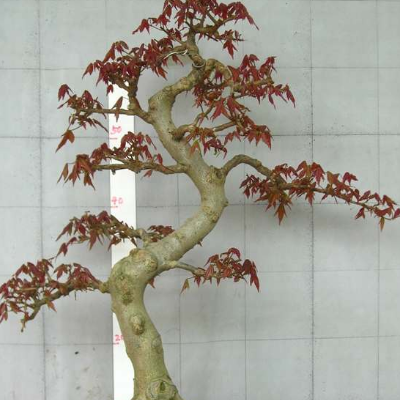
How to shape a trident maple bonsai:
Generally, it is best to carry out shaping design during the growing season, so that you can choose the right time according to the elasticity and flexibility of the branches. Also, because the trident maple itself grows rather quickly, the branches should be set into shape whenever they grow; otherwise, after growing for a period, the branches will become too hard, and if you try to set them into shape then, they will easily snap.
If you set the shape in the vigorous summer, you will encounter branches that split; at this time, its wounds will heal relatively quickly, so you can also set the shape at this time, trimming and pulling repeatedly, going through these processes over and over, setting the branch shapes into the style you like, and placing it in a shady spot for care. By mid-to-late July, after the leaves grow out, it will have a very beautiful effect.
How to care for a trident maple bonsai:
1. Trident maple bonsai is generally placed in a spot with good ventilation, light penetration, and relatively high humidity. In summer, it should be placed in a spot with tree shade or in a cool, shady place to prevent it from withering from exposure to the blazing sun; in winter, it should be placed indoors for care.
2. Because the trident maple has strong growth vigor, it must be pruned regularly to maintain its shape; by winter, it can be pruned and reshaped just once.
3. Pests and diseases are a major natural enemy of plants, so in spring, pesticide should be sprayed for pest prevention.
The methods for shaping a trident maple bonsai and how to grow it are introduced here. Hurry and get one for your home.
All the knowledge about trident maple bonsai is here
Trident maple: from the name alone, everyone knows it must be a maple whose shape is like a triangle, and many humorous netizens say the trident maple looks like a duck's foot; it really does look very similar, so the name "duck-foot maple" was born. The trunk of the trident maple is thick and sturdy, giving the feeling of a plant with age and stories, as if it has weathered many frosts. Because its story-filled appearance has attracted the attention of many friends, how should a trident maple bonsai be planted and cared for? Don't worry, the editor will tell you right away.
Transplanting and trunk chopping
The trident maple has strong bud-sprouting ability and roots quickly. For transplanting, the best time is from November in the solar calendar, when the leaves turn red and yellow, to before Qingming Festival the following year. Tree stumps transplanted at this time are relatively easier to manage, and off-season transplanting also has a relatively high survival rate, though management is relatively more troublesome; what is the same is that they require a humid environment, reasonable soil structure, reasonable light, and so on.
Before transplanting, carefully analyze the stump to be transplanted; choose one with a good root flare, ideal taper, natural wild charm, and vigorous growth. Dig at some distance from the root flare according to its size, and retain the root system as much as possible. For the first trunk chop, leave a larger margin and be conservative. Roots and branches are inevitably damaged during transport, so after arriving home, chop the stump again according to the idea in your mind. Stumps purchased from other places have long transport times, and this should be done the same way. This trunk chop still must not be fully completed in one go; leave one to two more bud points than you envision, because the stump's bud points are not obvious in position, and after enduring the long winter, the first bud may very well die; keeping one to two extra bud points is very necessary. Thick roots and old roots should be cut to position in one go, and try to retain young roots as thick as a finger, as their ability to produce fine roots is strong; survival and budding depend entirely on them.
After cutting the roots and trunk, we need to do some treatment to the cut surfaces. Find a sharp chisel to trim the wounds so they transition naturally and eliminate the traces of the artificial saw cuts; the cut surfaces of thick roots should also be chamfered and chiseled flat. Apply healing agent or white glue to the trimmed wounds once or twice; after they dry slightly naturally, press adhesive tin foil paper tightly over the wounds. Practice has proven that after applying tin foil paper, the wound healing speed increases greatly. This method can also be used on other tree species, with very obvious results. After trimming thick roots, apply erythromycin ointment; the purpose is to prevent the large cut surfaces of thick roots from being easily infected by bacteria. After application, it provides protection and, relatively speaking, roots form earlier.
Proper handling of the roots and trunk is crucial to survival and growth speed. I hope everyone will not mind the trouble and do the work thoroughly, laying a solid foundation for future development.
Planting and care
Planting methods include pot planting, ground planting, and brick-walled pool planting. Each planting method has its own characteristics; people's situations differ, so they should be treated separately.
Choose some dry fine river sand, which can be replaced with purchased perlite, some dry garden soil or leaf mold, and a small amount of coarse river sand for later use. What should be explained here is that soils differ from place to place; the key is that after mixing, it remains loose, breathable, and drains quickly. Because the trident maple is not strict about soil structure, generally any soil that is not sticky and does not compact is completely fine.
Many people in cities live in buildings, so pot planting is generally chosen; for those not yet shaped, large pots and deep pots should be used for planting. In practice, planting trident maples in large pots still gives fairly ideal growth speed. In 2007, I conducted an experiment: with reasonable soil and proper water and fertilizer management, a new top branch reached 2.7 cm thick in the first year, and side branches ranged from 1.5 cm to 2.5 cm. This data cannot fully explain anything, but what can be certain is that city apartment dwellers can likewise start from saplings; after 3-5 years of cultivation in small and medium-sized pots, trident maples can basically take shape.
For pot planting, cover the drainage hole with a shard of tile or screen mesh, and spread a layer of the prepared coarse sand, with the thickness flexibly controlled according to the depth of the pot. Then spread a layer of mixed soil made evenly from half fine river sand and half garden soil, place the treated stump, set the angle, and fill the root area with the mixed soil. In this step, note that using dry mixed soil helps the soil fully contact every part between the roots; poke it firmly little by little with a bamboo stick to avoid hollow spaces. Bury the soil slightly deeper than the original exposed position, but leave 1-2 cm of space from the pot rim to prevent the soil from being too high and causing water and fertilizer loss later.
At this point, water once to settle the roots, and water thoroughly. Those potted in winter for cultivation need to be bagged to keep warm and retain moisture; check once every few days. Before budding, the soil's water requirement is very small; moist is enough. After new buds emerge, the bag should be removed, and spraying water on the trunk 3-5 times a day is enough; keep the soil normally moist. A friend asked me how to tell when watering is needed; simply put, when the soil surface turns somewhat pale, it is time to water. The trident maple has a high water requirement; after normal growth, potted plants need water once a day, and the same applies on cloudy summer days, except on rainy days. Frequently spray water on the leaves; a water-deficient trident maple grows slowly and its branches are thin and weak.
For vigorous-growing ones, fertilizer should be tested starting at the end of May. For pot planting, liquid fertilizer is better; there are many fertilizer varieties. Choose organic fertilizer diluted 10 times with water, and in the evening pour a few ladles into each pot, then the next morning water thoroughly once. During the entire growing period, do this once every 10-15 days. Combined with good weeding and loosening of the soil, believe that growth at this time will certainly be very vigorous. For pot planting, note reasonable soil structure, light, water, and fertilizer; large pots must have their soil changed every 2 years, and small pots need annual soil changing and root trimming, which is the prerequisite for ensuring rapid growth.
For friends who have land, cultivating bonsai is like adding wings to a tiger. Choose a relatively high, level plot, with half sand and half soil being best. Loosen the soil, dig a hole, and plant, with the method the same as for pot planting and care the same as well, but growth speed is better than in pots, and the amount of watering noticeably decreases. The difference is that when small and medium-sized stumps are planted in the ground, later pruning is inconvenient, the bottom branches are too close to the ground, ventilation conditions are slightly poorer, cliff-style bonsai cannot be cultivated, and when herbicide needs to be sprayed, it easily sprays onto the branches, causing chemical damage. Ground planting and pot planting each have their own strengths, and measures should be adapted to local conditions.
At present, besides pot planting and ground planting, there is another method used relatively often. The brick-walled pool planting method fully absorbs the advantages of the previous two and avoids their disadvantages. For friends who have land, this method is worth promoting.
Use standard bricks to build a pool on level ground; the size should preferably be more than half again larger than the base size of the stump, and the height depends on the height of the stump, generally 40-60 cm. For the brick pool and another stump pool, it is best to leave 2 m of space around them. The bottom layer of the stump pool can be filled with relatively fertile soil; if there is pond mud or farmyard manure, some can be added; place a layer of cultivation soil in the middle; and for the upper soil where the stump is planted, use mixed soil containing sand. Before planting, poke the middle and lower soil firmly to prevent it from sinking after planting the stump and changing the stump's angle.
The advantages of the brick-wall planting method are shown in the following aspects:
1 Newly collected stumps will not have water accumulation with this method; of course, old stumps should not have water accumulation either.
2 Compared with direct ground planting, it increases the height, making observation easier, and allowing more accurate pruning.
3 Also because of the increased height, ventilation is good and light is good, so the bottom branches can better absorb light and heat, and growth speed will be somewhat faster.
4 When spraying herbicide, it will not spray onto the stump; in ground planting, because the lower branches of the stump are often too close to the ground, spraying herbicide inevitably sprays onto the branches.
5 With ground planting, exposing roots requires manually digging away soil; with this method, that is unnecessary. Simply remove one layer of standard bricks, and over time the roots will naturally become exposed; if one layer is not enough, remove two layers.
6 Practice has found that the stump's roots first grow outward in all directions, and when they are about to touch the bricks, they grow downward, so it does not affect the future aesthetic appearance of the roots.
Disadvantages:
1 It increases cost; one standard brick costs more than 2 mao. For a first-time medium-sized tree stump, an additional cost of 20 yuan is needed, and the bricks can be reused for several years.
2 In the first year, watering needs to be somewhat more frequent than in ground planting; once the roots grow down into the ground, it is completely the same as ground planting.
The advantages outweigh the disadvantages, so it is still worth promoting and applying.
Branch selection and pruning
By late May, a normally growing stump has branches about one meter long, and at this time branches can be selected according to future shaping needs. Before selecting branches, observe carefully, conceptualize, ponder more, and ask friends for reference; cut off branches that are absolutely useless, then select branches step by step from bottom to top. Because the trident maple grows quickly and its branches grow straight upward, side branches that need to grow horizontally must be manually pulled to the ideal angle with aluminum wire or rope. After a branch changes angle, the branch tip should be fixed upward with a bamboo stick; branches that droop or grow horizontally will slow down, which is related to apical dominance in plants. June brings the plum rain season, and strong winds and heavy rain occur from time to time. By then, new branches that are thick may already be nearly one centimeter, but they are not yet fully lignified. At this time, strong winds breaking the branches is very possible, so they need to be fixed and reinforced with wood or bamboo, which can be done together with branch selection.
Useless branches and buds should be cut off regularly to concentrate nutrients for the branches that are needed. For places lacking branches, approach grafting can be used. The trident maple has fast healing ability; you only need to peel the mother stump, approach a new branch to it, tie it tightly and wrap it well, and within one month they will heal together. After a year of growth, the mother branch can be cut off the following year. The same method can be used for missing roots; find some small old trees for approach grafting.
The trident maple has opposite buds, and during cultivation it will grow two opposite branches. At this time, one branch should be removed as early as possible; if too much time passes, a swollen belly branch will form, affecting the appearance. After one growing season, once the thickness reaches the intended range, it should be cut short; those not thick enough continue to be grown out freely. If during the growing season a certain branch reaches the desired thickness, the method of tip pinching can be used to control further thickening, and by the next spring it can be pruned into position. This avoids the possibility of losing branches due to an imbalance in tree vigor. Many friends like to do heavy pruning after leaf fall, but in fact this is inappropriate. In the climate of southern Anhui, winter is still relatively cold; after frost damage, if budding does not come out properly, it must be recultivated, increasing cultivation time. If there is a greenhouse, then that is another matter.
Off-season transplanting and management of weak stumps
Stumps collected in the normal season with a relatively good root system can be cultivated outdoors, and they grow fairly well without shade. For stumps purchased or dug in the off-season, we must treat them seriously. After mid-April, temperatures rise and branch growth has already begun. At this time, first soak the collected stumps overnight in clean water mixed with rooting powder, with a little of the branches exposed to breathe. The next day, handle them as usual for stump chopping. Coat the roots with rooting powder mixed into yellow clay slurry, plant the stump in fine sand, and bury it deeper than usual when planting, at most up to more than half of the stump. Keep the sand moist, and build a shed with 90% shade netting for cover. Increase the frequency of water spraying, retain all newly sprouted branches, and depending on the collection time, select branches in mid-to-late August or the following year.
For those with very weak growth, we should stop pruning and fertilizing; shade them before May, spray water more often, do not fertilize, and keep the soil merely moist. Water with rooting water; if conditions permit, you can buy some garden care medicinal liquids, which I believe will help somewhat with poor growth and root recovery.
After reading about trident maple cultivation, many friends who have trident maple bonsai at home must have gained some help. When dealing with a small plant like a bonsai, you must be more patient than with large plants, because small things can only be grown well with care; they are not as drought- and flood-tolerant as large trees. The trident maple has its own unique elegance: in summer the leaves are green, in autumn the scene is a sweep of yellow, and in early spring it sends out tender buds, with a scarlet color that is very eye-catching. Friends who love stories and love color changes will surely fall in love with trident maple bonsai, and through the trident maple can feel the changes of the four seasons.
Daily cultivation of trident maple bonsai and the use of sacrifice branches
Today we are going to introduce an article about the daily cultivation of trident maple bonsai and the use of sacrifice branches. Let's take a look!
▲June 2013
The photo above shows a trident maple that has already been cultivated for four years. When the photo was taken, partial leaf thinning and wiring for shaping had just been carried out. The long, straight branch in the distance is a deliberately kept "sacrifice branch." The "sacrifice branch" is used to thicken the lower trunk. Because the "sacrifice branch" will not be pruned for a long period, it grows very vigorously and can provide abundant nutrients to the trunk below the branch in order to thicken the trunk. When the lower trunk reaches the required thickness, the "sacrifice branch" will be ruthlessly discarded. This is precisely the origin of the name "sacrifice branch." The "sacrifice branch" can effectively shorten the time needed for a bonsai to take shape.
After shaping, it was planted in the ground to grow freely in order to speed up growth.
▲January 2015
The trident maple has vigorous vitality. After more than a year of free growth in the ground, it can be seen that both the main trunk and the "sacrifice branch" have thickened a great deal. The "sacrifice branch" has already grown to about the same thickness as the main trunk.
At this point, I felt the main trunk had reached the desired thickness. The "sacrifice branch" could be removed. The reason it was not removed now is that it was winter, and the plant had already entered dormancy; if cut now, wound recovery would be very slow. Therefore, it is generally recommended to prune during the plant's growing season.
data-s="300,640" data-type=jpeg data-src="?wx_fmt=jpeg" data-ratio=1.3333333333333333 data-w=768 data-fail=0 v:shapes="_x0000_i1027">
▲March 2015
In March 2015, spring arrived. As shown in the photo, the trident maple had already begun to bud and was gradually resuming growth. I planned to prune at this time. Because the "sacrifice branch" was relatively thick, cutting it off all at once would leave a very large scar, wound healing would be relatively slow, and tree vigor would also be damaged, affecting normal growth of the plant. Therefore, I planned to remove the "sacrifice branch" in stages. Regarding this technique of removing large branches in stages, the article the day before yesterday specifically discussed it; interested bonsai friends can go look at the previous article "Bonsai Classroom | Little Tricks for Removing Large Branches, You Have to See It!"
As shown in the photo above, only half of the "sacrifice branch" was cut off. After the wound heals, the other half will be cut off.
data-s="300,640" data-type=jpeg data-src="?wx_fmt=jpeg" data-ratio=1.499267935578331 data-w=683 data-fail=0 v:shapes="_x0000_i1028">
▲Late May 2015. Leaf thinning was carried out. The "sacrifice branch" was allowed to continue growing.
▲January 2016
In January 2016, it was dug out from the ground and potted for cultivation. At this time, the "sacrifice branch" had not yet been completely removed. I planned to remove it a bit later.
There is still a long way to go before the final finished product. Due to the continuous growing out and cutting back before, the top branch nodes are short and dense, and the branching structure is reasonable; these two points are the most satisfying. In the future, they will also be the highlights of this small stump.
The greatest advantage of using this method to grow stumps is that they take shape quickly. While growing out the main trunk, branches can be cultivated and the layout arranged at the same time.
Next, another "sacrifice branch" will be selected at the top to increase the thickness of the top branch, making the thickness transition of the entire trunk more natural and harmonious. At the same time, the branches will be grown out further to make the crown fuller. By then, this small trident maple piece will truly be complete.
Reprinted from: Siqi Bonsai
WeChat ID: siqipenjing