How to grow a dragon bone plant (Euphorbia lactea)? The ward-off-evil claims explained in one go
The dragon bone plant is something many people love to grow, and it really does look beautiful. How do you grow a dragon bone plant? Can a dragon bone plant ward off evil?
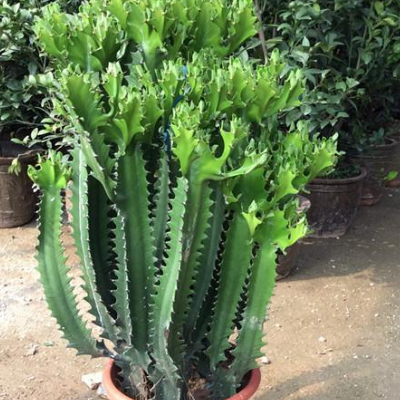
How to grow a dragon bone plant:
The dragon bone plant is suited to growing in a warm, humid, semi-shaded environment. It tolerates drought but fears low temperatures and frost. The suitable growing temperature is 25-35°C, and the wintering temperature must not drop below 7°C, otherwise it is prone to cold damage and the stem segments rot easily. Also, if direct sunlight is too strong the plant tends to turn yellow. It prefers fertile loam rich in humus. When cultivating a dragon bone plant, pay attention to the following points:
(1) Planting: the soil needs to be rich in humus; sandy loam is best. You can mix leaf mold and coarse sand in a 1:1 ratio, and add a small amount of well-rotted chicken manure or cow manure to make the potting mix.
(2) Watering and fertilizing: the dragon bone is a drought-tolerant plant, so in spring it should not be watered too much; watering once every 10-15 days is enough. In summer, water once a day, preferably in the morning or evening. In winter the potting soil should be kept moderately dry, and the pot can be wrapped and protected with plastic film to overwinter. In everyday care, water should be sprayed on the plant every day to increase air humidity.
(3) Light and temperature: under strong direct sunlight the dragon bone plant tends to turn yellow, so in summer it should be kept in a semi-shaded environment. In winter it needs plenty of light, so place it in a sunny spot indoors, and the temperature should be kept above 10°C.
Can a dragon bone plant ward off evil?
Yes, it can.
The dragon bone's stem grows upright and upward, shaped like an erect dragon's backbone, full of strength, with a unique and imposing appearance. It is best placed in an unfavorable direction, where it has a strong blocking effect against external evil. If you encounter a sharp corner aimed at you, a "heavenly chop" evil, or digging on the White Tiger side, you can place a dragon bone on the balcony or at the main entrance to ward off evil and block inauspicious energy.
That is all for the introduction to how to grow a dragon bone plant. So the dragon bone plant also has an evil-warding effect.
The feng shui knowledge of placing potted plants
Placing potted plants in a house fills it with greenery, very pleasing to the eye, and it really can beautify the home while also giving people a feeling of vitality. But everything should be done in moderation; as the saying goes, extremes meet. It must be judged according to the size of the house.
From the perspective of feng shui, potted plants should not only not be too many, but must also match the five elements needs of the householder, so that the effect of attracting good fortune and avoiding misfortune can be achieved. For example, a person born in summer with a fire fate would ideally have a fish tank or a fountain in the house, and potted plants would not be very suitable. As for people lacking wood in their five elements, they can have potted plants, but should not place too many. The potted plants placed should also be selected; the best are large-leaved evergreen (Rohdea japonica) or sago palm (Cycas revoluta). As for the currently popular dried flowers and dried branches, these are not very suitable for home decoration.
The bonsai plants placed must be healthy and attractive, and must not be withered. The wood element belongs to yang and is the only thing among the five elements with life; it can grow and reproduce. Avoid using dried flowers, which absorb yin energy and are bad in feng shui.
The due east direction is the direction representing health. Homes or rooms should pay attention to the feng shui layout of this direction to keep the family, especially the head of the household, healthy. Since due east belongs to wood, the best way to activate this direction is to place healthy green plants there. The size of the plants should be in proportion to the room, and plants with pointed leaves must not be used.
Potted plants in the house are best as evergreen plants, such as evergreen (Rohdea japonica) and bougainvillea. Avoid placing plants that wither easily and are hard to care for, otherwise they are not only unhelpful but harmful.
Most people know that growing thick-leaved, large-leaved green plants such as evergreen (Rohdea japonica), sago palm, fortune grass and lucky bamboo can "boost prosperity" and "attract wealth", while growing cacti, thorny roses and dragon bone plants can achieve the effect of dissolving evil.
Feng shui for placing indoor plants: pay attention to the balance of yin and yang
Beautiful women, spreading wisdomWise women, sharing happiness
Common plants for yin-yang balance
Because plants often have lively vitality, they are given different meanings. White flowers have the power to promote interpersonal relationships and purify the air; yellow can stimulate upward power; blue brings peace and calm judgment; red represents vitality and spirit; green helps health, represents safety and peace of mind, and helps stabilize the heartbeat; purple can make the mind clear and increase artistic sense. In the use of flowers, for example, if the bed faces the door, a vase with fresh flowers can be placed to resolve it; placing fresh flowers in the kitchen can enhance the housewife's temperament. If you are usually easily restless, depressed and pessimistic, then flowers in a combination of green, white and purple are very suitable.
I. Auspicious trees
Lingzhi (Ganoderma lucidum)
Since ancient times it has been regarded as an auspicious sign. Auspicious pictures often show a deer's mouth or a crane's beak holding lingzhi, and it is used as a birthday gift.
Plum blossom
Its five petals are considered to be five auspicious gods, hence the "plum blossom opening five blessings" picture. Plants believed to have the power to suppress demons and drive away evil
Sweet flag and mugwort leaves - during the Dragon Boat Festival, sweet flag and mugwort leaves are hung beside the door, or mugwort leaves are made into an "mugwort tiger" to carry on the body, which can drive out toxins and ward off evil.
Soapberry (Sapindus) - especially revered. This deciduous tree blooms white flowers in the fifth and sixth months, and its fruit is slightly larger than a loquat, green when unripe and yellow when ripe, with a hard stone inside like a bead. Its common name is "ghost's sorrow", and Buddhism calls it bodhi seed; it is strung together to make prayer beads, and with it one is "free from misfortune".
Pine - a plant praised in verse from ancient times to the present. "Hua Jing" says: "The pine is the chief of a hundred trees... full of nodes and long-lived, its bark rough like dragon scales, its leaves fine like a horse's mane. It does not wither when frost and snow come, and lasts a thousand years without dying." Wang Anshi of the Song dynasty said in "Zi Shuo": "The pine is the chief of a hundred trees, like a duke. Therefore its character follows 'gong' (duke)." Some split the character "song" (pine) into "eighteen gong (duke)", and Feng Zizhen of the Yuan dynasty wrote "Rhapsody on Eighteen Dukes", Hong Lu of the Ming dynasty wrote "Biography of Lord Mu", and the modern revolutionary and military strategist Tao Zhu also wrote "The Style of the Pine", and so on. History records that when Qin Shi Huang toured Mount Tai, a storm suddenly came, and he took shelter from the rain under a large pine; later he conferred on this tree the title "Fifth Rank Official", and later generations called this tree the "Fifth Rank Official Pine". "Youxue Gushi Qionglin" says: "Bamboo is called the gentleman, the pine is titled the official", and the phrase comes from this. The pine is cold-resistant and drought-resistant, and can grow in shady places and cracks in rocks. It is evergreen in winter and summer, does not wither through frost, and can stand proud over frost and snow. The pine can live long without aging, and folk birthday wishes often include "Fortune like the ever-flowing water of the East Sea, longevity like the immortal pine of the Southern Mountain". In painting and calligraphy there is often the "Three Friends of Winter" (pine, bamboo, plum) to show auspiciousness. In painting, calligraphy, utensils and decorations there are often "pine and cypress sharing spring", "pine and chrysanthemum prolonging life", and "immortal vase gathering blessings" (pine branches, narcissus, plum blossoms, lingzhi and so on gathered in a vase). The pine is widely regarded as an auspicious tree species.
Cypress - it has the virtue of chastity, so its character follows "bai" (white). White is the correct color of the west. "It does not go along with the corrupt world, is firm and principled, and holds a noble position." Wang Anshi said in "Zi Shuo": "The cypress is like a count (bo), so its character follows 'bai'." The pine is "gong" (duke) and the cypress is "bo" (count). Among the five noble ranks "duke, marquis, count, viscount, baron", the count ranks third, and the cypress is also compared to "ranking among the three dukes". "Fengsu Tong" records: demons like to eat the liver and brains of the dead, and fear tigers and cypress. Therefore, graves and tombs mostly have cypress planted and stone tigers erected. Folk custom also likes to use cypress wood to "ward off evil". "Bencao Gangmu" says "on New Year's Day it is steeped in wine to ward off evil" ("The cypress nature is withered yet durable, endowed with a firm and congealed substance; it is a tree of long life, and therefore can be taken as food. Daoists use it to make soup and often drink it, and on New Year's Day they steep it in wine to ward off evil, all taking from this. Musk deer that eat it have fragrant bodies, and the Hairy Woman who ate it had a light body; these are also clear proofs of it. (The Hairy Woman: according to "Baopuzi", in the reign of Emperor Cheng, a hunter saw a naked woman in Mount Zhongnan, covered all over with hair, leaping across streams as if flying; later she was surrounded and captured. Asked about it, she was a palace maid of Qin who had fled into the mountains to escape disorder. Starving with no food, an old man taught her to eat cypress leaves and fruit, and so she was neither hungry nor cold, and her body was light as if flying. By the time of Emperor Cheng of Han she should already have been three hundred years old!)" "Liexian Zhuan" also says "the Red-Whiskered Man loved eating cypress fruit, and his fallen teeth grew again", and "those who take cypress seeds live long." "Hangong Yi" says: "On New Year's morning, drink cypress leaf wine to offer longevity." In folk belief, the homophone of cypress, "bai" (hundred), is an extreme number, emphasizing abundance and completeness, with all matters covered in full by "hundred": hundred affairs, hundred birds, hundred rivers and so on. Therefore, auspicious patterns commonly include: cypress combined with the "ruyi" object to form "a hundred affairs as you wish", and cypress combined with orange to form "a hundred affairs of great fortune" (orange and fortune sound alike). "Xihu Youlan Zhi" says: "In Hangzhou custom, on New Year's Day cypress branches and persimmon cakes are signed, and a large orange is placed under them, called a hundred affairs of great fortune. This takes cypress, persimmon and large orange as sounding like a hundred affairs of great fortune."
Osmanthus - osmanthus mostly grows in southern China, with many kinds such as dan osmanthus, golden osmanthus, silver osmanthus, laurel, Burmese osmanthus and willow-leaf osmanthus. Among them, dan osmanthus, golden osmanthus and silver osmanthus are named for their red, yellow and white flower colors. In the osmanthus region it blooms in the eighth month (lunar calendar). Therefore the eighth month is also called "osmanthus month". Osmanthus flowers are fragrant and striking, can be used as a tea drink and as medicine. Custom regards osmanthus as an auspicious plant. Historically, passing the imperial examination with high honors was called "plucking osmanthus in the moon" or "plucking the moon osmanthus". In old times, descendants advancing in official career and being honored and noble was called "orchid and osmanthus fragrant together". In the Five Dynasties period, Dou Yujun of Yanshan had five sons who successively became accomplished. The minister Feng Dao presented a poem: "Dou the tenth son of Yanshan, taught his sons with righteous methods; the spirit chin has one old branch, the dan osmanthus has five fragrant branches." "Sanzi Jing" also records the historical fact: "Dou Yanshan, had righteous methods, taught five sons, all became famous."
The sound of osmanthus matches "gui" (noble), meaning glory and wealth. In some customs, a new bride wears osmanthus flowers, fragrant and "noble". Osmanthus combined with lotus seeds in a picture is "continuous birth of noble sons"; osmanthus combined with a longevity peach in a picture is "noble longevity without end", and so on. Osmanthus has an auspicious meaning, derived from its homophone.
But in terms of the plant's physiological habits, osmanthus likes purity and dislikes greasiness; it is suited to growing in academies and temples free of grease, and does not flourish in household courtyards.
Chun (Ailanthus altissima) - regarded as a tree of longevity; it grows easily and lives long. "Zhuangzi - Xiaoyaoyou" says: "In ancient times there was a great chun, which took eight thousand years as spring and eight thousand years as autumn." This shows the longevity of the chun. "Bencao Gangmu" says: "Chun and chu grow easily and are long-lived." People often use "chun years" and "chun age" to wish longevity. Qian Qi of the Tang dynasty wrote in the poem "Old Man of Baiya": "What power has the emperor's might? The chun years happily grow longer." Liu Yong of the Song dynasty wrote in the ci poem "Yujie Xing": "The chun age is endless, the vine map has blessings, always as master of heaven and earth." Since ancient times birthday couplets have included: "Before the banquet pour chrysanthemum brew; in the hall wish the chun age." "The chun tree is a thousand fathoms green; the flat peach has reddened several times." "The great chun never ages, the clustered osmanthus is most suited to autumn", and so on. Because the chun tree is long-lived, it is customarily used to refer to the father. Mou Rong of the Tang dynasty wrote in the poem "Seeing Off Xu Hao": "I know your feelings on this parting are especially keen; in the hall the chun and xuan are snow-white on their heads." The above text (osmanthus, Feng Dao's poem given to Dou Yujun) line "the spirit chun has one old branch, the dan osmanthus has five fragrant branches" also uses chun to refer to the father. Chun refers to the father and xuan refers to the mother. Zhu Quan of the Ming dynasty said in "Jinchai Ji": "Unfortunately there was mourning at the chun hall, and we deeply relied on the xuan hall's teaching to grow up." In addition, in some regions (such as southwestern Shandong), on New Year's Eve children have the folk custom of touching the chun tree and walking around it to seek greater height and longevity.
Huai (Sophora japonica) - a folk proverb says: "A huai before the gate, either it brings treasure or it brings wealth." It is regarded as an auspicious tree species. It is considered "the essence of the spirit star" and has the ability to judge lawsuits. "Chunqiu Yuanming Bao" says: "Plant a huai and hear lawsuits beneath it." The opera "Marriage of the Fairy Princess" also has the plot of deciding a marriage under the huai shade, and later sending a child under the huai. "Hua Jing" says: "People mostly plant it before the courtyard; one takes its shade, one takes the auspicious omen of the three huai, hoping for descendants to be among the three dukes." In addition, huai can also be medicinal. "Bencao Gangmu" says: "The newly sprouted tender buds of huai can be fried and rinsed in water before eating, and can also be made into a drink as a substitute for tea. Or collect huai seeds and plant them in a bed, and eating the seedlings is also good." "Baopuzi" says: "This thing greatly nourishes the brain; taken early it keeps hair from turning white and gives long life." "Mingyi Bielu" says: "Taking it fills the brain, keeps hair from turning white and gives long life." The huai tree benefits people, is commonly used for greening, and is also indispensable in feng shui arrangement. The huai tree is considered to represent "emolument". In ancient courts, three huai and nine jujube trees were planted, and dukes, ministers and senior officials sat beneath them; those facing the three huai were the three dukes. Later, ordinary people planted huai in their courtyards.
Wutong (Firmiana simplex) - wutong is one kind of tong tree. Tong includes tung oil tree, paulownia, purple-flower tong, white-flower tong, wutong and so on. Tong has many uses. Chen Zhu said in "Tong Pu": "The timber of tong, if cut at the wrong time, does not get worm-eaten; when soaked and wetted it does not rot; when wind-blown and sun-dried it does not crack; when rain-splashed and mud-stained it does not grow withered moss; dry and wet together, its substance does not change. Though nanmu is long-lived, its eternity cannot match it, and it has long been valued above others." Tung oil tree can be pressed for oil, paulownia gives the most shade, and wutong is suited to making qin instruments. Wang Chong said in "Lunheng": "The divine emperor cut wutong to make a qin." "Shijing - Yongfeng - Ding zhi fang zhong" says: "Plant hazel and chestnut, chair tong and catalpa, and then cut for qin and se." "Qimin Yaoshu" says: "Wutong growing among mountain rocks, when made into an instrument, resounds." "Hou Hanshu" records: "Cai Yong was traveling on Mount Tai and saw tong being burned; hearing the crackling sound he said: 'This is fine wood', and took it to make a qin", which was the "scorched tail", a famous qin. (To this day foreign violins deliberately have a "scorched tail" lacquer color, though it is unknown where this passed down from; this writer is ignorant!) Wutong is regarded as a "spirit tree" with the ability to verify current affairs. "Taiping Yulan" quotes "Wang Yi Zi" saying: "The fusang, wutong, pine and cypress all receive pure qi, different from other kinds." "Lifeng Weiyi" says: "When its government is fair, the wutong grows constantly." "Ruiying Tu" says: "When the ruler employs the worthy and good, then wutong grows in the eastern chamber", and conversely "if wutong does not grow, then the nine provinces have a different ruler". The wutong's spirituality also includes its ability to know the seasons. "Hua Jing" says: "This tree can know the seasons. After Qingming, the tong first flowers (the character bi, in ancient times hua and flower were the same character - author's note). If the tong does not flower, the year will certainly be very cold. At the start of autumn, at the appointed time one leaf falls first, hence the line 'One leaf of the wutong falls, and all under heaven knows autumn has come.'" Sima Guang's poem "Wutong" says: "At first hearing one leaf fall, I know the ninth autumn has come." "Hua Jing" records: wutong "has twelve leaves per branch, six leaves on each side; counting one leaf from the bottom as one month, in a leap year there are thirteen leaves. By looking at where the leaves are small, one knows which month is the leap month." The wutong's spirituality is said to be able to attract the phoenix. "Shijing - Daya - Juan'e" says: "The phoenix cries, on that high ridge. The wutong grows, in that morning sun." Zou Bo of the Song dynasty said in "Jianwen Lu": "A hundred birds dare not perch on the wutong; they only avoid the phoenix." Among China's dragons and phoenixes, in myth and legend the phoenix is a divine bird. The wutong that can attract the phoenix is naturally a wondrous plant. The auspicious wutong is often combined with the magpie in patterns, homophonous as "shared joy", also conveying auspicious meaning.
Bamboo - according to modern plant taxonomy, bamboo belongs to the grass family. Ancient Chinese, however, had special comments on bamboo, adding humanistic views. In Dai Kai's "Zhu Pu" of the Jin dynasty it says: bamboo is "neither soft nor hard, neither grass nor wood". Through the dynasties, poems, ci, songs and rhapsodies on bamboo have produced endless fine praises. Bamboo is closely related to people's livelihood; bamboo material can be used for building houses, making pens, making paper, furniture and carving and painting. "Hua Jing" holds: "It does not wither through frost and snow, remains lush through the four seasons, is not at all gaudy, and is enjoyed by both refined and popular taste." Literati regarded bamboo as a worthy gentleman. Bai Juyi said in his "Record of Cultivating Bamboo": "Bamboo resembles a worthy. How so? The bamboo root is firm, and firmness establishes virtue; when a gentleman sees its root, he thinks of one who is good and unshakable. The bamboo heart is empty, and emptiness embodies the way; when a gentleman sees its heart, he thinks of one who applies himself with openness to receive. The bamboo node is steadfast, and steadfastness establishes resolve; when a gentleman sees its node, he thinks of one who tempers his reputation and conduct and is consistent in safety and danger. For this reason, it is called a gentleman." Bamboo's noble integrity makes people wish to dwell with the worthy, hence the phrase "Better to eat without meat than to live without bamboo." In Chinese bamboo culture, bamboo is compared to a gentleman. In Chinese painting, pine, bamboo and plum are often called the "Three Friends of Winter". And the "Picture of Five Pure Things" is pine, bamboo, plum, moon and water; the "Picture of Five Auspicious Things" is pine, bamboo, daylily, orchid and longevity stone, often appearing at the painter's brush.
There are a great many bamboo species, over a hundred categories. Many bamboos already carry cultural meaning. For example: spotted bamboo (Xiangfei bamboo), ci bamboo (also called filial bamboo, mother-child bamboo), arhat bamboo, golden-and-silver jade bamboo, heavenly bamboo (nandina, southern large bamboo) and so on. If heavenly bamboo is combined with pumpkin and periwinkle in a pattern, the homophone conveys the meanings "heaven and earth in eternal spring" and "enduring as heaven and earth". Bamboo also sounds like "zhu" (to wish), carrying the customary meaning of good blessings.
Hehuan (Albizia julibrissin) - silk tree: a deciduous tree with pinnate opposite compound leaves that close in pairs at night, closing at night and opening in the morning, symbolizing conjugal love, harmony and a happy marriage. Therefore it is called the "marriage" tree. From the Han dynasty onward, the word hehuan entered deeply into Chinese marriage culture. There are the Hehuan Hall, hehuan quilt, hehuan hat, hehuan knot, hehuan banquet and hehuan cup. A poetic couplet says: "Twin lotuses bloom on the intertwined trees, new wine is poured into the hehuan cup." The silk tree is regarded by literati as a tree that releases grudges and dispels sorrow. "Hua Jing" says: "Hehuan, also called 'dispeller of human anger'; then give it the blue garment; the blue garment is also called hehuan, and can make one forget anger." Ji Kang's "On Nourishing Life" also says: "Hehuan dispels anger, daylily forgets sorrow." Because it is often "planted by the courtyard steps", it is suited to planting beside houses and in courtyards
Jujube - jujube is a common tree species beside Chinese homes. Its wood is hard and can be made into utensils and woodblock printing plates. Ancient books were once called "jujube editions". The fruit is edible and can "tonify the center and boost qi; taken long it makes one an immortal" ("Bencao Jing"). The jujube tree bears fruit very early; young trees can bear fruit. A northern folk proverb says: "Peach three, apricot four, pear five years; the jujube tree pays back that same year", speaking of how quickly it bears fruit. Jujube sounds like "zao" (early). Folk custom has patterns combining jujube with chestnut (or lychee), homophonous as "early establishment of a son". In weddings, gifts combining jujube with longan are homophonous as "early birth of a noble son". At the wedding "scattering the bed" ceremony, jujube, chestnut and peanut are used to seek good fortune.
Chestnut - chestnuts are edible and can be used as medicine; they are yang in nature. In ancient times chestnut wood was used to make ancestral tablets (spirit tablets of the dead), and the ancestral temple spirit tablet was called the "chestnut tablet". The ancients used it to express a woman's sincerity. "Liji - Quli" says: "A woman's gift is hazel and dried meat, and prepared jujube and chestnut." "Guoyu" also says: "A husband and wife's gift is no more than jujube and chestnut, to announce sincerity." "Taiping Yulan" says: "The chestnut of the east gate brings peace to the household." It benefits family harmony. Chestnut sounds like "lizi" (establishing a son), and is an auspicious object for seeking a child. Jujube, chestnut, peanut and pomegranate are often used on the new marriage table or in the canopy or in the bride's bosom, in the customary culture of seeking good fortune.
Peach - the peach originated in China and has Chinese cultural characteristics. In folk custom, religion and aesthetic concepts, it has an important cultural thread. Peach blossoms are red, white, pink, deep red, luxuriant and fragrant, charming and outstanding. Chinese people often use peach blossoms to describe a beauty's lovely face, and matters related to women often carry the character "peach". For example, peach blossom makeup, peach blossom luck, peach-colored news and so on. This culture spread east to Japan, and Japanese bathhouses (bath pools) also mark "peach bath" and "pine bath" (women's bath, men's bath). But people all love the peach. Folk belief holds that the peach has spirit; if the peach does not bloom in the third month, it foretells fire. The third month is also called "peach month". Chinese myth says the peach tree was transformed from the staff of Kuafu, who chased the sun. "Shanhai Jing" records: "Kuafu raced with the sun and entered the sun. Thirsty, he wished to drink, and drank from the Yellow River and Wei River; the Yellow and Wei were not enough, so he drank north from the Great Marsh. Before arriving, he died of thirst on the way. He cast away his staff, which transformed into Denglin. (Denglin is the peach grove.)" And "Chunqiu Yundou Shu" also says: "The star Yuheng scattered and became the peach." Whether the peach was transformed from a divine staff or from the Big Dipper star, in any case it carries something wondrous. "Taiping Yulan" quotes "Dian Shu" saying: "The peach is the essence of the five woods, and therefore can suppress evil qi. The essence of the peach is born at the ghost gate and controls a hundred ghosts, so today peach figures are made and placed at the door to suppress evil qi." The peach controls a hundred ghosts, and ghosts fear peach wood. The ancients often used peach wood to make various evil-suppressing and evil-warding items. For example: peach seal, peach tally, peach sword, peach figure and so on. After the Later Shu of the Five Dynasties period began writing Spring Festival couplets on peach wood boards, the Spring Festival couplet custom has continued to this day, only changed to red paper material. At the Dragon Boat Festival, peach branches are inserted at the door, also a customary idea that the peach can ward off evil qi. In addition, the peach fruit has the fine names "immortal peach" and "longevity peach". This comes from the legend that the flat peach planted by the Queen Mother of the West in the Jasper Pool blooms once every three thousand years and bears fruit once every three thousand years, and eating it adds six hundred years of life. The peach tree has beautiful flowers and fresh fruit, can in customary psychology attract good fortune and ward off evil, and suffers few diseases and is easy to plant, so it is often planted in gardens, green spaces and homes.
Pomegranate - pomegranate is also called anshi pomegranate. Historical records say that in the time of Emperor Wu of Han, Zhang Qian was sent to the Western Regions and brought it back from Anshi, hence the name anshi pomegranate. But the medical texts unearthed from the Han tomb at Mawangdui record that pomegranate already existed in China as early as before the Western Han. There are very many ancient poems and rhapsodies on pomegranate. For example, Emperor Yuan of Liang's poem "Ode to Pomegranate": "The tulin has not yet sprouted, late spring urges it on. It seems like a lamp lit at night, its red pearls surpass the early plum." Pan Yue's "Rhapsody on the Anshi Pomegranate": "Gazing at it from afar, it shines like Sui pearls lighting the deep abyss; examining it closely, it blazes like the stars emerging among the clouds. A thousand chambers share one membrane, a thousand seeds are as one; it relieves hunger and quenches thirst, dispels drunkenness and stops intoxication." In customary culture, it is believed that "the pomegranate has a hundred seeds", a symbol of "many sons and much fortune". In fact, the pomegranate's flowers and fruit are red as fire, the fruit can quench thirst and stop intoxication, and it has both ornamental and practical value, so it is widely planted in homes, courtyards and houses.
Orange - Qu Yuan once praised the orange's form, substance and character in "Ode to the Orange". The orange changes according to the qi of the land. "Zhouli - Kaogongji" says: "The orange crossed the Huai and becomes a trifoliate orange... this is the qi of the land." The orange has spirit, and legend says it can verify affairs. "Guang Wuxing Ji" says: "The Later Master of Chen dreamed of yellow-clad people surrounding the city, and all the orange trees around the city were cut down. Then the Sui army arrived, and those above and below all wore yellow clothing; before long came the omen of Sui attacking the city." Some also believe the orange was transformed from the star Tianxuan of the Big Dipper. "Chunqiu Yundou Shu" says: "The star Xuan scattered and became the orange." Its practical value is mainly that the fruit is delicious and edible, and the peel and stone can be used as medicine, so planting it has economic benefit. In folk custom, orange sounds like "ji" (auspicious), and the simplified character tong is commonly used. The orange is used to seek auspiciousness and pray for blessings. Kumquat can foretell the dawn. "Zhonghua Quanguo Fengsu Zhi" records that in the Hangzhou area "on New Year's Day, cypress branches are signed on persimmon cakes, and a large orange is placed under them, called a hundred affairs of great fortune"
Plum - the plum was once regarded as China's national flower (it is now designated as the peony). The plum blooms at the turn of winter and spring, "alone bringing spring to the world", and is called the "harbinger of spring". "Hua Jing" calls the plum "the peerless thing under heaven". It is said the plum has a jade-like flesh and bone, a beauty beyond the world, the leader of all flowers. The plum is used to describe women; bamboo describes the husband, the plum describes the wife, and a wedding couplet has the phrase "bamboo and plum, double joy". Young boys and girls are called "green plums and bamboo horses". The plum's character is proud of frost and snow, and there is the saying of the "four virtues": "The plum possesses four virtues: at birth it is yuan, when it blooms it is heng, when it bears seed it is li, when it ripens it is zhen." The plum blossom has five petals, symbolizing five blessings: happiness, good fortune, longevity, smoothness and peace. It also matches China's yin-yang "five elements": metal, wood, water, fire and earth. Longevity couplets often have "The plum opens five blessings, the bamboo reports three abundances" (bamboo has three leaves), conveying auspicious meaning. Courtyard planting and bonsai both have ornamental value. The plum has "four precious things": precious when sparse, not when dense; precious when old, not when young; precious when thin, not when fat; precious when half-open, not when fully open. Therefore "the plum opens twice" is used to describe beauty aptly. Thus sparse, old, thin and half-open are the plum's aesthetic "four precious things". These four precious things commonly appear at the painter's brush
Gourd - the gourd is a vine plant. Its vines stretch continuously, it bears abundant fruit, and its seeds are numerous; Chinese people regard it as an auspicious plant symbolizing prosperous descendants. The vine "man" sounds like "wan" (ten thousand), conveying endless generations. Folk tradition holds that the gourd is auspicious and wards off evil qi. In Dragon Boat Festival custom, peach branches are inserted at the door and gourds hung up. Modern qigong testing proves that the gourd has the function of isolating energy fields. A folk saying goes "not knowing what medicine is sold in the gourd", meaning it is hard to penetrate the gourd and see the contents. Analyzing from feng shui field energy, the gourd's curved outer shape contains the wondrous function of the "S"-shaped taiji yin-yang dividing line. Therefore it is often used in feng shui to dissolve evil.
Dogwood - dogwood has a strong fragrance and ripens around the ninth day of the ninth month, with a crimson color. Folk custom inserts dogwood on this day and makes dogwood sachets. This wards off evil. "Qunfang Pu" says: "On the ninth day of the ninth month, break off dogwood and wear it on the head; it can drive out evil and remove ghosts and demons." "Taiping Yulan" quotes "Za Wuxing Zhi" saying that planting a dogwood tree beside the house can "add years and increase longevity, and remove illness". "Hua Jing" also says: "Beside wells and rivers, this tree is suitable for planting. When its leaves fall into the water and people drink that water, they will never suffer plague." To seek good fortune, Han dynasty brocade included "dogwood brocade" and embroidery included "dogwood embroidery". China's Double Ninth Festival folk gathering on the ninth day of the ninth month is also called the "dogwood meeting".
Sweet flag - sweet flag is a perennial herbaceous plant. It is mostly wild, but is also suited to growing in green spaces beside homes. "Bencao Gangmu" says sweet flag "is the flourishing one among rushes". "Lushi Chunqiu - Rendi" says: "The chang is the first to appear among a hundred grasses." Folk belief holds that the sweet flag's flower governs nobility and its flavor gives long life. Ancient China believed the sweet flag was the regeneration of a heavenly star. "Chunqiu Yundou Shu" says: "The star Yuheng scattered and became the sweet flag." Legend says that one who sees the sweet flag flower will become noble. According to "Liang Shu": the empress Zhang of Taizu "once in her room suddenly saw a sweet flag flower grow before the courtyard, its radiance shining, unlike anything in the world. The empress was astonished and said to her attendants: 'Did you see it?' All said they had not. The empress said, 'I have heard that one who sees the sweet flag flower will become noble,' and so she picked and ate it, and gave birth to Gaozu." With such myths, legends and records, the sweet flag is widely favored in folk custom and regarded as an auspicious plant and grass that wards off evil qi. Sweet flag has medicinal value. "Bencao Jing" says: "Sweet flag mainly treats wind-cold-dampness impediment, cough and rebellious qi, opens the heart orifice, tonifies the five viscera, clears the nine orifices, brightens the ears and eyes and brings out the voice. Taken long it lightens the body, prevents forgetfulness and confusion, and prolongs life. It benefits the mind and intellect, and keeps high aspirations without aging." "Daozang - Changpu Jing" says: "The sweet flag is the elite of water plants and the spirit medicine of immortals." "Its medicine matches the five virtues to the five elements: leaf green, flower red, node white, heart yellow, root black. It can treat all types of wind, stubborn impediment of the hands and feet... strengthen the marrow, grow the spirit, moisten the five viscera, benefit the six bowels, open the appetite and harmonize the blood vessels, benefit the mouth and teeth, brighten the ears and eyes, gloss the skin, and remove cold and heat..."
Evergreen (Rohdea japonica) - also called thousand-year chang, a perennial herbaceous plant. Its leaves are thick and its fruit red; folk custom regards it as auspicious. When building a house or moving, when a child is newborn, and at all happy events it is commonly used as an auspicious symbol. Moving implies smoothness, marriage implies wishes fulfilled, and a birth implies longevity. In Chinese painting and textile patterns, the image of the evergreen is commonly used. The imperial family liked to plant evergreens in tubs, meaning "unification for ten thousand years". "Hua Jing" says: "People in Wu commonly use it. When building a house or moving, when sending betrothal gifts or preparing a tomb, when a child is newborn, at all happy events, it is always used, as an auspicious slogan." This shows the traditional custom that rulers and commoners alike love the evergreen.
II. Inauspicious trees
1. Types of inauspicious trees: willow, banana, fig, cherry tree, wood lotus, yucca, phoenix-tail bamboo, zelkova, white poplar and so on.
2. Under specific conditions the following trees become inauspicious: when a private residence's plot is narrow and they become inauspicious trees: persimmon, peach, bean tree, barrel tree, jujube tree, guava tree, plum, pomelo, kumquat, loquat and other trees that bear fruit.
3. Trees that grow taller than the roof: ginkgo, camphor and Chinese fir.
III. Other plants suitable for placing at home
Fresh flowers can also add vitality and energy to the home. Unlike plants, they bring a riot of color to a room in a particularly lively form. If carefully cultivated and tended, fresh flowers have a strong feng shui effect, and their color and shape will influence it. Therefore, in home life, the water must be changed diligently every day and the stems trimmed, so that their effect lasts.
Placing some plants at home can indeed add life to the home, and some even have the effect of dissolving evil. There are many plants suitable for placing at home; you can choose plants with lush branches and leaves to place at home, preferably green in color, and those with flowers are also fine. The varieties include:
Violet, evergreen (Rohdea japonica), dragon bone plant, golden pothos and so on. These plants can make family members full of vitality and energetic at work.
Lotus - the lotus is a aquatic perennial root plant of the water lily family, with many aliases: lotus flower, water hibiscus, hibiscus, water bloom, water yun, water dan. The rhizome is edible and medicinal; lotus seeds can clear the heart and relieve summer heat, and the rhizome can tonify the center and boost qi. "Bencao Gangmu" says: "Physicians take it as food, and a hundred illnesses can be cured." Besides practical value, the lotus has a profound cultural heritage in China. After the Tang dynasty established Buddhism as the state religion, the lotus was deeply revered by people. The hometown of the Buddha Shakyamuni was rich in lotus flowers, so Buddhism often uses the lotus as a metaphor for itself. "Bencao Gangmu" records: "Buddhists use it as a metaphor; wondrous principles all reside in it." The Buddhist realm also refers to where the lotus dwells. It is also called the "lotus realm". Buddhist scriptures are called "lotus sutras", the Buddha's seat is called the "lotus seat" or "lotus platform", Buddhist temples are called "lotus halls", monks' quarters are called "lotus rooms", and the kasaya is called "lotus clothing" and so on. Lotus patterns also became a symbol of Buddhism. Buddhist architecture, decoration and implements all have lotus patterns. In China, the lotus is revered as a gentleman. "Qunfang Pu" says: "All things first flower and then bear fruit; only this one flowers and fruits together. A hundred nodes are clear and open, ten thousand orifices are exquisite, gracefully standing above the mire yet unstained by it; it is the gentleman among flowers." Later Zhou Dunyi's "On the Love of the Lotus" had a profound influence. "Bencao Gangmu" says: "The lotus grows in the low and filthy, yet remains white and pure; its stem is soft yet its substance is firm, it dwells below yet has nodes. Its orifices are exquisite, with threads hidden within; born tender and weak, it develops into stem, leaf, flower and fruit; and again it sprouts, to continue the vein of endless life. It can be eaten in all four seasons and delights the heart; it can be called a spirit root!" A lotus with two flowers on one stalk is called a twin lotus, symbolizing the union of man and woman and conjugal love. Wedding couplets often have "Wing-to-wing birds forever perch on the evergreen tree, twin lotus flowers long bloom in the thrifty home" and so on. Lotus sounds like "lian" (honest/clean) and "lian" (continuous birth). Folk custom has homophonic meanings such as "a rank of purity and honesty" and "continuous birth of noble sons". But in some countries and regions the folk culture differs, which must not be ignored; for example, Japanese folk custom does not regard the lotus as so chaste as "unstained by the mire", but views the lotus as a "lowly" flower.
Hibiscus - hibiscus is of the lotus kind, divided into water hibiscus and wood hibiscus. Wood hibiscus is also called wood lotus, ground hibiscus, frost-resister and so on. Sichuan is rich in it; it blooms in autumn and winter, most profusely at Frost's Descent. In the Five Dynasties period, Meng Chang, Later Master of Shu, planted wood hibiscus all over the palace garden walls, and when the flowers bloomed they were like brocade, so later generations called Chengdu the Brocade City and the Hibiscus City. Hibiscus is cold-resistant and blooms profusely when frost comes, hence it is also called "frost-resister". Wang Anshi's poem "Frost-Resister Flower": "All flowers have fallen, yet it alone is fragrant." Su Dongpo praised it in "Harmonizing with Chen Shugu's Frost-Resister Flower": "A thousand groves are swept into a single yellow, only the hibiscus is fragrant alone." Hibiscus sounds like "furong" (wealth and glory). In patterns it is often combined with peony to form "prosperity and honor", both with auspicious meaning.
Peony - the peony is a shrub of the buttercup family. It has the names "king of flowers" and "flower of wealth and honor". Our country has now designated it as the national flower. The peony is a famous flower produced in China; it is already recorded in "Shennong Bencao", so it is very ancient. There are many peony varieties; "Qunfang Pu" records more than 180 kinds, and Xue Fengxiang's "Bozhou Peony Table" of the Ming dynasty records as many as 269 kinds, dividing peonies into six major categories: divine, famous, spiritual, extraordinary, capable and ordinary. It is said that when Emperor Xuanzong of Tang viewed peonies he once asked whose poem praising peonies was best, and someone recommended Li Zhengfeng's fine lines "Heavenly fragrance dyes the clothing at night, national beauty revels in wine at dawn", and later generations gave it the title "national beauty and heavenly fragrance". In "Bencao Gangmu" it says: "Among flower ranks, the peony is first and the herbaceous peony second, so the world calls the peony the king of flowers." By the Song dynasty, Luoyang peonies were already regarded as the finest under heaven, hence the name "Luoyang flower". Peony flowers are plump and beautiful. Zhou Dunyi's "On the Love of the Lotus" has the famous line "The peony is the wealthy and noble one among flowers", and the peony's reputation as the "flower of wealth and honor" spread even more. Since the peony is a flower of wealth and honor with national beauty and heavenly fragrance, famous figures and scholars through the ages often named their studies and gardens after it. For example, Zhou Bida's "Heavenly Fragrance Hall" of the Song dynasty and the Ming dynasty Prince Zhou's "National Beauty Garden". The peony has beautiful color and a fine reputation, conveying auspicious meaning, so in garden-making it is often combined with a longevity stone to form "long life and wealth and honor", and with periwinkle to form the landscape "wealth and honor in eternal spring".
Chinese rose - the Chinese rose is an upright shrub of the rose family. It was formed by complex crossbreeding of fifteen species of Rosa plants. Our country has more than six hundred kinds of Chinese rose. Its flowering period is very long, and it is also called monthly red. "Qunfang Pu" says the Chinese rose "opens once each month, uninterrupted through the four seasons". Yang Wanli's poem "Chinese Rose" has: "People only say a flower is not red for ten days; this flower has spring breeze every day." The Chinese rose originated in China. It is said that in the 1780s the Chinese rose was introduced to Europe via India. At that time the Anglo-French war was on, and to allow the precious Chinese rose introduced from China to pass safely from Britain to France, the two sides negotiated peace and escorted this flower. The British still regard the Chinese rose as their national flower. In our country, Tianjin, Changzhou and other cities have designated the Chinese rose as their city flower. Because the Chinese rose blooms all year round, folk custom regards it as auspicious, with the meaning of "peace through the four seasons". The combination of Chinese rose and heavenly bamboo carries the meaning "eternal spring through the four seasons".
But not all plants are suitable for placing at home. Which plants are not suitable?
Night-blooming jasmine - at night it releases a large amount of particles that strongly stimulate the sense of smell, doing great harm to people with high blood pressure and heart disease
Pine and cypress flowers - pine and cypress flowers give off an oily fragrance that can make people feel nauseated.
Oleander - oleander flowers are toxic, and their fragrance easily makes people drowsy and lowers intelligence.
Tulip - tulip flowers contain toxic alkaloids, and too much contact makes hair fall out easily
Welcome to click the upper right corner of the article to share it to Moments so more friends can learn
Share good articles, wise Chinese people!
】