How to Grow Forsythia viridissima? A Detailed Explanation of Its Differences from Forsythia suspensa
The small Forsythia viridissima easily reminds people of Forsythia suspensa. These two very similar plants truly confuse many people, so what are the cultivation methods for Forsythia viridissima? What are the differences between Forsythia viridissima and Forsythia suspensa?
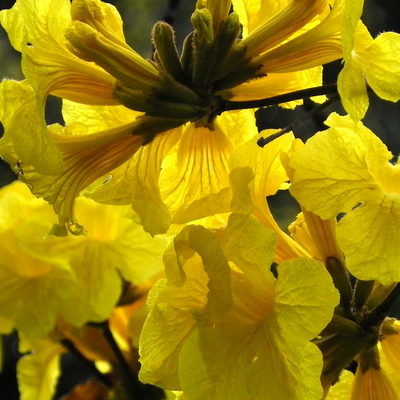
Cultivation methods for Forsythia viridissima:
1. Transplanting or turning the soil
Forsythia viridissima has two propagation methods, cuttings propagation and seed propagation, but after cuttings or sowing, attention should be paid to its transplanting situation. Before propagation, it is suitable to choose a small pot, and then according to the plant's growth size, transplant it into a suitable flower pot. This allows Forsythia viridissima to grow well. At the same time, in spring or autumn each year, the soil in the flower pot should be turned once to make the soil loose. While turning the soil, you can choose to add some organic fertilizer and mix it evenly together.
2. Fertilizer
Because Forsythia viridissima grows very fast and blooms relatively frequently, it needs sufficient fertilizer during the growing period. About three fertilizations are needed each month. However, in the scorching summer, fertilization may be unnecessary. Before fertilizing, observe whether the soil is relatively dry and loose. Be sure to fertilize when the soil is dry and loose. After fertilizing, the stems and leaves must be sprinkled with water once using a spray bottle. This prevents the stems and leaves of Forsythia viridissima from being contaminated by fertilizer, which could cause them to rot and die.
3. Temperature
Forsythia viridissima is suitable for growing at temperatures between 10-28 degrees. If it is a hot summer, preparations should be made in time to cool it down, and the temperature must not exceed 28 degrees. In autumn and winter, if the temperature is lower than 6 degrees, it will cause frost damage to Forsythia viridissima. In winter, it is best to place it in a place with abundant sunlight. But whether in summer or winter, ventilation is necessary.
For indoor potted plants, cleverly pairing Forsythia viridissima with other plants can produce unexpected beautiful scenery.
What are the differences between Forsythia viridissima and Forsythia suspensa:
1. Branch distinction
The branches of Forsythia suspensa grow in clusters, the branches are straight, and the branches expand outward from the center, forming an arch shape, like an opened small umbrella. The branches are yellow-brown.
The flowering branches of Forsythia viridissima are straight, and the small branches are yellow-green.
2. Flower and leaf distinction
The leaves of Forsythia suspensa grow directly on the branches, while the flowers bloom at the junction of the leaves and branches; the flowers are golden yellow; the flowers of Forsythia suspensa generally grow 3 together.
The leaves and flowers of Forsythia viridissima grow in the same way as those of Forsythia suspensa, but Forsythia viridissima does not always grow 3 together, sometimes 1, sometimes 2. The flower color is yellow-green.
The leaves of Forsythia suspensa grow oppositely, sometimes with 3 leaflets opposite, and sometimes with single leaves opposite. The edges of the leaves have coarse serrations.
The leaves of Forsythia viridissima are not like those of Forsythia suspensa, which have both single and multiple forms; they are simply single leaves, growing oppositely. The upper half of its leaves has coarse serrations.
The flowering period of Forsythia suspensa occurs twice, once in spring and once in winter.
3. Function distinction
Both Forsythia viridissima and Forsythia suspensa have ornamental and medicinal value. But Forsythia suspensa has a very strong function of water and soil conservation and is defined as an excellent variety in gardens. Forsythia viridissima can absorb toxic gases in the air.
Their cultivation methods, propagation methods, and daily care are very similar, including preferences, heat tolerance, drought tolerance, and so on. In fact, it is not difficult to distinguish them, as long as you pay attention to observation. For flower lovers, growing either one is the same, just do not call them by the wrong name when cultivating them.
Well, that is all for the introduction to Forsythia viridissima and Forsythia suspensa. Friends, do you all understand clearly now, and know the differences between the two plants? Do not get them mixed up.
The efficacy and functions of Forsythia suspensa, Forsythia suspensa price, Forsythia suspensa cultivation, the difference between Forsythia suspensa and winter jasmine, the difference between Forsythia viridissima and Forsythia suspensa
Forsythia suspensa
Forsythia suspensa (scientific name: Forsythia suspensa (Thunb.) Vahl): a deciduous shrub, commonly known in Hong Kong, China as "a string of gold", and a plant of the genus Forsythia in the family Oleaceae. The branches are spreading or pendulous, brown, brownish-brown, or light yellow-brown; the small branches are earth-yellow or gray-brown, slightly four-angled, sparsely lenticellate, with hollow internodes and solid pith at the nodes. Forsythia suspensa likes light and has a certain degree of shade tolerance; it likes a warm, humid climate and is also very cold-tolerant; it is tolerant of drought and barren conditions, and afraid of waterlogging; it is not choosy about soil and can grow normally in neutral, slightly acidic, or alkaline soil.The efficacy and functions of Forsythia suspensa
1. The efficacy of Forsythia suspensa
Forsythia suspensa is a traditional Chinese medicine for clearing heat and detoxifying, mainly treating the early stage of febrile disease, wind-heat common cold, fever, restlessness, sore throat, acute nephritis, and so on. Forsythia suspensa is also known as Huanghua Tiao, Lian Ke, Qing Qiao, Luo Qiao, Huang Qi Dan, and so on, and its fruit is used as medicine. Forsythia suspensa has pharmacological effects such as antibacterial, cardiotonic, diuretic, and antiemetic effects. It is commonly used to treat acute wind-heat common cold, carbuncles, sores, and toxins, lymph node tuberculosis, urinary tract infections, and other conditions, and is the main raw material of traditional Chinese medicine preparations such as Shuanghuanglian Oral Liquid, Shuanghuanglian Powder Injection, Qingre Jiedu Oral Liquid, Liancao Jiere Oral Liquid, and Yinqiao Jiedu Granules.
To treat Taiyin wind-warmth, warm-heat, warm epidemic, and winter-warmth with early-stage fever but no aversion to cold and with thirst: Forsythia suspensa 1 liang honeysuckle 1 liang Platycodon grandiflorus 6 qian mint 6 qian bamboo leaves 4 qian raw licorice 5 qian Schizonepeta spike 4 qian prepared soybean 5 qian Arctium lappa seed 6 qian Pound the above into powder. Take 6 qian each time decoct in fresh reed root soup when the aroma is strong take and administer immediately do not overcook. For severe cases take once about every two hours three times during the day once at night; for mild cases, take once every three hours three times during the day once at night; if the disease is not resolved take another dose. (Yinqiao San from Wenbing Tiaobian)
Forsythia suspensa price
1. Market quotation
Product name Specification Market Price Weekly change
Forsythia suspensa Yellow Qiao clean Anguo, Henan 85.00 2.41%
Forsythia suspensa Green Qiao raw Sun-dried standard Hehuachi, Henan 53.00 0%
Forsythia suspensa Green Qiao raw sun-dried standard Yulin, Henan 55.00 0%
Forsythia suspensa Green Qiao raw sun-dried standard Bozhou, Henan 53.00 0%
Cultivation of Forsythia suspensa
1. Soil: Potted cultivation of Forsythia suspensa requires loose and fertile potting soil with good drainage and air permeability.
2. Watering: The soil for growing Forsythia suspensa must not be too dry. Usually keep the potting soil moist but not waterlogged. Pay attention to drainage during the rainy season to avoid root rot caused by water accumulation in the potting soil.
3. Sunlight: Forsythia suspensa likes a sunny environment and is tolerant of partial shade. During the growing period, it can be placed outdoors in a sunny, well-ventilated place for care. Even during the high temperatures of midsummer, do not shade it.
4. Temperature: Forsythia suspensa is cold-tolerant. In winter, it can overwinter in a cold room, or the flower pot can be buried outdoors in a wind-sheltered, sunny place to overwinter. Control watering and keep the soil from freezing, and it can overwinter safely.
5. Fertilization: In spring and autumn, apply a decomposed dilute liquid fertilizer or compound fertilizer once every 15 to 20 days to Forsythia suspensa. In summer, stop fertilizing. In autumn, you can also spray the leaves with fertilizers with higher phosphorus content such as potassium dihydrogen phosphate to promote the formation of flower buds.
Forsythia suspensa flower language
Forsythia suspensa flower language: foretelling
Small Forsythia suspensa: magic This flower hides an incredible magical power. It is said that if you press small Forsythia suspensa under your pillow while sleeping, you can dream of the appearance of your future husband. Therefore, its flower language is - magic. However, this is not evil witchcraft, but well-intentioned magic. People born under the blessing of this flower have magical and keen insight, and a sixth sense like spiritual communication, and will regard the object of love at first sight as a lifelong partner.
The difference between Forsythia suspensa and winter jasmine
1. Attributes
Forsythia suspensa and winter jasmine are essentially of different attributes. Although both are in the family Oleaceae, winter jasmine is in the genus Jasminum, with the scientific name: Jasminum mudiflorum, while Forsythia suspensa is in the genus Forsythia, with the scientific name: Forsythia suspensa (Thunb.) Vahl.
2. Petals
The simplest way is to look at the petals of the two. Winter jasmine has six petals, while Forsythia suspensa has only four petals. When flowering, it is relatively easy to separate them just by looking at the petals.
3. Leaves
The leaves of winter jasmine all grow symmetrically in a cross shape. The leaves are relatively small, ovate-elliptic, entire, with a narrow and abruptly pointed tip; the leaves of Forsythia suspensa are ovate, broadly ovate, or elliptic-ovate, relatively large, with neat coarse serrations along the edges except at the base. In addition, winter jasmine has three leaflets in a compound leaf, while Forsythia suspensa has single leaves or three leaves opposite. This can also be observed from the growth of the leaves.
The difference between Forsythia viridissima and Forsythia suspensa
Forsythia viridissima and Forsythia suspensa are closely related siblings, with the main differences in plant shape and flower color. The branches of Forsythia viridissima are upright, and the flowers are bell-shaped, golden yellow or deep yellow; the branches of Forsythia suspensa are arching and pendulous, with hollow pith, and the flowers are bell-shaped and bright yellow. However, their hybrid is called Forsythia intermedia, whose plant shape resembles Forsythia viridissima with upright branches, and whose flower color resembles Forsythia suspensa, bright yellow. Below let us look at the specific differences between Forsythia viridissima and Forsythia suspensa:
Branches: Forsythia suspensa has clustered stems, upright, with spreading branches, arching and pendulous, small branches yellow-brown, pith hollow; Forsythia viridissima has upright branches, small branches yellow-green, pith flaky.
Flowers: Forsythia suspensa flowers are usually solitary, rarely 3 in leaf axils, corolla golden yellow, sepals equal in length to the corolla tube; Forsythia viridissima flowers are 1 to 3 in leaf axils, yellow-green, sepals reaching the middle of the corolla tube.
Leaves: Forsythia suspensa has single leaves or sometimes 3 leaflets, opposite, with coarse serrations along the leaf margins; Forsythia viridissima has single leaves opposite, with coarse serrations above the middle of the leaf.
Forsythia suspensa planting base
In China it is produced in Hebei, Shanxi, Shaanxi, Shandong, western Anhui, Henan, Hubei, and Sichuan. It grows in hillside thickets, under forests, or in grassy clumps, or in sparse forests in valleys and mountain gullies, at an altitude of 250-2200 m. In China, except for the South China region, it is cultivated in all other areas.
Related encyclopedia
Pocket scale non-woven bag rush pith bamboo shoot crab claw red rice note3 ykk zipper ybs zipper Prunus sargentii climbing rose Thermopsis chinensis wintersweet green pine wristwatch Omega Longines famous watch children's building blocks flint Cremastra appendiculata curling iron soursop
Forsythia viridissima picture collection The difference between Forsythia viridissima and Forsythia suspensa
Forsythia viridissima, also known as golden bells, blooms before its leaves and is golden and brilliant. It can be planted in clumps on lawns, at wall corners, along roadsides, at the edges of trees, in courtyards and in front of halls, with very good ornamental effects. However, Forsythia viridissima and Forsythia suspensa look quite similar. Below let us appreciate the flower posture of Forsythia viridissima and understand the difference between Forsythia viridissima and Forsythia suspensa:
Forsythia viridissima pictures
About Forsythia viridissima:
Forsythia viridissima, aliases: Forsythia viridissima, winter jasmine willow, winter jasmine strip, golden plum flower, golden bell flower; Latin name: Forsythia viridissima Lindl. A deciduous shrub of the genus Forsythia in the family Oleaceae, reaching up to 3-3.5 m in height. The whole plant is hairless except for the eyelashes on the edges of the calyx lobes. It grows in hillside thickets, by streams, and at forest edges. Golden bells blooms before its leaves and is golden and brilliant, and can be planted in clumps on lawns, at wall corners, along roadsides, at the edges of trees, in courtyards and in front of halls, and so on. The fruit shells, roots, or leaves of the Oleaceae plant Forsythia viridissima can be used as medicine.
Forsythia viridissima pictures
Morphological characteristics of Forsythia viridissima:
Deciduous shrub, up to 3 m tall, the whole plant hairless except for the eyelashes on the edges of the calyx lobes. Branches brown or reddish-brown, upright, small branches green or yellow-green, four-angled, with obvious lenticels and flaky pith. Leaves long elliptic to lanceolate, or obovate-long elliptic, 3.5-15 cm long, 1-4 cm wide, apex acute, base cuneate, usually with irregular sharp serrations or coarse serrations in the upper half, rarely nearly entire, dark green above, light green below, hairless on both sides, midvein and lateral veins sunken above and raised below; petiole 6-12 mm long. Flowers 1-3 (-4) borne in leaf axils, opening before the leaves; pedicel 3-7 mm long; calyx 3.5-5 mm long, lobes green, ovate, broadly ovate, or broadly oblong, 2-4 mm long, with eyelashes; corolla deep yellow, 1.1-2.5 cm long, corolla tube 5-6 mm long, lobes narrowly oblong to oblong, 0.6-1.8 cm long, 3-8 mm wide, with orange-yellow stripes at the inner base, recurved; in flowers with stamens 3.5-5 mm long, pistil 5.5-7 mm long; in flowers with stamens 6-7 mm long, pistil about 3 mm long. Fruit ovate or broadly ovate, 1-1.5 cm long, 0.6-1 cm wide, base slightly rounded, apex beaked and acuminate, with lenticels; fruit stalk 3-7 mm long. Flowering period March-April, fruiting period August-November.
Growth habits of Forsythia viridissima:
Habit characteristics: likes light, slightly shade-tolerant. Likes warm, humid environments, relatively cold-tolerant. Strong adaptability, not strict about soil, drought-tolerant, relatively moisture-tolerant. Well-developed root system, strong sprouting ability. Grows well in warm, humid, wind-sheltered and sunny places. In areas south of the Yellow River, it does not need shading in summer and does not need to be brought indoors in winter.
Forsythia viridissima pictures
Cultivation methods for Forsythia viridissima:
1. Propagate by cuttings, layering, division, and sowing, mainly by cuttings. Both hardwood and softwood cuttings can be used. Cut below the nodes, and they root easily after insertion.
2. It is not strict about soil. For potting, use loose, fertile, well-drained sandy soil.
3. Water once every 1 to 2 days in spring and autumn, once to twice daily in summer, and in winter water again when the soil surface is dry. For ground planting, keep the soil moist in late winter and early spring to promote the expansion of flower buds and flowering.
4. For potted plants, apply dilute liquid fertilizer once every half month, and apply phosphorus-potassium fertilizer once to twice more during the bud stage, which can make the flowers larger and more colorful. For ground planting, apply organic fertilizer once in a trench in winter and spring. After flowering each year, cut off dead branches, weak branches, and overly dense branches, and shorten leggy branches, so as to improve ventilation and light transmission and maintain a beautiful plant shape. As long as attention is paid to improving cultivation conditions and strengthening scientific management, pests and diseases generally will not occur.
The difference between Forsythia viridissima and Forsythia suspensa:
Forsythia viridissima and Forsythia suspensa are closely related siblings, with the main differences in plant shape and flower color. The branches of Forsythia viridissima are upright, and the flowers are bell-shaped, golden yellow or deep yellow; the branches of Forsythia suspensa are arching and pendulous, with hollow pith, and the flowers are bell-shaped and bright yellow. However, their hybrid is called Forsythia intermedia, whose plant shape resembles Forsythia viridissima with upright branches, and whose flower color resembles Forsythia suspensa, bright yellow. Below let us look at the specific differences between Forsythia viridissima and Forsythia suspensa:
Branches: Forsythia suspensa has clustered stems, upright, with spreading branches, arching and pendulous, small branches yellow-brown, pith hollow; Forsythia viridissima has upright branches, small branches yellow-green, pith flaky.
Flowers: Forsythia suspensa flowers are usually solitary, rarely 3 in leaf axils, corolla golden yellow, sepals equal in length to the corolla tube; Forsythia viridissima flowers are 1 to 3 in leaf axils, yellow-green, sepals reaching the middle of the corolla tube.
Leaves: Forsythia suspensa has single leaves or sometimes 3 leaflets, opposite, with coarse serrations along the leaf margins; Forsythia viridissima has single leaves opposite, with coarse serrations above the middle of the leaf.
Forsythia suspensa
Forsythia viridissima
Forsythia viridissima pictures, the difference between Forsythia viridissima and Forsythia suspensa, and other content are shared with everyone here. We hope it is helpful to everyone. For more related information, please continue to follow us.