Bromeliad offset propagation methods and how many years until it blooms
There are several different ways to propagate bromeliads, and offset propagation is one of them. So how do you propagate bromeliads by offsets? How many years until a bromeliad blooms?
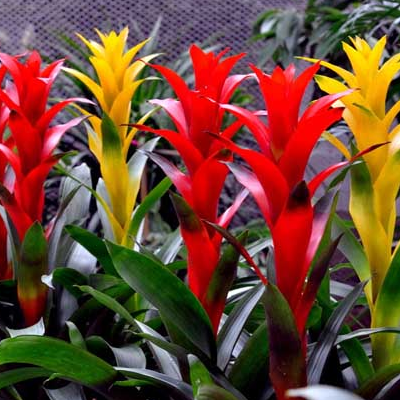
How to propagate bromeliads by offsets:
Offset propagation
Small shoots keep emerging from the leaf axils at the base of the bromeliad. When they have grown 5-6 leaves, they can be cut off for cutting propagation, and roots will appear in about 1 month.
1. Late spring to autumn is the growing season for bromeliads; watering can be increased appropriately, and some clear water can be poured into the leaf cups. You should change the water once every half month to prevent it from spoiling and smelling.
2. Mist the leaves often. In winter, it is better to keep the pot somewhat dry, but not excessively so.
3. From May to September, apply nitrogen fertilizer once a week, and appropriately increase phosphorus and potassium fertilizer before flowering to promote larger flowers and richer color.
4. When in bloom, do not pour water into the cup; keep it in a place away from sunlight to extend the flowering period.
5. After flowering, the plant enters dormancy, and the flower stalk must be cut off to reduce nutrient consumption.
6. Do not pour water into the cup in winter.
How many years until a bromeliad blooms:
Bromeliads do not bloom in a fixed season; it generally depends on growth time and care. As long as the growth time is more than 8 months (different varieties have different time requirements, ranging from 8 months to several years) and the plant is robust and large enough (including dead old leaves, it should have more than 20 leaves), it may bloom.
When a bromeliad has grown more than 30 leaves in natural conditions, it can bloom on its own under suitable environmental conditions. The flowering period is mainly late spring and early summer. To make ornamental bromeliads bloom as soon as possible, artificial forcing is often used. When some festivals are approaching, people artificially force the ornamental bromeliads to bloom so that people can see the colorful ornamental bromeliad flowers during the festival.
Alright, friends, now you all know that bromeliads do not have a fixed flowering season, but in general the flowering period is mainly late spring and early summer.
Bromeliads Bromeliads bromeliad illustrated guide: how to grow bromeliads / how to propagate bromeliads
Bromeliad profileBromeliads Bromeliads
Bromeliad cultivation methods and precautions, an introduction to bromeliads
Bromeliads, in the genus Billbergia, are native to the jungles from Mexico to southern Brazil and northern Argentina, with about 50 species, mostly terrestrial. The leaves are sickle-shaped, with the upper part sloping downward, arranged in 5-8 leaves as a tubular rosette.
Today's most popular indoor foliage plant, it amazes people with its unusual flowers and beautiful patterns.
Ornamental bromeliads were introduced into China since the 1980s and became popular with many people in some coastal cities. In 1994, at the Guangzhou Lunar New Year flower market, each pot of imported pineapple flower sold for 150-200 yuan, three times higher than Western azalea, and was quickly bought up by flower lovers.
The bracts are deep red, thick and glossy, and the entire inflorescence looks like a blazing torch. The flowering period can last up to three months, and it is also a favorite among ornamental bromeliads.
Morphological characteristics of bromeliads
The leaves of Billbergia are narrow and long like swords, green and glossy. From winter to early spring, a bright red columnar inflorescence emerges from the tender green leaf cup, about 30 cm tall; at the top are 6-12 small flowers, with 3 petals, pale yellow-green, edged in blue, curling outward after opening. When in full bloom, strings of blue-green flowers, set off by red bracts, look especially gorgeous and eye-catching, and the ornamental period can last up to two months.
The leaves are basal in a rosette, hard and leathery, strap-shaped and curving outward. Some leaves have dark green horizontal stripes, some are brown with green water-mark patterns, and some green leaves have dark green spots, etc. Especially near the flowering period, the leaves in the center turn bright deep red or pink, or the whole leaf turns deep red, or only the front end turns red. The leaf margins have fine sharp teeth, and the leaf tips have spines. The flowers are mostly sky blue or light purplish red.
Ecological habits of bromeliads
Bromeliads are highly ornamental flowering and foliage plants, especially suitable for growing indoors; as home garden ornamentals they are of very high taste.
Common cultivated varieties include the following:
In the genus Billbergia, native to the jungles from Mexico to southern Brazil and northern Argentina, with about 50 species, mostly terrestrial. The leaves are sickle-shaped, with the upper part sloping downward, arranged in 5-8 leaves as a tubular rosette.
This plant is very suitable for indoor decoration. It likes at least 3 hours of full sunlight per day, but also tolerates partial shade. In summer it likes cool, ventilated conditions, and can also tolerate slightly dry climates. Common varieties include Billbergia elegans, Billbergia rosea, Billbergia nutans, and Qiegonglei. The soil should be an acidic sandy loam rich in humus with good drainage.
In addition, there is the dragonfly bromeliad, also called "beautiful-leaved Aechmea" and variegated-leaf bromeliad.
At present, the ornamental bromeliads commonly cultivated in China include 5 genera:
Guzmania, Vriesea, Aechmea, Tillandsia, Neoregelia.
The leaves are basal in a rosette, hard and leathery, strap-shaped and curving outward. Some leaves have dark green horizontal stripes, some are brown with green water-mark patterns, and some green leaves have dark green spots, etc. Especially near the flowering period, the leaves in the center turn bright deep red or pink, or the whole leaf turns deep red, or only the front end turns red. The leaf margins have fine sharp teeth, and the leaf tips have spines. The flowers are mostly sky blue or light purplish red.
Cultivation techniques for bromeliads
Ornamental bromeliads are extremely easy to care for. As long as you master their habits of liking high temperature, humidity, and partial shade, they can be kept year-round in a warm, bright room. In winter they can receive full sun; in spring and autumn they should have morning and evening light; in summer avoid direct sunlight. With bright light, the leaf color is vivid. The overwintering temperature should preferably not be lower than 10°C; above 20°C is not conducive to the plant's dormancy and will affect the next year's growth and flowering.
From late spring to autumn, during the growing season, watering can be increased appropriately, and some clear water can be poured into the leaf cups. You should change the water once every half month to prevent it from spoiling and smelling. Mist the leaves often. In winter, it is better to keep the pot somewhat dry, but not too dry. From May to September, apply nitrogen fertilizer once a week, and appropriately increase phosphorus and potassium fertilizer before flowering to promote larger flowers and richer color. When in bloom, do not pour water into the cup; keep it in a place away from sunlight to extend the flowering period. After flowering, the plant enters dormancy, and the flower stalk must be cut off to reduce nutrient consumption. Do not pour water into the cup in winter.
Soil
River sand mixed with fine tree fern fiber or ordinary commercial potting soil is fine.
Water
Bromeliads do not need special care. In autumn and winter they can even be given water once every 7-10 days. When adding water, let it collect in the central leaf cup. Observe how the water is absorbed. If water remains for more than a week, it should be poured out and replaced with fresh water to avoid breeding pathogens.
Sunlight
Generally, bromeliads like sunlight, but strong light exposure is not allowed, otherwise the leaves will be damaged. They can grow well indoors. When the temperature is below 10°C, it is best to move them indoors.
Fertilizer
Their growth rate is not fast. It is best, after transplanting or planting, to mix slow-release fertilizer into the medium, or spray a very dilute liquid fertilizer on the leaves or pour it into the leaf cup once a month.
The root system of ornamental bromeliads is not very developed, with no main root, and some roots even like to be exposed to air. Therefore, planting in small, shallow pots will grow and develop better than in large, deep pots. The potting soil is best made of leaf mold plus a small amount of garden soil, or half peat and half perlite mixed together.
After flowering, the central leaf rosette dies, while the side offsets continue to grow. When this offset is 15 cm tall, it can be removed with roots from the mother plant and planted separately. Doing so can only be "passed down singly from generation to generation," and the number propagated is limited. Therefore, it is best to combine this with repotting in spring: cut off the small tubers growing from the tuberous part of the mother plant for cuttings, or divide the rooted tender shoots sprouting from the roots of old plants. Both require shade, moisture retention, and warmth. When the root system grows to 2-3 cm, it can be planted out. If cultivated properly, one mother plant can propagate about 10 plants per year.
In daily care, bromeliads should be placed in a partially shaded, ventilated place and grown under scattered light. Strong light easily scorches the leaves and causes mottled spots; but be careful not to keep them in too shady a place for a long time, as the beautiful leaf color often becomes lighter and paler because of this, causing regret in ornamental value.
Under conditions of drought, muggy heat, and low humidity, the leaf margins and leaf tips of bromeliads are very prone to scorching and withering. Therefore, keep the potting soil moist, spray clear water on the leaf surface 1 to 2 times a day, and fill the cup-shaped central part of the leaf rosette with clear water. Bromeliads were originally epiphytic plants, and their root systems are not well developed, with only small, short roots. Therefore, never apply too much fertilizer, to prevent root rot and yellowing leaves; apply dilute fertilizer water instead.
Small shoots keep emerging from the leaf axils at the base of ornamental bromeliads. When they have grown 5-6 leaves, they can be cut off for cutting propagation, and roots will appear in about 1 month. For planting bromeliads, it is best to choose loose peat soil, leaf mold, and tree fern fragments mixed as potting soil.
Key care points
Bromeliads are epiphytes, native to the tropical rainforests of Central America. From observing the native environment of bromeliads, most bromeliads like partially shaded conditions and avoid direct sunlight. Generally speaking, the suitable light environment for bromeliads is around 18,000 lux, and relative humidity needs to be maintained between 68-75%; in terms of temperature, daytime requirements are around 22-28C, while at night it is best to maintain around 20-21C. Bromeliads are very sensitive to relative humidity (RH). Under strong light or dry conditions, when humidity is less than 50%, the leaves will curl inward or fail to extend. Therefore, in high-light-intensity environments, we should appropriately match humidity above 75%. Although bromeliads like humid environments, during periods of high temperature and high humidity in summer, insufficient ventilation can easily occur, hindering growth and making them prone to pests and diseases, so ventilation must be maintained. Under strong light, if air humidity is below 65%, or if it is dry with good ventilation, leaf tips can also wither. Note that after the flower spike emerges, if it encounters high temperature (30 degrees), the color of the flower spike will fade and the flowering period will also be shortened.
How to imitate the native environment of bromeliads as much as possible is an important factor for successful cultivation. In terms of humidity, light, and temperature control, we can coordinate with equipment:
(1) Misting system - temperature and humidity control: Increasing air humidity can prevent excessive transpiration of the plant and the resulting scorching. Generally, high-pressure misting (small water cannon) can increase air humidity and at the same time achieve a cooling effect. The principle is to use small water droplets to take away excess heat from the greenhouse during evaporation. However, in the already high-humidity environment of southern China, the cooling efficiency is slightly poorer.
(2) Automatic shading system (can be retracted and extended at will) - light control: To avoid indoor temperatures becoming too high during the day due to strong light, we should install shade nets, but excessive shading will make the leaves narrow and long, affecting quality. Therefore, an automatic shading system that automatically adjusts with light intensity is a very effective light control system.
(3) Ventilation system (window opening and closing) - temperature control: This is mainly to avoid the problem of excessively high temperatures in the greenhouse. Ventilation helps prevent pests and diseases, and also helps the leaves cool down in hot environments.
(4) Heating and cooling systems - temperature control: When cultivating ornamental bromeliads in China, the primary problems to face are excessively high temperatures in summer and excessively low temperatures in winter. In summer, a water curtain fan system should be used for cooling. Its advantage is that when used in the humid southern climate, it can keep the leaves and medium from becoming too wet, and it also has a ventilation effect; when used in the dry north, its cooling effect is even better. In winter, a heater should be installed, not only to prevent cold damage and halted growth, but also to prevent natural flowering from occurring.
Proper water and nutrient management and medium application:
[Water quality]: Water quality is very important for producing ornamental bromeliads. Whether bromeliad cultivation succeeds or not, water quality must be taken into consideration. Generally, the lower the salt content of the water, the better. Domestic tap water/well water may sometimes contain large amounts of salt, and must be analyzed before use before it can be applied. Foreign bromeliad experts recommend using rainwater or reverse osmosis water for irrigation to ensure that the water does not contain excessive sulfur, chlorine, boron, and other elements. Before each irrigation, be sure to measure the EC and pH of the water.
[Nutrition]: The three major fertilizer elements are essential for bromeliad growth. General compound fertilizers describe the percentage content of the three elements as N:P2O5:K2O. Nitrogen (N) can cause leaves to elongate and turn dark green; phosphorus (P) helps transport within the plant; and potassium (K) has the function of making leaves shorter and wider. Bromeliads like potassium fertilizer (K); using appropriate potassium fertilizer can promote shorter, wider leaves and increase the quality of bromeliad foliage. As for bromeliads, they are very sensitive to boron (B). Whether the medium or irrigation water contains trace amounts of boron, it will cause tip burn symptoms on bromeliad leaves. In addition, note that high-nitrogen (N) fertilization will also cause plant aging.
[Fertilization essentials]: When fertilizing, water-soluble fertilizer should be kept at 1. Understanding bromeliads
Bromeliads, also called pineapple flowers, are crops native to the jungles of Mexico and Brazil, as a by-product of pineapple. Their shape is very unusual, more like the throne of Guanyin Bodhisattva, with very high ornamental value, and they are very popular potted plants on the market. The leaves of bromeliads are like sickles, hanging downward. Each leaf grows in a tubular rosette shape, and the flower shape is unusual. The flower language of bromeliads implies good fortune, good luck, and perfection, and also carries the auspicious meaning of great fortune.
2. Bromeliad growing environment
Bromeliads like warm and humid climatic environments and like sufficient sunlight. In winter, the temperature should be appropriately increased. In summer, do not place bromeliads directly under the sun; they should be appropriately shaded. Bromeliads like a partially shaded living environment. Spring and autumn are their growing seasons, and at this time they should be watered appropriately to keep the moisture moist. During the growing season, also pay attention to additional fertilization to ensure nutrient supply during the bromeliad's growth period, so they can grow larger leaves and flowers. Bromeliads like fertile, loose, sandy soil with good drainage.
Usually, caring for bromeliads is also easy. As long as you follow the bromeliad's living habits of liking warmth and humidity and keep light, water, fertilizer, and soil in line with the bromeliad's growth requirements, it is fine. Generally, in winter, when bromeliads enter dormancy, do not water or fertilize them anymore; just wait until the beginning of spring the next year to carry out care.
3. Care of bromeliads
Usually, place bromeliads indoors as much as possible to keep them cool, and do not place them outdoors in strong sun. When the climate is dry, water the bromeliads promptly. During the bromeliad's growing season, also pay attention to increasing fertilization. If they are potted specimens, pay attention to pruning the bromeliad's shape and removing weeds to keep the potted plant looking attractive.
Variety classification of bromeliads
The leaves of Billbergia are narrow and long like swords, green and glossy. From winter to early spring, a bright red columnar inflorescence emerges from the tender green leaf cup, about 30 cm tall; at the top are 6-12 small flowers, with 3 petals, pale yellow-green, edged in blue, curling outward after opening. When in full bloom, strings of blue-green flowers, set off by red bracts, look especially gorgeous and eye-catching, and the ornamental period can last up to two months.
Cryptanthus, also called small bromeliad, is most suitable for potted ornamental viewing. Its leaves are hard and slender, with wavy edges. The colors include creamy yellow, red, or purplish red, etc. The leaf surface has longitudinal stripes radiating like a crab shape. The flowers are white or light green, growing among the leaf clusters and forming a disc.
Aechmea, also called beautiful-leaved Aechmea and spotted pink pineapple, has a plant composed of 10-20 leaves forming a rosette, with a cup shape at the base. The leaf tips are bluntly rounded and turned outward, green, with a silvery white coating on the surface, and the leaf surface has irregular stored color and dark green horizontal stripes and patches. Between summer and autumn, after the peach-red columnar flower, about 15 cm tall. The densely packed small flowers are blue when first opened and later turn rose red, like a dragonfly flapping its wings in flight, and the ornamental period can last several months.
The leaves of the golden-edged bromeliad are sword-shaped, curling outward, crisp and glossy. The front of the leaf is dark green, the edges are yellow-green, and some leaves gradually also have varying yellow-green stripes in the middle. The back of the leaf is light green, with the same yellow-green hidden stripes as the leaf surface. In spring and summer, the cylindrical flower bud emerging from the leaf cup is about 2.5 cm thick, with 25-30 sepals wrapping from bottom to top like bamboo shoot shells into a column from deep red to pink, closely resembling a red bamboo shoot set in the leaf cup. Over two or three weeks, the columnar flower bud splits open, sending up a straight flower stem, on which more than a dozen small flowers bloom. Each small flower shows three colors from bottom to top: yellow, red, and purple, and is very ornamental.
Colorful-bracted bromeliad, also called torch, is a hybrid. The leaf edges are smooth and without serrations. From the center emerges an upright flower stem, up to 35-40 cm long, with a spike inflorescence at the top, and the flower spike has 2-4 branches. The bracts are deep red, thick and glossy, and the entire inflorescence looks like a blazing torch. The flowering period can last up to three months, and it is also a favorite among ornamental bromeliads.
Distribution area of bromeliads
In the genus Billbergia of the Bromeliaceae family, native to the jungles from Mexico to southern Brazil and northern Argentina, with about 50 species.
Medicinal food or medicinal value of bromeliads
The medical information and healthy food therapy information on Huhua Network is for reference only and cannot be used as a basis for diagnosis or medical treatment. Any health problem should be consulted with professional medical personnel, and treatment of any disease should follow doctor's advice.
Ultimate flower-protecting mission: love yourself, start from reality, and strictly follow doctor's advice. For illness, do not be careless, do not delay, do not give up hope; face it bravely, warm the silent world with love, and care for the flower field in your heart with your heart.
Medicinal value
Chemical composition
Regarding the requirements of bromeliads for the chemical properties of the medium, the focus is on the EC value and pH value of the medium. A medium with low salt content can promote root growth, and good roots are very important for supplying water to the plant. As for pH, if it can be continuously maintained at 5 to 5.5, that is best, indicating that the medium's buffering capacity is relatively strong. In addition to benefiting nutrient absorption, the external shock received by the roots is also greatly reduced.
High-quality peat-based media supplied on the market are generally pH-adjusted high-moor peat (such as Klasmann white peat), have the characteristic of low EC, and are usually also treated with added wetting agents, making them more suitable for producing high-quality bromeliads. Such media are suitable for adding fertilizer during crop cultivation or for fertigation management.
Landscape uses of bromeliads
Bromeliads are highly ornamental flowering and foliage plants, especially suitable for growing indoors; as home garden ornamentals they are of very high taste.
Uses of bromeliads: ornamental and practical
Pineapple, that is, pineapple, is a perennial herbaceous plant in the Bromeliaceae family, with about 60 genera and more than 1,400 species. Their homeland is the Caribbean coast and various parts of South America. In the pineapple family, there are varieties whose flowers are not beautiful but can bear pineapple fruit, which people call edible pineapple; there are also varieties whose flowers and leaves are both unusual and novel but cannot bear fruit, which people call ornamental bromeliads or pineapple flowers.
Ornamental bromeliads were introduced into China since the 1980s and became popular with many people in some coastal cities. In 1994, at the Guangzhou Lunar New Year flower market, each pot of imported pineapple flower sold for 150-200 yuan, three times higher than Western azalea, and was quickly bought up by flower lovers.
At present, the ornamental bromeliads popular in China include Billbergia, Cryptanthus, Aechmea, golden-edged bromeliad, colorful-bracted bromeliad, etc. Their plants have clustered grassy stems, and the stems are generally relatively short. The leaves are narrow and long, either sword-shaped or various strap shapes, and most leaf margins have serrations. The leathery leaves are brilliantly colorful. The flowers they produce are even more varied. Both their flowers and leaves seem coated with a layer of wax, soft yet firm and glossy. The bases of the top leaves often tightly overlap each other into an outward-expanding rosette, like a man-made water-holding tube, which can store water to slowly "drink" during drought. Therefore, they have become famous indoor foliage and flowering plants. As living room decorations, they are both warm and restrained, and very ornamental.
Medium application
Producing excellent bromeliads requires the use of medium-coarse and coarse-structured media in sphagnum peat. Generally, using half Klasmann peat 422# and half 414# can maintain good aeration and water retention. However, the leaf cup needs to remain filled with water frequently for the plant to grow well. Bromeliads can absorb large amounts of nutrients from water. If the leaf cup has no water, it will cause drought, curling at the leaf base, and leaf curl, etc.
The important roles of bromeliad roots and leaf cups:
Ornamental bromeliads originally belong to epiphytic plants. In the natural environment, they can even grow without a medium, because bromeliads possess a special structure that other plants do not have: the leaf cup.
Of course, bromeliads need to use a medium for commercial production. However, we must make use of this special function of the bromeliad leaf cup: the leaf cup has the ability to absorb nutrients and water. Under normal circumstances, as long as the leaf cup has sufficient nutrients and water, the plant can grow well; but we also cannot ignore the function of the bromeliad root. In addition to the need for physical fixation, the root is also an important organ for absorbing water and nutrients. But bromeliad roots especially need a medium with good aeration to have healthy roots. Medium management is very important during periods of rapid growth.
From small seedlings to finished products, cultivation takes about 1-1.5 years. Therefore, bromeliads have higher requirements for medium properties than other short-term crops. As mentioned above regarding the growth needs of bromeliads, good medium physical properties include: good aeration (good drainage), 50-60% water-holding capacity and a relatively low degree of medium shrinkage, good structural stability (decomposition rate), etc. Good aeration and drainage help reduce the occurrence of pests and diseases. Structural stability is very important for long-term crops such as bromeliads; media that decompose too quickly (such as coconut coir, sawdust, etc.), in addition to causing nitrogen deficiency, will also reduce aeration because the medium shrinks, affecting normal root growth and even causing root rot. Therefore, choosing media carefully is very important.
Flower language of bromeliads
The flower language and symbolic meaning of bromeliads: perfection. From sprouting, to growing, to brilliant full bloom, the bromeliad is single-minded, like a traveler without reins, and even in a tiny patch of soil, it must penetrate to the essence. This belief in pursuing perfection always accompanies the bromeliad. Numerous small flowers cluster densely on the flower stem, forming a thick flower spike, and the bracts at the tip of the flower spike extend radially. Each small flower is star-shaped. The flowers are yellow, light green, pink, white, etc.
Pineapple is a very beautiful indoor potted flower that is both ornamental in flower and foliage. With its unique rosette plant shape, bright spike inflorescence, and relatively long flowering period, it has gradually become the "favorite" of the Lunar New Year flower market. Flower-giving etiquette: spread thin paper in the flower basket, and place pineapple lilies and pineapples and other tropical fruits.
Bromeliad pictures
How many years is the lifespan of air plants? How often do air plants bloom?
Air plants are plants that like dryness and cannot tolerate high temperatures. At present, they are distributed in many places in China. Air plants are flowering plants, and they are very beautiful when in bloom, so they attract many people to cultivate them. However, many people do not understand their habits. After blooming, air plants will die!
How many years is the lifespan of air plants
As for how many years the lifespan of air plants is, there is currently no relatively exact data, because different varieties and different environments will lead to different lifespans. However, for air plants kept at home, flower lovers do not need to worry too much about how long air plants can live.
How often do air plants bloom
The main flowering period of air plants is between late autumn and early spring, but those grown indoors do not have a fixed flowering season. As long as conditions are suitable and the plant reaches maturity, it can bloom at any time. Air plants generally produce offsets or daughter plants from the base of the plant after the flowering period, and sometimes during the flowering period. Special varieties can produce small plantlets on the flower stem. The bad thing is that each plant blooms only once in its lifetime, but after flowering you can obtain offset plants, and then more flowers will bloom. Generally speaking, the flowering period lasts from a few days to several months, depending on the characteristics of the variety.
Do air plants die after flowering?
Air plants die after flowering, but not immediately; after flowering they will grow for 1-2 years. But everyone can take this opportunity to propagate offspring. When the flowers of the air plant begin to wither, it is recommended to cut off these withered flower stalks, as this will produce more plantlets. When the small plantlets from the offsets begin to sprout, the leaves at the base of the plant will begin to loosen and appear withered. At this time, do not cut off the leaves, because these places are the positions of the buds of the small plantlets. When the small plantlets grow up, they can be divided, and the mother plant can rest.
How to grow air plants so they bloom more
Offset propagation can make air plants bloom more and continue growing. The specific methods are as follows:
1. As air plants grow, many side shoots will grow on the plant. These side shoots grow very quickly, making them especially suitable for offset propagation. According to the growth condition of the mother plant, the newly grown side shoots can be separated from the mother plant and then planted separately. Generally, as long as the newly divided side shoots from that year are cared for properly, they can bloom.
2. When air plants are propagated by offsets, because growth is faster than from sowing, a lot of time can be saved. However, after the first division, unless the mother plant has already died, it is generally allowed to continue growing, and after new side shoots grow out, offset propagation can be carried out again.
3. It is just that when dividing, you will find that the air plant becomes thinner and thinner and will slowly die. If you do not want the air plant to die like this, you can divide it and let it grow in clusters, and you can still have a beautiful air plant.
4. After air plants are divided, they need a placement period of one month. During this period, just mist them with water. When you see that they have grown new roots, they can be mounted. After mounting, normal care is all that is needed. Offset propagation for air plants is actually a relatively good choice, because division can preserve their original traits to the greatest extent, but it may lead to a decline in quality. On the contrary, sexual propagation methods such as sowing can still ensure quality, so if conditions permit, sowing propagation can be adopted.
If air plants are well cared for, their lifespan will be longer; if poorly cared for, their lifespan will be shortened. Therefore, many skills are needed during the cultivation process. If you want air plants not to die after flowering, you can carry out offset propagation, so that they can continue to reproduce.