When Does the Gazania Bloom? A Detailed Guide to Planting Methods
Gazania, also known as the treasure flower, has a relatively long blooming period, which makes it very suitable as a potted plant. So when does the gazania bloom? What are the planting methods for gazania?
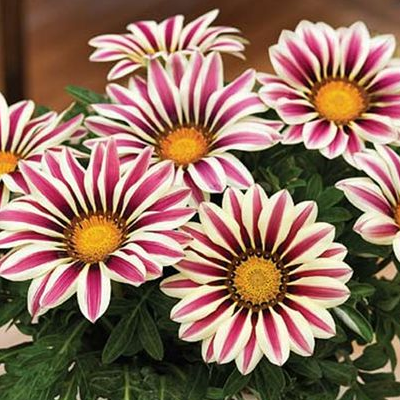
When does the gazania bloom:
The gazania has a relatively long blooming period. Gazanias generally bloom in late spring and early summer, and can continue from April to May. If the temperature is suitable, for example when cultivated in a greenhouse, the gazania can bloom continuously all year round.
When the gazania blooms, its flowers open facing the sun. They open when the sun rises in the morning, and the petals close when the sun sets at dusk, then open again the next day. This cycle repeats, and the flower only fades after about 10 days.
What are the planting methods for gazania:
1. Potted gazanias commonly use 12-15 cm pots, and the potting soil can be a mix of leaf mold, manure soil and coarse sand in equal parts. Seedlings can be potted up when they grow to 4-5 leaves.
2. Potted gazanias are grown in 10 to 16 cm flower pots with a well-draining medium. Keep the potting soil dry, and water only after the potting soil has dried each time. Watering gazanias is best done in the morning, which helps the leaf surface stay dry at night and prevents disease. Too much water causes leggy growth, while too dry a condition causes early flowering and the leaf surface is easily scorched under strong light.
3. Watering tips for gazania: keep the soil moderately moist during the growing period.
4. Temperature and light for gazania: under conditions of sufficient light and suitable temperature, it can bloom continuously. If you are not saving seeds, promptly cut off the spent flowers after they fade, which helps form more flower buds and produce more blooms.
5. Fertilizing tips for planting gazania: fertilize about once every half month, using Huiyou 15-15-30 special fertilizer for potted flowers or fermented cake fertilizer water.
6. Pest and disease control for gazania: leaf spot disease is a common threat, and it can be sprayed with a 1000-fold dilution of 25% carbendazim wettable powder. Pests include red spider mites and aphids. For aphids, spray with a 1000-fold dilution of 2.5% rotenone emulsifiable concentrate, and for red spider mites, spray with a 1500-fold dilution of 40% omethoate emulsifiable concentrate.
7. Propagation of gazania: gazanias are commonly propagated by sowing, division and cuttings. Sowing can be done in spring in April or in autumn in September. The suitable germination temperature is 16-20°C, and germination occurs 15-25 days after sowing. When the seedlings grow their first pair of true leaves, carry out the first transplanting. Division of gazania is mostly done in March-April before the leaf clusters sprout. Dig up the overwintered mother plant and cut it lengthwise from the root crown of the clump with a sharp knife. Each division should carry buds and roots, and can be potted directly. Cutting propagation of gazania can be done in both spring and autumn. Cut off shoots with stem nodes, keep the top 2 leaves, and insert them into a sand bed, keeping the medium moist. At a temperature of 20-25°C, roots form 20-25 days after insertion. If the cuttings are treated with 0.1% indolebutyric acid for 1-2 seconds, rooting is even faster.
Alright, everyone, you all now know that the gazania blooms in late spring and early summer.
How to Grow Gazania: The Complete Guide to Gazania Planting Methods
In today's life, many friends are very fond of growing all kinds of plants, so we often see a wide variety of plants and flowers indoors, and the gazania is one of them. This is a very beautiful flower, and when in full bloom it looks like a sunflower blooming in the desert, very passionate and warm, making people adore it. But how do you grow gazania, and what are its planting methods? Below let us take a look at an introduction to gazania planting methods.
Introduction to Gazania
Gazania, also called the treasure flower or African sunflower, is a perennial herbaceous flowering plant of the Asteraceae family. This is a very beautiful plant and flower, native to the regions of South Africa and Mozambique. Because this flower has high ornamental value, gazania is often cultivated in various places as an ornamental or garden flower. The reason this flower is called the gazania is that when it blooms, the arrangement of its petals looks just like a medal, very solemn and beautiful.
Growing Habits of Gazania
Gazania comes from the warm region of South Africa, so it is essentially very fond of warm and sunny growing environments. However, the flower is still fairly robust, and can grow very well even in a cool and moist environment, though it cannot adapt to hot and waterlogged conditions. Gazania is semi-hardy, meaning the flower is not particularly drought-tolerant, so in winter, as long as the temperature is not unusually low, it can generally overwinter safely. This is a clump-forming flower, usually appearing in groups, very beautiful.
Planting Methods for Gazania
1. Temperature
The suitable growing temperature is around 13 to 20°C. It is not tolerant of high temperatures, is semi-hardy, and is not particularly adaptable to hot and low-temperature environments. During cultivation, try to avoid both high-temperature and low-temperature climates. Pay attention to keeping warm in winter and cooling down in summer.
2. Water
The plant is fairly sensitive to water and loves a moist growing environment, but at the same time it is also very prone to problems with waterlogging and drought. Therefore, when watering daily, you must strictly control the amount, and do not let water accumulate in the flower pot, otherwise it may well cause the plant to die.
3. Light
A light-loving flower, it greatly enjoys sufficient light, and when the plant is in its growing and blooming periods it needs even more sufficient light. Therefore, when growing the plant normally, let it bask in the sun more and fully enjoy the light.
4. Soil
Its requirements for soil are not very high, but when growing it you should still prepare some loose, breathable and well-draining soil. You can mix together culture soil, leaf mold and an appropriate amount of coarse sand. The soil's drainage must be good to prevent water accumulation.
5. Fertilizing
Gazania's requirements for fertilizing are actually not very strict, because gazania has fairly strong adaptability and its demand for nutrients is not very high. Generally, fertilizing the plant once every half month during the growing period is enough. No heavy fertilizer is needed; ordinary light fertilizer is sufficient.
6. Control
Gazania's resistance is actually quite good, so basically the plant rarely suffers from pests and diseases. But this does not mean the plant has no pests or diseases at all, so when growing it you should still pay attention to watering and sun exposure to prevent the plant from getting sick and dying.
Summary: Gazania is a very beautiful flower. Its beauty is like warm sunshine, giving people a very gentle warmth. So people love to grow it, and it just so happens that the flower is also very easy to grow.
I. Planting Methods for Gazania
1. Soil
Gazania's requirements for soil are not very high, but it is still best to choose soil with relatively good breathability and drainage. If there really is none, that is fine too. Because, as we said earlier, its requirements for soil are not that high.
2. Light
Like most plants, gazania loves sunlight and needs to receive sufficient sunlight. Only this way can it help the gazania grow and make it bloom more brilliantly. Especially during the growing period of the gazania, you must let it get plenty of sunlight.
3. Water
Gazania likes to grow in a relatively moist environment and does not like living in a water-scarce, arid environment. But you also cannot water it too much, and you cannot let too much water accumulate in the flower pot, because this will drown it.
4. Temperature
It does not like living in a hot environment, because gazania cannot survive in a high-temperature environment. The suitable growing temperature is around 13-20°C. During cultivation, try to avoid both high-temperature and low-temperature climates. Pay attention to keeping warm in winter and cooling down in summer.
5. Fertilizing
Because gazania's adaptability is fairly strong among plants, its requirements for fertilizing are actually not very strict, and its demand for nutrients is not very high. Generally, fertilizing the plant once every half month during the growing period is enough. No heavy fertilizer is needed; ordinary light fertilizer is sufficient.
6. Control
Gazania's resistance is actually quite good, so basically the plant rarely suffers from pests and diseases. But this does not mean the plant has no pests or diseases at all, so when growing it you should still pay attention to watering and sun exposure to prevent the plant from getting sick and dying.