When does the Four O'Clock Flower bloom? A detailed guide to growing it
Most people have probably never heard of the Four O'Clock Flower; this plant is just like its name. So when does the Four O'Clock Flower bloom? What are the methods for growing it?
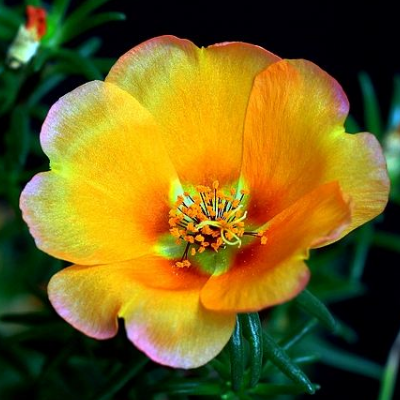
When does the Four O'Clock Flower bloom:
The Four O'Clock Flower, also known as Scutellaria barbata, Moss Rose, and Night-falling Money, etc., is an annual herbaceous plant of the genus Pentapetes in the family Sterculiaceae. The Four O'Clock Flower, 0.5 to 1 m tall, is a flowering plant native to India, and is now widely cultivated in Guangdong, Guangxi, southern Yunnan and other places in China. Its leaves are linear-lanceolate, with acuminate tips, and the leaf margins have a few obtuse serrations. The flowering period of the Four O'Clock Flower is usually in summer and autumn. When it blooms, its flowers grow in the leaf axils, and the flowers have 6 sepals and petals; the flowers are red and look very gorgeous. Bright red flowers, emerald green leaves, and together with its auspicious name, it has had the charm of "a heavenly maiden tossing coins under the moonlight" since ancient times, and is deeply loved by people.
Just as its name suggests, the Four O'Clock Flower usually opens at noon and closes the next morning, so people sometimes also call it the Sunflower, because the Four O'Clock Flower blooms right at the tip of the sun, while in the early morning and evening, or on cloudy days when there is insufficient light, the Four O'Clock Flower will close and not open. At the same time, when the Four O'Clock Flower falls, it falls whole, flower and all, so people also call it Night-falling Money. Although the Four O'Clock Flower opens at noon, this does not mean it blooms exactly at noon; its flowers generally open in the afternoon, mainly because the midday light is too intense and would scorch the leaves and flowers, so it generally does not bloom at noon.
What are the methods for growing the Four O'Clock Flower:
The Four O'Clock Flower is native to the tropical regions of India, so it is very suitable for warm places with plenty of sunlight. Usually, people sow it in open-ground seedbeds or flower pots. The method commonly used to cultivate the Four O'Clock Flower today is still sowing and growing. When sowing, soak the seeds of the Four O'Clock Flower in warm water for a while, then sow them into the prepared seedbed or flower pot. The Four O'Clock Flower is not cold-tolerant and likes a moist environment, so during cultivation, care should be taken to keep the soil moist, but there should not be too much water either, otherwise the flower pot is prone to water accumulation, causing the plant roots to rot, and the plant is also prone to pests and diseases, which is not conducive to normal plant growth.
In addition, the Four O'Clock Flower is mostly grown in pots for ornamental purposes, or planted in courtyards, roadsides and flower borders. During cultivation, care should be taken to apply a small amount of decomposed cake fertilizer as a base fertilizer before planting, to ensure that the plant has sufficient nutrient supply for growth. At the same time, during the growing period, the Four O'Clock Flower needs more fertilizer; at this time, generally apply a thin cake fertilizer solution once every half month. Do not apply too much fertilizer, otherwise there will be excess nutrients, hindering the growth of the flowers. In addition, the Four O'Clock Flower is not cold-tolerant, so during ordinary care, attention should be paid to maintaining the plant's growing temperature and strictly controlling the temperature to avoid frost damage.
Alright, that is all for the introduction to the Four O'Clock Flower. Friends, you all know now that the Four O'Clock Flower blooms at noon.
What is the Four O'Clock Flower? When is its flowering period? What medicinal value does it have?
The Four O'Clock Flower, which is what everyone calls the Sunflower, is a very common flowering plant. Today I will share with you: What is the Four O'Clock Flower? When is its flowering period? What medicinal value does it have?
What is the Four O'Clock Flower:
The Four O'Clock Flower, with the aliases Scutellaria barbata and Moss Rose, is an annual herbaceous plant, named the Four O'Clock Flower because it blooms at noon.
The Four O'Clock Flower originated in India and was later introduced to China. Today it is mostly grown in Guangdong, Guangxi, Yunnan and other regions, mostly for ornamental use, and is suitable for cultivation in hot regions and subtropical regions.
Morphological characteristics of the Four O'Clock Flower
Flowers: The Four O'Clock Flower is mostly axillary, and its flowers are mostly red, lanceolate in shape, with about 5 petals in an obovate shape, and inside there are calyx, floral tube, and filaments. A single Four O'Clock Flower plant has about 50 stamens, often gathered in groups of 3, mostly united, with no flower stalk.
Leaves: The leaves of the Four O'Clock Flower have fine hairs, are not prickly to the touch, are green in color, with serrated leaf margins and a triangular base; the petiole is about 1 cm long.
Fruit: The Four O'Clock Flower rarely bears fruit, and when it does, its shape is mostly spherical, about 1.2 cm in diameter, mostly after the flowering period.
Flowering period of the Four O'Clock Flower:
The flowering period of the Four O'Clock Flower is summer and autumn. Because the flowering period is relatively long, Four O'Clock Flower varieties cultivated in spring can continue to bloom from June to September.
The blooming time of the Four O'Clock Flower needs to be determined by the intensity of sunlight. On cloudy days, rainy days, and in winter, it will not bloom, and when the midday light is too intense, the plant will miss noon and open in the afternoon.
Flower language of the Four O'Clock Flower:
1. The flower language of the Four O'Clock Flower - "passion, vitality, youth".
2. The flower language of the Four O'Clock Flower - "hidden love, buried love, silent love".
3. The flower language of the Four O'Clock Flower - "guardianship, the dearest person, the woman who always watches over love".
What medicinal value does the Four O'Clock Flower have:
The Four O'Clock Flower contains a variety of chemical components. Its flowers can be harvested, dried in the sun, and used directly as medicine, mainly to clear heat and detoxify, and the flowers can also be made into sachets, which have the effect of calming the mind and aiding sleep.
The roots of the Four O'Clock Flower are used as medicine and have a remarkable effect on sore throat. You can also directly choose fresh Four O'Clock Flower roots, mash them into juice, and apply it to wounds; it has a very strong hemostatic effect and can also sterilize. It can also be held directly in the mouth, with a very strong health-care effect.
Decorative function of the Four O'Clock Flower:
The Four O'Clock Flower has bright colors. A single Four O'Clock Flower plant can produce flowers of many colors, mainly red, yellow, white, orange, etc. It is the best indoor decoration. Grown in pots and placed indoors or on balconies, its decorative function is obvious.
What is the Four O'Clock Flower? When is its flowering period? What medicinal value does it have? That is all for today's sharing. What everyone should note is that the Four O'Clock Flower has strong growth and reproductive ability, so it is recommended to grow just one plant per pot. In daily care, watering should be controlled, and it is enough to keep the soil moist. Caring for it like a tropical plant makes it easier to survive.
How to grow the Four O'Clock Flower
The Four O'Clock Flower is robust by nature, tolerates extensive management, and has low soil requirements. Generally, loam soil is enough for planting, and it is slightly resistant to alkaline soil (pH 6.5~7.5).
1. The Four O'Clock Flower likes light and a warm, humid climate, and avoids waterlogging. When planting, choose neutral plots with good drainage and a low groundwater table, preferably sandy soil and sloped areas. The Four O'Clock Flower grows very fast; a transplanted seedling can grow to 50~60 cm in the same year, with lush branches and leaves, and generally no weeding is needed.
2. The Four O'Clock Flower has strong drought tolerance, so it generally does not need frequent watering. If there is little rain and the temperature is high, water thoroughly about once every 20 d, which can ensure a good ornamental effect. Generally, watering once in spring for greening up and once in early winter for frost protection within a year is enough.
3. The Four O'Clock Flower tolerates poor soil and does not need much fertilizer, and its fertilizer requirements are not strict. When preparing the land, add organic fertilizer, applying about 7500 kg per hectare. During the vegetative growth period, mainly use nitrogen fertilizer, and appropriately apply a small amount of phosphorus fertilizer. Before the flowering period, spray 1~2 times with inorganic fertilizers such as nitrogen fertilizer, superphosphate, and potassium dihydrogen phosphate, which can achieve the ornamental effect of strong leaves and beautiful flowers.
4. The Four O'Clock Flower generally does not need pruning, but after pruning in the growing season, it grows very fast, and in about half a month it can form a landscape again.
5. The Four O'Clock Flower has strong adaptability, a high transplant survival rate, is easy to cultivate, simple to care for, has a strong group function, forms a landscape effect quickly, blooms year after year after one planting, and provides ornamental benefits for many years.
6. The Four O'Clock Flower has a well-developed underground root system, dense green branches and leaves, dense small flowers, strong resistance, and resistance to weed growth; after planting, it can grow for many years.
7. In the high-temperature season of July-August, the Four O'Clock Flower is prone to leaf spot disease, and the pests are mostly white grubs and cutworms, which often damage the roots and rhizomes, causing the plants to wither and die, resulting in missing seedlings and broken rows.