How to Propagate Michelia alba and How It Differs from Magnolia denudata
Michelia alba has a very long flowering period and a very strong fragrance, so what are the propagation methods for Michelia alba? What is the difference between Michelia alba and Magnolia denudata?
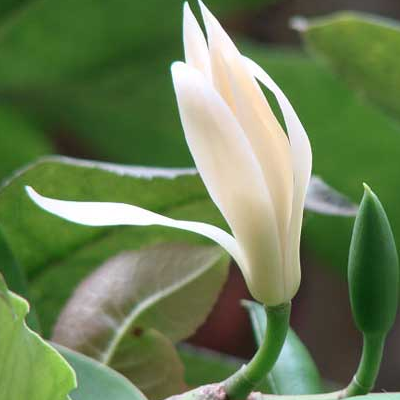
Propagation methods for Michelia alba:
1. Seed propagation
For sowing and raising seedlings at the end of September or early October, pick the mature fruit, take out the seeds, soak them in wood ash water for 1—2 days, then rub off the waxy aril, and wash them clean with water before sowing. The seeds can also be washed clean and then cold-stored by the wet sand stratification method, otherwise they easily lose their germination ability, and sown indoors in pots in March of the following year, sprouting in about 20 days.
2. Cutting propagation
Michelia alba can be propagated by cuttings, but Michelia alba has poor regenerative capacity, and cuttings do not easily root and survive, so this method is mostly not adopted.
3. Grafting propagation
Michelia alba is often propagated by grafting, generally using 2-3-year-old seedlings of Magnolia biondii or Michelia champaca as rootstock. There are two grafting methods: approach grafting and cut grafting.
1. Approach grafting: The time for approach grafting is from spring to autumn, and it can be done throughout the entire growing season. It is mostly done from April to July. The best position for approach grafting is 70 cm above the ground. After binding, wrap it with a mud ball and cover the outside with leaves to prevent rain from washing it away, and after about 60 days it can be cut off. Approach grafting is an easier method to survive, but it does not grow as vigorously as cut grafting.
2. Cut grafting: In mid-to-late September, select well-developed Magnolia branches as scions. The cut surfaces of the rootstock and scion should be tightly joined, bound with plastic film strips, smeared with mud, and the scion buried with soil to keep the soil moist. In northern China, the scion needs to be covered with straw and the like in winter, and the covering removed in the following spring. After sprouting, keep 4-5 buds on the upper part of the branch and remove all the rest. Through 2-3 years of routine care, it will bloom.
4. Layering propagation
Layering propagation of Michelia alba is also a relatively commonly used propagation method, mainly divided into ordinary layering and air layering.
1. Ordinary layering: Ordinary layering is best done in February-March. Cut halfway through the base of the branch to be layered, then cut upward a section, insert a piece of tile in the middle, then gently press it into the soil without breaking it, insert a thick U-shaped iron wire into the soil to fix it and prevent it from lifting, then pile soil on top. For spring layering, once root buds appear it can be cut off and planted separately.
2. Air layering: Before the dog days, select healthy and disease-free young branches (1.5-2 cm in diameter) on the mother plant, cut a slit at the lower part of the fork, then cover it with a bamboo tube or a bottomless clay pot, fill it with potting soil, tie it tightly outside with fine string, being careful not to disturb it, spray a little water frequently to keep it moist, and around May of the following year new roots will grow, after which it can be taken down and planted in place.
What is the difference between Michelia alba and Magnolia denudata:
Different family and genus
1. Magnolia denudata: Plantae, Angiosperms, Dicotyledons, Magnoliales, Magnoliaceae, Magnolia, subgenus Yulania.
2. Michelia alba: Plantae, Angiosperms, Dicotyledons, Archichlamydeae, Ranunculales, Magnoliaceae, Magnolieae, Michelia.
Difference in flowering period
1. Magnolia denudata: Magnolia denudata blooms in March, once a year, with flowers before leaves, and is jade-white.
2. Michelia alba: Michelia alba generally can bloom twice, the first time in summer and the second time in autumn. There are more flowers in summer, and the flower color is generally milky white.
Different habits
1. Magnolia denudata: Magnolia denudata is suitable for growing in a warm and humid climate and fertile, loose soil. It likes light, is not tolerant of drought, and is not tolerant of waterlogging either. If the roots are submerged for 2-3 days, it will die. It is relatively sensitive to toxic gases such as sulfur dioxide and chlorine, and has poor resistance.
2. Michelia alba: Michelia alba likes light, fears high temperatures, is not cold-tolerant, and is suitable for slightly acidic soil. It likes warmth and humidity, is not tolerant of drought or waterlogging, and is relatively sensitive to toxic gases such as sulfur dioxide and chlorine, with poor resistance.
Difference in characteristics
1. Magnolia denudata: Magnolia denudata flowers open before the leaves, terminal, large, 12-15 cm in diameter, with 9 tepals, bell-shaped, actinomorphic, rose-like corolla, distinct stamens, apocarpous pistils, and an superior ovary.
2. Michelia alba: Michelia alba is white, extremely fragrant, with 10 tepals, lanceolate, 3-4 cm long and 3-5 mm wide. The connective of the stamens extends into a long pointed tip, the gynoecium is covered with fine pubescence, the gynophore is about 4 mm long, and there are many carpels, usually some not developing. At maturity, as the receptacle extends, it forms an aggregate fruit with sparsely arranged follicles, and the follicles are bright red when ripe.
Different effects
1. Magnolia denudata: Magnolia denudata is pungent in taste and warm in nature, and has the effects of dispelling wind and scattering cold, unblocking the orifices, and dispersing lung qi and unblocking the nose. It can be used for headache, blood stasis-type dysmenorrhea, nasal congestion, acute and chronic sinusitis, allergic rhinitis, and other conditions.
2. Michelia alba: Michelia alba is bitter and pungent in taste and slightly warm in nature, and has the effects of warming the lungs, relieving cough, and resolving turbidity. It mainly treats chronic bronchitis, prostatitis, white turbidity, leukorrhea in women, and other conditions.
Alright, friends, you all understand clearly now, right?
How to distinguish Magnolia denudata from Michelia alba
Recently a friend asked how to distinguish Magnolia denudata from Michelia alba and what the differences are. So the editor specifically looked up some information about Magnolia denudata and Michelia alba, and found that their differences are quite significant. Let us now look at the differences between Magnolia denudata and Michelia alba!
Magnolia denudata
Magnolia denudata is a variety of Magnolia that bears white flowers. Also known as magnolia and yulan. It is a deciduous tree of the Magnoliaceae family, generally 2-5 m tall or up to 15 m tall. The flowers are white, large, fragrant, opening before the leaves, with a flowering period of about 10 days. Magnolia denudata is a famous ornamental flower and tree in China and the most important flowering tree in early spring in the north. It has also been designated the city flower of Shanghai, has a cultivation history of about 2,500 years, and is the most precious ornamental tree in courtyards. Magnolia denudata is native to the central provinces of China, and is now cultivated in Beijing and south of the Yellow River basin. It is now mostly seen planted singly or scattered in gardens and factory and mining areas, or used as street trees on both sides of roads.
Michelia alba
Michelia alba is an evergreen tree of the Magnoliaceae family and Michelia genus, reaching 17 to 20 m tall, usually 3 to 4 m tall when potted, and there are also small plants. The bark is grayish white, young branches are often green, the leaves are oblong, simple and alternate, green, leathery and glossy, oblong. The flower buds of Michelia alba look like the tip of a writing brush, with 8 petals, white as snow, growing between the leaf axils. The flower color of Michelia alba is only white and white with yellow, and its petals are thick, long lanceolate, and strongly fragrant, with flowering periods in April to May and August to September. In addition, Michelia alba contains linalool, phenylethyl alcohol, methyl eugenol, and other components, which after collection can be used for scenting tea, brewing wine, or extracting essence. Nowadays, many perfumes, skin creams, and snow creams with Michelia alba fragrance often use Michelia alba as an ingredient.
The above is detailed information about Magnolia denudata and Michelia alba, from which we can see that Magnolia denudata is snow-white, with not many leaves and rather large; while Michelia alba belongs to a small plant family and has relatively small flowers, but is very fragrant. Whether Magnolia denudata or Michelia alba, both are very good flower varieties, and friends who need to grow them can look up detailed information.
Further reading:
Michelia alba pruning methods, how to grow it, planting methods, cultivation methods and precautions
How does Michelia alba propagate? Introduction to Michelia alba propagation methods
Michelia alba is a famous ornamental flower and tree, with pure and elegant flower color, charming fragrance, a long flowering period, and dense green branches and leaves. It has very high ornamental and beautifying value, is relatively easy to care for, and has many propagation methods. The more commonly used ones are grafting and layering, while sowing and cuttings are used less. However, for home cultivation, grafting and layering are enough.
Magnolia denudata seed propagation
For sowing and raising seedlings at the end of September or early October, pick the mature fruit, take out the seeds, soak them in wood ash water for 1—2 days, then rub off the waxy aril, and wash them clean with water before sowing. The seeds can also be washed clean and then cold-stored by the wet sand stratification method, otherwise they easily lose their germination ability, and sown indoors in pots in March of the following year, sprouting in about 20 days.
Michelia alba cutting propagation
Michelia alba can be propagated by cuttings, but Michelia alba has poor regenerative capacity, and cuttings do not easily root and survive, so this method is mostly not adopted.
Michelia alba grafting propagation
Michelia alba is often propagated by grafting, generally using 2-3-year-old seedlings of Magnolia biondii or Michelia champaca as rootstock. There are two grafting methods: approach grafting and cut grafting.
1. Approach grafting: The time for approach grafting is from spring to autumn, and it can be done throughout the entire growing season. It is mostly done from April to July. The best position for approach grafting is 70 cm above the ground. After binding, wrap it with a mud ball and cover the outside with leaves to prevent rain from washing it away, and after about 60 days it can be cut off. Approach grafting is an easier method to survive, but it does not grow as vigorously as cut grafting.
2. Cut grafting: In mid-to-late September, select well-developed Magnolia branches as scions. The cut surfaces of the rootstock and scion should be tightly joined, bound with plastic film strips, smeared with mud, and the scion buried with soil to keep the soil moist. In northern China, the scion needs to be covered with straw and the like in winter, and the covering removed in the following spring. After sprouting, keep 4-5 buds on the upper part of the branch and remove all the rest. Through 2-3 years of routine care, it will bloom.
Michelia alba layering propagation
Layering propagation of Michelia alba is also a relatively commonly used propagation method, mainly divided into ordinary layering and air layering.
1. Ordinary layering: Ordinary layering is best done in February-March. Cut halfway through the base of the branch to be layered, then cut upward a section, insert a piece of tile in the middle, then gently press it into the soil without breaking it, insert a thick U-shaped iron wire into the soil to fix it and prevent it from lifting, then pile soil on top. For spring layering, once root buds appear it can be cut off and planted separately.
2. Air layering: Before the dog days, select healthy and disease-free young branches (1.5-2 cm in diameter) on the mother plant, cut a slit at the lower part of the fork, then cover it with a bamboo tube or a bottomless clay pot, fill it with potting soil, tie it tightly outside with fine string, being careful not to disturb it, spray a little water frequently to keep it moist, and around May of the following year new roots will grow, after which it can be taken down and planted in place.