Canna Lily Cultivation Methods and Flowering Time
Canna lilies have a very long history of cultivation in China. They originated in the Americas and India, and were later widely planted across China. What are the cultivation methods for canna lilies? When do canna lilies bloom?
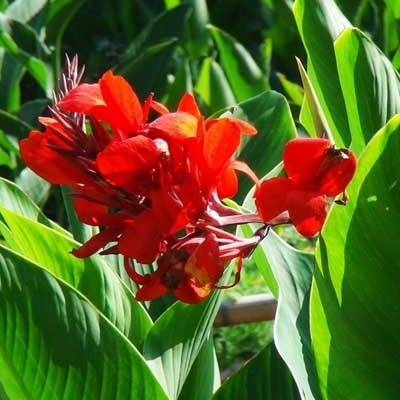
Cultivation methods for canna lilies:
Canna lilies belong to the genus Canna in the family Cannaceae. Also known as red canna, tanhua, cornflower, and broad-heart ginger. They originated in tropical America and India. At present they are widely cultivated across both northern and southern China, but in areas north of Hunan Province they cannot overwinter outdoors. Canna lilies have a long history of cultivation in China and were called red banana in ancient times. Because their leaves are large and glossy green, their flowers are bright and beautiful, and the plants are sturdy and upright, growing vigorously with minimal management, they have always been loved by people. “The banana leaves wave toward the distant sky, the moon-like calyx climbs high reflecting the red sun, just like a beauty waking from spring sleep, with crimson lips and green sleeves dancing in the east wind.” This is how the name canna lily came to be.
I. Growing Environment for Canna Lilies
1. They prefer a warm and humid climate, are not tolerant of frost, and their suitable growing temperature is 25-30°C. They like full sunlight and fertile soil. In their place of origin they have no dormancy and grow and bloom year-round. They are robust and highly adaptable, almost not selective about soil, and do best in moist, fertile, loose sandy loam. They are slightly tolerant of waterlogging. They fear strong winds. In spring, plant after the frost in April-May. After sprouting, flower buds form at the top of the stem, and the small flowers open from bottom to top. During the growing season, the rhizomes sprout one after another to form new stems that bloom, flowering continuously from June until before frost, with a long overall flowering period. The rhizomes can overwinter outdoors in areas south of the Yangtze River, but north of the Yangtze River they must be protected by humans to overwinter.
2. Canna lilies are not cold-tolerant and fear strong winds and frost. They are not demanding about soil and can tolerate poor soil, but grow best in fertile, moist, well-drained soil. After the plants wither in late autumn, cut off the aboveground parts, dig out the rhizomes, dry them in the sun for 2—3 days, and bury them in sandy soil in a well-ventilated greenhouse. Do not water them; keeping the temperature above 5°C is enough for them to overwinter safely.
II. Ground Planting Management for Canna Lilies
After late autumn, generally from the end of October to early November, the leaves and flowers begin to turn yellow and wither. At this time the rhizomes can be dug out, the upper branches and leaves cut off, and placed indoors where it does not freeze, or buried in a sun-facing, wind-sheltered cellar in the courtyard, with the temperature kept at 5~8°C. During the overwintering period, check 2~3 times to prevent them from being damaged by heat or freezing. After there is no frost in the following spring, divide the rhizomes and replant them separately. South of the Yangtze River basin, there is no need to dig out the rhizomes in winter; they can be dug out and divided in the following spring when new shoots grow. After dividing and replanting, keep the soil moist at all times and loosen the soil and remove weeds promptly. During the growing period, apply topdressing 2~3 times along with watering to promote healthy growth.
III. Potted Management for Canna Lilies
For potted canna lilies, choose dwarf varieties. The potting soil should be fertile. Plant 2~3 buds per pot, water thoroughly after planting, and place in a spot with plenty of light. Apply liquid fertilizer once as topdressing before flowering. During the growing period, keep the potting soil moist at all times and apply plenty of cake fertilizer water, which will make the plants grow vigorously with abundant leaves and flowers.
IV. Pest and Disease Control for Canna Lilies
Canna lilies are highly adaptable and have few pests and diseases, making them very easy to cultivate. Their main pests and diseases include leaf-rolling caterpillars and cutworms.
1. Leaf-rolling caterpillar
[Pest symptoms] From May to August each year, leaf-rolling caterpillars are prone to occur, mainly damaging tender leaves and flower clusters, which curl after being damaged.
[Control methods] ① Spray with 50% dichlorvos at 800 times dilution. ② Spray with 50% fenitrothion emulsifiable concentrate at 1000 times dilution.
2. Cutworm
[Pest symptoms] Cutworms occasionally occur on ground-planted canna lilies.
[Control methods] ① Handpick early in the morning. ② Drench the root soil with trichlorfon at 600~800 times dilution.
When do canna lilies bloom:
Canna lilies are perennial bulbous herbaceous flowers. Flower colors include creamy white, bright yellow, orange-yellow, tangerine, pink, bright red, purple-red, and multi-colored spotted types, with more than 50 varieties. In the north, the flowering period is usually from June to October, while in the south they bloom year-round.
Canna lilies have large, brightly colored flowers, rich colors, good plant form, are easy to cultivate, and have high ornamental value. They can be potted or planted in the ground. Many people like to grow them in their courtyards. They have the effect of purifying air and protecting the environment, making them ideal flowers for greening, beautifying, and purifying the environment.
Alright, friends, now you all know how long the flowering period is.
How to Grow Canna Lilies: Cultivation Methods and Tips for Canna Lilies
Not many people may grow canna lilies, but in fact growing canna lilies requires certain precautions. Below we will introduce the cultivation methods for canna lilies.
Cultivation Methods for Canna LiliesI. Cultivation Methods for Canna Lilies——Morphology
Canna lilies are relatively low-growing plants with elegant appearances and diverse, rich flower colors. Canna lilies have extremely high ornamental value, and clustering densely together they are very beautiful.
II. Cultivation Methods for Canna Lilies——Habits
Canna lilies like high-temperature environments. A humid yet hot climate is suitable for growing canna lilies. The temperature for canna lilies is best kept at around 32°C. Once the ambient temperature drops below 20°C, the chance of the flowers blooming becomes lower. Once the temperature drops below 0°C, frost damage problems will gradually occur.
III. Cultivation Methods for Canna Lilies——Sowing
Canna lilies can be seed-collected in winter so that sowing in spring is most suitable. Winter seeds need a warm environment to keep warm and prevent frost damage. It is best to sow when the temperature is relatively warm and wait for germination. Germination generally takes about 25 days.
IV. Cultivation Methods for Canna Lilies——Cuttings
Canna lilies can also be propagated by cuttings. Spring and summer are good times for cuttings. Select sturdy branches, keep the length at about 10 cm, plant them in an acidic sand bed, and after waiting 40 to 50 days they will gradually take root. During this period, watch out for pests.
Cultivation Methods for Canna Lilies
Light
Canna lilies should be grown in full sun. If the environment is too dark and light is insufficient, the flowering period will be delayed. If placed in a cool spot while flowering, the flowering period can be extended.
Temperature
The suitable growing temperature for canna lilies is 15°C-30°C. When flowering, placing canna lilies in a low-temperature, light-free spot can extend the flowering period. The ambient temperature must not be lower than 10°C.
When the temperature is as high as above 40°C, canna lilies can be moved to a ventilated, cool place. Around the time of frost, potted canna lilies can be moved to a place at 5-10°C and can then overwinter safely.
Watering
During the growing period, canna lilies need to be misted on the leaves 1-2 times a day to maintain humidity.
Since canna lilies greatly like fertilizer and tolerate moisture, the pot should be watered thoroughly, and the number of waterings should be adjusted according to actual conditions.
Fertilizing
Apply sufficient base fertilizer before planting. In addition, during the vigorous growing period, apply topdressing 3-4 times each month.
Soil
Canna lilies are not demanding about soil, but grow best in loose, fertile, well-drained sandy loam. Fertile clay soil also works.
The above is an introduction to the flower language and cultivation methods of canna lilies. To learn more, please follow Four Seasons Plant Network!