Uses and Care Methods of the Black Prince Plant
The Black Prince plant can be kept in an office and has a certain ornamental value. What is the Black Prince plant good for? How do you care for the Black Prince plant?
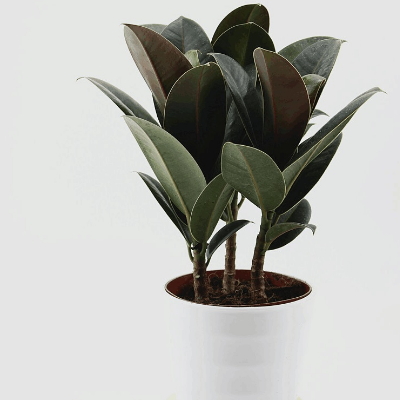
What the Black Prince plant is good for:
1. Ornamental value: The ornamental value of the Black Prince plant is mainly shown in its leaves: the mature leaves of the Black Prince are thick and gorgeous, broad, beautiful and glossy, and the terminal bud at its tip looks like patches of fiery sunset clouds, while the stipules, once split, hang down like red tassels, giving a distinctive charm. By the way, because the Black Prince plant likes sun and also tolerates shade, and is fairly adaptable to light, it can be placed in the living room, study and other places; if the plant is fairly large, then placing it on both sides of the entrance hall and in the center of the lobby of a large building can make it look majestic.
2. Economic value: Various tiny particles of dust often float in the air, and some dust, after entering the human body, can harm health; if a "powerful weapon" against dust like the Black Prince is placed indoors, it can stick to charged dust, thereby reducing the harm of indoor dust and purifying the air; moreover, the Black Prince can also absorb carbon monoxide, carbon dioxide, hydrogen fluoride and so on from the air.
How to care for the Black Prince plant:
1. Suitable temperature: When growing the Black Prince plant, the suitable temperature is between 20-30°C, and it grows most luxuriantly at 25-30°C; if it is below 10°C, growth will be poor, and note that below 0°C the Black Prince will suffer cold damage and die.
2. Appropriate amount of watering: The Black Prince likes a high-temperature environment, and it also likes water very much; its watering principle should follow "dry then wet," so it can be watered appropriately, but it must not be watered too frequently, otherwise root rot is very likely to occur. In winter, when the weather is cold, water about once a week; in summer, it can be decided according to the weather and the moisture of the potting soil.
3. Appropriate soil: The Black Prince is suited to living in neutral soil, and the fertilizer content must be sufficient. When potting the Black Prince, use 1 part leaf mold, 1 part garden soil and 1 part river sand, and add a small amount of base fertilizer to make a growing medium for cultivation, and it can also be provided with a high-temperature, humid environment, so the Black Prince plant will also grow faster.
4. Sufficient sunlight: The Black Prince likes to grow in places with high temperatures or sufficient sunlight, so it needs to be given sufficient sunlight. But it can also endure a shady environment, and if it grows in a shady indoor environment, it can also survive.
Alright, that is all for the introduction to the care methods and uses of the Black Prince plant. Everyone understands now, right?
How to care for the Black Prince plant, Black Prince plant pictures
The first time I heard the name "Black Prince," if it were not followed by the word "plant," I really would have thought it was another name for some kind of car, or else the name of a character in an animated film. So does this plant, whose name easily causes misunderstanding, have anything special about it? Why was it given such a powerful name? Is there some reason? Let us find out below.
I. What the Black Prince plant is
The Black Prince plant is a foliage plant. It belongs to a new variety derived from the rubber tree (Ficus elastica) and is fairly common. Its habits are very obvious: it likes to live in places with high temperatures and sufficient sunlight. Although it likes the sun, it can also endure a shady environment; if the temperature gets a bit lower and becomes a cold environment, then the Black Prince cannot stand it. Its branches and leaves are very crisp and neat, the trunk is distinct, there are few branches, the leaves are oval, and the leaves are very thick, with a feel similar to leather to the touch; young leaves are red, and after the leaves mature, the color slowly turns bright green, or even blackish green; the Black Prince has high ornamental value and is often used as a home landscape plant.
II. Uses of the Black Prince plant
Ornamental value: The ornamental value of the Black Prince plant is mainly shown in its leaves: the mature leaves of the Black Prince are thick and gorgeous, broad, beautiful and glossy, and the terminal bud at its tip looks like patches of fiery sunset clouds, while the stipules, once split, hang down like red tassels, giving a distinctive charm. By the way, because the Black Prince plant likes sun and also tolerates shade, and is fairly adaptable to light, it can be placed in the living room, study and other places; if the plant is fairly large, then placing it on both sides of the entrance hall and in the center of the lobby of a large building can make it look majestic.
Economic value: Various tiny particles of dust often float in the air, and some dust, after entering the human body, can harm health; if a "powerful weapon" against dust like the Black Prince is placed indoors, it can stick to charged dust, thereby reducing the harm of indoor dust and purifying the air; moreover, the Black Prince can also absorb carbon monoxide, carbon dioxide, hydrogen fluoride and so on from the air.
III. How to care for the Black Prince plant
Suitable temperature: When growing the Black Prince plant, the suitable temperature is between 20-30°C, and it grows most luxuriantly at 25-30°C; if it is below 10°C, growth will be poor, and note that below 0°C the Black Prince will suffer cold damage and die.
Appropriate amount of watering: The Black Prince likes a high-temperature environment, and it also likes water very much; its watering principle should follow "dry then wet," so it can be watered appropriately, but it must not be watered too frequently, otherwise root rot is very likely to occur. In winter, when the weather is cold, water about once a week; in summer, it can be decided according to the weather and the moisture of the potting soil.
Appropriate soil: The Black Prince is suited to living in neutral soil, and the fertilizer content must be sufficient. When potting the Black Prince, use 1 part leaf mold, 1 part garden soil and 1 part river sand, and add a small amount of base fertilizer to make a growing medium for cultivation, and it can also be provided with a high-temperature, humid environment, so the Black Prince plant will also grow faster.
Sufficient sunlight: The Black Prince likes to grow in places with high temperatures or sufficient sunlight, so it needs to be given sufficient sunlight. But it can also endure a shady environment, and if it grows in a shady indoor environment, it can also survive.
After reading the whole article, I find that as a landscape plant, the Black Prince is actually not simple to grow. So where is its "powerful" aspect shown? It is not shown in how it grows, but in its survival ability and growing environment. Plants that can endure high temperatures are already few, and it can also endure a shady environment; you can see just how impressive its adaptability to the environment is.
Is the Black Prince plant toxic? Is it suitable to put in the bedroom?
The Black Prince plant can be kept in an office, but can it be kept in a bedroom, a place for rest? So, is the Black Prince plant toxic? Is it suitable to put the Black Prince plant in the bedroom?
Is the Black Prince plant toxic:
The claim that the Black Prince flower is toxic when placed indoors is incorrect. The Black Prince is not toxic and can be placed indoors; it is quite good at purifying the air and absorbing harmful gases. Generally, it is better to place it in a bright, well-ventilated spot on a balcony; it is a light-loving, drought-tolerant plant.
Is it suitable to put the Black Prince plant in the bedroom:
As far as I know, it is fine. The Black Prince can be placed on an east-facing, south-facing or west-facing balcony for care, and among these, cultivation on a south-facing balcony gives the best results.
1. Light: The Black Prince is a light-loving, drought-tolerant plant. Placing it in a bright, well-ventilated spot on a balcony is fine. In dim light it tends to grow leggy and easily loses its color. Note that in summer, when temperatures are high and light intensity is great, it can be appropriately shaded, or placed in a bright spot indoors, which is quite good. A slightly greater light intensity is no problem; in dim light it tends to grow leggy.
2. The Black Prince is fairly drought-tolerant, so watering it once the soil has dried out is fine; do not water if the soil is not dry. It fears waterlogging, and frequent watering easily causes root rot, so before watering, check the dryness and moisture of the potting soil. It is fine if the soil is a bit dry; "dry then wet" is better.
3. The Black Prince likes fertilizer. Each time you water, you can add a little nutrient solution, and the plant will grow better and more vigorously, or when watering you can add a little potassium dihydrogen phosphate, and the leaves will be plump and thick.
4. Pruning: From March to September, during the growing season, growth is fairly fast, so it can be pruned to encourage the growth of side branches; the cut parts can be used for cuttings.
5. Propagation: Generally, cuttings are enough. It is better to root cuttings in sandy soil, keeping a certain humidity; they will root in about a month, with a fairly high survival rate.
The Black Prince plant is not toxic and can be placed in the bedroom. Everyone understands now, right?