How do you care for a Brazil iron plant, and how is it different from a Yemen iron plant?
The Brazil iron plant (Dracaena fragrans) is a very attractive plant that grows up easily. How do you care for a Brazil iron plant? What is the difference between the Brazil iron plant and the Yemen iron plant?
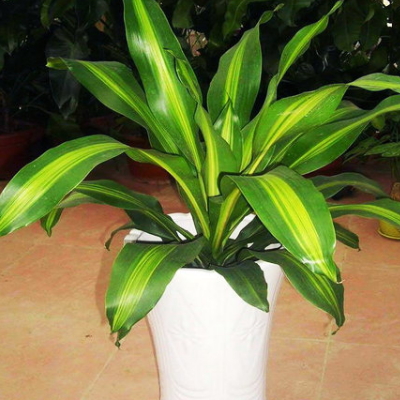
How to care for a Brazil iron plant:
1. The Brazil iron plant likes warmth, tolerates shade and fertilizer but not cold, and is suitable for growing in a loose, well-drained and fertile substrate. Usually, a potting soil made from garden soil, leaf mold, peat soil and river sand in a 4:2:2:1 ratio can be used for planting;
2. For those with thick, sturdy stems, the potting soil can be made by mixing equal amounts of coconut coir, peat soil or garden soil, and river sand. Normally, you should ensure humidity in the growing environment of the Brazil iron plant, often spray water on the leaves, and keep the soil moist but not waterlogged, so as to avoid root rot.
3. The suitable growing temperature for the Brazil iron plant is 20°C~30°C. During the growing season, apply liquid fertilizer or granular compound fertilizer 1~2 times a month (never use concentrated fertilizer), to ensure lush growth of branches and leaves.
4. In winter, fertilization should be stopped and the plant moved indoors to overwinter. Strong light will cause its leaves to turn yellow, and too much shade will also fade the leaf color. For variegated varieties, the proportion of nitrogen fertilizer should be reduced, to avoid excessive growth of leaves and the disappearance of the variegation.
5. In late autumn, in addition to controlling the amount of watering, you can spray 0.2% to 0.5% phosphoric acid; phosphorus and potassium fertilizers such as potassium oxide can improve the plant's cold resistance and ability to overwinter in winter.
6. In daily care, the Brazil iron plant often suffers from pests and diseases such as longhorn beetles boring into the heart or gnawing the cortex, causing the plant to rot at the heart or lose its bark and die. Once found, use 50% dichlorvos 800—1000 times solution for drenching or spraying to kill them.
Differences between the Brazil iron plant and the Yemen iron plant:
1. The leaves of the Brazil iron plant are softer, with the leaf tips drooping noticeably, forming an arching, drooping shape.
2. The leaves of the Yemen iron plant are harder, with the leaf tips not drooping noticeably, spreading out in a slanting, extended shape.
3. Most Brazil iron plants on the market are horticultural varieties, with golden centers or golden edges.
4. The leaves of the Yemen iron plant are slightly longer than those of the Brazil iron plant (there are differences between different plants and at different stages).
Well, that is all for the introduction to the differences between the Brazil iron plant and the Yemen iron plant. Everyone should understand now and know how to care for a Brazil iron plant.
How to tell the difference between the Yemen iron plant and the Brazil iron plant? Picture identification of the Brazil iron plant and the Yemen iron plant
Introduction: Both the Yemen iron plant and the Brazil iron plant are foliage plants of the genus Dracaena. These two indoor potted plants look very similar, and if you do not pay attention to distinguishing them, it is easy to mistake them for the same plant. So, what exactly is the difference between the two? Below, the editor of Diyi Nongjing introduces the plant characteristics of the Yemen iron plant and the Brazil iron plant and several of the most intuitive ways to tell them apart.
Yemen iron plant
The Yemen iron plant belongs to the Agavaceae family, genus Dracaena. Its leaves are broadly linear, the stem is upright, the leaf color is deep green, and the plant shape is well proportioned. The leaves are long lanceolate-linear, 30—40 cm long and 5—10 cm wide. It is robust by nature and highly adaptable to light. Under weak light, old leaves become even deeper and more verdant deep green. It has no petiole, and the leaf margins are slightly wavy. The leaf color is attractive, and it tolerates shade. The umbel inflorescence is arranged in a raceme, with small, yellow-green, fragrant flowers; the flowering period is June—August, and the berry is spherical. It likes high temperature and high humidity, and the suitable growing temperature is 20—35°C. In winter, when the temperature is below 10°C, attention should be paid to taking cold protection measures to prevent cold damage from drying out the leaves. Pay attention to good ventilation and maintain relative air humidity above 80%.
Brazil iron plant
The Brazil iron plant is a perennial woody foliage plant of the Liliaceae family, genus Dracaena. It is an evergreen tree and can reach more than 6 m tall in its place of origin, while potted plants are generally 50—100 cm tall. Its trunk is upright, sometimes branched. The leaves are clustered at the top of the stem, long elliptic-lanceolate, with no petiole; the leaves are 40—90 cm long and 6—10 cm wide, curved into a bow shape, with wavy undulating leaf margins and slightly blunt leaf tips; bright green and glossy. The spike inflorescence has small, yellow-green, fragrant flowers. It likes high temperature, high humidity and a well-ventilated environment. It prefers light but also tolerates shade, fears strong light, and avoids dryness and drought. It likes loose, well-drained sandy loam. The suitable growing temperature is 20-30°C, the dormancy temperature is 13°C, and the overwintering temperature is 5°C.
Picture of the difference between the Yemen iron plant and the Brazil iron plant
Overall, the most intuitive differences between the Yemen iron plant and the Brazil iron plant are as follows:
1. The leaves of the Brazil iron plant are softer, with the leaf tips drooping noticeably, forming an arching, drooping shape.
2. The leaves of the Yemen iron plant are harder, with the leaf tips not drooping noticeably, spreading out in a slanting, extended shape.
3. Most Brazil iron plants on the market are horticultural varieties, with golden centers or golden edges.
4. The leaves of the Yemen iron plant are slightly longer than those of the Brazil iron plant (there are differences between different plants and at different stages).