The best time to propagate pothos by cuttings, and how many days until the cuttings take root
Pothos can be transplanted and has very strong survival ability; managing it a few times a week is enough. When is the best time to take pothos cuttings? How many days until the cuttings take root?
When is the best time to take pothos cuttings:
1. Spring and summer are the peak growing seasons for “pothos”. If you need to take new cuttings, simply cut off stems that have aerial roots and lay the stems horizontally in the soil. You can also use the layering method: bury the stems in the soil, then water thoroughly, and place the new cuttings in a shaded spot. After half a month, the new cuttings will sprout new shoots. At this point, you can give the new “pothos” cuttings normal fertilizer and water care. For the fertilizer and water care of “pothos”, during the growing season, apply fertilizer mainly based on nitrogen, or use a compound nutrient fertilizer bought from the market. Apply fertilizer once every two weeks.
2. In summer, temperatures are high and rooting is fast. The root system of pothos likes a moderately moist environment. The leaves require relative humidity above 60%, so while watering moderately and keeping the potting soil on the dry side, frequently spray water on the leaf surfaces and undersides. In summer and autumn, spray the leaf surfaces in the morning, at noon, and in the evening every day to increase humidity. Apply dilute liquid fertilizer once every 10 to 1 days. Plants with many branches should be pruned appropriately.
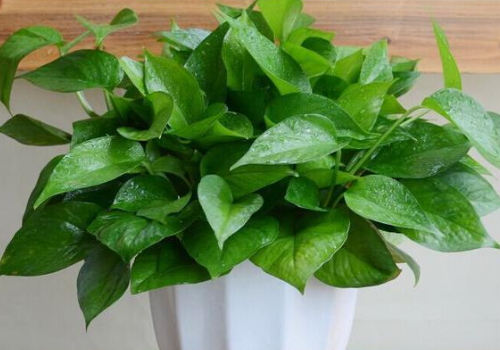
How many days until pothos cuttings take root:
About half a month. During the cutting process, do not expose them to sunlight. Spray water on the leaf surfaces. Do not water the soil too wet, or the roots that grow will rot.
1. Pothos is generally propagated by cuttings. Insert stem sections with aerial roots directly into plain sand or vermiculite, with a depth of 1/3 of the cutting, water thoroughly, place in a shaded spot, spray water on the leaf surfaces every day or cover with plastic film to keep moist, and keep the ambient temperature no lower than 20°C.
2. Keeping pothos as a household potted plant is relatively simple. First, there should be at least 4 established seedlings in one pot. The potting soil should be loose, fertile, and rich in organic matter, which helps the plant take shape. Second, pothos requires growth in an environment with relatively high temperatures (in winter, room temperature must not be lower than 10°C, otherwise yellowing and leaf drop easily occur) and strong scattered light. If it is kept in too dark a place for a long time, the internodes will become thin, long, and weak, and the leaves will also become thinner, paler, and lose their luster.
Alright, that is all for the introduction to the timing of pothos cuttings. I hope everyone understands now.
Both cuttings and water propagation are suitable: how to take pothos cuttings
Pothos has a fairly obvious effect in absorbing formaldehyde and purifying the air, and pothos also has a graceful form, so growing pothos at home is quite common. So how do you take pothos cuttings? This article intends to introduce two methods of taking pothos cuttings: cutting propagation and water propagation, which are suitable for soil culture and water culture respectively.
Pothos has an extremely strong air-purifying function and is known as a green purifier. Pothos can convert formaldehyde into substances such as sugar or amino acids during metabolism, and can also break down benzene emitted by copiers and printers, and can absorb it as well.
Pothos can be propagated by two methods: cutting propagation and water propagation
1. Cutting propagation
Propagation uses cutting and stem burying methods. Select robust pothos vines, cut them into sections of two nodes each, being careful not to damage the aerial roots, then insert them into plain sand or coal cinders, with a depth of 1/3 of the cutting, water thoroughly, and place in a shaded spot. Spray water on the leaf surfaces every day or cover with plastic film to keep moist, and keep the ambient temperature no lower than 20°C. The survival rate is above 90%.
Keeping pothos as a household potted plant is relatively simple. First, there should be at least 4 established seedlings in one pot. The potting soil should be loose, fertile, and rich in organic matter, which helps the plant take shape. Second, pothos requires growth in an environment with relatively high temperatures (in winter, room temperature must not be lower than 10°C, otherwise yellowing and leaf drop easily occur) and strong scattered light. If it is kept in too dark a place for a long time, the internodes will become thin, long, and weak, and the leaves will also become thinner, paler, and lose their luster. In late spring and early summer (from April to August), cut 15 to 30 cm stems, remove the leaves from the basal 1 to 2 nodes, and pot them directly in culture soil, with 3 to 5 stems per pot. Water thoroughly, place in a cool and ventilated spot, keep the potting soil moist, and roots and sprouts will appear in about one month. In the same year, it can grow into a plant with ornamental value.
2. Water propagation
Pothos can also be propagated by water rooting terminal buds. The method is: cut tender, robust stems into 20 to 30 cm sections, insert them directly into a bottle filled with clean water, change the water once every 2 to 3 days, and they can take root and survive in just over 10 days. Because potted pothos is limited by the potting soil, after being cultivated for too long it is easy for the plant to age, and the leaves become smaller and drop. Therefore, after 2 to 3 years of cultivation, repotting or pruning and renewal is necessary.
Hydroponically grown pothos grows relatively fast and is extensive in cultivation and management. During cultivation and management, in summer, spray water on the plants more often, and add nutrient solution once every 10 days to keep the leaves green and lush. For potted seedlings, when the seedlings grow 30 cm up the cultivation pole, they should be cut off; plant or directly insert 4 to 5 plants per pot, and set up a palm pole in the middle of the pot to make it easier for hydroponic pothos to twine and grow upward. After shortening, when new buds and new leaves sprout, cut off the stem tips of the remaining plants.
Pothos has very strong vitality and lives as soon as it meets water. Therefore, whether by cutting propagation or water culture, it is very easy to keep alive, and it is also very easy to propagate without much management and maintenance.
How to take pothos cuttings: pothos grows luxuriantly and strives to grow
During the growth of pothos, if you want it to become more luxuriant, you need to help it by taking cuttings so it can grow better. But how do you take pothos cuttings? Because they have no experience growing pothos, many people do not know much about this information. Below, the editor introduces how to take pothos cuttings.
Cutting propagation
Propagation uses cutting and stem burying methods. Select robust pothos vines, cut them into sections of two nodes each, being careful not to damage the aerial roots, then insert them into plain sand or coal cinders, with a depth of 1/3 of the cutting, water thoroughly, and place in a shaded spot. Spray water on the leaf surfaces every day or cover with plastic film to keep moist, and keep the ambient temperature no lower than 20°C. The survival rate is above 90%.
Keeping pothos as a household potted plant is relatively simple. First, there should be at least 4 established seedlings in one pot. The potting soil should be loose, fertile, and rich in organic matter, which helps the plant take shape. Second, pothos requires growth in an environment with relatively high temperatures (in winter, room temperature must not be lower than 10°C, otherwise yellowing and leaf drop easily occur) and strong scattered light. If it is kept in too dark a place for a long time, the internodes will become thin, long, and weak, and the leaves will also become thinner, paler, and lose their luster. In late spring and early summer (from April to August), cut 15 to 30 cm stems, remove the leaves from the basal 1 to 2 nodes, and pot them directly in culture soil, with 3 to 5 stems per pot. Water thoroughly, place in a cool and ventilated spot, keep the potting soil moist, and roots and sprouts will appear in about one month. In the same year, it can grow into a plant with ornamental value.
Water propagation
Pothos can also be propagated by water rooting terminal buds. The method is: cut tender, robust stems into 20 to 30 cm sections, insert them directly into a bottle filled with clean water, change the water once every 2 to 3 days, and they can take root and survive in just over 10 days. Because potted pothos is limited by the potting soil, after being cultivated for too long it is easy for the plant to age, and the leaves become smaller and drop. Therefore, after 2 to 3 years of cultivation, repotting or pruning and renewal is necessary.
Hydroponically grown pothos grows relatively fast and is extensive in cultivation and management. During cultivation and management, in summer, spray water on the plants more often, and add nutrient solution once every 10 days to keep the leaves green and lush. For potted seedlings, when the seedlings grow 30 cm up the cultivation pole, they should be cut off; plant or directly insert 4 to 5 plants per pot, and set up a palm pole in the middle of the pot to make it easier for hydroponic pothos to twine and grow upward. After shortening, when new buds and new leaves sprout, cut off the stem tips of the remaining plants.
In addition to taking cuttings, as pothos grows to a certain stage, it also needs to be pruned so that it has a neat shape, achieves a better decorative effect, and brings an even nicer decorative touch to the home.