Australian Pine (Norfolk Island Pine) pruning methods and root rot solutions
The Australian Pine (Norfolk Island Pine) is an excellent bonsai plant and is also suitable for growing at home, so how do you prune an Australian Pine? What should you do if the Australian Pine gets root rot?
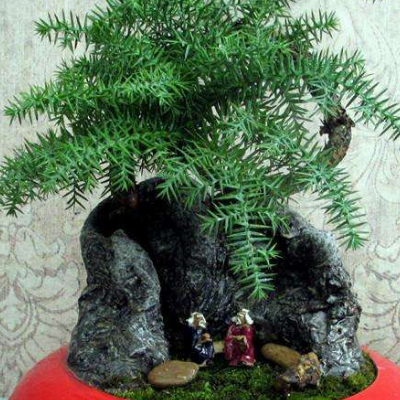
How to prune an Australian Pine:
1. Prune according to its habits
First, let's talk about the growth habits of the Australian Pine, because no matter how we prune, we must ensure it can grow and develop healthily! The most suitable temperature for the Australian Pine is 10°C to 25°C, and you must also ensure the temperature is at least above 5°C. In any season, a certain amount of light every day is essential, and at the same time, note that the potting soil should be moist and the air around the plant should also maintain a certain humidity.
2. Pruning methods
1. Heading back. This pruning method is to cut off part of the overly long branches growing on the Australian Pine. The purpose of doing this is to stimulate its lateral buds to sprout quickly and grow new branches, improving the visual ornamental effect of the Australian Pine.
2. Thinning out. This pruning method is to cut the branches of the Australian Pine from the fork. Doing this can make its branches distribute more evenly, increase ventilation and light penetration, and help the inner branches of the Australian Pine grow quickly. This method is mainly for cutting off dried-up branches and overly dense branches.
3. Removing tillers. This pruning method is to remove the tender shoots or root tillers growing at the base of the Australian Pine trunk or near the ground, to prevent these root tillers from affecting the overall appearance.
Finally, I want to remind everyone that when pruning, you need to note that the pruning shears must be sharp and smooth. When pruning, the blade and the branch should form a 45-degree angle, so the cut will be smaller, which helps the cut heal and allows new tender buds to grow out quickly. If you want to suppress branches that are growing too vigorously, you can choose the small tender buds of the Australian Pine as the cutting point, which can promote the growth of strong buds!
What to do if the Australian Pine gets root rot:
1. Ventilate promptly
If root rot occurs, you must place it in a location with good air circulation so it won't be so humid, and keep the growing environment dry. Because if the bottom of the pot is too humid, it will make the roots of the Australian Pine prone to water accumulation. If it remains in an especially moist state for a long time, exceeding its water needs, it will be easy for the roots to be unable to breathe. Good ventilation can promptly keep it in a dry state, so root rot won't occur so easily. You must pay special attention to ventilation.
2. Disinfect the flower pot
When choosing to plant an Australian Pine, we should choose good soil quality, preferably soil with good drainage, to ensure the needs of the roots. Then properly disinfect the flower pot, so the roots are also less likely to be infected by bacteria. When root rot occurs, disinfecting the flower pot again can also eliminate some bacteria from the roots, so the roots won't continue to be infected, and the root rot will gradually improve.
3. Use medication for control in the early stages of the disease
In the early stages of the Australian Pine's disease, we can spray a little wettable powder on the above-ground part about every 10 days, and the dosage must be prepared according to the required instructions. For the underground part, dilute 70% of other chemical preparations and water it 2 to 3 times. In this way, the root rot can be controlled and won't become more serious. In the early stages of the disease, all those bacteria will be killed. The survival rate will also be very high.
4. Transplant and replant
When root rot occurs, we can remove the twisted roots and the roots that have already rotted, then spray a special spray on the wounds, let it dry, and then plant it again. It will survive very well.
5. Spray treatment with medication
If the decay bacteria in the rotted root area of the Australian Pine are relatively active and difficult to suppress, then we can appropriately spray some medication to completely eliminate them.
Alright, friends, now you all know how to prune an Australian Pine.
Australian Pine prices and care methods
Nowadays, various small potted plants and large bonsai have become popular decorative trends in offices and homes, and the Australian Pine is an excellent choice. The Australian Pine likes to stay in a warm, humid environment, has a certain tolerance for shade, and is very suitable for long-term care indoors with insufficient light, just like an office environment. Moreover, its vitality is very tenacious, its insect resistance is also very strong, and it is also an expert at purifying the air. Next, let's learn about Australian Pine prices.
The Australian Pine is an evergreen tree. Generally, potted plants are young trees, with a height below 2 m. It likes a warm, humid environment, has a spire-shaped crown, and is dark green. The stem is upright, and the lateral branches are whorled and extend horizontally. The branchlets are alternately arranged in two rows, extending horizontally or slightly drooping. The leaves have two types. The cones are nearly round.
Cultivation techniques and planting
1. Seedlings grown from seeds are firm, strong, and vigorous
The Australian Pine is suitable for mass propagation. Generally, from July to August, first scarify the seed coat of freshly collected seeds to promote germination; otherwise, if left in the soil too long, the seeds are prone to rot. Then sow the treated seeds in a sand bed, covering them with fine sand about 1.5 to 2 cm. Under conditions of 25 to 28°C and a certain humidity, they will germinate in about 2 to 3 weeks. After germination, plant them immediately.
2. When taking cuttings, if the main axis or a leggy branch is selected as the cutting, it is easy to cause the plant's crown shape to be irregular, and it can only grow horizontally, affecting its ornamental value. Cut the 2 to 3 nodes at the tip of a healthy, easy-to-root branch as the cutting, remove some leaves, soak it in clean water overnight, and then insert it into a sand bed with coarse sand or vermiculite as the substrate. Maintain a temperature of 20 to 25°C and relatively high air humidity. After about 3 months, it will take root.
Care
When potting, use a mix of garden soil, leaf mold, and peat moss.
The prepared substrate is best. Potted plants mostly use small seedlings, and a suitable flower pot should be chosen according to the size of the seedling. The Norfolk Island Pine likes diffused light and should be placed in a bright place inside a shed. If kept in a dark place for a long time, it should be moved into sunlight every few weeks for appropriate exposure, which can keep the dark green leaves maintaining a beautiful color. Its growing season is long; except when the summer temperature exceeds 32°C, it can grow all year round.
From spring to autumn, it should be watered more, but avoid water accumulation in the pot. During high temperature and dryness, spray water on the potted plant and the nearby ground to lower the temperature and increase humidity. Water promptly; do not wait until the soil is dry before watering. From late autumn onward, gradually reduce watering to enhance its cold resistance. During the growing season, apply fertilizer once every 2 weeks, preferably a compound fertilizer containing nitrogen and potassium. Insufficient fertilizer can easily cause the branches and leaves to turn yellow.
Specific management principles and measures
The Australian Pine is one of the world's three major ornamental trees. The Australian Pine is neither afraid of strong light nor unable to withstand low light. Its vitality is very tenacious. It likes humidity and is also drought-tolerant. It is evergreen in all four seasons. As long as it is kept above zero degrees, it can overwinter, and it does not grow insects. Usually just water it a little; wet or dry does not matter much, which can save a lot of care time. When potting, use a substrate made by mixing garden soil, leaf mold, and peat moss. Potted plants mostly use small seedlings, and a suitable flower pot should be chosen according to the size of the seedling.
It likes warmth, likes sunlight, is drought-tolerant, and fears cold. It likes to grow in a humid, ventilated environment and in loose, fertile, slightly acidic sandy soil, and it dislikes water accumulation. Specific management methods:
1. When winter begins, it should all be moved indoors for warmth. At a room temperature of about 5°C, it can overwinter safely.
2. Summer and autumn are the growing seasons. Potted plants can be placed in a semi-shaded area outside, or kept in a ventilated place at a window with light. Avoid exposure to scorching sun above 35°C, and do not place it for a long time in a completely dark, shaded place. Either of these will cause the branches and leaves to turn yellow or become leggy, affecting the ornamental value.
3. Regarding fertilizer and water, during high temperatures in summer and autumn, water to prevent dryness, and keep the potting soil somewhat moist. Also apply topdressing 1-2 times per month. In early spring or autumn and winter, the potting soil should be on the dry side and avoid being too wet, to prevent root rot.
The propagation method can be the same as for sago palm, using the method of dividing young offshoots, preferably carried out in spring and summer.
Pest control
It has very few pests and diseases. When cared for indoors, scale insects are more commonly seen. You can spray methidathion, chlorpyrifos EC, Guoguang Jiebisii, and other controls, with good results.
Propagation methods
Mainly by seed propagation, but cuttings can also propagate young plants.
Now let's look at the current prices of Australian Pines on the market:
1. Australian Pine, Fujian
≥4 plants, ¥ 130.00/plant
2. Supplied by Fujian Lvdadi Supplying Australian Pine evergreen tree height 1 m seedlings bonsai
≥40 plants
Price ¥ 300.00/plant
3. Australian Pine bonsai Australian Pine belongs to the Araucariaceae family Australian Pine small seedlings air purification formaldehyde absorption radiation protection
1-49 pots, ¥ 65.00/pot
50-199 pots, ¥ 64.50/pot
≥200 pots, ¥ 64.00/pot
4. For sale Australian Pine bonsai Australian Pine height 1.1 m crown width 60 thickness 6-8 cm Jiangsu
1-14 pots, ¥ 383.00/pot
15-39 pots , ¥ 382.00/pot
≥40 pots, ¥ 380.00/pot
5. Supplied by Tianchang Dijiu various potted plants office potted plants Australian Pine
1-9 pots, ¥ 110.00/pot
10-19 pots , ¥ 99.00/pot
≥20 pots, ¥ 89.00/pot
6. Base direct sales wholesale foliage plants suitable for office business environment greening arrangements 15 cm Australian Pine
15-149 pots, ¥ 22.00/pot
150-599 pots, ¥ 21.80/pot
≥600 pots, ¥ 21.60/pot
Notes on growing Australian Pine:
1. Summer and autumn are the growing seasons. Potted plants can be placed in a semi-shaded area outside, or kept in a ventilated place at a window with light. Avoid exposure to scorching sun above 35°C, and do not place it for a long time in a completely dark, shaded place. Either of these will cause the branches and leaves to turn yellow or become leggy, affecting the ornamental value.
2. During growth, to prevent the trunk from leaning to one side, it is best to turn the pot once every half month so the plant receives light evenly. In addition, the trunk of young trees is fragile and easily bends and deforms, so from the young plant stage it is best to set up a support to fix the trunk. To prevent the plant from growing too tall, repot once every 2-3 years after spring warms up. Usually pay attention to protecting the lateral branches so they are not damaged and affect the plant shape.
3. Under normal circumstances, the Australian Pine does not need branch pruning; let it grow naturally. The suitable growth temperature is 10 to 25°C, and the overwintering temperature is above 5°C. During the wintering season, some light can be given, the potting soil should not be too dry, and on clear days water should also be sprayed to increase humidity.
How often should an Australian Pine be watered:
During care, how often to water an Australian Pine depends on the moisture of the potting soil. In summer, generally watering twice a week is enough. In winter, the watering control can be reduced by one time compared with summer.
From spring to autumn, the Australian Pine bonsai should be watered more, but avoid water accumulation in the pot. During high temperature and dryness, spray water on the potted plant and the nearby ground to lower the temperature and increase humidity. Water promptly; do not wait until the soil is dry before watering. From late autumn onward, gradually reduce watering to enhance its cold resistance.
In summer, water when the potting soil is half dry, and when watering, just water in a circle along the edge of the pot. If the weather is very dry, spray water around the Australian Pine bonsai to increase air humidity and create a humid, suitable environment for it.
The editor has learned that the price of potted Australian Pines varies according to shape and size. The thicker the roots and the taller the tree, the more expensive it is, but the price is generally in the range of 400-****. In addition, on the market, those 15-25 cm tall are about 30 yuan, those about one meter tall require 300-400, and taller and thicker ones are even more expensive. At present, Australian Pine prices are still fairly stable, and both small and large ones are still quite suitable. So friends who are tempted should act quickly!
How to grow an Australian Pine bonsai, Australian Pine cultivation methods and precautions / avoid water accumulation
The Australian Pine, many flower lovers should know it. It is an ornamental tree with extremely strong vitality and is often made into bonsai and kept indoors. As the Australian Pine gradually becomes known, more and more people are starting to want to grow it, so how do you grow an Australian Pine bonsai? Below are the Australian Pine cultivation methods and precautions carefully compiled by the editor, very detailed. Friends who want to grow it should not miss it~
1. How to grow an Australian Pine bonsai, understand its habits
Because the Australian Pine originally grew in the desert environment of Australia, it has developed a preference for a warm environment with sufficient light. At the same time, it is drought-tolerant, fears cold, and dislikes water accumulation. Therefore, how do you grow an Australian Pine bonsai? You should place it in a ventilated, sunny place, provide shade in summer, and keep it warm in winter. As for the growing soil, it is best to use loose, fertile, slightly acidic sandy soil.
2. Australian Pine cultivation methods and precautions
1. Soil
How to grow an Australian Pine bonsai? First, you should reselect the potting soil. The reason is that many flower lovers' Australian Pine bonsai are existing potted plants bought from flower shops or online. Normal care can ensure the plant's growth. But that soil is all very cheap. If you want the Australian Pine to grow well, it is best to choose again.
Soil selection: According to the growth habits of the Australian Pine, we know it likes loose, fertile, well-drained, slightly acidic sandy soil. For this, the editor recommends using a substrate made by mixing garden soil, leaf mold, and peat moss.
2. Light
As a green plant, the Australian Pine still has a great demand for light. It is understood that the Australian Pine likes light and is relatively shade-tolerant. During the summer and autumn growing seasons, it can be placed in a semi-shaded area outside, or kept in a ventilated place at a window with light.
Precautions: The Australian Pine dislikes strong light. When the temperature is above 35°C, avoid direct strong light. In addition, do not place it for a long time in a completely dark, shaded place, otherwise it will cause symptoms such as yellowing leaves and leggy growth in the Australian Pine, affecting the ornamental value.
3. Temperature
How do you grow an Australian Pine? Adjusting the temperature in a timely manner is also very important. The Australian Pine likes a warm environment and is not cold-tolerant. In winter, the plant should be moved indoors for warmth. Only at a room temperature of about 5°C can it overwinter safely.
4. Watering
Water is the source of life, so in the cultivation methods of the Australian Pine, watering is a very important part. The Australian Pine likes a humid environment, and the potting soil should remain moist, especially during high temperatures in summer and autumn, when the potting soil must be prevented from becoming too dry. The Australian Pine also dislikes water accumulation, so in early spring or autumn and winter, the potting soil should be on the dry side and avoid being too wet, to prevent root rot.
5. Fertilizing
Having covered watering, let's now talk about fertilizing, which is also indispensable in the cultivation methods of the Australian Pine. During the summer and autumn growing seasons, everyone should apply topdressing 1-2 times per month, preferably a compound fertilizer containing nitrogen and potassium. Do not neglect fertilizing, because once nutrients are insufficient, it can easily lead to poor growth of the Australian Pine.
6. Repotting and changing soil
How do you grow an Australian Pine bonsai? Repotting and changing soil is also a point that cannot be ignored. Because for any potted plant, the soil inside will eventually become poor one day, so timely repotting is indispensable. Everyone should repot once every 2-3 years, and use the growing soil mentioned above. As for pruning, under normal circumstances, the Australian Pine does not need branch pruning; just let it grow naturally.