Jasminum officinale, this is also a kind of plant, it grows really beautifully, blooming with small white flowers, so what is the cultivation method for Jasminum officinale? Is it the same as jasmine:
Cultivation method for Jasminum officinale:
1. Temperature
Their requirements for temperature are still relatively high. Most are more suitable for growing in a 20-30°C environment. In winter when it is relatively cold, it will basically hinder the growth of Jasminum officinale and cause it relatively major obstacles. Because the varieties of this flower differ from place to place, the lower temperature limit they can tolerate also varies. In cultivation, they must be treated differently according to the varieties from different regions, so that their respective overwintering requirements can be met.
2. Water
This flower still needs a lot of water during its growing stage, so the water given to it must be relatively sufficient. Water generally includes the water in the soil and the water in the air it breathes. Therefore, the humidity in the living environment is very important to them. However, because the places where it originally grew are very different, and because of the composition of its appearance and its diversified growth, their humidity requirements for the environment are also different.
3. Light
If Jasminum officinale is to bloom, it needs more light, so that their basic needs can be met. Generally, Jasminum officinale grows under tree shade, so it is more suitable for planting in semi-shaded places. But light also depends on its type, so the demand for light is also different, so this point must be noted. Moreover, light does not have an influence in only one aspect; its influence is multifaceted, and among them the intensity of light and the quality of light are the two most important aspects of light. If we cultivate it according to the circumstances in this way, and reasonably control all the requirements needed for its growth, then it can grow better, grow more luxuriant in branches and leaves, and look even more beautiful.
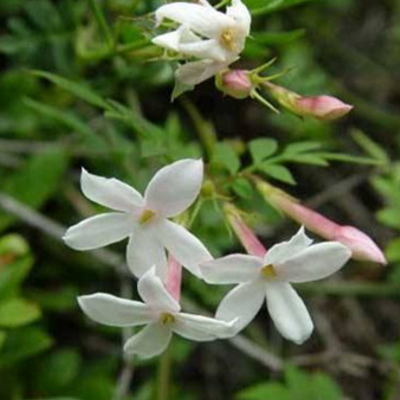
Is Jasminum officinale jasmine:
Jasminum officinale and jasmine really are not the same, let us look at the differences:
1. Jasminum officinale
0.4-5 m tall. Branchlets angular or grooved, glabrous, rarely puberulent. Leaves opposite, pinnately parted or pinnately compound, leaf blade and leaflets glabrous or sparsely pubescent on both surfaces; terminal leaflets ovate, narrowly ovate or ovate-lanceolate to narrowly elliptic, fruit globose or elliptic, turning from dark red to purple when mature. Flowering period May-August, fruiting period September.
2. Jasmine
Up to 3 m tall. Branchlets cylindrical or slightly compressed, sometimes hollow, sparsely pubescent. Leaves opposite, simple, leaf blade papery, round, elliptic, ovate-elliptic or obovate, both ends rounded or obtuse, base sometimes slightly cordate, slightly sunken or concave above, convex below, fine veins often obvious on both surfaces, slightly raised, except for the vein axils below which often have tufts of hair, otherwise glabrous; lobes oblong to nearly round, apex rounded or obtuse. Fruit globose, purple-black. Flowering period May-August, fruiting period July-September.
The cultivation method for Jasminum officinale is introduced here. Be careful about the differences from jasmine, and do not mistake one for the other.
Cultivation method and precautions for Jasminum officinale
Chinese scientific name: Jasminum officinaleLatin scientific name: Jasminum officinale L. var. officinale L.Other names: Xiuying flower, climbing jasmine, SufangKingdom: PlantaeDivision: MagnoliophytaClass: LiliopsidaSubclass: SympetalaeOrder: ScrophularialesSuborder: OleineaeFamily: OleaceaeSubfamily: JasminoideaeTribe: JasmineaeGenus: JasminumSpecies: Jasminum officinaleEnglish name: Large flower jasmine FlowerJasminum officinale, alias: Yeximing, Latin name: Jasminum officinale L. var. officinale L. Oleaceae, Jasminum, climbing shrub, 0.4-5 m tall. Branchlets angular or grooved, glabrous, rarely puberulent. Leaves opposite, pinnately parted or pinnately compound, leaf blade and leaflets glabrous or sparsely pubescent on both surfaces; terminal leaflets ovate, narrowly ovate or ovate-lanceolate to narrowly elliptic, fruit globose or elliptic, turning from dark red to purple when mature. Flowering period May-August, fruiting period September. Produced in Sichuan, southwestern Guizhou, Yunnan, Tibet. Grows in valleys, ditches, thickets or forests, or alpine grassland, at an altitude of 1800-**** m. Widely cultivated around the world.1. Morphological characteristics
Climbing shrub, 0.4-5 m tall. Branchlets angular or grooved, glabrous, rarely puberulent. Leaves opposite, pinnately parted or pinnately compound, with 3-9 leaflets, usually 5-7, the base of branchlets often with unlobed simple leaves; leaf rachis often with narrow wings, petiole 0.4-4 cm long, glabrous; leaf blade and leaflets glabrous or sparsely pubescent on both surfaces; terminal leaflets ovate, narrowly ovate or ovate-lanceolate to narrowly elliptic, 1-4.5 cm long, 0.4-2 cm wide, apex acute or acuminate, rarely obtuse, base cuneate, lateral leaflets ovate, narrowly ovate or elliptic, 0.5-3 cm long, 0.3-1.3 cm wide, apex acute or obtuse, base rounded or cuneate. Cymes umbellate or nearly umbellate, terminal, rarely axillary, with 1-10 flowers; peduncle 0-4 cm long; bracts linear, 1-10 mm long; pedicel 0.4-2.5 cm long; calyx cup-shaped, smooth and glabrous or slightly pubescent, 1-3 mm long, lobes 5, subulate-linear, (3-)5-10 mm long; corolla white, or red outside and white inside, corolla tube 1-1.5(-2) cm long, throat diameter 2-3 mm, lobes usually 5, narrowly ovate, ovate or oblong, 6-8 mm long, 3-8 mm wide; style heterostylous. Fruit globose or elliptic, 7-10 mm long, 5-9 mm in diameter, turning from dark red to purple when mature. Flowering period May-August, fruiting period September.Planting method for jasmine
Flower Bonsai Network flower care column: The planting method for jasmine will introduce to you the cultivation method for jasmine, how to care for jasmine well, and pest and disease control for jasmine(1) Overview of jasmine
Jasmine is also called jasmine, Xianghun, Molihua, Meili, Meili, Mali, Moeli, Moeli, Muli flower, an evergreen shrub or vine of Oleaceae. Plant height 0.5-2 m. Simple leaves opposite, elliptic, 3-9 cm long. Cymes terminal, with 3-9 flowers, corolla pure white, single or double, some turning dark red when withered, very fragrant, flowering on new shoots, flowering period in North China June-September. Under forced cultivation in a greenhouse, it can also bloom in winter under high temperature conditions. The leaf color is emerald green, the flower color is pure white, and the fragrance is rich, deeply loved by the masses. Used to beautify courtyards and balconies, fresh and pleasant, sending bursts of fragrance from time to time, giving people a feeling of returning to nature. In South China and the Yangtze River basin, jasmine is cultivated in large quantities, and the fresh flowers are used as a scenting material for tea, and the tea scented with them is the famous jasmine tea. Jasmine likes a warm, humid and sunny environment; its leaf color is emerald green, its flowers are pure white, and its fragrance is rich, making it the most common fragrant potted flower and tree. Among the genus Jasminum, the most famous one is double-petal jasmine, which is what people commonly call jasmine. Jasmine has good health care and beauty effects, can be used in food and drink, and can be used in the production of jasmine tea. [Ornamental value] From June to October there are many white flowers, with a fragrant scent; besides potting, it can also be used for vases and brewed as tea. [Habits] (1) Likes light. (2) Likes high temperature, suitable temperature 20-30°C, stops growing below 10°C, and will freeze to death below 5°C. (3) Likes fertile acidic soil.(2) Key cultivation points for jasmine
If potted jasmine is well cared for, it can bloom three times a year. Temperature: Likes a warm environment; the minimum overwintering temperature for jasmine, Jasminum multiflorum and Jasminum officinale is above 10°C, while Yunnan yellow jasmine and Jasminum floridum can go as low as 5-7°C. Light: Likes sufficient sunlight; in summer it can be placed in an open sunny place with direct sunlight for cultivation, and in winter greenhouse cultivation it should also have direct sunlight. Water: Often keep sufficient water in the pot soil, but avoid water accumulation in the pot soil. Air humidity: Likes humid air, and water can often be sprayed around the plant. Repotting: Repot in spring as needed. After several years of cultivation, jasmine needs renewal, and it is best to replace it with a new plant. When repotting an old plant, remove the already decayed old branches, separate the new growth parts, and then replant them. Propagation: Use branches for cuttings in spring, which root easily. By the way, jasmine is the national flower of the Philippines, Tunisia and Indonesia, symbolizing love and friendship. [Key cultivation points] (1) Use cuttings for propagation (see Q&A 122 for details), or divide and pot in spring when repotting. (2) When potting, 5% base fertilizer should be applied at the bottom, and the pot soil should preferably be a mixture of fertile compost soil and river sand. Pot from March to April. (3) From April to October, fertilize once a week, from dilute to concentrated. Fermented oil cake water, human and livestock manure, or fishy water can all be used. In the early stage add 8-10 times water, and during the flowering period add 3-4 times water (see Q&A 123 for details). (4) Water as soon as the pot soil is dry; in midsummer water every morning and evening, and if the air is dry, also supplement with spraying. But during winter dormancy, the pot soil only needs to be kept slightly moist; if too wet, it will drop leaves and rot roots. (5) The branches have strong sprouting ability; when repotting in spring, pinch and shape them, and during the full flowering period prune heavily for renewal, so as to promote the sprouting of new branches and flowers. After each flowering period, remove leaves. (6) Potted flowers should be placed in a place with sufficient sunlight. In shady places the leaves become larger but no flowers are produced. (7) It is often harmed by tortricid moths and red spiders, and timely control is needed. Related articles:Why does jasmine only grow leaves but not bloom?
Why does jasmine develop yellow leaves? How to rescue it?
How can the flowering period of jasmine be extended?
How to propagate jasmine by cuttings?