What to Do If Clematis Wilts? Growing Methods and Precautions
Clematis comes in many flower colors, which makes it a fairly suitable ornamental plant for the home. So what are the growing methods and precautions for clematis? What should you do if it wilts?
Growing methods and precautions for clematis:
1. Soil requirements for clematis
It prefers fertile, well-drained alkaline loam and dislikes waterlogging. The most important thing is that the potting soil must be breathable. If conditions allow, choose a better-quality soil that has been strictly sterilized; if conditions are poor, you can use perlite and peat. Try not to dig up garden soil directly for pot cultivation.
2. Watering requirements for clematis
For clematis to grow well, the roots must be able to breathe freely, so watering should alternate between dry and wet. The potting soil should be allowed time to dry out; generally, when the soil 2-3 cm below the surface is dry, you can water. If it is a plastic pot, that is a different matter - you can judge by the weight of the potting soil, and water when it becomes lighter; for a clay pot, observe the potting soil, and when it turns pale, it needs watering. When watering, you must water thoroughly; the concept of watering thoroughly means that at least water flows out from the bottom of the pot. After watering, be careful to ventilate promptly.
3. Light requirements for clematis
Potted clematis should be placed under full-light conditions from autumn to early spring of the following year, with no need for shade. After summer arrives, strong light will cause the leaves of clematis to age and turn yellow, resulting in poor growth, so appropriate shading is needed. When grown indoors, at least about 4 hours of sunlight per day must be ensured, otherwise clematis will grow poorly.
4. Fertilization methods for clematis
Adhere to light fertilizer applied frequently, and avoid seeking quick results. There are many clematis varieties, and some are not tolerant of fertilizer, such as Clematis cirrhosa, evergreen clematis, and Clematis montana, which should be given less fertilizer during care. Also, when fertilizing small seedlings, it is best to use only root-promoting and seedling-recovery fertilizer, and not apply heavy fertilizer. Winter is the best season for fertilizing clematis; basically, applying once can last for several months!
5. Precautions for growing clematis
For newly planted clematis, sufficient water is needed in the first few months, so that the roots have enough moisture to extend.
Clematis is a vine plant, and its branches are relatively brittle and easy to break, so be careful to guide and secure them in time.
For clematis grown on an open-air balcony, pay attention to timely drainage, especially in the rainy season. It can appropriately receive rain, but not excessively, and should be moved indoors at the right time.
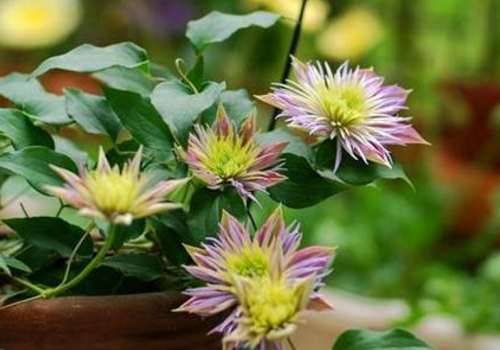
What to do if clematis wilts:
I. Causes of clematis wilting
1. Wilt disease is mostly triggered by humid air, with mold invading the branches.
Therefore, in the rainy, humid, and warm spring, wilt disease occurs more often. It especially happens in weather that is particularly clear after heavy rain. In fact, the wilting point has already appeared several days earlier, but because of the rain, the branches are not short of water and still maintain a healthy appearance. Once the sun comes out, the branches suddenly lack water, and the tender top branches droop.
2. Wilt disease is very hard to discover in advance, and you cannot check every branch point by point every day.
However, during the growing process, take as many preventive measures as possible. Although it cannot be absolutely avoided, it can still reduce the probability of occurrence somewhat.
II. How to handle wilted clematis branches
Although wilt disease occurs frequently, it is generally not fatal. If only one or two branches wilt, the handling method is to prune off the wilted branches from the blackened point, which will not affect the other healthy branches. If the whole plant wilts, after pruning everything and keeping only the root system, it may still send out new branches in autumn.
Actually, the wilted branches do not need to be discarded. If discovered in time, cut off the tender top branches with flower buds and keep the semi-lignified parts of the branches; after placing them in water for a while, the leaves revive, and they can be used for cuttings.
III. Prevention methods for clematis wilt disease
Try not to place organic fertilizer applied in winter at the root nodes, otherwise incompletely fermented organic fertilizer can very easily produce mold. In early spring, when wilt disease occurs frequently, you can use some carbendazim, combining watering and spraying.
Strengthen ventilation and air permeability to reduce the production of mold.
Also, the most important point is that when purchasing, everyone should try to choose a reputable flower shop, and before buying, be sure to understand your own needs clearly and buy a clematis variety that suits you.
Well, friends, now you all know what to do if clematis wilts.
Growing methods and precautions for clematis
Clematis growing methods. Clematis grows in hilly scrub in low mountain areas. It prefers fertile, well-drained alkaline loam and dislikes waterlogged soil or soil that dries out in summer and cannot retain water. It is highly cold-tolerant and can withstand low temperatures of -20. If there is damage from red spiders or leaf-eating pests, ventilation needs to be strengthened. Clematis has rich flower colors and a faint fragrance, with great ornamental value, and is deeply loved by many people. So here are the growing methods and precautions for clematis.
Clematis growing method 1: WateringClematis is very sensitive to moisture and cannot be too dry or too wet, especially during high-temperature summer periods, when the substrate must not be too wet. Generally, during the growing period, water thoroughly once every 3-4 days, watering when the substrate is dry but the plant has not yet wilted. During dormancy, simply keep the substrate moist. When watering, do not let water accumulate on the leaf surface or at the base of the plant, otherwise it can easily cause disease.
2. TemperatureThe optimum temperature for clematis growth is 15-17°C at night and 21-25°C during the day. When the summer temperature is above 35°C, it will cause clematis leaves to turn yellow or even fall, so cooling measures should be taken in summer. In November, as the temperature continues to drop, when it falls below 5°C, clematis will enter dormancy. In December, clematis fully enters dormancy, and in the 1st and 2nd weeks of dormancy it begins to lose leaves.
3. PruningThe purpose of pruning clematis is to make the plant bloom more. Generally once a year, remove some overly dense or weak branches and allow new branches to extend in all directions. The timing of pruning depends on the flowering period of different varieties. Early-flowering varieties (flowering period April-May) should be pruned after the flowering period, that is, in June-July, removing excess branches, but not cutting off branches that have already lignified. If pruned before this, it will result in no flowering that year.
4. LightClematis needs more than 6 hours of direct light per day, which is very beneficial to its growth, although spots may appear when the weather is hot. Potted clematis should be placed under full-light conditions from autumn to early spring of the following year, with no need for shade; after summer arrives, direct strong light must be prevented, with appropriate shading. Otherwise, it can easily cause clematis leaves to age and turn yellow and grow poorly.
5. FertilizationBefore clematis sprouts new buds in late February or early March, a little compound fertilizer with an NPK ratio of 15:5:5 can be applied to speed up growth, and in April or June, a topdressing of phosphoric acid fertilizer can be applied once to promote flowering. Ordinarily, a 20:20:20 or 20:10:20 water-soluble fertilizer at 150 mg/kg can be used, increased to 200 mg/kg during the peak growing period, sprayed 2-3 times per month.
Propagation methodsa. Sowing: Species clematis can be propagated by sowing. Sown in spring, it germinates in about 3-4 weeks; sown in autumn, it sprouts when spring warms.
b. Layering: Clematis layering propagation is done in March using mature branches from the previous year, usually rooting within 1 year.
c. Division: Clustered clematis plants can be divided.
d. Cuttings: For hybrid clematis cultivated varieties, cuttings are the main propagation method.
Precautions for growing clematis1. For clematis in poorly drained clay or light sandy soil, after loosening the bottom of the hole, mix in a shovel of peat soil or humus; in places where water may accumulate, raise the bottom with stones or rubble, 25 cm above the surrounding soil surface.
2. In the first few months after planting clematis, pay attention to giving sufficient water, with a watering range no less than 50 cm in diameter, so that the roots can extend outward in all directions; at the same time, special attention should be paid to drainage.
3. Clematis pests include red spiders and nettle grubs; spray with 50% fenitrothion emulsifiable concentrate at 1000 times dilution.
4. When planting clematis, generally dig a hole 40 cm deep and 60 cm in diameter. After loosening the hard soil at the bottom of the hole, put in a large amount of humus, then add topsoil mixed with bone meal. Note that the branches are brittle and easy to break, so attention should be paid to guiding and securing them.
5. Clematis diseases include wilt disease, which is especially likely to occur in summer when rainy days clear up and the temperature rises sharply, with branches suddenly wilting, often sprouting new shoots in autumn or the following spring. Others include powdery mildew and viral diseases, sprayed with 10% antibacterial agent 401 acetic acid solution at 1000 times dilution.
Value of clematis 1: Ornamental valueClematis has sparse and graceful branches and leaves; some have large and brightly colored flowers, while others have many small flowers gathered into large inflorescences, with unique charm. It is an indispensable good material in climbing greening and has a certain ornamental value.
2. Use for beautifying the homeClematis can be planted beside home building walls, in front of windows, or attached beside courtyard trees and shrubs, arranged among rockeries and rocks, climbing on flower pillars, flower gates, and fences. It can also be potted for viewing, and is a very good choice for beautifying and accenting the home environment.
How to grow clematis? Growing methods and precautions for clematis
[Common question] How to grow clematis?
[Expert answer] Growing methods and precautions for clematis:
1. Temperature: The optimum temperature for growth is 15-17°C at night and 21-25°C during the day. In summer, when the temperature is above 35°C, it will cause clematis leaves to turn yellow or even fall, so cooling measures should be taken in summer. In November, as the temperature continues to drop, when it falls below 5°C, clematis will enter dormancy; in December, clematis fully enters dormancy, and in the 1st and 2nd weeks of dormancy, clematis begins to lose leaves.
2. Light: Clematis needs more than 6 h of direct light per day, which is very beneficial to its growth, although spots may appear when the weather is hot.
3. Watering: Clematis is very sensitive to moisture and cannot be too dry or too wet, especially during high-temperature summer periods, when the substrate must not be too wet. Generally, during the growing period, water thoroughly once every 3-4 d, watering when the substrate is dry but the plant has not yet wilted. During dormancy, simply keep the substrate moist. When watering, do not let water accumulate on the leaf surface or at the base of the plant, otherwise it can easily cause disease.
4. Fertilization: Before new buds sprout in late February or early March, a little compound fertilizer with an NPK ratio of 15:5:5 can be applied to speed up growth, and in April or June, a topdressing of phosphoric acid fertilizer can be applied once to promote flowering. Ordinarily, a 20:20:20 or 20:10:20 water-soluble fertilizer at 150 mg/kg can be used, increased to 200 mg/kg during the peak growing period, sprayed 2-3 times per month.
5. Pruning: The purpose of pruning is to make the plant bloom more. Pruning is generally once a year, removing some overly dense or weak branches and allowing new branches to extend in all directions. The timing of pruning depends on the flowering period of different varieties: early-flowering varieties (flowering period April-May) should be pruned after the flowering period, that is, in June-July, removing excess branches, but not cutting off branches that have already lignified. If pruned before this, it will result in no flowering that year.
6. Pest and disease control: Clematis has relatively strong resistance to pests and diseases, and serious pest or disease damage rarely occurs. Diseases include wilt disease, which is especially likely to occur in summer when rainy days clear up and the temperature rises sharply, with branches suddenly wilting, often sprouting new shoots in autumn or the following spring. Others include powdery mildew (damaging leaves or flowers) and viral diseases (yellow spots on leaves, deformed flowers), sprayed with 10% antibacterial agent 401 acetic acid solution at 1000 times dilution. Pests include red spiders and nettle grubs, sprayed with 50% fenitrothion emulsifiable concentrate at 1000 times dilution.
[Editor's comments] There are many clematis varieties, but most of them are deciduous or evergreen herbaceous vines, and they have the reputation of "queen of vine flowers." They generally bloom from June to September, with white flowers, and can be exhibited or used as ground cover, with the roots and whole plant used as medicine, and many other uses. The editor of First Agricultural Economics above introduced its growing methods and some precautions for you, and hopes this article is helpful to you.