What is the difference between the cultivation techniques for flowering cherry trees and cherry trees?
Many people cannot tell flowering cherry trees and cherry trees apart, and many think they are the same plant, so what are the cultivation techniques for flowering cherry trees? What is the difference between flowering cherry trees and cherry trees?
Cultivation techniques for flowering cherry trees:
1. Dig holes and plant: Before planting a flowering cherry tree, level the ground, then dig a hole 0.8 m in diameter and 0.6 m deep. First put 10 cm of organic fertilizer into the hole, then place the seedling in the hole and spread its roots out in all directions. After filling with soil, lift the seedling upward a little so the roots spread deeply, then firm the soil. The planting depth should be about 5 cm above the upper layer of the seedling's roots. After planting, water thoroughly and irrigate fully, and set up a support with sticks to prevent strong winds from blowing it over.
2. Water reasonably: After the flowering cherry tree is established, the seedling is prone to drought damage. In addition to full watering at planting, water once every 8-10 days afterward, keeping the soil moist but without standing water. After watering, loosen the soil in time, and it is best to cover the ground surface with a thin layer of grass to reduce water evaporation. Within 2-3 years after planting, to prevent the trunk from drying out, it can be wrapped with rice straw. But after 2 to 3 years, once the seedling grows new roots and its adaptability to the environment gradually increases, it no longer needs to be wrapped in grass.
3. Fertilize at the right time: Flowering cherry trees are fertilized twice a year, and acidic fertilizer is preferable. One is winter fertilizer, applied in winter or early spring as organic fertilizer such as bean cake, chicken manure and decomposed fertilizer. The other is after the flowers fall, applying quick-acting fertilizers such as ammonium sulfate, ferrous sulfate and superphosphate. Generally, for fertilizing large flowering cherry trees, the hole application method can be used, that is, dig a ring-shaped trench about 10 cm deep at the edge of the vertical projection line of the canopy, and apply the fertilizer into it. This is both simple and good for root absorption. As the tree grows, the diameter and depth of the fertilizing ring trench should also increase.
4. Prune reasonably: Pruning mainly removes withered branches, water sprouts, overlapping branches and diseased or pest-infested branches. Generally, when many branches grow on the trunk of a large flowering cherry tree, several vigorous branches should be retained and all the rest cut off from the base to improve ventilation and light penetration. After pruning, the wounds on the branches should be disinfected promptly with medication to prevent pathogens from invading after rain and causing rot. After long exposure to the sun, the bark of flowering cherry trees is prone to aging and damage, causing rot, so it should be removed promptly and disinfected.
5. Pest and disease control: Flowering cherry trees mainly suffer from gummosis and root rot, and both should be treated promptly by improving the soil, strengthening water and fertilizer management, and pruning reasonably. During a year of growth, flowering cherry trees can be harmed by aphids, red spiders and scale insects. Generally, spray 3-4 times: the first before flowering, the second after flowering, and the third in July-August. Careful observation and timely control are necessary to achieve better results.
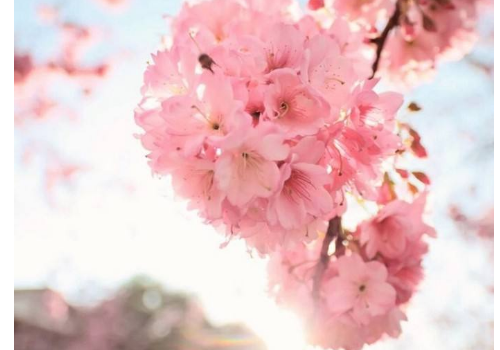
The difference between flowering cherry trees and cherry trees:
1. Flowering cherry trees and cherry trees actually belong to the same family, and their relationship is quite close; both are plants of the genus Cerasus in the subfamily Prunoideae of the family Rosaceae. Flowering cherry can be divided into two types, single-petaled and double-petaled. The single-petaled type can bloom and bear fruit, while the double-petaled type mostly does not bear fruit. Cherry blossom is the flower of the cherry tree, and it is different from flowering cherry. The fruit of the cherry tree is the edible cherry, that is, the chelizi in Cantonese; this name comes from a transliteration of cherries, the plural of the English word cherry. The fruit of the flowering cherry tree is called flowering cherry fruit.
2. In terms of use, cherry is a fruit tree, while flowering cherry is an ornamental flowering plant. In terms of appearance, flowering period and other aspects, the two also differ. Cherry is a small tree, relatively short, with an early flowering period in early March. Its flowers are white with a slight pink tint, smaller and denser than flowering cherry flowers, and it bears fruit after flowering; the fruit is the familiar fruit cherry, red when ripe. Flowering cherry is a tree, relatively tall, with a flowering period in late March to early April. Its flowers are white or pink. Although some cultivars of flowering cherry also bear fruit, the fruit is very small, very astringent when eaten, and almost inedible.
3. From the perspective of plant naming, "cherry blossom" has been the customary Chinese name for this type of plant (flowering cherry) since ancient times. Therefore, in Flora of China, these plants are all named ×× cherry, with some plants of the subgenus Cerasus called ×× cherry and some called ×× flowering cherry. The flowers borne by this type of plant are what we now prefer to call flowering cherry, and this is the root cause of the misunderstanding.
4. In terms of flowering time, cherry is a tree species that flowers in early spring; its flowers open before the leaves grow, and its flowering period is similar to that of white magnolia and earlier than that of flowering cherry. Because cherry blossoms and flowering cherry flowers are quite similar and the flowers also open before the leaves grow, many visitors mistake the two for each other. In fact, cherry blossom is the flower of the cherry tree, and flowering cherry is the flower of the flowering cherry tree.
All right, friends, do you all understand clearly now, and know the difference between flowering cherry trees and cherry trees?
Differences between flowering cherry trees and cherry trees
Different varieties
The flowering cherry tree belongs to Rosaceae. It is a commonly used deciduous landscaping tree and has only ornamental value; however, the cherry tree plant belongs to the genus Prunus, and its fruit is also edible. The plants are generally clustered.
Different flowering periods
Flowering cherry trees usually bloom in April and bear fruit in May, and the flowering period is very short. The flower colors are mostly white, pink and red. Cherry trees usually bloom in March, and the flower color is white. When in bloom, the ornamental value of the flowers is not high.
Different distribution areas
Flowering cherry trees originated in the temperate regions of the Northern Hemisphere. They are now mostly planted in China or Japan. In China, they are mostly distributed in the Yangtze River basin region and are relatively rare in the south. Cherry trees prefer a warm environment and are suitable for planting in southern China.
Different uses
When flowering cherry trees bloom, they have very high ornamental value, so they are suitable for planting in parks or beside roads. When in full bloom, the flower colors are gorgeous and give off a faint delicate fragrance, deeply loved by people. The main value of cherry trees is their fruit, which tastes sweet and sour and is highly nutritious.
After understanding the differences between flowering cherry trees and cherry trees, let us discuss how to plant flowering cherry trees!
Differences between flowering cherry trees and cherry trees_How to plant flowering cherry trees?
Content summary: As is well known, the flowering cherry tree is a world-famous flower variety, while the cherry tree belongs to the fruit tree category, but the cherry tree also has its own flowering period, so it is also called flowering cherry. So, what is the difference between flowering cherry trees and cherry trees? How do you plant a flowering cherry tree?
[Differences between flowering cherry trees and cherry trees]
▍Different varieties
The flowering cherry tree is recorded in Rosaceae, and its value lies only in flower viewing. It is a deciduous small tree and can grow to more than 25 m at its tallest. It has no fruiting period, and its flowering period is not fixed.
Although the cherry tree also belongs to Rosaceae along with the flowering cherry tree, the plant belongs to the genus Prunus, is mostly clustered, and its main value is its edible fruit.
▍Different flowering periods
Because flowering cherry trees vary by variety, their flowering periods are not fixed, but most varieties mainly bloom from April to June, and the flowering period is short. The flower colors are mostly white, pink and deep red.
The flowering period of cherry trees is slightly earlier, around March, and the flowers are white. May-June is the fruiting period of cherry trees. The flowers are somewhat small, and the ornamental value is not high.
▍Different distribution
Flowering cherry trees are mostly planted in Japan and China, while flowering cherry in China is mainly distributed in the Yangtze River basin region, such as Shandong, Tianjin, Jiangsu, Hubei and other provinces and cities, and is relatively rare in southern regions.
Cherry trees like light, so they are suitable for cultivation in southern China, such as the Sichuan and Guizhou areas, or Jiangsu, Beijing and other provinces and cities, where there are large areas of cherry tree planting.
▍Different uses
Flowering cherry trees are suitable for planting along pedestrian paths, in courtyards, parks or gardens. Their flower colors are gorgeous, and when in full bloom they are like rosy clouds, mainly for ornamental purposes.
Cherry trees mainly demonstrate their value through their edible fruit. The fruit tastes sweet and sour and has extremely high nutritional value, making it a major fruit variety on the market.
[How to plant flowering cherry trees]
Planting flowering cherry trees requires mastering two aspects: the planting method for flowering cherry trees and later-stage management.
▍How to plant
1. Land preparation: Flowering cherry trees are suitable for planting on flat land or in mountainous areas. The diameter of the planting area should be about 0.6 m or more. During land preparation, organic fertilizer can be filled in.
2. Planting seedlings: Place successfully cultivated flowering cherry seedlings directly into the dug holes by hole planting, and fill in an appropriate amount of soil.
3. Watering: After establishment, water with root-setting water, and fix the seedling by making a greenhouse or stick frame to avoid interference from strong winds.
▍How to manage
Point one: After a flowering cherry tree is successfully planted, apart from the first watering, it should be watered once at intervals of more than 8 days afterward. Do not water frequently.
Point two: Within 2 years after the flowering cherry tree is established, the base of the main trunk can be wrapped with rice straw to avoid water loss from the trunk and the appearance of drying. The duration is within 2 years.
Point three: Artificially planted flowering cherry trees should be fertilized once a year, and acidic fertilizer is best. Fertilization can be carried out in spring and winter, and fertilizing in summer is taboo.
Point four: For better shaping, it is recommended to prune flowering cherry trees that have grown for more than 3 years once every half year, to avoid the growth of diseased and pest-infested branches and also to effectively prevent excessive vegetative growth.
Summary: The above mainly introduces the differences between flowering cherry trees and cherry trees, as well as how to plant flowering cherry trees. After reading the above, have you understood flowering cherry trees?