What type of plant is the sunflower? Detailed guide to growing methods
The sunflower has tremendous uses; the seeds we eat and the cooking oil we use all come from sunflowers, so what type of plant is the sunflower? What are the sunflower growing methods?
What type of plant is the sunflower:
The sunflower is an angiosperm. Taxonomically, the sunflower belongs to the angiosperms, and its fruit is an achene, commonly known as the sunflower seed, which is edible. The fruit consists of three parts: the pericarp, the seed coat, and the embryo. Edible-type seeds are longer, with black-and-white striped pericarps in the majority; the pericarp is thick, accounting for more than 40% of the seed weight, with a 1000-grain weight of 100-200 grams. Oil-type seeds are shorter and smaller, with pericarps mostly black and thin, about 20-30% of the seed weight, with a 1000-grain weight of 40-110 grams.
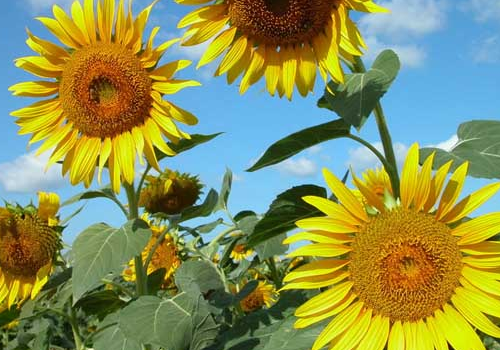
Sunflower growing methods:
1. Site selection and land preparation: For sunflower cultivation, choose a plot with level land, medium fertility, convenient irrigation and drainage, and relatively low soil stickiness; it should not be planted in continuous cropping. It reproduces by seed, and peat soil is suitable for sowing. Before sowing, dress the seeds with New High-Fat Film, which can repel underground pests, isolate viral infections, and increase the seed germination rate.
2. Timely sowing: The sowing time for sunflowers is generally March to April, and the suitable temperature for sowing is 18-25°C; usually, sprouts emerge about 5-7 days after sowing. The basic principle for choosing the sowing period is to sow appropriately early or late according to the patterns of salinization, so that the seedlings avoid saline-alkali damage. Spring sowing or summer sowing is carried out according to the growth period of the variety.
3. Field inspection and replanting: The sunflower is a dicotyledonous crop, and it takes considerable effort for the seedlings to push through the soil and emerge. In addition, poor land preparation or sowing quality, surface soil crusting after rain following sowing, or damage from diseases, insects, rodents, and birds can easily cause missing plants and broken rows. To ensure full stands after sowing, it is necessary to inspect field by field and row by row during the emergence period, and promptly replant where plants are missing in patches or rows.
4. Thinning and final singling: In sunflower cultivation, thinning should be done early to prevent seedlings from crowding one another, which affects the cultivation of strong seedlings and even later yield. As for saline-alkali land and plots with severe pest damage, the timing of final singling can be appropriately delayed. At the same time, sunflowers should also be singled early, which helps cultivate strong seedlings and also benefits flower disk development; final singling should be carried out when there are 2 pairs of true leaves.
5. Intertillage and weeding: Sunflowers are generally intertilled 2-3 times to weed and loosen the soil, break up crusting, conserve water, reduce evaporation, and lessen saline-alkali damage. The first intertillage is carried out at the 1-2 pairs of true leaves stage together with thinning and final singling; the second intertillage is carried out 1 week after final singling; the third intertillage is completed before row closure together with furrowing, earthing up, and fertilization.
6. Furrowing and topdressing: Sunflowers are relatively fond of fertilizer, and furrow topdressing is usually carried out at the third intertillage, mainly with nitrogen and phosphorus fertilizers, applying 5 kg of diammonium phosphate and 10 kg of urea per mu, mixed evenly and then applied to the soil. Furrowing and earthing up can effectively ensure the growth and development of secondary roots, prevent lodging, and reduce branching on the basal part below the cotyledon node.
7. Timely irrigation: Sunflower irrigation uses the furrow irrigation method. Generally, for varieties with a plant height of 1.5 m, the first watering should be done at the bud stage, the second at the early flowering stage, and the third at the grain-filling stage. For varieties with a plant height of about 2 m, the first watering is done 4-5 days before flowering (in severe drought, irrigation is moved earlier), the second 6-7 days after the first watering, and the third at the grain-filling stage.
8. Pollination management: Sunflowers have a low seed-setting rate with self-pollination and a high seed-setting rate with cross-pollination. During cultivation, artificial supplementary pollination should be carried out in a timely manner, using methods such as pairing flower disks, powder puffs, and cotton gloves to transfer pollen, or collecting paternal pollen and gently dabbing it onto the maternal stigma with a small brush; pollination is carried out 3-4 times during the full flowering stage.
Alright, friends, now you all know how to grow sunflowers.
What type of plant is the sunflower?
Sunflowers can be divided into general ornamental varieties and edible varieties. General ornamental varieties are characterized by being relatively short, usually not exceeding half a meter, so they are suitable for growing in pots, while edible varieties are relatively tall and are planted in ordinary open-air nursery soil, where they can grow to more than 2 meters. Now let us take a look together at what type of plant the sunflower is!
What type of plant is the sunflower?
The sunflower is an angiosperm. Taxonomically, the sunflower belongs to the angiosperms, and its fruit is an achene, commonly known as the sunflower seed, which is edible. The fruit consists of three parts: the pericarp, the seed coat, and the embryo. Edible-type seeds are longer, with black-and-white striped pericarps in the majority; the pericarp is thick, accounting for more than 40% of the seed weight, with a 1000-grain weight of 100-200 grams. Oil-type seeds are shorter and smaller, with pericarps mostly black and thin, about 20-30% of the seed weight, with a 1000-grain weight of 40-110 grams.
Why does the sunflower face the sun?
The stem of the sunflower contains a marvelous plant growth hormone. This growth hormone is very afraid of light; upon exposure to light, it moves to the shaded side, and at the same time it can stimulate the cells on the shaded side to multiply rapidly, so the shaded side grows faster than the side facing the light, causing the sunflower to produce a phototropic curvature. At the same time, the sunflower facing the sun is also closely related to the effect of gravity.
The sunflower's growing environment
1. Temperature: The sunflower is a warmth-loving yet cold-tolerant crop with strong adaptability to temperature. The seeds have very strong low-temperature tolerance; when the soil temperature is stable above 2°C, the seeds begin to germinate, at 4-5°C they can sprout and take root, and when the soil temperature reaches 8-10°C, it can meet the needs of seed germination and seedling emergence. Throughout the entire growth process, the sunflower can grow normally as long as the temperature is not lower than 10°C.
2. Water: The sunflower is a crop that consumes relatively more water. The plant is tall, with many dense leaves, and its water uptake is 1.74 times that of corn. However, because its growth and development mostly coincide with local rainfall and heat, the contradiction between water supply and demand is not prominent, and the water requirements differ greatly at different growth stages. From sowing to budding, it needs little water; from budding to flowering is the peak water-demand period; and from flowering to maturity, the water demand is also relatively high.
3. Light: The sunflower is a short-day crop and is not very sensitive to daylength. It likes ample sunlight, and its seedlings, leaves, and flower disks all have strong phototropism. With sufficient sunlight, the seedlings are robust and can be prevented from becoming leggy. Sufficient sunlight in the mid-growth period can promote vigorous stem and leaf growth, normal flowering and pollination, and a higher seed-setting rate. Sufficient sunlight in the late growth period makes the grains plump and full.
4. Soil: The sunflower has low soil requirements and can grow in all kinds of soil, from fertile soil to dry land, barren land, and saline-alkali land. It not only has strong saline-alkali tolerance but also has salt-absorbing properties. At the same time, the sunflower has a well-developed root system and strong drought resistance. Moreover, the sunflower's roots and stems have well-developed aerenchyma, making it very tolerant of waterlogging.
How to grow sunflowers: sunflower growing methods
The sunflower is a plant very familiar to everyone. Its seeds are the snack people most love to eat, and after the kernels are harvested, they can also be used to press oil. Today, the sunflower is one of the most important oil crops in the country, and the economic returns from growing it are especially high. Many people want to plant it on a large scale, but they do not know much about its growing methods, so today the editor will introduce them specifically to everyone.
How to grow sunflowers1. Choosing seeds and land
When growing sunflowers normally, be sure to choose those high-yielding and disease-resistant sunflower varieties. Today's new-generation hybrid seeds, with high yield and high oil content, are the best choice for people growing sunflowers. Land selection is also very important when growing sunflowers; it is not suitable for continuous cropping and prefers loose, fertile soil. After planting, the land should be deep-plowed with sufficient basal fertilizer and leveled.
2. Sowing time
The sunflower plant has strong cold tolerance, and in normal cultivation it is especially suitable for early sowing. If plastic film mulching is chosen, planting can be done in early March each year; for open-field planting, sowing needs to be done in late March or early April. The best time for summer-sown sunflowers is between late June and early July each year.
3. Field management
Field management is also very important when growing sunflowers. After the seedlings emerge and the first true leaf grows, final singling should be carried out. During its growth period, weeding should be done twice; the first time can be combined with intertillage, and after the second weeding, earthing up should also be done in time to prevent sunflowers from lodging.
4. Fertilizer and water management
Fertilizer and water management is also very important when growing sunflowers. In the early stage after planting, this plant has a relatively low demand for fertilizer, and a relatively high demand later on. If spring sowing is chosen, with sufficient basal fertilizer applied, topdressing can be done after the sunflower grows 8 pairs of true leaves. For topdressing, ammonium bicarbonate or uric acid can be chosen. Sunflowers have relatively strong drought resistance; normally the field should not be allowed to dry out, and after it enters the flowering stage, if the weather is dry, it needs to be watered in time.