What fertilizer is best for Dendrobium officinale? Causes of yellowing leaves and solutions
Dendrobium officinale, many people have surely seen it, and there are some particular points to observe when growing it. What fertilizer is best for Dendrobium officinale? Causes of yellowing leaves and what to do?
What fertilizer is best for Dendrobium officinale:
Fertilizer: the nutrition of the aerial roots of Dendrobium officinale mainly relies on the orchid mycorrhiza of the root system to fix free nitrogen in the air, but applying an appropriate amount of fertilizer can promote stem enlargement and make the leaves plump and strong. After the new roots begin to sprout, you can start spraying liquid fertilizer, such as monopotassium phosphate solution, or monopotassium phosphate plus urea solution, etc., all at a concentration of about 0.1%, generally sprayed once every 10 days or so. After 1 to 2 months, when the transplanted seedlings have gradually adapted to the new environment and the new roots have grown to about 10 cm, you can apply a slow-release granular fertilizer to help them grow strong.
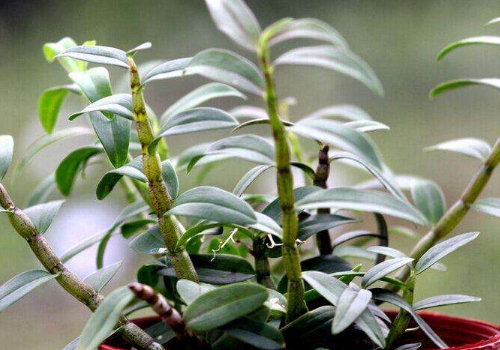
Causes of yellowing leaves in Dendrobium officinale and what to do:
1. Unsuitable substrate
Cause: the aerial roots of Dendrobium officinale are exposed in the air, absorbing air and rainwater.
Solution: the first choice of substrate material is tree bark, followed by sawdust, both of which need to be crushed, sterilized and fermented; usually mix several materials and substrates of different coarseness
2. Substrate too wet
Cause: too much watering leads to the substrate being too wet, and the root system rots.
Solution: for potted Dendrobium officinale, you need to water once every one or two weeks; after watering thoroughly, mist normally, and you need to control factors such as air circulation on the balcony. If the stems and rhizomes of Dendrobium officinale have not died, they can sprout again after the weather warms in spring, but watering should be controlled to prevent root rot.
3. Water shortage and drought
Cause: water shortage leads to yellow leaves. Some growers control water excessively, and combined with the current relatively low humidity, this leads to the yellowing of leaves. Although it is now winter, water control should not be excessive either, especially for bed-planted Dendrobium officinale. In winter, yellowing leaves caused by water shortage are relatively common.
Solution: water with suitable slightly acidic to neutral water, and avoid water containing too many minerals such as calcium and magnesium. In spring, summer and early autumn, sufficient water is required; after mid-autumn it gradually enters a dormant state, and the amount of watering should be reduced accordingly until watering is stopped completely. You can begin reducing watering before the leaves turn yellow, reduce further as the leaves yellow and fall, and stop watering when the leaves have all fallen. In North China, after stopping watering, relatively high indoor air humidity must be maintained to prevent the pseudobulbs from shrinking; if the indoor air is too dry, water the pot once every 1 to 2 weeks.
4. Too many miscellaneous bacteria
Cause: the substrate has too many miscellaneous bacteria, and the symbiotic bacteria of the root system are not competitive enough, leading to yellowing leaves.
Solution: use fermented tree bark or wood shavings, coconut shell, bagasse, decomposed fallen leaves or moss as the growing substrate; it must be fully dried in the sun and treated with phoxim for insecticidal treatment, killing the pests and eggs remaining in the soil.
5. Light too strong
Cause: the growing environment of Dendrobium officinale needs to be kept in a moist, semi-shaded place; if the sunlight is too strong, the dendrobium will feel dry, which is not good for the breathing of its aerial roots, so controlling its growing environment is very important.
Solution: with sufficient light, in spring, summer and autumn, control the shading amount between 30% and 50%; only with sufficient light can a large number of flower buds form.
6. Temperature too high
Cause: growing Dendrobium officinale at too high or too hot a temperature leads to yellowing leaves.
Solution: dendrobium does not like too high temperatures in summer; in the hot summer it often stops growing and should be placed in a well-ventilated place. After the flower buds emerge, keep the greenhouse temperature at 20°C to 25°C during the day and around 15°C at night; it must not be too high or too low, otherwise the flower buds are prone to dropping.
7. Lack of potassium fertilizer
Cause: the leaves of Dendrobium officinale first begin to turn yellow from the leaf tips, and then the whole leaf turns yellow and then falls off; this phenomenon may be due to potassium deficiency, which makes the leaves turn yellow at the tips first and then fall off whole.
Solution: spray potassium fertilizer.
Well, that is all for the introduction to fertilizers for Dendrobium officinale and the causes and solutions for yellowing leaves; I trust everyone understands now.
What to do about yellowing leaves in potted Dendrobium officinale: change the potting soil, control watering / shade appropriately
As the most useful of the dendrobium varieties, Dendrobium officinale has strong effects; not only are its flowers beautiful, it also inherits the medicinal value of dendrobium and can treat various human diseases. However, during cultivation, many flower lovers often encounter one problem, namely yellowing leaves. So what to do about yellowing leaves in potted Dendrobium officinale? Today the editor will solve this problem.
1. What to do about yellowing leaves in potted dendrobium: find the cause
As a potted plant, Dendrobium officinale is not easy to grow. Once we are slightly negligent, for example if we do not care for it according to the cultivation methods for Dendrobium officinale, its leaves may show signs of yellowing. By then, flower lovers must be very anxious, right? To solve this problem, the editor has summarized 5 causes of yellowing leaves in Dendrobium officinale and attached solutions; let us continue reading.
2. Causes of yellowing leaves in Dendrobium officinale and solutions
1. Unsuitable soil
When it comes to the causes of yellowing leaves in Dendrobium officinale, there are actually many, but the first thing everyone should consider is the soil problem. As for the soil problem, it can be divided into two situations, as follows:
① Soil unsuitable
Dendrobium officinale has high requirements for soil; if the soil is unsuitable, the root system will lose its activity, causing the aerial roots to be exposed in the air, and problems will appear over time, manifested as yellowing leaves in Dendrobium officinale.
Solution: change the potting soil; place large stones at the bottom of the flower pot, spread a layer of water-permeable gravel on top, then spread a mixture of fermented pine bark and sawdust on top of the gravel. Note that the mixture needs to be crushed, sterilized and fermented.
② Soil with many miscellaneous bacteria
Even if the soil is well chosen, if it is not disinfected, causing too many miscellaneous bacteria in the soil, the symbiotic bacteria of the Dendrobium officinale root system will not be competitive enough, and the result may be symptoms of yellow leaves.
Solution: dry the soil, that is, the mixture, in the sun, then treat it with phoxim for insecticidal treatment to kill the pests and eggs remaining in the soil; after a period of time, the Dendrobium officinale will recover its health.
2. Improper watering
Besides soil, improper watering is also one of the causes of yellowing leaves in Dendrobium officinale. The watering problem is also divided into two situations: one is too much watering, and the other is too little watering, as follows:
① Too much watering
Dendrobium officinale likes a moist environment, so we should water frequently to keep the potting soil moist. But once there is too much watering, causing the soil to be too wet, the root system of Dendrobium officinale will rot, and the result may be yellowing leaves.
Solution: if the stems and rhizomes of Dendrobium officinale have not died, they can sprout again after the weather warms in spring, but watering should be controlled: water once every one or two weeks; after watering thoroughly, mist normally.
② Too little watering
Too much watering is no good, and too little is also no good; it will also cause yellowing leaves in Dendrobium officinale. Once there is too little watering or the watering is not thorough, the potting soil will dry out, and the leaves will show symptoms of yellowing due to insufficient water absorption.
Solution: water with suitable slightly acidic to neutral water; in spring, summer and early autumn, sufficient water is required; after mid-autumn, reduce watering until watering is stopped completely. Before the leaves of Dendrobium officinale turn yellow, begin reducing watering, reduce further as the leaves yellow and fall, and stop watering when the leaves have all fallen.
3. Fertilizer problems
Having discussed watering, let us now talk about fertilizing, which is also one of the causes of yellowing leaves in Dendrobium officinale. Dendrobium officinale needs fertilizer, but once fertilizing is improper or too little, such symptoms will appear: the leaves first begin to turn yellow from the leaf tips, and then the whole leaf turns yellow and then falls off.
Solution: in the above situation, this may be caused by a lack of the potassium element, so it is also very easy to solve; just spray an appropriate amount of potassium fertilizer.
4. Light too strong
Dendrobium officinale likes a moist, semi-shaded place; although it needs light, it should be diffused light. Once the light is too strong, the dendrobium will feel dry, which is not good for the breathing of its aerial roots, and the result may be symptoms of yellow leaves.
Solution: while keeping sufficient light for Dendrobium officinale, shade appropriately; for example, in spring, summer and autumn, control the shading amount between 30% and 50%; in winter the light is weak, so the pot can be moved outside to bask in the sun.
5. Temperature too high
Dendrobium officinale is very sensitive to problems; it is neither cold-tolerant nor heat-tolerant, and once the temperature is too high, the leaves may turn yellow and even the flower buds may drop.
Solution: Dendrobium officinale does not like too high temperatures, so in the hot summer it should be placed in a well-ventilated place. If the temperature is too high, cooling measures should be taken.
Overall, Dendrobium officinale is not easy to grow, and since many flower lovers are beginners, symptoms of yellow leaves will inevitably appear. But after reading the whole article, I believe everyone has a better idea now; when the yellow leaf problem appears, just follow the methods above. That is all the editor has to introduce about yellowing leaves in Dendrobium officinale, hoping it can help everyone.
What are the causes of yellowing leaves in spider plants?
Many people develop symptoms of yellowing leaves when cultivating spider plants, and how is this symptom in spider plants caused? The author will introduce the habits of spider plants and the causes of yellowing leaves to users in more detail. If the spider plant in your home also shows this symptom, then great, let us take a look together!
Growth habits of spider plants
Spider plant is also called ribbon plant, spider ivy, Saint Bernard's lily, etc. This plant originally grew in South Africa. It is a comfortable perennial herbaceous plant, with slender leaves just like an orchid, with green or striped centers; next, the flower stalk is drawn out from the leaves, then forms a stolon at the tip of the leaf. Its flowers are white, and what is often seen is 2——4 growing together. Of course, some flowers are purple. And each plant has about 3 to 5 seeds; its flowering period is in May, and August is the fruiting period. Next, growing spider plants also has the effect of purifying the air, and the plant can also be used as medicine.
Causes of yellowing leaves in spider plants
When cultivating spider plants, you should understand the plant's nature, that is, spider plants like warm and humid places, and their adaptability is also very strong, and their drought tolerance is also very good, and they can be grown successfully in any kind of soil; next, they also grow very well in well-drained, loose and fertile sandy soil. The causes of yellowing leaves can roughly be divided into the following:
1 Too much fertilizer, exceeding the growth needs of the spider plant;
2 The potting soil has not been changed for a long time;
3 Insufficient light;
4 Poor air permeability and drainage in the soil;
Solutions for yellowing leaves in spider plants
The above are the causes of yellowing leaves compiled by the editor for users, and the solutions are also very simple. Of course, during cultivation, you should also pay attention to which cause of yellowing leaves the plant actually has.
1 Immediately stop applying fertilizer, and water with more clear water, or wash the fertilizer off the roots and replace with new soil.
2 If the new soil has not been changed for a long time, the elements in the soil are also exhausted, so the plant lacks nutrients and the leaves turn yellow; therefore, users should replace the soil and fertilize in time.
3 During the cultivation of spider plants, ensure that the plant receives at least 4 hours of sunlight, increase the chlorophyll in the leaves, and also be careful to avoid strong light.
4 Ensure good water permeability of the pot and good air permeability in the soil.
Editor's reminder: I believe after reading the above, users should understand the causes of yellowing leaves in spider plants and the solutions! During cultivation, the first thing is to understand the plant's habits, and the second is to make timely adjustments according to conditions. Of course, this can also effectively avoid the phenomenon of yellowing leaves.
Taxus bonsai prices Japanese cherry blossom pictures red maple tree prices Dendrobium officinale cultivation methods are azaleas easy to grow