When Does Rosemary Bloom? A Detailed Guide to Hydroponic Methods
Rosemary is generally used as a spice for eating, and can also be used as an essential oil for skincare, so when does rosemary bloom? What are the hydroponic methods?
When does rosemary bloom:
Rosemary is a perennial herbaceous plant. In its natural environment, the flowering period is from November to April. When it blooms, the upper part and tips of the branches are covered with small light blue and white flowers. However, in a relatively cool environment, rosemary may also bloom from June to July.
The Flower Language of Rosemary
Keeping memories, reminiscing about the past.
People who like this flower are kind and friendly to others, good at caring for and soothing others' emotions, and are great listeners. However, they are not good at expressing their own feelings, nor do they know how to use little tricks like acting cute or throwing tantrums to attract others' attention. They often grieve alone. If they can find someone who truly understands them, life will be full of happiness.
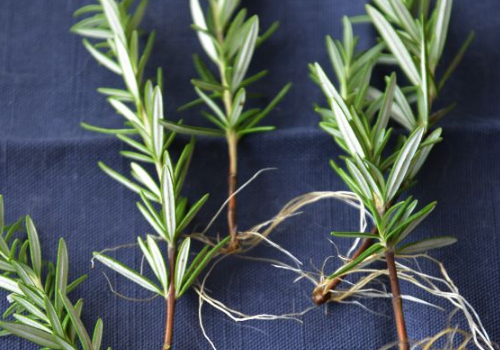
Hydroponic Methods for Rosemary:
Materials to Prepare for Rosemary Hydroponics
One pot of soil-cultivated rosemary, pruning shears, a transparent container
Hydroponic Method for Rosemary
1. Cut branches. Depending on the season, in spring or summer take green, relatively tender branches 5-10 cm long; from summer to autumn, cut grayish-white branches 10-15 cm long; in autumn, cut brown, hard branches 15-35 cm long.
2. Use your fingers to rub off the leaves on the lower 1/2 of the branch. If the cutting is too tender, you can use tweezers to remove them.
3. Put the prepared branch into a transparent container, and add enough water to reach the height of the lowest leaves.
4. Then place the plant in a sunny spot. In the first week, change the water once every 2-3 days; afterward, change it once the water becomes cloudy.
5. In 5-8 weeks, will many small white roots grow from the lower part of the branch? Continue hydroponic cultivation. When the roots grow to about 5 cm, you can take out some branches for soil cultivation, or continue hydroponic cultivation. However, hydroponic cultivation requires appropriately supplementing with nutrient solution.
Alright, now you know the hydroponic methods for rosemary.
Is Sedum genus Guanyin Lotus (Sempervivum) toxic? Can it be grown hydroponically?
Sedum genus Guanyin Lotus belongs to a type of Buddha's seat lotus, houseleek, and Guanyin seat lotus. It is a succulent herbaceous plant of the Crassulaceae family mainly grown for its foliage. The shape of Sedum genus Guanyin Lotus is very similar to a lotus-shaped leaf rosette. It has many varieties, and the leaf diameter is 3-15 cm. The fleshy part is spoon-shaped, and the leaf tips are pointed. It has many varieties, and the leaf colors are also diverse, including yellow-green, red-brown, dark green, and gray-green. The relatively pointed parts at the leaf tips have purple, red, and green colors. It is a relatively popular succulent among succulent plants. Below let's take a look at whether Sedum genus Guanyin Lotus is toxic, and whether Sedum genus Guanyin Lotus can be grown hydroponically.
[Introduction to Sedum genus Guanyin Lotus]
Sedum genus Guanyin Lotus is mainly a relatively small succulent grown for its foliage, and is very popular among people. Sedum genus Guanyin Lotus likes to grow in a warm environment. When it is growing, do not water it too much, so that the plant can grow normally. The plant shape of Sedum genus Guanyin Lotus is very neat and orderly, like a pot of blooming lotus. The leaf color changes as it grows, especially when the leaves are purplish-red, which is very unique and distinctive. It is suitable for cultivation as a small to medium-sized potted plant. If different flowerpot shapes are used for planting, the ornamental effect is also different. Cartoon-style flowerpots can be used, giving a lively and cute feeling, and are very popular among girls and children. If purple clay pots or porcelain pots with different flower shapes are used for planting, it gives a dignified and elegant feeling, and is very popular among elderly people. Using wooden flowerpots for planting is very green and environmentally friendly, and is very popular among young people. Overall, Sedum genus Guanyin Lotus is a succulent plant that is very popular among people.
[Morphological Characteristics of Sedum genus Guanyin Lotus]
Sedum genus Guanyin Lotus is a succulent plant belonging to the Sempervivum genus of the Crassulaceae family. Its plant shape is a lotus-shaped leaf rosette. It has many varieties. The leaf rosette diameter is 3-15 cm, the fleshy part is spoon-shaped, and the tip is pointed. Depending on the variety, the leaf color is also very different. The leaf colors are very rich, including yellow-green, red-brown, gray-green, dark green, and so on. The color of the leaf tips is also very rich, including red, purple, and green. The purple leaf tip varieties are very popular. Its leaf margins are finely serrated. If Sedum genus Guanyin Lotus grows very well, a whole ring of small rosettes will grow around the edge of the rosette, and at the end of each year it will grow red stolons like those of a spider plant. The small flowers that grow are star-shaped and pink, with very good ornamental value.
[Can Sedum genus Guanyin Lotus Be Grown Hydroponically]
When people cultivate Sedum genus Guanyin Lotus, they often use soil cultivation. Very few people use water cultivation. Water cultivation is very rare, and the survival rate is not particularly high. The main methods for Sedum foliage plants include leaf cutting propagation, division propagation, cutting propagation, and so on.
1. Leaf cutting propagation: Mainly place mature, intact leaves into relatively moist soil, with the leaf surface facing up and the leaf back facing down. There is no need to cover them with soil, and then propagate them in a shady location. Within one week, small leaves and new roots will grow from the base of the leaf, thereby placing the roots into the soil. After they survive, carry out maintenance methods such as sufficient sunlight exposure, watering, and fertilizing.
2. Cutting propagation: Mainly use single leaves, top branches, and tiller branches. Propagate for about one day to let the cut surface of the cutting dry, then take the cutting. Then remove the lower leaves and insert it into the cutting bed. Generally, it will take root in about half a month. Keep the soil moist, but it should not be too moist, otherwise it will cause the cut surface to rot and turn yellow. The roots need to be about 2-3 cm before potting. Leaf cutting can also be used for propagation.
3. Division propagation: This propagation method is carried out in spring, while cuttings can generally be done indoors in all four seasons. Generally, August to October is the best time, so rooting and sprouting will be faster, and the survival rate is very high.
[Is Sedum genus Guanyin Lotus Toxic]
Guanyin Lotus is mainly divided into Sedum genus Guanyin Lotus and Araceae genus Guanyin Lotus. The entire plant of Sedum genus Guanyin Lotus is non-toxic. However, Araceae genus Guanyin Lotus is toxic, and the toxicity of the stems and branches is the greatest. If the sap gets on the skin, it will cause itching; if the sap accidentally gets into the eyes, it can cause blindness; if Sedum genus Guanyin Lotus is accidentally consumed, it will cause itching and swelling of the throat and tongue, leading to nausea, and in particularly severe cases, it can lead to death from cardiac paralysis. If there are small children at home, it is best to place it out of children's reach to avoid unnecessary problems. When cultivating Sedum genus Guanyin Lotus, you must pay extra attention.
More related information: The flower language of black tulip How to grow mimosa Rosemary pictures What to do when clivia has stuck arrows Is mimosa toxic
Plants that bloom in autumn. What plants bloom in autumn, pictures of plants that bloom in autumn
?`?.??.?′′ˉ`?Related recommendations:
? Phalaenopsis flower language ? Cornflower flower language ? Sandalwood bonsai ? Hydroponic lucky bamboo
?`?.??.?′′ˉ`? Green plants, this article originates from [Decoration Information]
Because different plants have different flowering periods, we can feel the beauty and wonder of nature throughout the four seasons. It is also these flowers that bring more color and happiness to our lives. In this issue, the editor mainly introduces what plants bloom in autumn? Because autumn is the season of fruiting, but some plants still bloom in autumn, bringing us beauty. Let's take a look at what yellow plants bloom in autumn.
[Plants that bloom in autumn - Osmanthus]
There are many types of osmanthus. The fragrance of osmanthus can be "fragrant for ten li." In autumn, the fragrant flowers that can still be smelled may only have the charm of osmanthus. Its flowers and leaves are lush and evergreen, the tree age is long, it blooms in autumn, and its fragrance spreads all around. It is an ornamental flowering tree and fragrant tree unique to our country. Osmanthus seedlings have obvious main roots, and the root system is developed and deep. Young roots are light yellow-brown, and old roots are yellow-brown. Osmanthus wood is fine, dense, and tough, and has many uses. Osmanthus has a pungent, warm odor and is non-toxic, and has effects such as relieving toothache. Freshly picked osmanthus can be made into osmanthus cake and osmanthus sugar, both of which are top-grade desserts, very sweet and fragrant, and loved by everyone.
[Plants that bloom in autumn - Chrysanthemum]
The chrysanthemums that can bloom in autumn are of course autumn chrysanthemums. The colors of chrysanthemums are single colors, but there are also many kinds of chrysanthemum flower shapes. Chrysanthemum is one of China's top ten famous flowers and has a cultivation history of more than three thousand years in China. Chinese people greatly love chrysanthemums. Since the Song Dynasty, there has been an annual chrysanthemum festival among the people. In ancient myths and legends, chrysanthemums were also given the meaning of auspiciousness and longevity.
[Plants that bloom in autumn - Camellia]
Camellia, also known as tea flower, is a plant of the Camellia genus in the Theaceae family. Camellia flowers are full and graceful, dignified and elegant, and are one of China's traditional top ten famous flowers. They are also one of the world's famous flowers. Also known as camellia, belonging to the Theaceae family, evergreen shrub or small tree, commonly cultivated tall varieties also include Yunnan camellia and tea plum; there is also the golden camellia discovered in China in recent years.
[Plants that bloom in autumn - Marigold]
The flower language of marigold refers to people using flowers to express human language and express certain feelings and wishes. It is a herbaceous plant of the Asteraceae family, with diverse varieties and strong vitality, much more rough-growing than ordinary chrysanthemums. Double-petaled varieties have large flowers, with a diameter of 9-11 cm, a long flowering period, and flower colors including goldfish yellow, orange-yellow, orange-red, and milky white. Tall-stem varieties can be used as cut flowers.
[Plants that bloom in autumn six - Jasmine]
Jasmine likes a warm, humid, and sunny environment. Its leaves are emerald green, its flowers are white, and its fragrance is rich. It is the most common fragrant potted flowering plant. Jasmine has good health and beauty benefits, can be used in food and drink, and can be used to make jasmine tea. Jasmine is a plant that blooms in autumn. It can be grown indoors as a home decorative plant.
Conclusion:There are still many plants that bloom in autumn. In this world where a hundred flowers contend in beauty, plants that can bloom in autumn really still have great ornamental value. Whether indoors or outdoors, its ornamental value is very high. For more plant cultivation, please continue to follow Aiyouwo Decoration Information.
▓ Recommended Reading
? Kudin tea price ? How to grow aloe ? Buckwheat hull pillow ? Lavender pillow ? Lavender flower language
? Agave pictures ? Rosemary planting ? Shangzhifang wallpaper ? How to plant bowl lotus ? Wintersweet bonsai