How do you prune a yew (Taxus) bonsai, and when is the right time to prune it?
Yew bonsai, I believe many people have seen them, and many families have bought them to grow. How do you prune a yew bonsai? When should you prune?
How to prune a yew bonsai:
1. Bud removal:
After many yews are transplanted and the trunk is established, many buds sprout on the trunk of grafted seedlings.
2. Pinching:
The branches of a yew bonsai grow unevenly, some strong and some weak. For coniferous species, double leaders, multiple leaders and the like caused by certain reasons can all be controlled by pinching off the growing points of the branches, so as to balance the vigor of the branches.
3. Heading back:
Cutting off part of a one-year-old branch is called heading back. There are 4 types of heading back: light heading, medium heading, heavy heading and very heavy heading.
On a single plant, all heading methods may be used, such as on stone fruit and pome flowering shrubs, ornamental peach, elm-leaved spirea, purple-leaf plum, purple-leaf peach, cherry, apple and pear.
The tips of the main branches are given medium heading, the side branches are given light heading, and the inner part of an open-center tree is given heavy or very heavy heading. For weeping-type nursery stock, such as Chinese pagoda tree (Sophora japonica 'Pendula'), weeping ornamental peach, weeping elm, weeping apricot and the like, whose branches hang down, generally one method is used most, namely heavy heading, cutting off 90 percent of the branch.
This stimulates the sprouting and growth of branches growing upward and forward, forming a round-headed crown. If light heading is used, the branches will become weaker and weaker, and the crown cannot be formed.
4. Thinning:
Cutting off a branch or branch group entirely from its base is called thinning or thinning out. What is removed may be a one-year-old branch or a perennial branch group. The effect of thinning is to increase the growth vigor of the remaining branches, because their nutritional area is relatively enlarged, which benefits their growth and development. But it weakens the growth vigor of the whole tree and reduces the amount of growth. After thinning there are fewer branches, which improves the ventilation and light conditions of the crown, and the branches are evenly distributed and reasonably arranged; for flower and fruit species, it helps form flower buds and bloom and bear fruit.
5. Branch bending:
Branch bending means using pulling and guiding to make branches or large branch groups change their original direction and position and continue to grow, such as with coniferous species like spruce and Chinese pine. If for some reason the branches in a certain direction are damaged or missing, to make up for the missing branch you can pull the branches on both sides toward the missing area, making up for the original defect in the crown. Otherwise it will become a worthless seedling. Branch bending is used most in the cultivation of large nursery stock of flowering and fruiting trees.
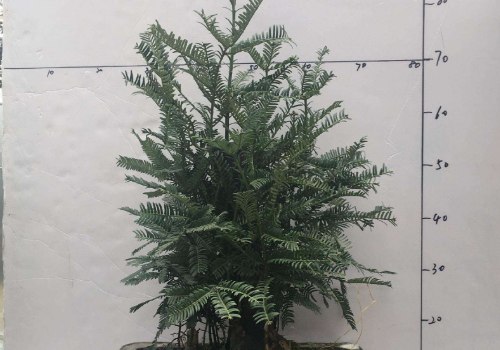
When to prune a yew bonsai:
1. According to the growth and dormancy periods of the yew bonsai, pruning is divided into growing-season pruning and dormant-season pruning, also called summer pruning and winter pruning.
2. Summer pruning is from April to October, winter pruning from October to April. In the south, where the four seasons are not obvious, it is all called summer pruning. Different trees and species have different biological characteristics, especially different phenology, so the specific pruning time for a certain tree species must still be determined by specific analysis of its phenology, bleeding, wind chill, freeze damage and so on.
3. Generally, deciduous tree species are suitable for winter pruning; those with severe bleeding should be pruned early or after the bleeding stops; evergreen tree species are suitable for both winter and summer pruning.
Well, that is all for the introduction to the pruning time and methods of yew bonsai. I hope everyone understands now.
How to prune a yew bonsai
The pruning time for yew bonsai
Different pruning should be carried out according to the growth period and dormancy period of the yew bonsai. Growing-season pruning is generally from April to October, and dormant-season pruning is generally from October to April of the following year. At the same time, it should be analyzed specifically according to the plant's phenology, bleeding, wind chill, freeze damage and so on.
The pruning methods for yew bonsai
Bud removal
After the yew is transplanted and established, it will grow many new buds. Some sprouts should be removed appropriately to avoid excessive consumption of nutrients and at the same time promote better growth of the yew bonsai.
Pinching
In order to balance branch vigor, the growing points of branches should be pinched off to regulate uneven branch growth, double leaders, multiple leaders and other conditions in the yew bonsai.
Heading back
Cut off part of a one-year-old branch. Heading back includes light heading, medium heading, heavy heading and very heavy heading. Generally, a single plant may use all four methods, but they should also be chosen according to different situations.
Thinning
Thinning means cutting off a branch or branch group entirely from its base. It may be a one-year-old branch or a perennial branch group. Thinning helps the remaining branches grow better, improves the ventilation and light conditions of the crown, and helps form flower buds and bloom and bear fruit.
Branch bending
When pruning a yew bonsai, we often find that because the angle of the main branch is too small, pruning alone cannot achieve the goal of opening the angle, so branch bending must be used. Pull the branches of the yew bonsai outward in all directions, with 70 degrees as the best angle for the main branch. This can effectively reduce the space occupied by the crown and slow the growth rate of the tree.
Notching
On a branch or trunk of a yew bonsai, use a knife or scissors to remove part of the bark or xylem at a certain place, so that nutrients accumulate below the wound, which stimulates the growth of the buds and branches below the wound.
Note: Yew is a plant that tolerates pruning, so you can give free rein to your personal preferences and imagination.
Yew bonsai prices and yew bonsai care
Yew has very broad development prospects in landscaping and indoor bonsai. For example, the high-grade bonsai made from it, with yew bonsai treated by dwarfing techniques, has a simple and elegant shape, with compact but not crowded branches and leaves, spreading but not loose, and has multiple ornamental values of stem, branch, leaf and fruit. Below let us take a look at how much a pot of yew bonsai costs!
How much does a pot of yew bonsai cost?
Specifications (height) Price (yuan/plant) Specifications (height) Price (yuan/plant) Specifications (height) Price (yuan/plant)
30 cm 8 yuan 40 cm 12 yuan 50 cm 25 yuan
60 cm 60 yuan 70 cm 80 yuan 90 cm 100 yuan
1 m 130 yuan 2 m 400 yuan 903 m 800 yuan
Note: Yew is recognized worldwide as a rare natural anti-cancer plant on the verge of extinction. It is an ancient tree species left over from the Quaternary glaciation and has a history of 2.5 million years on Earth. At present, the price of yew bonsai on the market is mainly calculated by the height of the yew, but market conditions vary from place to place, so you can compare when buying.
How to grow a yew bonsai
1. Light: Yew is a shade-loving, drought-tolerant plant, so it should be placed indoors. In summer it should be properly shaded; it should not be placed in a room with western sun exposure, and should not be placed at the air outlet of an air conditioner or next to a heater, as that will increase the evaporation of water from the yew's leaves, causing the branches and leaves to dehydrate and finally the leaves to curl and dry up. In summer, the light duration should be as short as possible; in autumn and spring it can be longer.
2. Potting soil: Choose a slightly larger flower pot for the yew, and make several more holes in the lower part of the pot to enhance the pot's water permeability and air permeability. The soil should be loose, rich in humus, fertile, water-retaining, fertilizer-retaining and air-permeable, with a slightly acidic soil, and loam is best. Clay is not air-permeable, and sandy soil has poor fertilizer and water retention, so neither is suitable. In addition, peat soil, perlite and the like can also be mixed with loam to make a mixed growing medium.
3. Water: When a little yellow-white appears on the surface of the yew's potting soil and the leaves curl slightly, there is no need to water; just spray the leaves. When the soil turns white, it should be watered. Water thoroughly in one go so that the potting soil fully absorbs enough water. If placed outdoors, water once every 15 to 20 days; indoors, water once every 20 to 25 days. Keep the soil moisture content at about 40 percent, and note that watering too much or too often will cause root rot in the yew.
4. Fertilizing: For each potted yew, apply 0.2 jin of organic fertilizer and 0.02 jin of compound fertilizer. Farmyard manure and cake fertilizer (such as cottonseed cake, peanut cake, sesame cake) can also be added. Fertilizer should be applied along the pot wall as much as possible and must not come close to the yew's roots. Generally, newly bought yew bonsai contain nutrient soil, so no fertilizing is needed within 3 months; afterward, apply once every 2 to 3 months.
5. Repotting: After about a year, the potted yew seedling gradually grows larger and its root system becomes well developed, at which point it needs to be transplanted and repotted. Break the old pot, without damaging the original soil ball, move it into a new pot, and water to settle the roots, ensuring the root system and soil are closely combined to ensure survival. If conditions permit, the yew seedling can be transplanted into open fields, where it will grow faster.
6. Shaping: If the lower branches and trunk of the yew bonsai grow too densely, dry, yellow leaves may appear and fall off. Part of the overly dense lower branches and trunk can be pruned away. During pruning, you can shape it freely, into an umbrella shape, pagoda shape, round shape and so on. To keep the yew's crown beautiful, the terminal buds and some lateral buds can be moderately removed.
7. Pests and diseases: Under normal conditions, yew has very few insect pests. If the yew is found to turn yellow or have pests and diseases, it can be watered or sprayed with thiophanate-methyl and potassium dihydrogen phosphate. Yews will suffer root rot, stem rot and root rot during the rainy season, especially young trees; at this time, dexon can be sprayed for care. In high-temperature and dry seasons, leaf blight and red blight are prone to occur, which can be prevented and controlled by spraying Bordeaux mixture.