How to propagate Chinese roses by cuttings? Learn to tell the difference between Chinese roses and roses
Chinese roses and roses are both very popular, and many people in daily life cannot tell them apart. How to propagate Chinese roses by cuttings? And the difference from roses?
How to propagate Chinese roses by cuttings:
1. Selecting branches. At the end of autumn when winter is approaching, when pruning Chinese roses, take healthy and thick branches, and they must not be new branches of the current year, nor old branches of three or four years, that is, two-year-old branches, about 15 cm long, and each branch must carry three to four leaf buds. Large old leaves cannot all be kept; only one to two may be retained, so as not to affect the nutrient supply of the branch, and this is also beneficial for photosynthesis and promotes the production of new roots.
2. Choosing soil. The soil is best sandy soil, not too sticky, as this would affect water and air permeability, nor should it be all sand, as this has no nutrients. After the new branch is inserted, the soil must be kept moist for one week, but the soil must not be allowed to accumulate water, as this easily causes root rot and leads to the death of the branch.
3. Choosing the season and weather for cuttings. Many traditional habits are to take cuttings in spring, but based on many years of trials, late autumn and early winter are the best season. The survival rate of branches inserted in winter reaches 70%. Branches inserted in spring seem to have a very high survival rate right after insertion, but when the weather turns hot in May and June, those new buds wither before the new roots below have grown out. Therefore, Chinese roses are generally chosen for cuttings in late autumn. After brewing through a winter, by spring the new roots below have already grown out, and as soon as the buds above emerge they have the function of photosynthesis, so under such circumstances the surviving Chinese roses can bloom in the same year. In late autumn, choose overcast and rainy days, and insert the cut branches halfway into the soil. The winter sunlight is not intense, and proper exposure is also beneficial for root growth.
4. Watering and fertilizing. Newly inserted branches must be watered every day for the first three days, and it is best to have shade from a large tree above, or place them in a ventilated and shady place. Keep moisture neither too much nor too little, that is, there must be no water accumulation and it must not be too dry, which would cause the branches to lose moisture. Fertilizing is what newly inserted branches most taboo; their absorption function is very weak, and they generally do not need fertilizer. If fertilizer is truly to be applied, it is best to apply a special fertilizer that promotes root development.
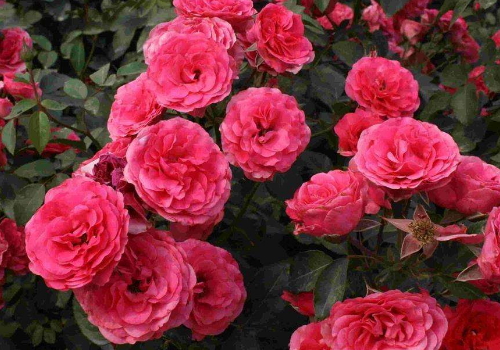
The difference between Chinese roses and roses:
1. The appearance of Chinese roses and roses looks roughly similar, but careful observation will reveal that they are different. The stems of Chinese roses are low and short, with large thorns, roughly 3 or 4 hooks per node; the flowers are large, the flower colors are rich, the scent is faint or absent, and the small leaves are generally 3 to 5, with flat and smooth leaf blades.
2. The stems of roses are tall and long, and also carry many thorns, most of which are straight thorns; the flowers are very small, the flower colors are very uniform, and the flowering period is relatively short. However, the flowering branches of roses are very upright, the flower colors are rich, and the scent is very fragrant. Rose small leaves are also 5 to 9, but the underside of the leaf blade is wrinkled, the leaf back is whitish with small thorns, and the entire leaf blade is also relatively thick.
Alright, the introduction on the difference between Chinese roses and roses ends here. Friends, you all understand now, right?
A complete guide to propagation methods for Chinese roses: cutting propagation methods for Chinese roses
Flower Bonsai Network introduction: the common propagation methods for Chinese roses include cutting propagation, division propagation and layering propagation. Today Flower Bonsai Network will share an article on the complete guide to propagation methods for Chinese roses. How to propagate Chinese roses? Let's take a look together.
Chinese roses have relatively strong adaptability. However, only by creating an environment suited to the requirements of their biological characteristics can their varietal traits and the best ornamental effect be brought into fuller play.
Chinese roses like mild conditions, dislike intense heat, and are averse to severe cold. The best temperatures for the growth and development of Chinese roses are 20 to 25 degrees Celsius during the day and 12 to 15 degrees Celsius at night. When the temperature exceeds 30 degrees Celsius, growth begins to be inhibited, flower buds no longer differentiate, and already differentiated flower buds and formed flowers progress slowly, with small flowers, incorrect flower color and short-lived flowers. During the flower bud differentiation period, if a short period of low temperature (around 5 degrees Celsius) is encountered, blind branches (that is, branches without flowers) will be produced. Regarding the ability of Chinese roses to adapt to low temperature and cold, there are relatively large differences among variety groups. Some ancient Chinese roses can endure a low temperature of -20 degrees Celsius. The floribunda rose group and the hybrid climbing rose group can generally endure a low temperature of -15 degrees Celsius. The hybrid tea rose group is truly not cold-tolerant, but in a low-temperature environment of -10 degrees Celsius, it can also overwinter safely without protection. Among the varieties within each variety group, there are also relatively non-cold-tolerant varieties.
Chinese roses are drought-tolerant and not waterlogging-tolerant. During the growth period, especially in the peak growth season of spring, a lack of water in the soil will affect the growth amount of new branches, flower size, flower color luster and flower longevity. If air humidity is too high, under poorly ventilated conditions, they are prone to infection by diseases.
Chinese roses like sufficient light and are not shade-tolerant. In a shady environment, the plant branches are slender, the leaves are thin and pale, and there are few and small flowers, but if they are in direct strong sunlight when flowering, the petals change color and their lifespan is shortened.
Cuttings and grafting are the two methods commonly used to propagate Chinese roses. Under certain conditions, other propagation methods are also used. For example, for varieties that are relatively difficult to root from cuttings, layering is used to propagate own-root seedlings; for certain clustered varieties, division propagation is often used; in order to cultivate rootstocks in large quantities or breed new varieties, seed propagation is used.
Cuttings can be carried out all year round, but hardwood cuttings in winter or autumn are preferable. For green cuttings in summer, attention must be paid to water management and temperature control. Otherwise they are not easy to root. Winter cuttings are generally carried out in a greenhouse or plastic tunnel; if cuttings are taken in the open field, attention must be paid to adding moisture-retention measures. For those propagated by sowing, this is used for sexual crossbreeding. For a few famous varieties that are difficult to root, grafting propagation is used, and the rootstock is best wild rose. Such as the yellow series varieties.
Seed propagation: after Chinese roses flower and are fertilized, the seeds mature in about 140 days. Only after the seeds go through the dormancy period (after-ripening) can they germinate under suitable environmental conditions for germination. Therefore, when the fleshy rose hip changes from green to yellow and then to red (generally after early October), harvest it, take out the seeds (achenes), do not dry them in the sun, and immediately stratify them with sea sand. Wait until early spring of the next year (March to April) to sow. Dry seeds have their germination seriously affected. In order to sow earlier, artificial low-temperature treatment can be used to promote after-ripening and break dormancy. The temperature for low-temperature treatment is below 3 degrees Celsius, around 0 degrees Celsius, and the treatment time is 55 to 65 days. The treated seeds, when sown in an environment of 20 to 25 degrees Celsius, begin to germinate in 7 days, and germination continues for about 1 month. For seeds from artificial hybridization, when 7 to 13 true leaves appear, flower buds may form at the top and bloom. This provides an early basis for preliminary identification of the plant's plant type, flower color, type, and whether it is a healthy flower; there are also some that bloom only 1 to 2 seasons a year. Some seedlings do not form flower buds and should be divided and transplanted for cultivation as early as possible.
Cutting propagation is divided into two types: softwood cuttings and hardwood cuttings.
Softwood cuttings use semi-lignified branches, usually making use of branches pruned after flowering. After the flowers fade, cut off the spent flowers together with the 1 leaf below them, then take the 3 leaves below and cut them off as cuttings. The cut at the base of the cutting is 0.3 cm below a leaf, and the cut is required to be smooth, with the bark not crushed or injured. Cut off the lowest 1 leaf, keep 2 small leaflets on each of the middle and top two compound leaves, cut off all the rest, and then they can be inserted.
Softwood cuttings root best in late spring and early autumn. Although summer cuttings root quickly, because of high temperatures and rampant microorganisms, the cut surfaces of the cuttings are easily infected by pathogens and cause rot, so summer cuttings require special attention to disinfection.
The rooting medium for cuttings can use vermiculite, pure sand or plain sandy soil. Vermiculite has good air permeability and water-holding performance, and because it is formed by calcination, it is relatively clean, and the rooting effect of cuttings is relatively good. Pure sand should be screened to remove too-coarse sand grains, stones and impurities, rinsed with clean water to remove powder and too-fine sand grains, and then scalded with boiling water for disinfection. Plain sandy soil is best baked over fire, or disinfected with chemical agents before use.
The depth to which cuttings are inserted into the rooting medium should be slightly deeper in spring and autumn, about one half of the total length of the cutting, and shallower in summer, about one third. After insertion, water thoroughly, then cover with glass or plastic film to retain moisture and provide shade.
The main management work after cutting is watering. In the first 10 days after cutting, watering can be more frequent and more plentiful, maintaining a relatively moist environment; after 10 days, control watering, gradually reaching the point of watering only when dry, maintaining a slightly dry and moist state. Cuttings in an environment of 20 to 25 degrees Celsius root in 20 to 35 days. After rooting, transplant them, especially cuttings in vermiculite or pure sand as the rooting medium, which should be transplanted in good time.
Hardwood cuttings are all carried out in spring, generally making use of branches pruned in winter; select healthy, plump-axillary-bud one-year-old branches and cut them into 10 to 15 cm long sections as cuttings. The cut at the lower end of the cutting is 0.5 cm from the leaf stalk. After cutting, tie the cuttings into bundles, bury them in soil to overwinter, at a depth of about 30 cm. In early spring of the next year (early March), take them out and insert them. Choose a wind-sheltered sandy soil plot for the cutting bed. The cutting should leave only one top bud exposed above the soil surface. Water after insertion. After budding, management must be strengthened even more, because although the top bud has sprouted, roots have not necessarily already formed, so the upper part should also keep the soil moist, and the leaf surface should also be sprayed with water frequently. When the leaves of the new plant do not wilt at noon, this indicates that the base has already rooted; from then on, spray less water and shorten the shading time, and combine watering with the application of light fertilizer.
Transplanted cuttings that have survived often die. To ensure survival after transplanting, attention should be paid to the following points. First, the pot should not be large, and the potting soil must not be too rich. Second, transplant on a windless day, in the evening. Third, lift and plant immediately, not allowing the root system to be exposed to the air for too long. Fourth, when lifting seedlings, take care to protect the root system and do not break it. Fifth, after planting, water thoroughly and place in a shady place, and remove the shade only after growth has resumed.
Grafting propagation. Grafting propagation produces finished seedlings faster than cutting propagation, and stem grafting also produces finished seedlings faster than bud grafting. In addition, root grafting can also be used in grafting. The choice of propagation method mainly depends on the source of rootstock and local custom.
For rootstock, the commonly used choices are multiflora rose and pink cluster rose. These rootstocks propagate easily, have strong adaptability, well-developed root systems and good compatibility. Stem grafting and root grafting are carried out in early spring from February to March. When grafting, dig out the rootstock and do it indoors, or graft directly in the field. Cut off the above-ground part of the rootstock leaving 3 to 6 cm, choose a smooth side and make a slanting cut slightly into the xylem, about 2 cm long. Cut a healthy branch with two buds as the scion, and on one side of the scion cut a cut surface slightly longer than the rootstock cut (about 2.1 cm), and on the other side at the base, cut obliquely about 0.5 cm to form a slant. Then insert the prepared scion into the rootstock cut, making the cambium of the two cut surfaces fit tightly, and then tie it well with binding material (hemp bark, plastic tape). For field grafting, then build a mound of sandy soil. For indoor grafting, the grafted seedlings can be buried with semi-moist soil in a warm place to promote healing, and after 2 weeks or a little longer they are planted in the field.
Bud grafting is carried out from June to October. Bud grafting commonly uses branches after flowering, selecting axillary buds with 5 leaflets below the flower. Require plump axillary buds that have not yet sprouted, cut off the branch, leave a 2 cm long leaf stalk, cut off the leaf blade, and wrap it with a wet cloth or paper to prevent drying for later use. If grafting is to be done, fully irrigate the rootstock once 2 to 3 days before grafting. When grafting, first use a sharp knife to carve a "T" shape on the rootstock, deep to the xylem, with the upper horizontal line 1.2 cm long and the lower vertical line cut 1.8 to 2 cm long. Pry open the "T" shape, ready to insert the bud. When cutting the bud, first make the cut 0.5 cm above the bud, cut downward slightly into the xylem, cut to 1.8-2.0 cm, and pull it off with the bark. Then pull off the attached xylem from bottom to top, and cut off the excessively long bark at the lower part. Pry open the "T" shaped bark of the rootstock, insert the prepared bud so that the upper end of the bud bark fits tightly against the horizontal line of the rootstock, and then tie it well from top to bottom with binding material (hemp bark or plastic tape). Then break the main shoot on the rootstock to control its growth. One week after grafting, the leaf stalk falls off naturally, and the bud piece is fresh green, proving that compatibility and healing have begun. Two weeks later, if the grafted bud swells, remove all the buds and eyes on the rootstock to promote the sprouting of the grafted bud. For buds grafted and surviving in October, no longer promote the grafted bud to sprout in the same year, to prevent the new branch from failing to mature before overwintering and suffering freezing damage. Before budding in spring of the next year, cut off the rootstock 0.8-1.0 cm above the grafted bud.
Grafting and breeding techniques for Chinese roses and roses
For grafting Chinese roses, roses and the like, generally a rose with a well-developed root system, vigorous growth and strong disease resistance is selected as the rootstock. The varieties selected are mostly pink cluster rose and wild rose. The rootstock can be propagated by cuttings, and can also be grown from seed, using seedlings for grafting. The grafting methods usually used are bud grafting, stem grafting and root grafting, with bud grafting used most often. The commonly used bud grafting methods are T-budding and patch budding.
1. T-budding method
This is carried out during the seedling growth season when the plant has a relatively high water content and the phloem is easy to peel off. When grafting, on the current-year plump new shoot select a plump bud as the scion, cut off the leaf blade, retain the leaf stalk, then cut slightly into the xylem, making a cut 1.5 to 2 cm long and 0.5 to 0.6 cm wide, forming a T shape. Next, use the bone part at the tail of the budding knife to pry open the cut, so that the phloem separates from the xylem. After gently tearing off the xylem of the grafted bud, insert it into the opening of the rootstock, so that the upper flat edge of the grafted bud aligns with the horizontal cut of the rootstock, and the cambium of the grafted bud and the rootstock fit closely. Bind with a plastic film strip 0.6 to 0.8 cm wide and about 20 to 25 cm long, sealing the wound tightly, leaving the grafted bud and leaf stalk exposed. After grafting, after 5 to 7 days, move the leaf stalk with a finger; if the leaf stalk falls off easily, it indicates the graft has succeeded, and about 15 days after survival, untie it in good time.
2. Patch budding method
This is a single-bud graft used in autumn and winter when the bark of the rootstock is not easy to peel off. The grafted bud can be cut slightly into the xylem, cut into an olive shape. The rootstock part is also cut with a similar cut surface as in bud grafting. At the lower part of the cut, leave a 2 to 3 mm horizontal cut, leaving a small stub to facilitate insertion of the grafted bud. After aligning the cambium of the bud and the rootstock (aligning the two bark layers with the naked eye), bind. In the Shanghai area, this method usually takes rose cuttings from September to October, lifts rooted cuttings from November, grafts them indoors, and then plants them in a seedbed at a spacing of 10 to 15 cm. Plant 45 to 100 plants per sq m. The seedbed should be covered with film or placed in a plastic tunnel. When the new seedlings are 30 to 40 cm tall, they can be planted out.
Management
Transplanting of Chinese roses is carried out between November and March of the following year. Pruning can be carried out at the same time as transplanting. First cut off dense branches and dead branches, then cut off old and weak branches, leaving 2 to 3 outward-growing buds so as to spread in all directions; appropriately shorten particularly strong branches to strengthen the growth vigor of weak branches. In summer, when new branches grow too densely, thin them out. After each batch of flowers fades, promptly cut off the upper part of the branch connected to the spent flowers, so that it does not set seed and consume nutrients, and retain the full middle and lower parts of the branch to promote early new branch growth and reblooming. Chinese roses like heavy application of base fertilizer before flowering and topdressing with quick-acting nitrogen fertilizer after flowering to strengthen seedlings and force flowers. Chinese roses have strict water requirements and cannot be too wet or too dry; too dry causes withering, too wet damages roots and causes leaf drop.
The main pests of Chinese roses include aphids, leaf-rolling moths, slug moths and so on. For control, pesticides such as 1000 to 1200 times dimethoate or isocarbophos are mainly used.
Factors affecting grafting survival
1. Selection of rootstock:
2. Grafting compatibility between rootstock and scion:
3. The cambium of both rootstock and scion:
4. Temperature, moisture and oxygen conditions at the time of grafting:
5. The quality of the rootstock and scion:
Can Chinese roses inserted in May bloom in the same year? When is the flowering period of Chinese roses
Chinese roses are ornamental flowering plants that many people like to grow in daily life, but many people do not understand Chinese rose cuttings very well. So can Chinese roses inserted in May bloom in the same year? When is the flowering period of Chinese roses? Let's take a look together below.
Will Chinese roses inserted in May bloom in the same year
Chinese roses inserted in May will not bloom in the same year. If the inserted cuttings can survive after insertion now, that already counts as success. Blooming in the same year is relatively difficult, because after insertion the rooting time takes 1-2 months, and factors such as transplanting after the cuttings survive will all affect their blooming in the same year. Under better planting and management conditions, they usually wait until the next year to bloom normally. At present there is a kind called Rixianggui that can bloom in the same year after spring cuttings.
Two points to note when taking Chinese rose cuttings
1. The seedlings selected for cuttings must not be too tender, and lignified branches must not be used either. It is suitable to choose relatively thick and strong branches with a dark green color showing through.
2. At a place 1 cm below the bud eye, ring off a ring of outer bark about 0.2-0.3 cm, and after one week cut it off for insertion; the survival rate is highest this way. To ensure 100% survival, the air layering propagation method can be used. That is, wrap mud around the notch; in about a month roots will certainly appear. The disadvantage is that the air layering propagation method is only suitable for strong branches, the quantity is small, the speed is slow, and it is not as quick and simple as the cutting method, because the branches used for cuttings can even be the remaining branches after pruning Chinese roses, and dozens of seedlings can be propagated at one time.
When is the flowering period of Chinese roses
The flowering period of Chinese roses is from May to November, among which the peak flowering period is May to June. If you have not grown them before, you can start growing them before the flowering period, because before this the flower growers have already carried out soil replacement and spring pest control, and you can observe the flowers not long after buying them, which helps increase enthusiasts' interest in care.
The difference between Chinese roses and roses
The appearance of Chinese roses and roses looks roughly similar, but careful observation will reveal that they are different. The stems of Chinese roses are low and short, with large thorns, roughly 3 or 4 hooks per node; the flowers are large, the flower colors are rich, the scent is faint or absent, and the small leaves are generally 3 to 5, with flat and smooth leaf blades.
The stems of roses are tall and long, and also carry many thorns, most of which are straight thorns; the flowers are very small, the flower colors are very uniform, and the flowering period is relatively short. However, the flowering branches of roses are very upright, the flower colors are rich, and the scent is very fragrant. Rose small leaves are also 5 to 9, but the underside of the leaf blade is wrinkled, the leaf back is whitish with small thorns, and the entire leaf blade is also relatively thick.