Which country's national flower is the hibiscus? Causes of yellowing leaves and solutions
Hibiscus, this is also a kind of plant, and many people like it. Its flowers are fairly large, and many people like it. So what are the causes of yellowing leaves in hibiscus and the solutions? Which country's national flower is it:
Causes of yellowing leaves in hibiscus and solutions:
1. Yellow leaves caused by temperatures that are too low
Hibiscus mutabilis belongs to strong sun-loving plants. Sunlight must be sufficient, and the temperature must not be too low. In winter, it is easily frostbitten by cold and its leaves turn yellow and fall off.
Solution: If it is potted, it can be moved indoors. If the room temperature is also very low, you can cover the pot with a plastic film. Be careful to expose it to as much sun as possible and keep the potting soil slightly dry, so that it can be protected from cold damage. If it is planted outdoors in the open ground, you can also cover it with transparent plastic film or take other insulation measures.
2. Yellowing leaves caused by sudden environmental changes
For example, after winter, if you are in a hurry to move Hibiscus mutabilis outdoors and place it somewhere much warmer than indoors, plus exposure to the sun, it may be unable to adapt to the sudden environmental conditions and shed its leaves.
Solution: The environmental temperature, light, and other conditions for Hibiscus mutabilis must not change too much. There needs to be a transition, and it can be moved from indoors to outdoors in warm spring or early summer.
3. Yellow leaves caused by improper watering
Yellowing leaves in Hibiscus mutabilis may also be caused by improper watering. Waterlogging or excessive dryness can both cause the leaves to turn yellow or even fall off.
Solution: If the potting soil is too wet, let the potting soil dry out before watering again, because it likes air humidity to be slightly higher, not moisture in the potting soil. If it is too dry, water it promptly, and be careful to control the amount and frequency of watering.
4. Yellow leaves caused by alkaline soil
For Hibiscus mutabilis, choosing slightly acidic loam with pH 6.5 to pH 7 is best and most favorable for its growth. If the potting soil becomes alkaline, it will also cause its leaves to turn yellow or even fall off.
Solution: Replace the potting soil, replacing compacted or alkalized soil with acidic soil. When watering in the north, be careful to regularly apply diluted acidic solution to prevent the potting soil from becoming alkaline.
5. Insufficient light or poor ventilation can also cause yellowing leaves
Hibiscus mutabilis is a sun-loving plant. Daily sunlight must not be less than 8 hours, otherwise yellow leaves are likely. If ventilation is poor, that can also easily cause yellowing leaves.
Solution: Simply plant or place it in an environment with sufficient sunlight and good ventilation.
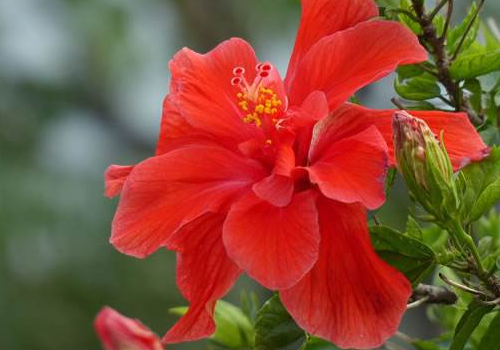
Which country's national flower is the hibiscus:
The national flower of Malaysia.
It is native to our country and distributed in Fujian, Guangdong, Guangxi, Yunnan, and Sichuan provinces and autonomous regions. It grows in mountain open forests. It grows easily, has strong stress resistance, and has very few pests and diseases. It likes warm, humid climates, cannot tolerate cold, and requires sufficient sunlight. It grows well in areas with an average temperature above 10°C. It likes light and cannot tolerate shade. It is suitable for growing in slightly acidic soil rich in organic matter with a pH value of 6.5--7. In the south, it is planted in the ground as a flowering hedge. In areas north of the Yangtze River basin, it is grown in pots in greenhouses.
The methods for dealing with yellowing leaves in hibiscus are introduced here. This is the national flower of Malaysia.
(Prevent in advance) Hibiscus needs winter protection against leaf drop and autumn protection against bud drop
Hibiscus is a plant that blooms in summer and autumn. It is the national flower of Malaysia, Sudan, and Fiji, and the state flower of Hawaii, USA. It is native to southern China, cannot tolerate cold or drought, and likes warm, humid environments with sufficient light. It requires fertile soil with good drainage. Today I will take everyone through all the content on how to prevent leaf drop in winter and bud drop in autumn in hibiscus.
Hibiscus likes light and likes warm, humid environments. It cannot tolerate cold or frost. Generally around the Autumn Equinox and before Cold Dew, it should be moved indoors and placed in a sunny, ventilated place. In order to increase its light time, you can choose a warm, windy noon to move the potted plant outdoors for more sun. If light is insufficient, existing flower buds will wither, and leaves will turn yellow and fall off. During overwintering, the position should be adjusted frequently, and 15-22°C should be maintained. If the temperature is too high, the branches and leaves will grow excessively and consume nutrients, so spring growth will not be vigorous. If the temperature is below 10°C and the day-night temperature difference changes greatly, all old and new leaves will fall off completely. If it is below 5°C and suffers frost, it will not easily turn green again in spring.
During the long winter, the potting soil should maintain 30% humidity. Every three to five days, spray the leaf surface with clean water close to room temperature. This can not only increase humidity and reduce dust, but also improve ornamental value. Because growth is slow in winter, it cannot be watered heavily. It is best to follow "do not water if not dry; when watering, water thoroughly." If there is too much water, the roots easily rot, which not only causes leaf drop but can also lead to death.
Hibiscus likes fertilizer. It should be regularly top-dressed with liquid fertilizers such as decomposed cake fertilizer water, sesame paste residue, fishy water, chicken and duck manure, and bone meal to promote large and abundant flowers and a continuous flowering period. But after autumn, stop applying nitrogen fertilizer and apply more organic phosphorus and potassium fertilizers. Before bringing it indoors, if 0.2% potassium dihydrogen phosphate is sprayed 2-3 times, it has a significant effect on preventing bud drop and leaf drop. In winter, fertilization is generally stopped. If room temperature, light, and other conditions can meet the conditions for flowering, a small amount of dilute liquid fertilizer can be applied. With rich nutrition, growth will not decline, and it may bloom as usual.
Hibiscus tolerates pruning and sprouts easily. Before bringing it indoors, combine shaping with pruning to remove excessive growth branches, diseased and weak branches, and inner canopy branches to reduce the consumption of nutrients. In northern regions, heavy pruning is needed, and the next year it will sprout more and bloom more. Hibiscus is a sun-loving plant, and in winter it must receive 4 hours of light. Do not place the potted plant in an indoor corner, because thin air and little light are extremely unfavorable to its growth. This needs attention.
The above is all the content I have learned today about winter protection against leaf drop and autumn protection against bud drop in hibiscus. I hope flower lovers will find this article helpful after reading it. To learn more, please continue to follow our Succulent Flower Garden!
Four-leaf clover Lotus corniculatus L. Four-leaf clover guide: how to grow four-leaf clover / how to propagate four-leaf clover
Four-leaf clover profileFour-leaf clover Lotus corniculatus L.
Four-leaf clover cultivation methods and precautions, introduction to four-leaf clover
Four-leaf clover is a rare variant of plants in the genus Trifolium (including clover and alfalfa), and there are also those with more than five leaves, up to eighteen leaves. In Taiwan, China, "four-leaf clover" generally refers to four-leaf wood sorrel. In the West, finding a four-leaf clover is considered a sign of good luck, and in Japan it is believed to bring happiness, so it is also called the lucky clover.
Four-leaf clover is given these meanings because it is extremely rare. Roughly only one plant in about ten thousand clovers has four leaves (one saying is that only one appears in one hundred thousand plants).
Morphological characteristics of four-leaf clover
Four-leaf clover is a perennial herb, 10-60 cm tall; the stem is erect, sparsely branched, with 4 angled edges, hairless, with only a ring of white bristles at the nodes. Leaves are papery, 6-10 in whorls, oblanceolate, oblong-lanceolate, or narrowly elliptic, 1.5-6.5 cm long, 4.5-17 mm wide, the lower ones smaller, 6-15 mm long, 3-5 mm wide, apex shortly acute or gradually acute, or obtuse with a short mucro, base gradually narrowed, along the margin and sometimes along the veins beneath with short, upward bristles, or both surfaces sparsely appressed-bristly, 1-veined, sessile or with a very short petiole.
The corymb-like cyme is terminal, up to 9 cm long; bracts 4-6 at the base of the inflorescence, often paired at the branching points, the smallest 1.5-2 mm long, lanceolate; flowers 3-7 mm in diameter; pedicels 2-3 mm long, hairless like the peduncle; corolla white or bluish white, shortly funnel-shaped, about 4.5 mm long, corolla lobes 4, oblong, 2.5 mm long, longer than the corolla tube; stamens 4, with short filaments; style short, 2-parted to the base, stigma spherical.
Fruit lobes paired or solitary, spherical, about 2 mm in diameter, densely covered with hooked hairs; fruit stalk about 4 mm long. Pod brown, oblong-cylindrical, 21-27 mm long, about 3-4 mm wide, mostly with seeds.
Four-leaf clover flowering period is May-July, fruiting period is August-September.
Ecological habits of four-leaf clover
Four-leaf clover likes sun and moisture and has strong vitality. Cutting a section and planting it can grow a new plant; at night, the four leaves close tightly together and open again before the sun rises the next day. It seems it understands human nature!
Four-leaf clover grows in mountain forests or shrub forests, at an altitude of 1580-2800 m. It likes moisture and is relatively shade-tolerant. It is not strict about soil, but grows best in neutral soil that is deep, flat, fertile, and well-drained. It tolerates trampling and is suitable for pruning. The stem grows prostrate, but is not easy to break.
After being potted for a period of time, four-leaf clover will change and grow worse than before potting, and the leaves will also become sparse and small, and fertilization will have little effect. If the above situation is found, it may be that there are insects in the potting soil (possibly white ones). It is recommended to change the soil, otherwise it may die of illness! It is best to plant it in the wild, as it is difficult to grow!
Four-leaf clover goes through a cycle once a year; it withers between July and September each year. Clover has seeds and can grow new young plants under suitable conditions, while four-leaf clover has no seeds, and can only be found among ten million traditional clovers. Even if found, it is hard to avoid its departure! Its preciousness lies in this!
Cultivation techniques of four-leaf clover: soil and tillage
Four-leaf clover has strong stress resistance and wide adaptability, and is not strict about soil. As long as there is sufficient precipitation, a humid climate, good drainage, and it is not strongly saline-alkaline, it can grow normally in various soils; it can even be planted under garden trees. The seeds are tiny, the seedlings are slender and weak in emerging from the soil, and growth at the seedling stage is extremely slow. To ensure full stands, land preparation must be fine. Whether spring sowing or autumn sowing, the land must be prepared in advance: first shallow plow to remove stubble, clear debris, store water and preserve soil moisture, then after 10-15 days, deep plow and harrow, level the ground, make the soil clods fine and the sowing layer loose, ready for sowing.
Fertilization
Combine deep plowing with sufficient base fertilizer. Apply 1500-2000 kg of organic fertilizer per mu, mix in 15-20 kg of superphosphate, pile and ferment to decompose for 20-30 days in a humid environment, then apply. Before sowing, shallow plow the soil again and apply 5-8 kg of ammonium nitrate etc. per mu to promote seedling growth and fully realize production potential.
Sowing
For seed fields, sow Grade I seeds as stipulated by national or provincial forage seed quality standards. For artificial grasslands, Grade I, II, and III seeds can all be sown. White clover seeds have a relatively high hard seed rate. Before sowing, scarify the seed coat by mechanical means, or soak and corrode the seed coat with concentrated sulfuric acid, and sow after seed treatment. The sulfuric acid soaking method is: soak for 20-30 minutes, remove, rinse clean with clean water, air-dry, and sow. Seed fields are sown at 5 kg per mu. Artificial grasslands are sown at 8 kg per mu. In humid areas, the sowing rate should be smaller; in arid areas, the sowing rate should be larger. Sowing depth is 1-2 cm. If sown too deep, it is not easy to emerge, so it should be controlled appropriately according to soil texture and moisture conditions. Sowing period: spring, summer, and autumn are all acceptable, but in relatively cold high-altitude areas, spring and summer sowing are better. If autumn sowing is done, it should be early, so that the seedlings have more than one month of growth time to facilitate overwintering. Sowing methods are varied: single sowing or mixed sowing, drilling or broadcasting.
Field management
After sowing and before emergence, if the soil becomes compacted, harrow promptly to break the compacted layer and facilitate emergence. Seedling growth is slow. To prevent weed damage, cultivate, loosen soil, and weed 1-2 times; if pests are found, control them promptly. For grasslands more than two years old, the soil layer is compact and poor in aeration. In spring and autumn, before turning green and before regrowth after grazing or mowing, harrow and loosen the soil, and combine soil loosening with topdressing. Apply 20-25 kg of superphosphate per mu, or 5-8 kg of diammonium phosphate, to facilitate the growth and development of new buds and new roots. Four-leaf clover has relatively high soil moisture requirements. Where irrigation conditions exist, irrigate when the soil is dry or combine it with topdressing. In mixed-sown grasslands, because forage grasses grow at different rates in early and late stages, competition for light, water, and fertilizer may cause uncoordinated growth, or excessive nitrogen application may inhibit growth. This should be adjusted by applying more phosphorus and potassium fertilizer and by grazing to control grass growth and avoid inhibition or disappearance from the mixed grassland.
Four-leaf clover cultivation methods: key cultivation points
For four-leaf clover in pots, it is best to transplant seedlings. Planting can be done in all four seasons. Generally it can be planted in spring, and after one summer, by autumn it can cover the surface of a pot 50 cm in diameter.
When planting, dig holes along the edge of the pot and plant. Because it grows very fast, the plant spacing should not be too dense (sparser spacing will not affect fertilizing the plants in the pot in the early stage). After the pot surface is fully covered, liquid fertilizer can be applied to the plants in the pot. When applying liquid fertilizer can no longer meet its growth needs, the four-leaf clover at the intended fertilization site can be dug out before fertilizing.
For overall fertilization, all the four-leaf clover can be dug out, and after fertilization is completed, replant it. When the plants grow too densely, they can be mowed to let them regrow. When planted as ground cover, it tolerates extensive management. Be careful to control rust disease.
Wide adaptability, not strict about soil, as long as there is sufficient precipitation, a humid climate, and good drainage.
Propagation methods of four-leaf clover
Four-leaf clover is propagated by seeds and by cuttings from stolons.
Disease control of four-leaf clover
The main diseases of four-leaf clover are anthracnose and leaf spot. They can be sprayed with 1000-times liquid of 70% thiophanate-methyl wettable powder. If indoor ventilation is poor, stems and leaves are susceptible to scale insects, which can be killed by spraying with 1000-times liquid of 40% omethoate emulsifiable concentrate.
When four-leaf clover is planted as ground cover, it tolerates extensive management. Be careful to control rust disease.
Variety classification of four-leaf clover: common varieties
Red clover
Also known as red clover. It is distributed in Europe, the United States, New Zealand, and other regions. It is also cultivated south of the Huai River in China. The stem is erect or ascending, round with uneven longitudinal ridges, 60-100 cm tall. The leaflets have light white V-shaped markings, the leaf surface is hairy, and the margin is entire. The capitulum has more than 100 flowers, red-purple, and is self-infertile. The pod is obovate, the pericarp membranous, and each pod contains 1 seed. The seed is kidney-shaped or nearly triangular, yellow-brown, with a 1000-seed weight of about 1.5 g.
It likes a humid and warm climate and is relatively drought-tolerant and cold-tolerant. It is suitable for growth in well-drained, calcium-rich clay soil. The growth cycle is generally 2-6 years; under warm conditions, it is often shortened to biennial or annual. Red clover is a long-day crop and can flower and set seed only with more than 14 hours of sunlight. When cultivated as livestock forage, it is generally mixed-sown with grasses; when used as green manure or feed, it is often grown alone. Inoculation with rhizobia can significantly increase yield. It can be sown in spring and autumn, with a sowing rate of about 15 kg per hectare. Drilling row spacing is 20-40 cm, with a depth of about 1.5 cm. It can be mowed 2-4 times per year. The stems and leaves are soft, with a slight bitter taste. Fresh grass contains about 4.1% crude protein, 1.1% crude fat, 7.7% crude fiber, 12.4% nitrogen-free extract, and 2.0% ash. Fresh grass yield per hectare can reach 30-60 tons.
Also known as white clover. It was first cultivated in the Netherlands in the late 16th century and is now widely distributed in temperate regions. It is cultivated south of the Huai River and in the southwest region of China. It is a perennial herb that roots where it touches the ground. The stem is slender and soft, prostrate on the ground, and the plant is 30-60 cm tall. The petiole is long, the leaflets are obovate or nearly obcordate, and the leaf margin has fine serrations. The capitulum has 10-80 flowers, white or pale purple-red. The pod is obovate-rectangular, and each pod has 3-4 seeds. The seed is nearly round, yellow, with a 1000-seed weight of 0.5-0.7 g. It likes a warm, humid climate, has wide adaptability, and strong acid tolerance. It can still grow in soil with pH 4.5. Except for saline-alkaline soil, it can grow in various well-drained soils. It has good regeneration and tolerates trampling, and is a grazing-type forage grass. Before flowering, fresh grass contains 5.1% crude protein, 0.6% crude fat, 2.8% crude fiber, 9.2% nitrogen-free extract, and 2.1% ash. Although its yield is not as good as red clover, its palatability is good and its nutritional value is also relatively high.
Crimson clover
Also known as crimson clover. It is native to Europe and distributed in northeastern Europe and North America. It is widely introduced and cultivated in northern Huai and south of the Yangtze River in China. It can be used as forage, ground cover vegetation, or green manure, and can also be used as a catch crop. It is an annual or winter annual herb. The stem is round and hollow, about 70 cm tall. The leaves are nearly round, with short hairs on both sides, the petiole is large, and the stipules are round and large, membranous. The capitulum is cylindrical, and the flowers are deep red. The pod is obovate and contains 1 seed. The seed is round, yellow or brown, with a 1000-seed weight of 3.2 g. It likes a warm, humid climate and tolerates poor soil and shade. At the bud stage, fresh grass contains 3.0% crude protein, 0.60% crude fat, 4.7% crude fiber, 7.4% nitrogen-free extract, and 1.7% ash.
Precious five-leaf clover
If a lucky clover with 5 leaflets can be found, it is even likened to having the power to rule the earth, and such an opportunity comes only when one's luck turns. The legend of the 5-leaf lucky clover originates from Japan. Legend says a child named Matsudaira Takechiyo was sent to the Imagawa clan as a hostage. During his time as a hostage, the child went to a local shrine to pray, saw a 5-leaf plant on the shrine steps, picked it, and took it into the shrine. The shrine's onmyoji asked him for his wish. The child wished to be able to stand on his own and become an upright samurai. Later, the onmyoji made a seal and prayed according to his birthday on the 5-leaf plant.
Several years later, the child became an adult and finally achieved his wish to stand on his own, becoming the famous figure who influenced Japanese history, Tokugawa Ieyasu. Therefore, in Japan it is popular that if you pick a 5-leaf plant, you should ask an onmyoji to make a seal according to your birthday. "Those born in lunar March, April, and May need to add 'Yucheng seal, Nangong Jumo seal, Jiangcao seal' to the seal register."
Those born in lunar June, July, and August need to add "Kuzhou Yanji seal, Qingzhu Danfeng seal, Yunsong seal" to the seal register. Those born in lunar September, October, and November need to add "Chuyun Anma seal, Fusang Sanfan seal, Qianfan Tuanfan seal" to the seal register. Those born in lunar December, January, and February need to add "Bixi seal, Yuxin seal, Yucheng seal" to the seal register."
Distinguishing fake four-leaf clover
The currently popular "four-leaf lucky clover" decorations, although they indeed have 4 leaves, are actually Marsilea and water clover. In the rice fields of China's Yangtze River basin, they are very common. You will often see some plants with 4 small leaflets, called ping, water clover, or four-leaf ping. They naturally have 4 small leaflets, so they are not as precious as mutated clover.
The obvious differences between Marsilea/water clover and the real lucky clover are:
1. Marsilea/water clover - all have four leaflets. The real four-leaf clover is only one four-leaf mutation among one hundred thousand clovers.
2. Marsilea/water clover - is an aquatic plant that grows in water. The real four-leaf clover grows in soil.
3. Marsilea/water clover - the leaf size is especially small. The diameter of the real lucky clover is generally not less than 2 cm.
Distribution areas and introduction status of four-leaf clover
Four-leaf clover is native to the temperate zones of Europe and Asia and began to be cultivated in the late 19th century. In China, wild distribution occurs in Sichuan, Guizhou, Guangxi, Guangdong, Hubei, Jiangsu, Fujian, Henan, Hebei, **, and Gansu (mainly the Longnan mountainous area). Units such as the Lanzhou Institute of Animal Husbandry of the Chinese Academy of Agricultural Sciences, Gansu Agricultural University, the Gansu Grassland Work Team, and the Gansu Grassland Ecology Institute have successively introduced superior varieties from other places and carried out introduction trials in Lanzhou, Wuwei, Minxian, Yuzhong, Qingyang, and other places. They have done a great deal of work. Although they grew well in various places, none entered the stage of promotion and application in production.
Uses of four-leaf clover: four-leaf clover specimens
1. Plant specimens
Dry old newspapers or straw paper, breathable specimen press, solid copper oxide, 50% glacial acetic acid.
Four-leaf clover green-preserved specimen
Four-leaf clover green-preserved specimen
When collecting specimens, it is necessary to collect typical, complete, and representative plants. Our four-leaf clovers are all carefully selected to be symmetrical, green, and at a certain growth stage, so that the finished product will be a fine item suitable for collection.
2. Preparation of the solution
Pour solid copper oxide into a glacial acetic acid solution of a certain ratio, heat in a water bath at a certain ratio (specific ratio confidential) until the copper oxide and acetic acid form copper acetate solution and it turns blue. Filter the copper acetate solution and pour it into a wide-mouth bottle for storage. When using, add an equal amount of distilled water to make the color-preserving solution.
3. Heating and color preservation
After heating the color-preserving solution to a certain temperature, place the washed and arranged plants into it. Determine the time according to the leaf texture. Thin and tender leaves only need to be boiled for a few minutes, while thick and firm leaves need to be boiled for a longer time. The change in the leaves is: green -> yellow-green or brown -> green. Then remove the specimen and wash it clean with clean water.
(Note: If the ratio of the prepared color-preserving solution is unsuitable or the heating time is not controlled well, the boiled four-leaf clover specimen will turn yellow, or even the four-leaf clover will be ruined by boiling.)
4. Pressing and drying
After arranging the specimen, press and dry it. Wrap each fresh specimen with old newspaper or straw paper. For some plants whose leaf blades have obvious characteristics on the back and front, part of the leaves can be turned over. After the specimen is wrapped, place it in a breathable specimen press and tie it tightly with rope, then press it tightly with a heavy object on top. The next day, arrange the specimen and replace it with dry old newspaper or straw paper. After a few days, take out the pressed specimen for making.
5. Making color-preserved specimens
When making specimens, choose mounting paper according to the size of the specimen. When mounting on the paper, be sure to arrange the mounting paper and plant specimen well, and lay out the specimen reasonably on the mounting paper.
6. Laminating
A complete four-leaf clover specimen, made after color preservation and then sealed by lamination, can be preserved for a long time and is also a handicraft with certain appreciation value. It is the first choice for collection and gifting.
Application value
Four-leaf clover is a good plant for soil and water conservation, and is also an excellent forage grass. It is a forage and green manure crop, and can also be used as green manure; the seeds contain about 11% oil; the whole plant is used medicinally and has the effects of clearing heat and cooling blood. Both flowers and leaves have ornamental value, with a long green period and a long flowering period. It tolerates trampling and can be used for path and ditch edge, embankment slope protection and soil conservation lawns, and enclosed lawns in green spaces of factories, mines, institutions, schools, and other places.
Medicinal or dietary therapeutic value of four-leaf clover
The medical information and health dietary therapy information on Hugarden.com is for reference only and cannot be used as a basis for diagnosis or medical treatment. Any health problem should be consulted with professional medical personnel, and treatment of any disease should follow a doctor's advice.
Ultimate flower-protecting task: love yourself, start from reality, and strictly follow a doctor's advice. For illness, do not be careless, do not delay, do not give up hope, face it bravely, use love to warm the silent world, and use your heart to care for the flower field within.
Medicinal value
[Medicinal introduction] Nature, flavor, and meridians: pungent, neutral. The whole plant is used as medicine. Collected in spring and summer, chopped, and sun-dried. Main indications: clear heat and detoxify, stop cough and calm asthma. Used for wind-heat cough, pharyngitis, tonsillitis, and stuffiness and pain in the stomach; externally used for eczema, sores and boils, and hemorrhoids. The whole plant is used as medicine and has the effects of clearing heat and detoxifying, reducing swelling, and dispersing accumulations. It can treat snake and insect stings, and can also treat hematuria, urinary tract infections, jaundice hepatitis, and so on.
[Usage and dosage] 3-5 qian each time; appropriate amount for external use, add a little borneol, pound, and apply externally.
[Biological classification]: Angiosperms, Dicotyledons, Geraniales.
[Nature, flavor, and meridians] Taste is sour and sweet, cool in nature. Jiangxi Herbal Medicine: "Sweet, neutral."
[Functions and indications] Clear heat and promote diuresis, detoxify and reduce swelling. Used for cold and fever, enteritis, urinary tract infections, urinary tract stones, and neurasthenia; externally used for traumatic injuries, venomous snake bites, carbuncles, sores and boils, athlete's foot, eczema, and burns. Jiangxi Herbal Medicine: "Clear heat and detoxify; reduce swelling and stop pain, promote urination."
[Usage and dosage] 0.5-2 liang; appropriate amount for external use, pound fresh product and apply to the affected area, or decoct in water and wash. Decoct in water, 0.5-1 liang (fresh product 2-3 liang); or pound and take with boiled water. External use: pound and apply.
[Selected formulas]:
① Treat urinary tract infections and red and white vaginal discharge: fresh Four-leaf Galium 1 liang, decoct and take. (Su Medical "Chinese Herbal Medicine Manual")
② Treat dysentery: Four-leaf Galium 5 qian to 1 liang, decoct in water and take, with brown sugar as a guiding agent, once daily.
③ Treat hemoptysis: fresh Four-leaf Galium 2 qian, wash clean, pound, and take with cold boiled water.
④ Treat traumatic injuries: Four-leaf Galium root 1 liang, decoct in water, take mixed with water and wine, once daily.
⑤ Treat snakehead felon: appropriate amount of fresh Four-leaf Galium, pound and apply externally. (Formulas ③ and below are from Jiangxi Herbal Medicine)
Cultural background and symbolism of four-leaf clover
In Taiwan, China, "four-leaf clover" generally refers to four-leaf wood sorrel.
In Irish folklore, people believe that a four-leaf clover can bring good luck. It is the most well-known national symbol of Ireland. Animal husbandry holds a pivotal position in the country's national economy, and its excellent forage grass, white clover, stands out above all others. Therefore, white clover is regarded as the national flower of Ireland. It is the flower used to honor Ireland's patron saint - St. Patrick. Ireland once fought a long and bloody war of resistance against Britain to win independence. Therefore, its flower meaning is - patriotism.
In Germany, the lucky clover is considered a symbol of freedom, unity, solidarity, and peace.
In Europe, searching for four-leaf clovers is still a popular game among children. They believe that finding a four-leaf clover will bring them happiness.
Legend
Legend 1
The legendary four-leaf clover (Clover) was brought to earth from the Garden of Eden by Eve, and its flower meaning is happiness. It is also known as the three-leaf clover. It usually has only 3 leaflets; the probability of finding a 4-leaflet one is very small, the probability of finding a 5-leaflet one is moderate, and the probability of finding a 6-leaflet one is only one in one hundred thousand. It implies obtaining happiness and being favored by heaven.
Legend 2
There is also a very beautiful legend about the four-leaf clover! Once upon a time, there was a pair of lovers who truly loved each other and lived together in a very beautiful peach grove. But because of a very small matter, they had a quarrel and neither was willing to give in. Finally one day, the goddess of love could not stand it anymore. She drifted to the peach grove where they lived and quietly told a lie: she told them that each of them would face disaster, and only by finding that four-leaf clover in the deepest part of the peach grove could they be saved. After hearing this, they pretended to be completely indifferent, but in their hearts they still worried about each other. That night it rained, a heavy rainstorm, but they still secretly went to the deepest part of the peach grove to look for the four-leaf clover for each other. When they learned that they both cared deeply about each other, they were both very moved and decided to let the four-leaf clover witness their love. The goddess of love smiled... This was a joke played by the goddess of love, because she did not want happiness to come too easily. Only those who care for each other and cherish each other deserve to have happiness...
Four-leaf clover, the witness of love!!
Legend 3
It is also said that the name "lucky clover" originates from Napoleon. Once, while leading his troops across a grassland, he discovered a four-leaf clover and found it very strange. When he bent down to pick it, he just happened to dodge a bullet fired at him and escaped disaster. From then on, he called the four-leaf clover the lucky clover. As it spread over time, the four-leaf clover has been internationally recognized as a symbol of good luck. Its four leaves represent love, health, honor, and wealth respectively, and possessing it will bring you good luck.
Legend 4
The lucky clover originated first in Europe, and was especially popular in Britain and Ireland. To this day, it has become a folk tradition in Western countries. Children take pleasure in searching for four-leaf clovers on grasslands, and every March at the St. Patrick's Day celebration held in New York, people wear green clothing and bring mascots - four-leaf lucky clover ornaments - to parade.
Clover taste: sweet and sour. Games you can play: pinch off the four-leaf clover and leave only the thread-like stems, which can be intertwined and pulled back and forth.
Legend 5
Irish folklore says that a four-leaf clover can bring good luck and is the most well-known national symbol of Ireland. At traditional Irish weddings, the bride's bouquet and the groom's boutonniere must both include lucky clover. The lucky clover is considered an indispensable third person at the wedding.
Legend 6
In Switzerland, every Christmas, real four-leaf lucky clover potted plants can be bought in shopping malls. The lucky clover is considered the most creative Christmas gift. The good luck of the lucky clover, given to relatives, means the recipient will from then on begin a happy life and have everything go smoothly in this world.
Legend 7
In Germany, a real four-leaf clover was discovered in 1190, and the lucky clover is considered a symbol of freedom, unity, solidarity, and peace. They believe that nothing bad can happen if they possess a four-leaf clover.
Legend 8
People always say that finding a four-leaf clover means finding happiness, because the first leaf of the clover represents hope, the second leaf represents giving, the third leaf represents love, and the rare fourth leaf - is happiness.
The meaning of the three-leaf clover is:
Even if you have given, hoped, and loved, you will not necessarily find happiness. The meaning of the four-leaf clover is:
Regain confidence in hope, win love with confidence, and what you get is happiness!
The magic of the four-leaf clover
One leaf for fame,
One leaf for wealth,
One for a faithful lover,
One for glorious health,
All in this four-leafed clover.
After murmuring the above hymn to the four-leaf clover, hold the four-leaf clover with two fingers of your right hand, slowly rotate the four-leaf clover, and make your wish.
Origin
When it comes to the origin of the lucky clover, it can be traced back as early as the 5th century AD, when the missionary St. Patrick came to Ireland with the Bible and the Gospel, bringing forgiveness and benevolence. At that time, Ireland was a pagan country full of violence, savagery, and cruelty, and even human sacrifice was a common phenomenon.
He used the three-leaf clover, which could be seen everywhere in Ireland at the time, to explain the famous Christian theory of the "Trinity," namely "the Father is God, the Son is God, and the Holy Spirit is God, yet they are not three gods, but one God." After enduring many hardships, he spread the Gospel to the people of Ireland. Later, inspired by him, more missionaries followed in his footsteps to Ireland.
Over the years, like spring breeze and rain, wherever the Gospel reached, killing by sword was "peacefully transformed" by the Bible, schools, and literacy classes, and savage superstition was "reformed and renewed" by civilization and education. Patrick poured the care of his whole life into Ireland, this green island country. He not only loved the souls of the Irish people, but also cared about the welfare of the Irish people. He did countless good deeds for the Irish people, and his influence even wrote a new chapter in Irish culture.
After his death, the Irish people did not forget him. Generation after generation of Irish people commemorated his contributions to their nation and country, and designated the day of his death, March 17 each year, as "St. Patrick's Day." The three-leaf clover he used to explain the "Trinity" became a symbol of Ireland. Passing down to the present, "St. Patrick's Day" has become an important holiday for Christians in Western Europe and North America. On this day, people wear clothing decorated with green three-leaf clovers, gather for parades, hold dinners, and attend church activities. Even in Chicago, on this day a harmless dye is used to dye the entire Chicago River green.
The three-leaf clover spread into the Middle Ages, when Christians unexpectedly discovered that this plant occasionally appears in a four-leaf form, closely resembling a cross. They then believed that the four-leaf clover was a plant with magical powers, a treasure bestowed by God upon the human world, which could help them drive away demons. People who found a four-leaf clover would have special abilities and could see things others could not see, and those things might bring disaster. Therefore, the four-leaf clover was widely recognized by people at the time as a token of good luck and was called the lucky clover.
The earliest document recording the four-leaf clover appeared in 1620 AD. The author John Melton penned in the document that "if someone finds a four-leaf clover, then he will have good luck within a short period of time. What is the probability of finding a four-leaf clover? Only one in one hundred thousand."
The above is a description of the origin of the lucky clover that is relatively consistent with real history. There is also a legend that after Adam and Eve were driven out of the Garden of Eden, Eve decided to find the four-leaf clover again to commemorate the lost life in paradise. Therefore, if such a clover is found, it is equivalent to possessing a part of heaven.
To this day, the lucky clover has been endowed by the people who love it with all kinds of beautiful meanings, and has become a token for expressing love, family affection, and friendship among people, widely circulated among all people who love life.
Ornaments
Four-leaf clover ornaments are made by embedding a real four-leaf clover specimen into fashionable accessories designed specifically for it. While blooming with beauty, they also quietly bring people a blessing of good luck.
Four-leaf clover ornaments can have effects such as fragrance, cleaning, and purification. Four-leaf clover ornaments can make people feel refreshed and relaxed. Among the many boutique shops on the street, more and more attention is being paid to the ornament market. Home decoration and birthday gifts are inseparable from ornaments, and ornaments have become an indispensable element in today's non-mainstream context, becoming an important finishing touch. As the name suggests, four-leaf clover ornaments can bring people good luck and have become ornament products favored by young people.
Ouroba's four-leaf clover ornament series includes: four-leaf clover necklace pendants, four-leaf clover bracelets and bangles, four-leaf clover phone chains, four-leaf clover rings, lucky four-leaf clover anklets, four-leaf clover keychains, four-leaf clover couple ornaments, four-leaf clover leisure products, etc. The materials all use natural four-leaf clovers paired with various fashionable metal accessories, 925 silver, crystal, zircon, shell, resin, etc. The use of materials is bold, original, and unconventional. Ouroba four-leaf clover ornaments are novel and unique in creativity. They not only have the varied styles of trendy ornaments, but also eye-catching beautiful shapes.
Data show that during every holiday, sales of the Ouroba four-leaf clover ornament series surge. Give them to your lover on Valentine's Day, to your mother on Mother's Day, and to friends on Christmas. The four-leaf clover carries people's beautiful wishes, bringing luck and care to the people you are concerned about. This has made the Ouroba brand's four-leaf clover ornament series deeply loved by customers at home and abroad.
Foreign names for the four-leaf clover
English: Four Leaved Clover/bunge bedstraw herb
German: Vier Canacsa
Japanese: の
Spanish: Cuatro Canacsa
French: Quatre Canacsa
Korean: 4?? (ku lou ba)
Italian: Quattro Canacsa
Portuguese: Quatro Canacsa
The flower meaning of the four-leaf clover
The flower meaning of the four-leaf clover: luck.
The first leaf represents true love, the second leaf represents health, the third leaf represents honor, and the fourth leaf represents wealth.
Long ago, there was such a legend: Eve brought the four-leaf clover out of the Garden of Eden. It is rare, and it also represents good luck. If you can find a four-leaf clover among three-leaf alfalfa, then you will have unexpected good luck.
Four-leaf clover pictures